The Congress System

The Congress System

In this article , we will  deal with topic titled ‘The Congress System in India after Independence.’


In the initial three general elections, the congress gained overwhelming majority. The congress won three out of every four seats . We will discuss how Congress was able to achieve it.


One Party Dominance

  • Congress emerged as the single dominant party in India but it was different from One Party Dominance in other countries like China , USSR etc where constitution allowed just one party.


Reasons why Congress emerged as Single Dominant Party within India

  • Congress was the main party  fighting for freedom struggle movement . It had inherited the legacy of Indian National Congress Movements and their stalwart leaders.
  • Due to their strong organizational network throughout the country, it reached out to the masses instantly . It was impossible for other political parties to organize themselves in such a short time .
  • Congress was an ideological coalition. It accommodated the revolutionary and pacifist, conservative and radical, extremist and moderate and the right, left and all shades of the centre


=> Noted political scientist, Rajni Kothari termed this period of Indian Politics as “The Congress system”


Emergence of Opposition Parties

As the ability of congress to accommodate all interests and all aspirants for political hour steadily declined, other political parties started gaining greater significance.


Socialist Party

  • Roots of Socialist Party lay in Congress Socialist Party formed in 1934
  • Later after independence, the congress party had changed the rule regarding dual membership and barred the C.S.P members with congress’s membership. This situation compelled CSP leaders to form separate Socialist Party in 1948.
  • Socialist party leaders criticized congress for favouring capitalists and landlord and ignoring teaming masses like workers, peasants.
  • Socialist party was in big dilemma when the congress party in 1955 declared its goal to be the socialist pattern of society. In such scenario, their leader Ashok Mehta offered limited cooperation with the congressMany faction emerged from the split and union of the socialist party viz. Kisan Mazdoor Praja party, Praja Socialist party, Samyukta Socialist Party


Bhartiya Jan Sangh

  • Formed in 1951  by Shyama Prasad Mukherjee and trace its roots with RSS & Hindu Mahasabha
  • Emphasised the idea of ‘ONE COUNTRY, ONE CULTURE AND ONE NATION
  • BJP in traces its origin to BJS


Communist Party of India

  • Took inspiration from Bolshevik Revolution . Communists believed in violent uprising, as they thought transfer of power was not genuine. Very few people believed in their ideology and they got crushed by the armed force. They later abandoned violent means and participated in general elections and emerged as second largest opposition party.
  • It had well organized dedicated cadre and healthy machinery to run political party.
  • stalwart leaders included A.K. Gopalan, S.A. Dange, E.M.S. Namboodiripad, P.C. Joshi, Ajay Ghosh and P. Sundarrya.


Swatantra Party

  • Swatantra party was formed in August 1959 after Nagpur resolution of the Congress which called for
    • land ceilings,
    • takeover of food grain trade by the state,
    • adoption of cooperative farming.

They didn’t believe this resolution.

  • The party believed lesser involvement of the government in economy. It opposed the development strategy of state intervention in economy, central planning, nationalization, Public sector. They opposed progressive tax regime, demanded dismantling of license Raj.
  • It was critical of non-alignment policy and friendly relations with the Soviet Union and advocated closer ties with the U.S.A.
  • The industrialist and big landlords had supported this party.
  • This party has a very limited influence, lacked dedicated cadres, so it didn’t perform well.
  • The stalwart of party were C. Rajagopalachari, K.M. Munshi, N.G. Ranga and Minoo Masani.

Democracy in India

Democracy in India

In this article , we will  deal with topic titled ‘Democracy in India after Independence.’


  • In India, view of leaders was different from leaders of other countries which gained independence post World War 2
    • World : National Unity was declared to be priority which couldn’t be sustained with democracy as it would bring differences and conflicts
    • India : In-spite of problems like illiteracy , poverty and diversity, our leaders choose Democracy to be main pillar


  • On 26 Jan 1950, India adopted Constitution. New democratically elected government was need of the hour and for this  election commission of India was set up in January 1950 with a constitutional provision to conduct free and fair elections. Sukumar Sen became the first Chief Election Commissioner.


  • India has adopted universal adult franchise model of democracy where any person with prescribed condition of age, could vote without any form of discrimination.


Many problems were faced by Election Commission

  • No election on this scale had ever been conducted in the world before. At that time there were 17 crores eligible voters
  • Only 15% of these eligible voters were literate.
  • caste ridden, multi religious  and backward society  where voters were prone to vote on irrational basis


Steps taken by Election Commission of India (ECI)

  • Due to illiteracy , Election Commission devised special method of voting – candidates were to be identified by symbols, assigned to each major party and independent candidates, painted on the ballot papers in the box assigned to a particular candidate and ballot was secret.
  • Over 224000 polling booths, one for almost every 1000 voters were constructed and equipped with over 2.5 million steel ballot boxes one box for every candidate. Nearly 620,000,000 ballot papers were printed.
  • Stable conditions were created for free participation of opposition parties in elections including Jan Sangh & communist party of India (CPI)
  • Election Commission trained over 3 lakhs officers and polling staff to conduct the election


People’s response to the new political order was tremendous. At certain places, people treated polling as a festival wearing festive clothes, women wearing their jewelry. Despite higher percentage of poverty and illiteracy, the number of invalid votes cast was as low as 0.3% to 0.4%. A remarkable feature was the wide participation of women: at least 40% of women eligible to vote did so.  When the elections results were declared, it was realized that nearly 46% of the eligible voters had cast their vote.


Result of first elections

  • Congress had emerged as the single largest party by winning 364 seats with 45% of total polled votes for Lok Sabha
  • Congress formed all the government in all the states and at the centre too. It did not get a majority on its own in four states–Madras, Travancore-Cochin, Orissa, PEPSU but formed governments even there with the help of independents and smaller local parties which then merged with it.
  • Communist performance was big surprise and it emerged as the second largest group in the Lok Sabha.
  • Princes and big landlords still wielded a great deal of influence in some parts of the country. Their party Gantantra Parishad won 31 seats in Orissa Assembly.
  • Despite the numerically dominant position of the congress, the opposition was quite effective in parliament


Side Note

  • During Nehru Period, In 1957, the communist were able to form a government in Kerala, which was the first democratically elected communist government anywhere in the world.

Tribal Consolidation

Tribal Consolidation

In this article , we will look deal with topic titled ‘Tribal Consolidation in India after Independence.’


Phases

At the time of Independence, Tribal Consolidation was one of the major Issue . Tribes were very important because already we were suffering the issue of Territorial Integration and Tribal areas constituted substantial area of India’s territory.


Phase 1 : Pre British

  • Policy of Non-Interference
  • Tribals were following their own customary laws and traditions and were self sufficient remaining isolated from the outside world .


Phase 2 : British Rule 

Radical Transformation happened

  • Traditional Livelihood suffered due to invasion of colonial machinery and Dikus. Britishers forced them to abandon Jhum Agriculture and practice Settled Agriculture
  • Culture : Forest wasn’t just their source of livelihood but part of their culture as well + Christian Missionaries trying to convert them to Christianity
  • Relation with forest altered : Britishers were interested in the wood and due to this they passed various Forest Laws making it illegal for Tribals to gather resources or cut wood from these forests


Phase 3 : Post Independence

At time of Independence, there were majorly two approaches wrt Tribals in India ie Isolationist approach and Assimilationist approach . However, Nehru rejected both these approaches as isolation is not desirable

Different approaches

Isolation
  • By Verrier Elwin
  • Just leave them on their own as they were before advent of British rule


Assimilation
  • By GS Ghurye
  • Tribals are just backward hindus who need to be assimilated in Hindu fold


Integration
  • Envisaged in Tribal Panchsheel Policy by JL Nehru
  • Nehru rejected both of the above approaches as isolation is not desirable and assimilation would lead to loss of social and cultural identity of tribals . Hence he gave the Panchsheel policy
  1. Tribal should develop along the line of their own genious
  2. Tribal rights in land and forest should be respected
  3. Promotion of tribal languages
  4. No over administration
  5. Tribal assistance should be seeked in managing polity and administration


  • To give effect to the Panchsheel policy, following provisions were introduced
  1. Reservation of seats for Tribals
  2. Setting up of Tribal Advisory Councils
  3. Commissioner for STs was appointed to investigate whether the safeguards provided to them are properly observed or not
  4. Provision of 5th and 6th Schedule
  5. Article 46 : State should promote with special care the educational and economic interest of Tribal People and should protect them from social injustice and exploitation
  6. PESA (Panchayat (Extension to Scheduled Areas) Act)
  7. Forest Right Act , 2006


Side Topic : Forest Right Act, 2006

  • It is a framework to ensure local self governance
  • It guarantees following rights  (TURFm)
        • Title Rights : the right in the land is granted to STs and the people who are residing there for 75 years but don’t have documents (maximum 4 hectare)
        • Right of use of resources. Eg : Minor Forest Produce (honey, herbs etc) , Common Property Resource etc
        • Relief and Developmental Rights : in case of any displacement of tribals , proper relief packages should be given
        • Forest Management Rights 
  • Issues wrt Forest Right Act
        • Task of documenting the claims of communities is very tedious
        • Reluctance on the part of bureaucracy
        • Narrow interpretation of the law
        • Opposition from wildlife conservationists
  • Way forward
      • Political will should be there
      • Devolution of fund, functions and functionaries
      • Awareness among the tribals about their rights


Issues wrt Tribals

Irrespective of Government efforts , Tribal progress has remained dismal due to

  • weak execution of policies and ineffectiveness of state government in administering the policies
  • misappropriation of funds
  • ineffective functioning of Tribal Advisory Council
  • lack of awareness among tribals wrt their rights and entitlements
  • evasion of laws
  • Deforestation
  • neglect of primary education in tribal languages
  • emergence of class differences among tribes due to unequal distribution of benefits of affirmative action
  • Retreatment of tribals into inaccessible stretches due to loss of land, culture , forest rights etc


Xaxa Committee

  • The Committee was setup in 2013 to study socio-economic, health and educational status of tribals  and also to suggest policy initiatives and interventions for tribal upliftment
  • Following are the suggestions
      • Gram Sabha’s power needs to be increased wrt land alienation
      • Mining rights needs to be given to the tribal cooperatives (eg : Andra Model of Tribal Cooperatives for Mining)
      • Unused land should be acquired and used for tribal rehabilitation
      • Impose penalties on officials for delayed implementation of FRA or PESA
      • Appoint judicial commissions to investigate Naxal cases against tribals and their supporters
      • Instead of large dams, small sized water harvesting should be created

Official Language Issue

Official Language Issue

In this article , we will look deal with topic titled ‘Official Language Issue in India after Independence.’


  • Our leadership was very clear that India cant have any language as national language since it would lead to curbing the diversity vis a vis language.  However, in order to carry out Official Tasks , there was a need of Official Language.
  • There were majorly two contenders
    • Hindi
    • English

Despite the richness , English language (eg : it was language of diplomacy, international commerce etc) it occupied a very unnatural place in India due to unequal relationship with Britishers . Hence,  our Constitution declared Hindi in Devanagari Script along with Roman Numerals will be our Official Language and English will continue as Associate Official language till 1965 .


  • Issue of the time-frame for a shift from English to Hindi produced a divide between Hindi & non Hindi areas.
    • Proponents of Hindi wanted immediate switch over
    • Non Hindi areas advocated retention of English for a long if not indefinite period.

Nehru was in favor of making Hindi the official language, but he also favored English to be continuing as an additional official language.


  • Due to the over-zealous attitude of Hindi language proponents to Sanskritise the language on the name of purity led to the emergence of Supra-State Regionalism wrt language. Hence, to contain these riots and violent activities, 1963 Official Language Act was passed . According to this act, English may continue as the official language post 1965. However, this may clause created apprehension among the South Indian states and finally the issue was addressed with the passage of 1967 amendment to Official Language Act according to which the Veto power was given to South Indian States wrt English as Associate Official Language.


Question

  1. Implementation of language provision in the constitution proved to be a formidable task even though Congress was in power all over the country. In this regard , discuss the challenges and the manner in which the language issue was resolved .

Rehabilitation of Refugees

Rehabilitation of Refugees

In this article , we will look deal with topic titled ‘Rehabilitation of Refugees in India after Independence.’


Due to ‘Two Nation Theory’ India was divided on religious basis resulting in

    • Mass exodus of Sikhs and Hindus from Pakistan (80 lakh people migrated)
    • Brutal killings, atrocities, rapes, on both sides of the border . In many cases women were killed by their own family members to preserve the ‘family honor’.  (10 lakh people killed)


How Government settled these refugees

  • India had to rehabilitate nearly six million refugees from Pakistan.
  • Department of Rehabilitation was created.
  • Various refugee camps were set up some notable being camp at Kurukshetra (for Punjab Refugees) and Kolwada camp at Bombay (Sindh Refugees).
  • Camps such as Kurukshetra were but a holding operation. The refugees had to be found permanent homes and productive work. Thus refugees required land for permanent settlement.


Settling farmers

Leading the operations was the director general of rehabilitation, Sardar Tarlok Singh of the Indian Civil Service. A graduate of the London School of Economics, Tarlok Singh used his academic training to good effect

  • Now commenced ‘the biggest land resettlement operation in the world’. But there were problems
    • Against 2.7 million hectares abandoned by Hindus and Sikhs in West Punjab, there were only 1.9 million hectares left behind by Muslims in East Punjab.
    • Areas in the west of the province (now gone to Pakistani Punjab) had richer soils, and were more abundantly irrigated.
  • To begin with, each family of refugee farmers was given an allotment of four hectares, regardless of its holding in Pakistan. Loans were advanced to buy seed and equipment.
  • Applications were invited for permanent allotments. Each family was asked to submit evidence of how much land it had left behind. These claims were then verified in open assemblies consisting of other migrants from the same village. Expectedly, many refugees were at first prone to exaggeration. However, every false claim was punished
  • The rehabilitation on East took years and it was more difficult because of constant exodus of Hindus from East Bengal continued for years.

India-Japan Relations

India-Japan Relations

This article deals with ‘India-Japan Relations.’ This is part of our series on ‘International Relations’, which is an important pillar of the GS-2 syllabus. For more articles, you can click here.


Brief History

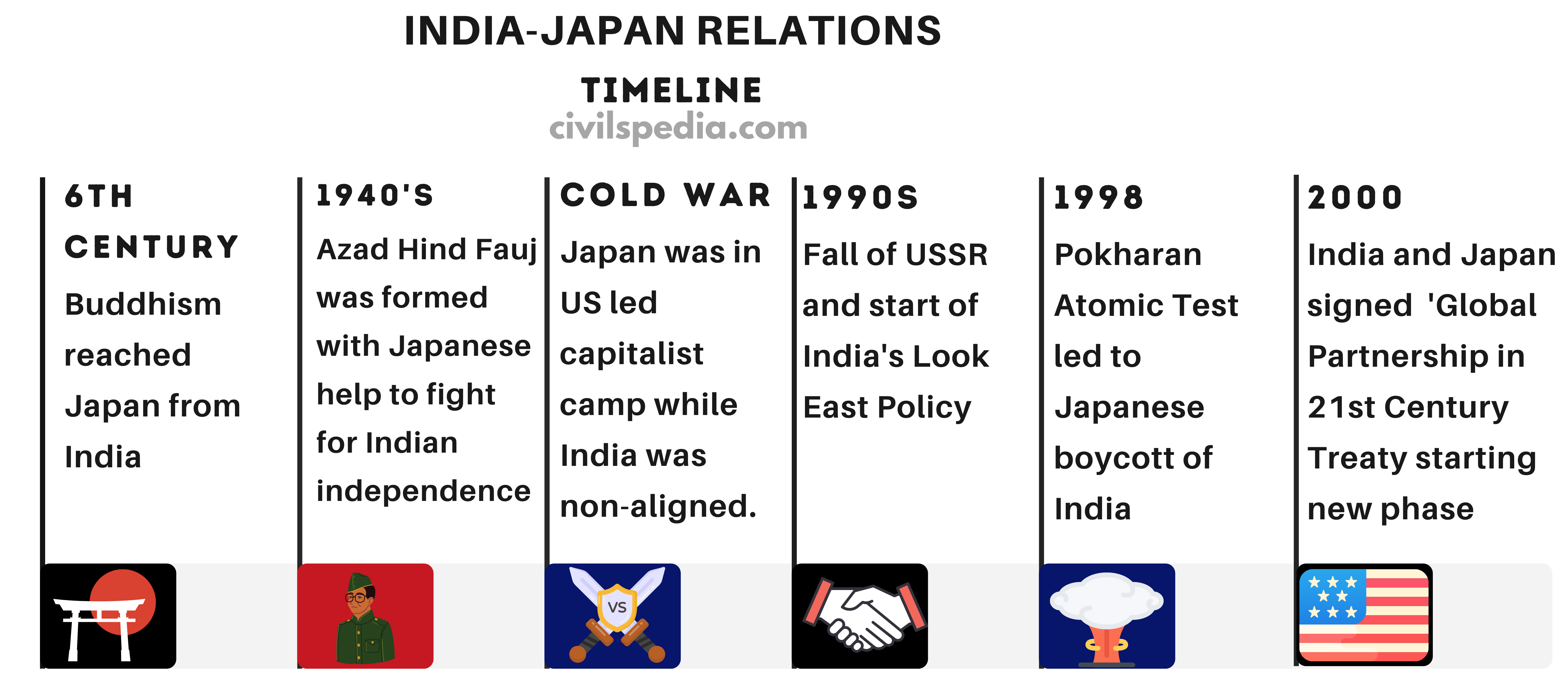
India-Japan Timeline

Till Independence

  • The relations between India and Japan can be traced back to the 6th century when Buddhism from India reached Japan. 
  • The Japan- India Association was set up in 1903, post which the direct political exchanges began.
  • Rabindranath Tagore had a close relationship with Okakura Kakuza.
  • SC Bose sought Japan’s help in his fight against Britishers. Azad Hind Fauz was the brainchild of Japanese Major Fujiwara. 
  • The sole dissenting voice of Judge Radha Binod Pal at the War Crimes Tribunal struck a deep chord among the Japanese public that continues to reverberate to this day. 

Post Independence Relations

  • The diplomatic relations between the two countries began with the signing of Japan’s Peace Treaty with India in 1952, thus starting the formal ties between the two countries.
  • India was one of the first countries to extend diplomatic ties, with the invitation to the Asian Games held in New Delhi in 1951. The relations were further strengthened by the mutual visits of Japanese Prime Minister Nobuke Kishi and Jawaharlal Nehru.

Cold War Period

  • The relations between the two countries suffered a setback during the cold war years, as Japan aligned with the United States while India chose to adhere to a Non-alignment policy. 
  • Further, the relations were hampered when Japan took a neutral stand during the Sino-Indian border war of 1962.
  • Japan’s economic engagements with East and South-East Asian nations deepened during the 1970s and 1980s. Due to India’s domestic ferment and problems during the Cold War, Japan always perceived India as a chaotic and desperately poor nation, having no potential to be a partner in the near times.
  • During this period, nothing substantive came out till the fall of the USSR, barring Suzuki’s investment.

1990 – 1998

  • Two events had a marked impact on Indo-Japanese relations & these were
    • Fall of USSR leading to end of the cold war.
    • The process of liberalisation started in India.
    • India began to improve its relations with the USA. It also led India to strengthen its ties with other allies of the USA.
  • Japanese Overseas Development Assistance (ODA) started to flow into India, which helped plug the economic development gaps. 
  • In 1991, Japan was among the few countries that bailed India out of the Balance of Payment crisis.
  • In 1993, Narsimha Rao’s Look East policy started & played an essential role in shaping India’s ties with Japan. 
  • Till 1998, bonhomie was seen in bilateral relations between India & Japan. 

Pokharan II Nuclear Explosion & Japanese Reaction

  • In 1998, Nuclear tests were conducted during Atal Bihari Vajpayee’s regime.  
  • After the test, Japan became a vocal critique of India at the regional and international levels. Japan even went on to cut its economic aid to India. It was natural for Japan to condemn such foreign policy behaviour as it had been the only nation in the world to have witnessed the horror of an atomic bomb attack. Along with that, as Japan enjoyed protection under the nuclear umbrella of the US, it perceived a new nuclear power as a threat to its security.
  • It marked the lowest point in Indo-Japanese bilateral relations. Japan pressurised India to roll back its nuclear program. 

Beginning of New Era

  • PM Yoshiro Mori visited India in 2000 & signed a landmark treaty called ‘Global Partnership in 21st Century ‘. Subsequently, Japanese sanctions were lifted in 2001.
  • India is the only country with which Japan has Annual Summit Meetings alternating between Delhi & Tokyo.
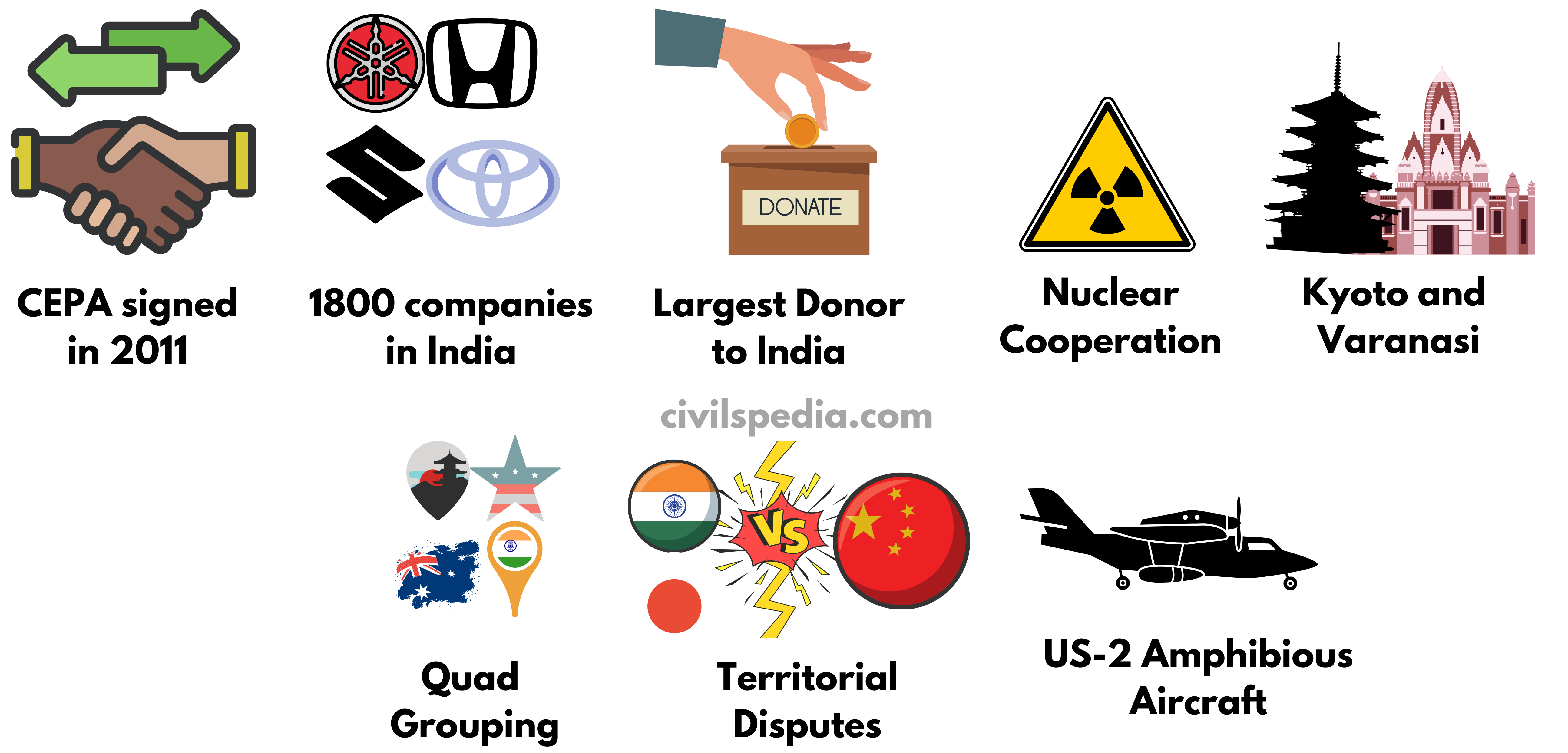
  • 2011: India and Japan signed CEPA (Comprehensive Economic Partnership Agreement). 
  • 2014: Prime Minister Shinzo Abe was the chief guest at India’s Republic Day parade.
  • 2017: Shinzo Abe visited Ahmedabad, and he inaugurated the Shinkansen (Bullet Train) project funded by Japan. The railway operation will commence in 2023.
  • 2022: 70 years of the establishment of diplomatic relations between the two countries.

Different Aspects in Indo-Japan Relations

Different Aspects in Indo-Japan Relations

1 . Export -Import

  • Japanese brands such as Sony, Yamaha, Honda and Toyota have become household names in India.
  • Suzuki’s partnership with the Indian automobile company – Maruti is the largest Indian car manufacturer.
  • India and Japan signed CEPA in 2011. India feels the CEPA is an alliance between Japanese technology and the Indian labour force. Under the provisions of CEPA, 94% of tariffs were eliminated. As a result of CEPA, bilateral trade between the two countries increased to  $17.6 billion (2018-19)
  • India exports petroleum products, iron ore, chemicals, fish, clothing and machinery to Japan while it imports electrical machinery, transport equipment, plastic materials and precision instruments. 

2. Japanese FDI

  • Japan is the 5th largest investor in India with a cumulative investment of upto $43.2 billion (till December 2024).
  • 1800 Japanese companies are operating in India.
  • India established the “Japan Plus” office in the Ministry of Commerce and Industry in 2014 as a “one-stop” location for resolving problems Japanese companies face.  

3. Largest Donor

  • Japan is the largest development assistance donor & 30% of the total ODA from Japan comes to India.
  • Some projects funded by Japan
    • Delhi Metro   
    • Mumbai -Ahmadabad High-Speed Rail  
    • Western Dedicated Freight Corridor (DFC)
    • Bangalore-Chennai Expressway
  • These loans are given at very favourable terms. E.g., Financial assistance for Mumbai-Ahmadabad Freight Corridor consists of a soft loan of ₹90,000 crores at an interest rate of 0.1% over 50 years. The re-payment of the loan is to begin after 15 years of receiving the loan. 

4. Currency Swap Agreement

  • In 2019, India and Japan signed a $75 billion currency swap agreement. Hence, in an emergency, India can get $ 75 billion in dollars or yen at a pre-determined exchange rate and later return it at the same exchange rate.

5. Security Issues

  • Japan signed the Declaration on Security Cooperation with India in 2008, only the third country to have such a security relationship after the USA and Australia.
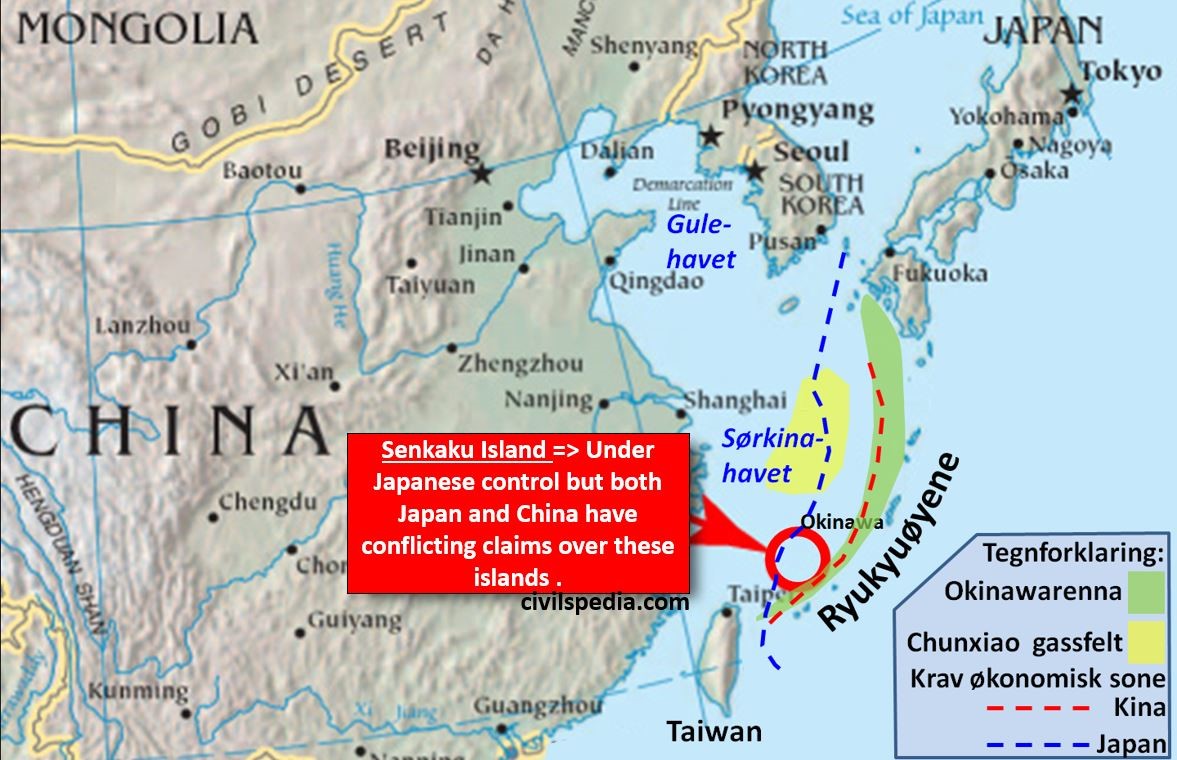
  • The rise of China serves as a significant reason for the realignment of partnerships in the region. Both India and Japan have unsettled territorial claims with China. E.g., conflict over Senkaku island(Japan vs China) and conflict over Aksai Chin and Arunachal Pradesh (India vs China).
  • The National Security Strategy of Japan announced in 2013 has included India as a primary driver in maintaining the balance of power in Asia disturbed by a rising China.
  • Malabar Exercise: India, US & Japan conduct an annual naval exercise to ensure freedom of navigation. It is mainly aimed at China, emerging as the revisionist power in the Indo-Pacific region. 
  • Quad: It is an informal strategic forum between India, Japan, USA and Australia. Also labelled as “Asian NATO”, it is the brainchild of Shinzo Abe and mainly aimed at containing the rise of China in the Indo-Pacific.
  • Japan is helping India build strategic infrastructure in North East and Andaman and Nicobar. 
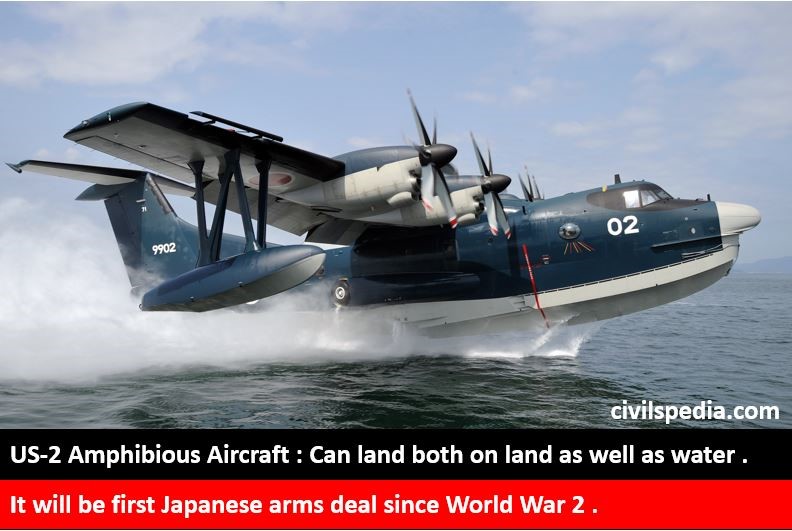
  • US-2 Amphibious Aircraft: India is planning to buy US-2 Amphibious Aircraft from Japan which can land both on land and water. This deal has strategic importance as this will be the first arms deal since World War 2, in which Japan will make an overseas military sale.
US-2 Amphibious Aircraft

Important note: The reinterpretation of Article 9 of the Japanese Constitution allows Japan to boost strategic cooperation with India. The amended Article 9 (since September 2015) allows Japan to send military aid to friendly states that including India) if they come under attack from another state. This amendment has opened up new avenues of strategic diplomacy between India and Japan.


  • Senkaku Island dispute involves the issue of sovereignty over eight uninhabited islands and rocks in the East China Sea
  • Japan and China have conflicting claims on these islands.
    • These islands have been under Japan since 1895. After World War 2, the US took over these islands but returned them to Japan in 1972.
    • China started to assert historical claims over Senkaku island in the 1970s.
  • Although uninhabited, these islands are important because
    • Close to important shipping lanes
    • EEZ offers rich fishing grounds
    • They lie near potential oil and gas reserves.
    • Control over these islands helps in maintaining military primacy in the Asia-Pacific region
Senkaku Island Issue

6. Nuclear Agreement Signed

  • Japan and India have reached a broad agreement in 2015 on Civil Nuclear Cooperation. It will provide India access to the Japanese nuclear market and its technology.
  • Along with that, as most of the nuclear parts are made by Japan, India found it tough to order nuclear technology from the US, France, and Russia in the absence of a deal with Japan.

7. Indian Diaspora

  • Indian merchants have been settling in Japan since 1870. But their number increased exponentially during World War I when Japanese goods were sought to fill the void of European goods. 
  • In recent years, there has been a change in the composition of the Indian community with the arrival of a large number of professionals. These include 
    1. IT professionals & engineers working for Indian & Japanese firms 
    2. Professionals in management, finance, education, and S&T research
  • Nishikasai area in Tokyo is emerging as “mini-India”.

8. Multilateral Cooperation

India and Japan are members of the following multilateral organisations 

  1. G-4: Both India and Japan are demanding a permanent seat in UNSC. 
  2. G-20
  3. Quad  

9. Other Cooperations

  • India and Japan are jointly working on Asia-Africa Growth Corridor (AAGC) announced in 2017 to counter China’s Belt and Road Initiative. 
  • India will supply rare earth metals to Japan for making defence and high tech electronics. At present, China is the biggest producer of rare earth.
  • Varanasi has been declared as Kyoto’s sister city.
  • India and Japan have started conducting the Annual Bilateral Space Dialogue to enhance bilateral cooperation in outer space. 
  • Japan will train 30,000 Indian youth in the next ten years by setting up a Japan-India Institute for manufacturing.
  • ISRO and Japan Aerospace Exploration Agency (JAXA) are working on a joint lunar polar exploration (LUPEX) mission. In 2024, the mission aims to send a Lander and Rover to the Moon’s south pole.
  • India & Japan complement each other
    1. Japan has an ageing population, while India has a young population. 
    2. They have surplus capital & we need capital.
    3. India has resources; they have the technology.
    4. India’s has prowess in services, and Japan has excellence in manufacturing. 

Issues

  • Due to project delays and bureaucratic hurdles, Japanese firms do not find it easy to do business in India.
  • India has refused to join the recently concluded RCEP.
  • Rising Trade Imbalance: The higher minimum standards on everything in Japan acts as an entry barrier for Indian companies and products, reducing dynamism in investment.  
  • Both had a diverging interest in economic issues like E-commerce rules and data localization (Osaka track). 
  • At WTO and its Doha Round of Talk, both India and Japan are in the opposite camps. 
  • Despite CEPA India-Japan trade, it has not produced the anticipated results.
  • No Concrete Achievement by Asia-Africa Growth Corridor (AAGC): Since the 2016 launch, AAGC has not been able to move beyond the vision statement or provide an alternative to Chinese OBOR. 
  • Japan is concerned about its intellectual property in defence technology transfers.
  • India is part of the Shanghai Cooperation Organisation as well as BRICS. 

Indian Diaspora and Issues

Indian Diaspora and Issues

This article deals with ‘Indian Diaspora and Issues – UPSC.’ This is part of our series on ‘International Relations’ which is important pillar of GS-2 syllabus . For more articles , you can click here

What is meant by Diaspora?

  • Indian Diaspora is a generic term to describe the people who
    • migrated from territories that are currently within the borders of the Republic of India.
    • It also refers to their descendants. 
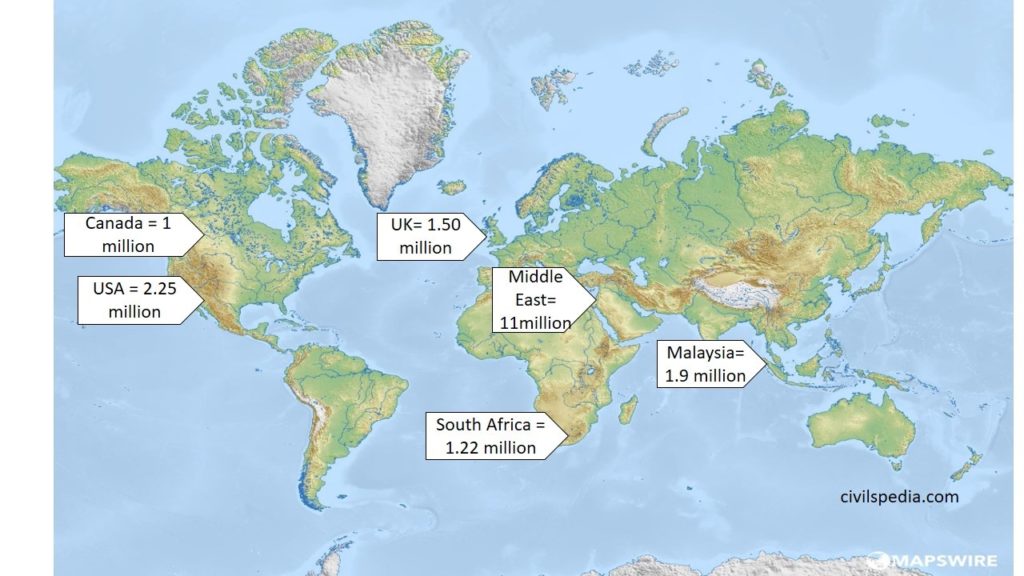
  • Diaspora is currently estimated to number over 26 million, composed of “NRIs” (Indian citizens not residing in India) and “PIOs” (Persons of Indian Origin who have acquired the citizenship of some other country).

Distribution

  • India has the second largest (first being China) Diaspora in the world.
  • The overseas Indian community estimated at over 26 million is spread across every major region in the world. The major concentration of Indian diaspora is in Middle East (11 Million) , U.S.A, U.K, Canada, Malaysia, Sri Lanka, and South Africa respectively.
Indian Diaspora and Issues

Trends of Indian Diaspora

  • Overseas Indian community is the result of different waves of migration over hundreds of years driven by a variety of reasons-mercantilism, colonialism and globalization. 

Changing nature

  • British times => Indentured Labour to Fiji, Kenya, West Indies, Mauritius etc
  • In the last three decades of the 20th century the character of migration began to change and a ‘new Diaspora’ led by
    • High skilled professionals moving to the western world
    • Semi-skilled contract workers moving to the Gulf, West and South East Asia emerged.

View of Various leaders towards Diaspora

JL Nehru Although we want to maintain close relationship with Indian Diaspora but Diaspora should re-affirm their commitment to Country they are settled in and integrate themselves in that country
Present Since 2002 (since formation of Singhavi Committee) , Indian government has started to view Diaspora as their important asset which can help in foreign policy and safeguarding Indian interests abroad.

Earlier Government viewed Diaspora as burdensome & refused to help them in various crisis

  • 1964 Myanmar crisis when 3 lakh India businessmen expelled & their businesses nationalised
  • 1972 : When 70,000 Indians faced  persecution in Uganda by Idi Amin regime

Role of Indian Diaspora in development of country they are settled in

  • They have also contributed to the growth and development of the country of their residence. For example, Silicon Valley represents the success of Indians. 4 out of 10 startups in the region are Indian.
  • Becoming important part of Government and political establishments and helping in nation building  .
    • Canadian Government has 4 Ministers (including Defence Minister of Indian Origin)
    • More than dozen MPs in UK are of Indian origin
    • US representative to UN (Nikki Halley (Randhawa)) is of Indian Origin
    • Portugual PM Dr Coasta is of Indian (Goa) origin (he was Chief Guest at 2017 Pravasi Bhartiya Divas held in Bangaluru)
    • Leo Varadkar – Former Ireland PM

How they help India

They help Home Country ie India in various ways. Instances are 

  • It is the source of large inflows of remittances, which has been helping balance the current account. According to the World Bank Indian diaspora sends highest amount of remittances back home (followed by China)
  • During Indo-US Nuclear Deal, US Indians played part in lobbying for India
  • Many Indians invest in philanthropic activities back in India especially in their AlmaMater
  • Mauritian President is generally of Indian Origin and always act as important ally in Indian Ocean. China has not been able to make deep inroads in Mauritius .
  • They are investing in Indian . States to which they belong try to woo them . Eg : Punjab organises Progressive Punjab Summit and Punjabi NRIs are given special invitation for doing investments
  • Help to re-develop after disasters . Eg :
    • Kerala Diaspora helped Kerala during 2018 floods
    • UAE government proposed to give ₹700 crore to Kerala recognising the contribution of Keralites in building UAE & their importance in country and economy

Remittances send by Indians 

Remittances : World Bank Ranking

India 72 (billion $)
China 64
Philippines 30
Mexico 22
Nigeria 21

Major Issues

  • Dual Citizenship: Majority of Indian diaspora want to retain their Indian citizenship along with the citizenship of the country of their residence.
  • Customs and Immigration Official Issues : The commonest grievance of the Diaspora is the ill treatment, harassment and the demands for illegal gratification it encounters at the hands of our customs and immigration officials at the points of entry.
  • Threat to their employment (Nitaqat Law): It is aims to replacing a large section of overseas workers with locals in Saudi Arabia. Because of this, overseas workers from Kerala, TN etc. affected.
  • Threat to their security by IS: In view of the recent cases of violence in the Middle East, there has emerged a new threat the very security of oversees workers in the region. For example, the recent kidnapping of Indian workers by IS group.
  • Evacuation from War Zones : Explained Below

Side Topic : Evacuation of Indians

  • Various Evacuations done by Government till now
2016 Sankat Mochan From South Sudan (Civil War going on in South Sudan)
2015 Raahat Yemen (Civil War between Government and Houthi Rebels )
2011 Op Safe Home Coming Libya (Civil War after Arab Spring)
2006 Sukoon Lebanon
1990 ——- From Kuwait (Airlift movie made on this)

Do we need Evacuation Policy / Doctrine

  • India has conducted more than 30 evacuation operations across Africa, Asia, and Europe, including its largest-ever civilian airlift of 110,000 people from the Persian Gulf in 1990. However , India does not have a comprehensive evacuation policy to evacuate Indian stranded in conflict zone.

Why We need Evacuation Policy

  • US, UK, and the NATO have institutionalised Non-Combatant Evacuation operations (NEO) doctrine. Among the developing countries, Brazil too has institutionalised a standard operating procedure (SOP).
  • India has more than 25 million strong Diaspora and in that  11 million Indians are in West Asia which is becoming unstable with growth of ISIS   
  • Fast Reaction : Whenever such situation arives, Government and Officials can take steps at earliest to save Life of Indians.
  • Will establish clear chain of command and in case of failure , responsibility can be properly expressed

How to make and what it can include

  • Take lessons from  India’s  previous Evacuation Operations  and best practices  along with Evacuation Plans of US, UK, NATO etc
  • India’s diplomatic cadre must be given specific training to operate in hostile environments. 
  • Assign a greater role to its armed forces, in particular by strengthening the Navy and Air Force’s capacity to operate in tandem with civilian authorities. 
  • Government must establish a permanent civil reserve air fleet that pools aircraft from all Indian airlines based on pre-established requisition and reimbursement process.
  • Invest in new technologies to better monitor the diaspora’s profile and mobility

Steps Taken

  • India setup Dr LM Singhavi Committee (High Level Committee on Indian Diaspora)  in 2002 which gave various recommendations. (Almost all steps taken by the Government are based on this report like starting Pravasi Bhartiya Divas , giving more importance to Diaspora etc

  • For giving special focus to the issues pertaining to the Indian diaspora, the government set up a dedicated Ministry of oversees Indian affairs in 2004. It provides all round services to the diaspora. (Again merged with External Ministry. Retrograde step)
  • Government has started, since 2003, the organization of Pravasi Bhartiya Diwas, to mark the contribution of the overseas Indian community to the development of India. 
  • The government has launched various social security schemes for Indian diaspora living abroad, like
    • Pravasi Bhartiya Bima Yojana, 2006
  • Skilling for Foreign Jobs
    • Swarnapravas Yojana : focuses on skill development of Indians  who want to go abroad  in select sectors that face skill shortages in the international labor market, and increase their employability  
    • Pradhan Mantri Kaushal Vikas Yojana : PKVY has exclusive program to train Indians seeking jobs abroad which train them in suitable skill sets 
  • Various online platforms for Diaspora
    • MADAD App : To help NRIs in distress relating to work permit, visa , employer issue
    • E-Migrate Portal : Recruiting Agents have to register here
  • Schemes to know about India  and their roots
    • Know India Programme was launched as a three-week Orientation programme for diaspora youth (aged 18 to 30) conducted with a view to promote awareness on different facets of life in India and the progress made by the country in various fields (latest such program conducted in Dec 2017) .
    • Ministry of Overseas Indian Affairs is running a scheme known as “Tracing the Roots” to facilitate PIOs in tracing their roots in India.
  • Oversees Citizenship of India Scheme (OCI): The Scheme provides for benefits comparable to citizens in certain fields, like in economic and education fields etc. PIO Card was merged with OCI Scheme as well
  • State level initiatives : States like Punjab with huge diaspora have started NRI police stations and NRI Sabha to deal with cases and issues of NRIs.

What more can be done

  • To ensure that Diaspora members feel welcomed on their arrival in India and also recall warmly their visits, a friendlier reception at their point of entry; easier procedures for immigration and customs clearances that are marked by courteous service are essential
  • To address the problems of our overseas blue-collar workers, following should be implemented at the earliest possible.
    • Establishing a welfare fund for repatriated overseas workers in distress;
    • Monitoring and supervision of both the employment contracts, and conditions of our overseas workers by our Missions;
    • Launching compulsory insurance schemes covering the risks faced by our overseas workers;
  • Diaspora can make a significant contribution to the growth of tourism in India. PIOs make frequent visits to their home state or  their relatives. There should be greater focus on promoting tourism among 2nd generation PIOs.
  • Parliamentary Standing Committee on the Indian Diaspora could be constituted.This Committee could also act as a focal point for interaction with Parliamentarians of Indian Origin in other countries. Such exchanges are essential in order to bring about greater understanding and amity between them. 
  • Giving Voting Rights to Indians living abroad . Procedure through which it can be done like e-ballot or on Indian Consular office etc can be debated

DNA Fingerprinting

DNA Fingerprinting

DNA Fingerprinting

This article deals with ‘DNA Fingerprinting  – UPSC.’ This is part of our series on ‘Science and Technology’ which is an important pillar of the GS-3 syllabus. For more articles, you can click here.


DNA Finger Printing / DNA Profiling

  • DNA profiling, or DNA fingerprinting, is a forensic method used to identify a person using a unique signature found in their DNA.
  • Alec Jeffreys first developed DNA fingerprinting technique in 1985. 
  • It uses the fact that the DNA of a person is unique.  
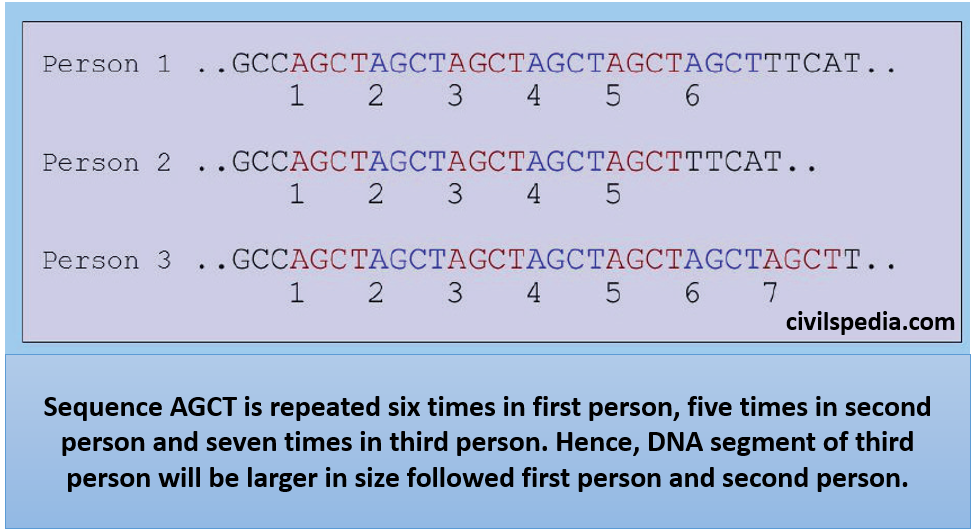
  • The Short Tandem Repeat (STM) Technique is the most commonly used technique, which involves identifying differences in some specific regions in DNA sequence. However, there are 23 pairs of human chromosomes with 1.5 million pairs of genes. But 99.9% of the DNA base sequences are the same (called Bulk Genomic DNA). The remaining 0.1% DNA sequence differs from one individual to another and is present as a small stretch of repeated sequences called Short Tandem Repeats (STM).
What is DNA Finger Printing

Technique

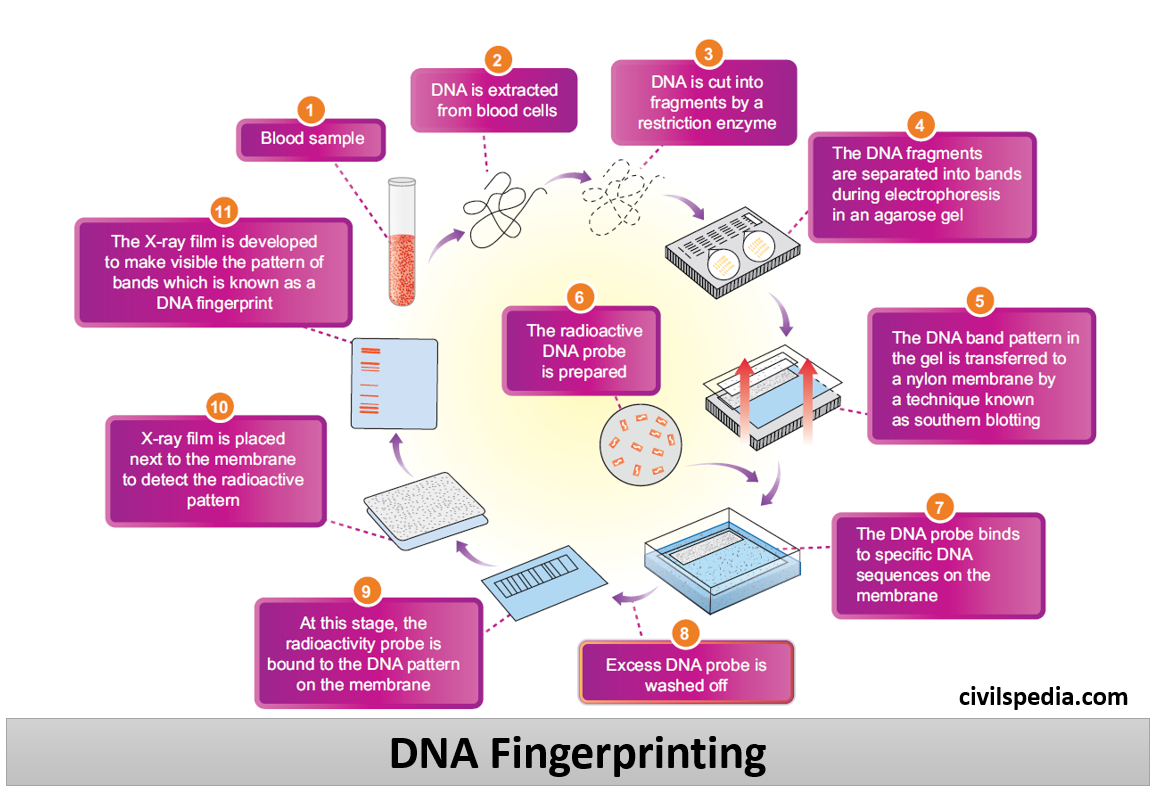
It involves following steps

Technique of DNA Fingerprinting

Uses of DNA Fingerprinting

  • Forensic analysis: It can be used in the identification of a (1) person involved in criminal activities, (2) for settling paternity or maternity disputes, and (3) in determining relationships for immigration purposes.
  • Pedigree analysis: It can be used for inheritance pattern of genes through generations and for detecting inherited diseases such as Cystic Fibrosis, Haemophilia, Huntington’s Disease, Sickle Cell Anaemia etc.
  • Personal Identification: DNA fingerprints can be used as a genetic bar code to identify individuals.
  • Anthropological studies: It is useful in determining the origin and migration of human populations and genetic diversities.
  • DNA Barcoding: A technique for specifying the organisms’ species using a short sequence of DNA situated in the genome is termed DNA bar-coding. The barcode DNA sequences are too short in respect to the complete genome and hence cheaper.


DNA Fingerprinting in India

  • Pioneering work was done by Lalji Singh at the Centre for Cellular and Molecular Biology (CCMB), Hyderabad 
  • Other centres are :
    1. Centre for Cellular and Molecular Biology (Hyderabad)
    2. Centre for DNA Fingerprinting & Diagnostics (Hyderabad)
    3. Central Forensic Science Laboratory, Kolkata 
    4. National Bureau of Plant Genetic Resource (NBPGR), New Delhi
    5. National Institute of Plant and Genetic Research (NIPGR), New Delhi


  • It is an international research effort to map the DNA of the entire human genome.
  • It started in 1990 and was completed in 2003.
  • The National Institutes of Health, USA and the Department of Energy, USA coordinated it.

  • The project was started in 2020 under the Department of Biotechnology.
  • The project has collected 10000 genetic samples from citizens across India to build a reference genome. The data has been made publically available to the researchers as a  “digital public good.”
  • Use: The data can be used by researchers to develop new diagnostics and therapies, identify new rare diseases, and cure existing ones.
  • The second phase of the project will try to sequence the genome of persons with specific diseases. The researchers can then compare these genomes with healthy ones and identify the genes that are responsible for those diseases.

  • The program aims to sequence the whole genome of 1000 Indian individuals representing diverse ethnic groups from India.
  • It is funded by CSIR.  

DNA Technologies (Use & Regulation) Bill, 2019

Introduction

There are a large number of 

  1. Missing persons 
  2. Unclaimed dead bodies 

DNA fingerprinting can help the government in this regard.

Moreover, DNA is accepted as evidence under Evidence Act. Hence, it can help in increasing the conviction rate.


Issues with DNA Fingerprinting in India

  • Lack of regulation
  • Privacy issue
  • Lack of DNA labs and experts.
  • Unscientific forensic data collection techniques used by police.

Working

  • Use of DNA Data: DNA testing is allowed only regarding matters listed in the schedule to the Bill (such as paternity suits). 
  • Permission for the use of DNA Data: While preparing a DNA profile,
    • Authorities must obtain consent for collection if the offence carries a punishment of up to 7 years.  
    • If the offence carries more than seven years of imprisonment or death, consent is not required.  
  • Two new bodies will be created
    • DNA Regulatory Board: To supervise and regulate  DNA Data Banks and DNA Laboratories. 
    • DNA Data Bank (National & State): Data Banks will store DNA profiles received from DNA laboratories.
  • Protection of information: 
    • Board is required to ensure that all information relating to DNA profiles with the Data Banks, laboratories and other persons are kept confidential
    • DNA data can only be used for identification of the person (and not for extracting any other information (like Health Vulnerabilities to be used by Insurance companies))
  • Option for deletion of data – There is also provision for defined instances for deletion of profiles and destruction of DNA profiles (like if the charge-sheeted person whose DNA samples has been stored in DNA Data Bank has been acquitted by Court).
  • Penalties: Any violation would attract imprisonment up to three years and a fine of up to 1 lakhs. 

Issues

Privacy Issues 

  • In the absence of any Data Protection Act, DNA information stored in Data Bank can be vulnerable.
  • Along with that, leakage of data can reveal intrusive information like a person’s allergies or vulnerability to diseases. This information can be misused by various organizations such as (health) insurance agencies.

Technology 

  • Critics say that DNA Matching tech is not entirely foolproof. There are chances, even if very low, of erroneous results. 
  • Problems of cross-contaminating samples, mislabelling samples, misrepresenting test results and intentionally planting DNA.  

Unscientific investigation

  • In India, instead of forensic investigators and scientists, an untrained constable goes to the crime scene first, who does not know how to collect evidence scientifically and, in the process, destroys vital DNA evidence.

Lack of DNA examiners 

  • According to international practice, one DNA examiner can take 100 cases per year. As of now, there are 40,000 unclaimed dead bodies each year & 400 examiners are required. But India has a total of 35-40 examiners.

No improvement in conviction rates 

  • Over the last 25 years, most countries have adopted a DNA fingerprinting law and have developed databases for criminal investigation, disaster identification and forensic science. However, DNA tests have not improved conviction rates in countries where it is already being followed. 

Pros

Is already happening, better to do it in a regulated way 

  • Experts say that apprehensions of data misuse & privacy are more in case of the absence of regulation.

Privacy 

  • Minimal information is proposed to be stored (just 13 sets of numbers out of billions ). This can tell nothing about an individual except to act as a unique identifier 
  • Moreover, DNA will be collected from very limited persons in conflict with the law. 

Utility

  • Time has come to use forensic evidence in corroboration with eyewitness evidence. 

Designer Baby

Last Updated: Feb 2025 (Designer Baby)

Designer Baby

This article deals with ‘Designer Baby – UPSC.’ This is part of our series on ‘Science and Technology’, an important pillar of the GS-3 syllabus. For more articles on Science and Technology, you can click here.


Introduction

Designer Baby
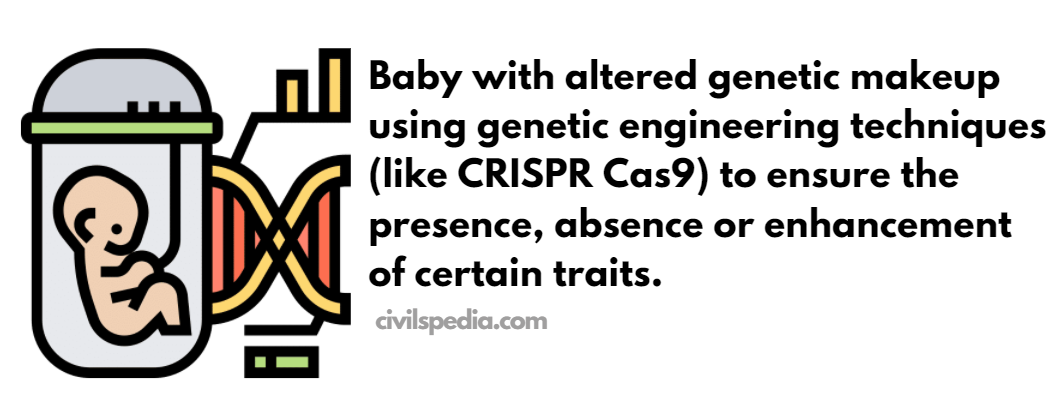
  • Baby whose genetic makeup has been altered using genetic engineering techniques (like CRISPR Cas9) to ensure the presence, absence or enhancement of certain traits. 
  • These traits include
    1. Appearance (like height, skin colour, eyes etc.)
    2. Disease resistance
    3. Intelligence
  • Bio-information of physical characteristics is encoded in the genetic material. With the ability to alter this information, scientists try to control some of these features.

Discussion: Should it be allowed?

Pros of allowing this technology

  • It reduces the risk of genetic diseases. Thus, it prevents the next generation of the family from getting characteristic diseases.
  • It has the potential to increase the human life span by up to 30 years.
  • Designer babies have a greater probability of success in life.
  • Development in the field will help in a better understanding of genetics.

Cons of allowing this technology

  • It will create a social gap as the designer babies will have better looks, intelligence etc. and thus more chances of success. 
  • The genetic engineering technology used is not 100% safe yet. 
  • It has the possibility of damaging the gene pool.
  • It is not an inclusive technology as it is expensive, and only the rich can afford it.

Updates

2019: A Chinese scientist claimed that he made the world’s first “genetically-edited” baby in whom a gene linked to HIV was removed using the CRISPR technique.


Side Topic: Euthenics

  • Euthenics is the science of improving the well-being of humans by improving the external factor of their environment.
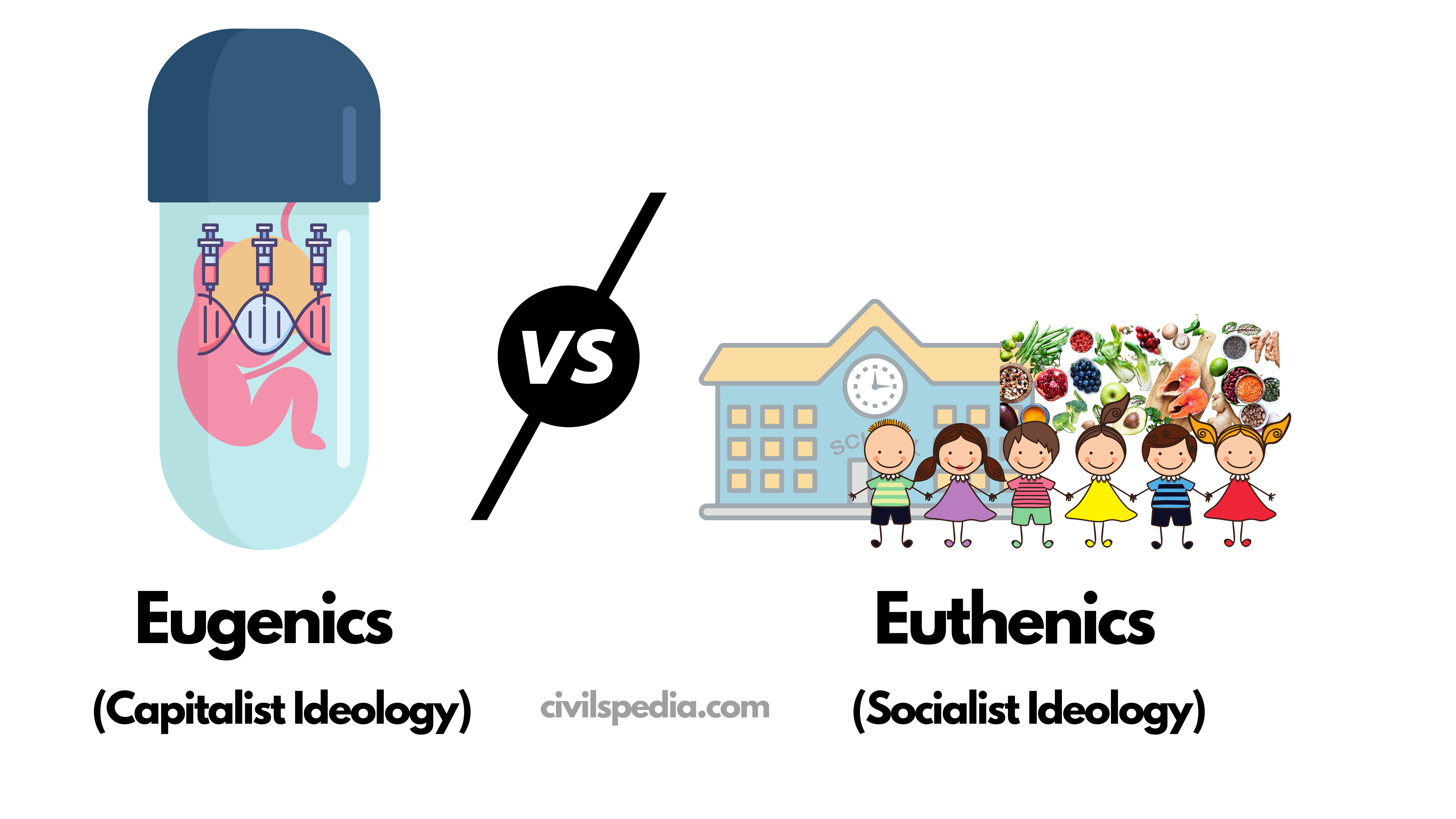
  • In contrast to Eugenics which is a capitalist ideology, Euthenics belongs to socialist ideology. It emphasises that instead of changing the genes, governments should provide a better environment for the people to develop.
Euthenics

Gene Therapy

Last Updated: Feb 2025 (Gene Therapy)

Gene Therapy

This article deals with ‘Gene Therapy – UPSC.’ This is part of our series on ‘Science and Technology’, which is an important pillar of the GS-3 syllabus. For more articles on Science and Technology, you can click here.


Introduction

Gene Therapy
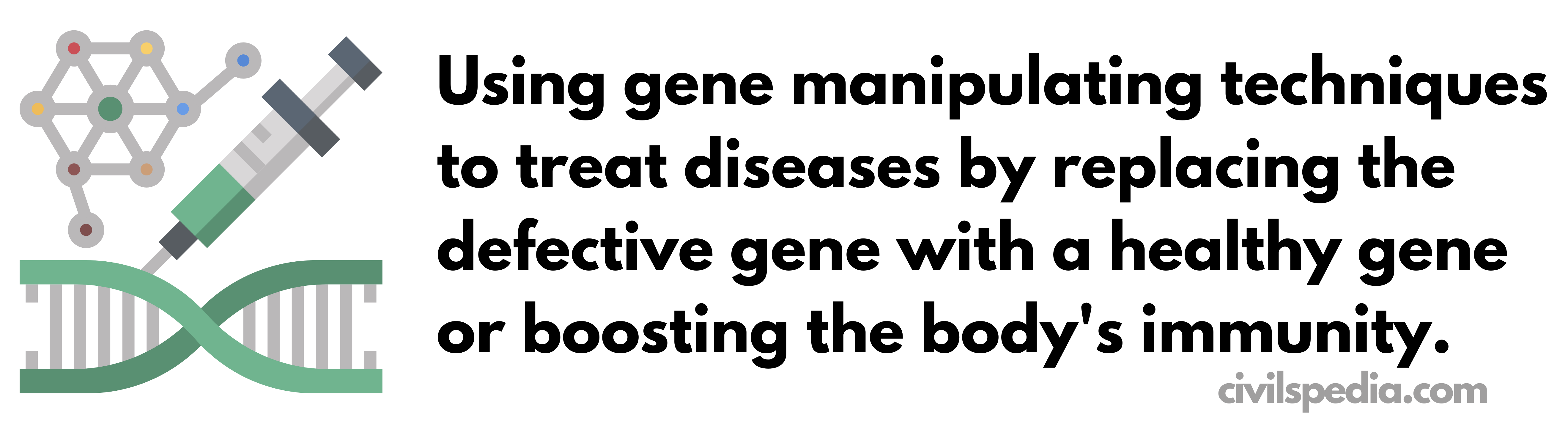
  • Gene Therapy means using gene manipulating techniques to treat diseases by replacing the defective gene with a healthy gene or boosting the body’s immunity.
  • It is an extremely useful tool for numerous diseases, like severe combined immune deficiencies, haemophilia, Parkinson’s disease, cancer, etc.

Types of Gene Therapy

Gene Therapy can be of two types

Somatic Cell Gene Therapy

It involves Gene Therapy in normal cells. 

It has two categories:

  1. Ex-Vivo: Cells are taken from an individual, modified genetically outside the body and then transplanted into the same person’s body or some other person.
  2. In-Vivo: Genetic modification is done inside the body using a gene delivery system.

Germ Cell Gene Therapy

  • Germ Cell Gene Therapy is carried out in Germline Cells (sperm or egg).
  • Next-generation will not be affected by a genetic disorder.

Techniques

  • Same techniques which we used in Gene Editing, like CRISPR Cas9. (Gene Therapy is one of the applications of Gene Editing only).
Techniques of Gene Editing

Some real examples

#1. Yescarta

  • Yescarta is Gene Therapy developed by Novartis to treat blood cancer (Acute Lymphoblastic Leukaemia). 
Yescarta

  • NexCAR19 CAR-T Cell Therapy is developed by IIT Bombay to treat cancer and is India’s first homegrown gene therapy.
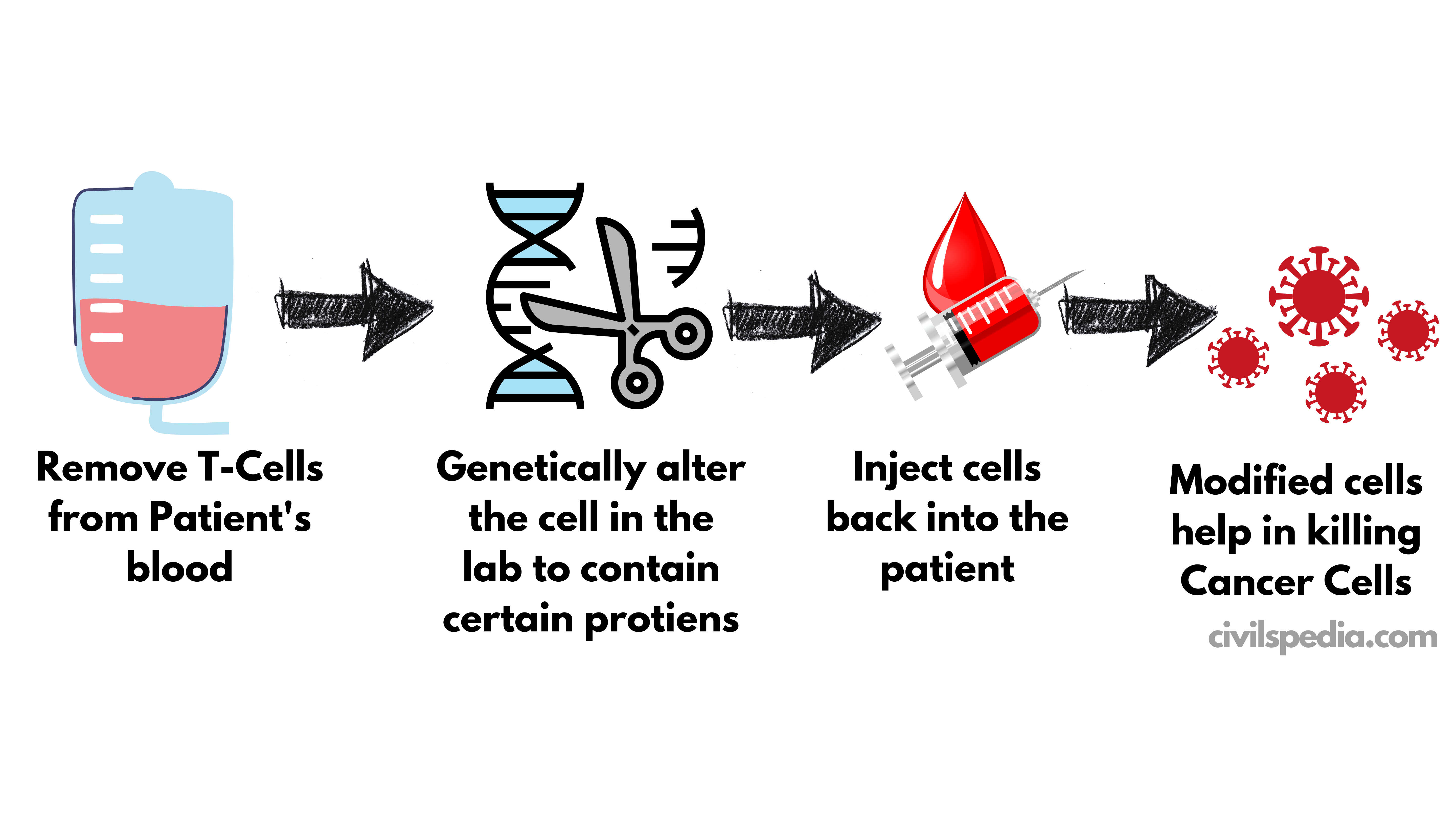
  • CARs are proteins that assist the T-cells to recognize and attach to a specific protein present in cancer cells. T-cells then kill the cancer cells.

#3. Zolgensma

  • Gene Therapy developed by Novartis to treat Muscular Atrophy.
  • It is extremely expensive, costing over 15 crore.

Benefits of Developing Gene Therapy for India

  • In India, around seven crore people suffer from genetic diseases such as Thalassemia, Sickle Cell Anaemia etc. These can be cured using Gene Therapy.
  • Economic benefits: It is a growing market with a potential market of $250 billion. India can earn huge revenue and strengthen its position as a destination for medical tourism by developing expertise.


Problems with Gene Therapy

  • The efficacy of Gene Therapy is still questioned. 
  • Short-lived nature of gene therapy as a result of which patients have to undergo multiple rounds of gene therapy. 
  • Immune response: The immune system has evolved to attack the invader whenever a foreign object is introduced into human tissues. Hence, when foreign DNA is introduced into the body for gene therapy, the immune system attacks it and reduces the efficacy of the gene therapy.
  • Side effects of virus delivery tools: Viruses are used as vectors in most gene therapies. This virus can cause various problems for the patient undergoing gene therapy like toxicity, immunity and inflammatory responses, gene control, etc. 
  • Equal Access to treatment: Gene therapy at present has a high cost. Hence, there are inclusivity issues associated with gene therapy.