
Last Updated: November 2025 (Indian Air Force)
Table of Contents
Indian Air Force
This article deals with the ‘Indian Air Force.’ This is part of our series on ‘Science and Technology’ which is an important pillar of the GS-3 syllabus. For more articles, you can click here.
Airforce
- The Indian Airforce with 135,000 active personnel, defends the Indian airspace.
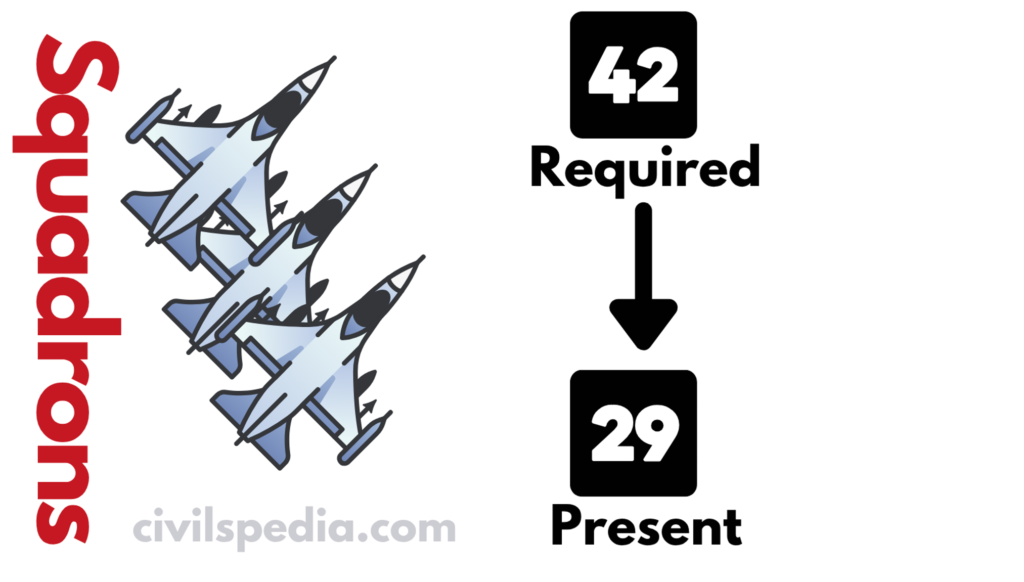
- At present, the Indian Airforce (IAF) has 29 fighter squadrons. But to be effective against China and Pakistan, India needs at-least 42 squadrons.
Aircrafts of India
Combat Aircraft
These are the “warriors of the sky. Their main job is to fight and destroy enemy aircraft, ground targets, or ships using missiles, bombs, and guns.
| Dassault Rafale | 26 |
| Sukhoi Su-30 MKI | 272 |
| HAL Tejas | 22 |
| Mig-29 | 66 |
| Mirage 2000 | 49 |
| Jaguar | 120 |
| MiG-21 Bison | 107 (retired in 2025 and to be replaced by Tejas) |
India is planning to issue global bids for 114 multi-role fighter aircraft (MRFA). Potential contenders include Lockheed Martin (F‑21), Dassault (Rafale), Sukhoi (Su‑57), Saab (Gripen E), and Eurofighter.
Reconnaissance Aircraft
These are the “eyes and ears of the Air Force.” Their job is to collect intelligence — taking high-resolution photos, radar scans, or electronic data from enemy areas without getting caught.
| Boeing 707 | 1 |
| Global 5000 | 2 |
| Gulfstream | 2 |
Tanker Aircraft
These are aerial petrol pumps that refuel other aircraft mid-air, so that fighter jets can stay longer in the air and go farther without returning to base. This capability greatly extends the range of combat aircraft during missions.
| Il-78 | 6 |
Transport Aircraft
These are the “trucks and trains of the sky.” They carry troops, weapons, food, medical aid, or even tanks to areas where they’re needed — from high mountains to disaster zones.
| Ilyushin IL-76 | 17 |
| Boeing C-17 Globemaster | 11 |
| C-130J Super Hercules | 12 |
| Antonov A-32 | 104 |
| Dornier 228 | 50 |
Helicopters
- Unlike jets, they can take off and land vertically, even from narrow mountain helipads or moving ships.
- They are used for transporting troops, search and rescue, medical evacuation, disaster relief, and combat support.
| HAL Light Combat Helicopter | Attack Helicopters |
| HAL Rudra | Armed |
| HAL Dhruv | Utility |
| Boeing Apache | Attack Helicopters |
| Mi-24 | Attack Helicopters |
| Chinook | Heavy Transport |
UAVs
| Harop | Loitering Munition |
| Heron | Surveillance |
| Searcher | Surveillance |
| DRDO Lakshya | Target Drone |
Side Topic: Generations of Aircrafts
It should be noted that the notion of aircraft generations came up only in the 1990s. It has thus been retrospectively applied to fighter aircraft that came before this period.
Also, a generational shift in fighter jets is said to occur when a certain technological innovation cannot be incorporated into an existing aircraft through upgrades and retrospective fit-outs — each new generation comes with a certain significant leap in technology.
| Period | Features | Examples | |
| 1st Gen Fighters | 1940s-50s | – Turbojet Engines They were faster than their piston-engined contemporaries, but otherwise not very different from existing fighter aircraft. | Mig-15 and Mystere-IV |
| 2nd Gen Fighters | 1950s-60s | – Delta Wings – Afterburners – Guided and Beyond Visual Range Missiles They had massive improvements in terms of speed, weaponry, and avionics | Mig-21, Su-7 and F-104 |
| 3rd Gen Fighters | 1960s-70s | – Improved Radars, Missiles and Avionics | Mig-25 and F-4 Phantom |
| 4th Gen Fighters | 1970s-90s | – Fly by wire controls – Multi-role capabilities | Mirage-2000, Mig-29, Su-27, F-16 Fighting Falcon |
| 4.5th Gen Fighters | 1990s onwards | – Some stealth features – Advanced avionics | Su-30 MKI, Rafale, Eurofighter Typhoon, F-16 Desert Falcon |
| 5th Gen Fighters | 2000s onwards | – Advanced Stealth – Highly sophisticated avionics – Thrust Vectoring – Supersonic cruise without the use of afterburners | F/A-22 Raptor, F-35, Sukhoi T-50 and J-20 (China) |
Detail of Combat Aircrafts in news
1. Rafale & MMRCA
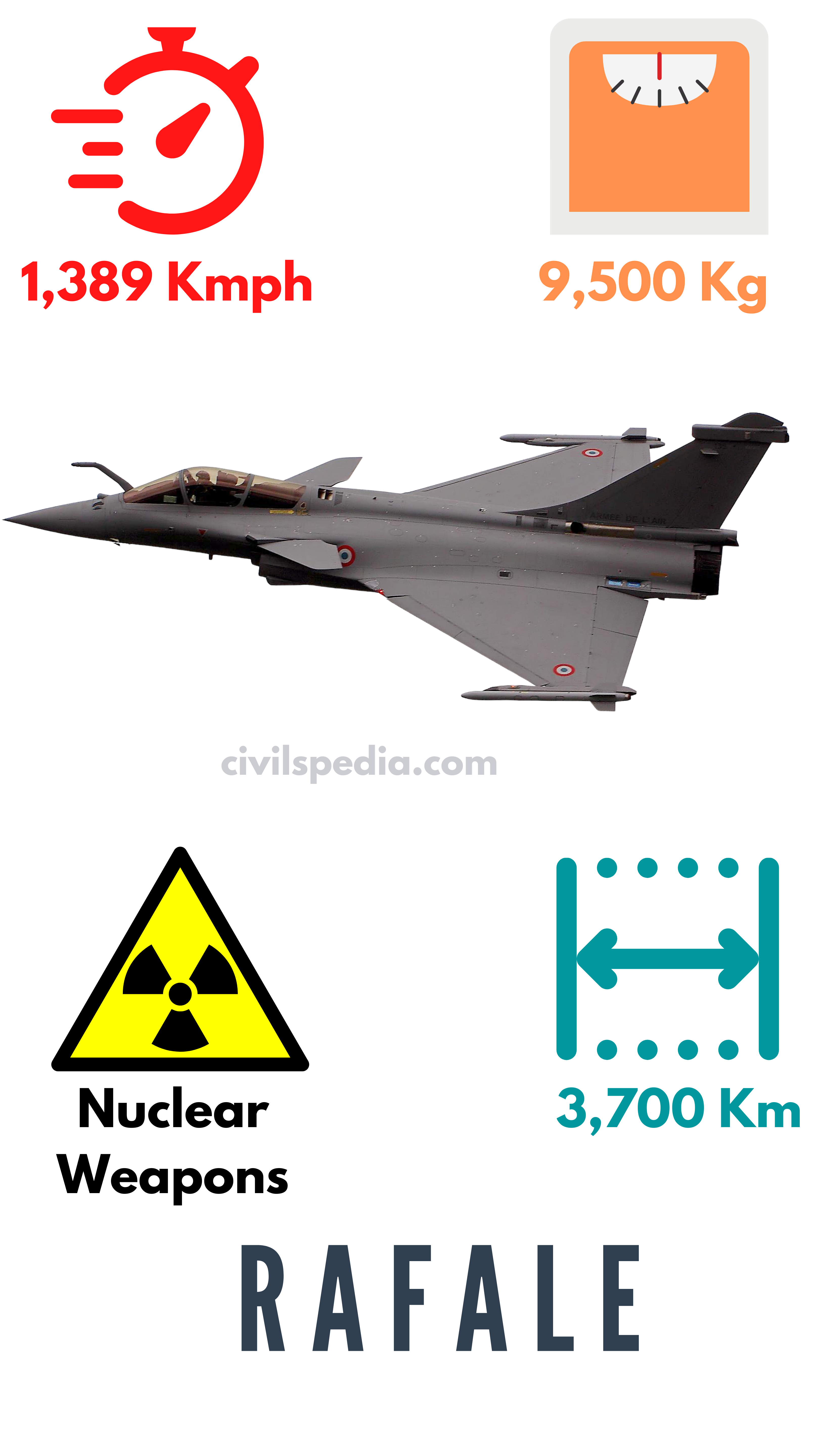
Rafale is 4.5 generation Medium Multi-Role Combat Aircraft (MMRCA) aircraft made by Dassault Aviation of France.
The Rafale deal was part of India’s effort to modernize its ageing Air Force fleet and maintain air superiority, especially given China’s 5th-generation J-20 and Pakistan’s JF-17 programs.
Main features of Rafale
- 4.5 generation Multirole combat aircraft, i.e. can be used for ground support, in-depth strike, and anti-ship strike.
- Rafale is capable of carrying nuclear weapons.
- Equipped with precision air to air and air to surface missiles.
- Range: 3,700 Km
- Max Speed: 1,389 Km/hr
- Load Carrying Capacity: 9,500 Kg
Rafale Acquisition: Chronology of Events
| 2007 | Tender for MMRCA was invited, and various bidders such as Eurofighter (of British Aerospace), F-16 (of Lockheed Martin), MiG-35 (of Russia) and Rafale (of Dassault (France)) applied for the bids. |
| 2011 | Rafale was shortlisted. It was decided that India would buy 126 Rafale. In this, 18 were to be purchased in fly-away condition, and the rest 108 were to be made by HAL under Transfer of Technology. |
| 2015 | But the issue was Dassault was not prepared to guarantee the performance of aircraft manufactured in India. The plan was changed, and the government decided to buy 36 Rafale in the ready-to-fly condition to be given to India in two years. |
| 2018-19 | The case went to Supreme Court to increase the cost per aircraft and give offset contract to Reliance instead of HAL. |
| 2020 | Delivery of Rafales started. The first batch of 5 aircraft was delivered to India. |
| Current | 36 Rafales are in the service of the Indian Airforce deployed at Ambala (Haryana) and Hasimara (West Bengal) |
Issues
- The stealth system of Rafale is outdated compared to other competitors in the same class.
- Rafale doesn’t have STOVL (Short take-off and vertical landing) capability, present in other competitors.
- Brazilian Airforce was earlier interested in buying Rafale but later changed to Swedish Gripen jet.
2. Tejas / HAL’s LCA
- HAL Tejas or Light Combat Aircraft (LCA) is a 4th Generation fighter aircraft made by India. Tejas represents India’s ambition to build a fully indigenous multirole fighter aircraft — strengthening both national security and technological self-reliance under Atmanirbhar Bharat.
Chronology
| Year | Event |
| 1983 | LCA program launched by Government of India to develop an indigenous fighter. |
| 1993 | Aeronautical Development Agency (ADA) established to manage the project; HAL chosen as lead manufacturer. |
| 2001 | First prototype (Technology Demonstrator) made its maiden flight. |
| 2015 | First Tejas delivered to Indian Air Force; marks India’s entry into the limited club of nations producing fighter aircraft. |
| 2021 | Government approved purchase of 83 Tejas Mk-1A aircraft worth ₹48,000 crore; production to continue till 2030. |
| Future (under development) | Tejas Mk-2 (Medium Weight Fighter) under design with higher payload, range, and advanced sensors — bridging towards India’s AMCA (5th gen) program. |
Features of HAL Tejas
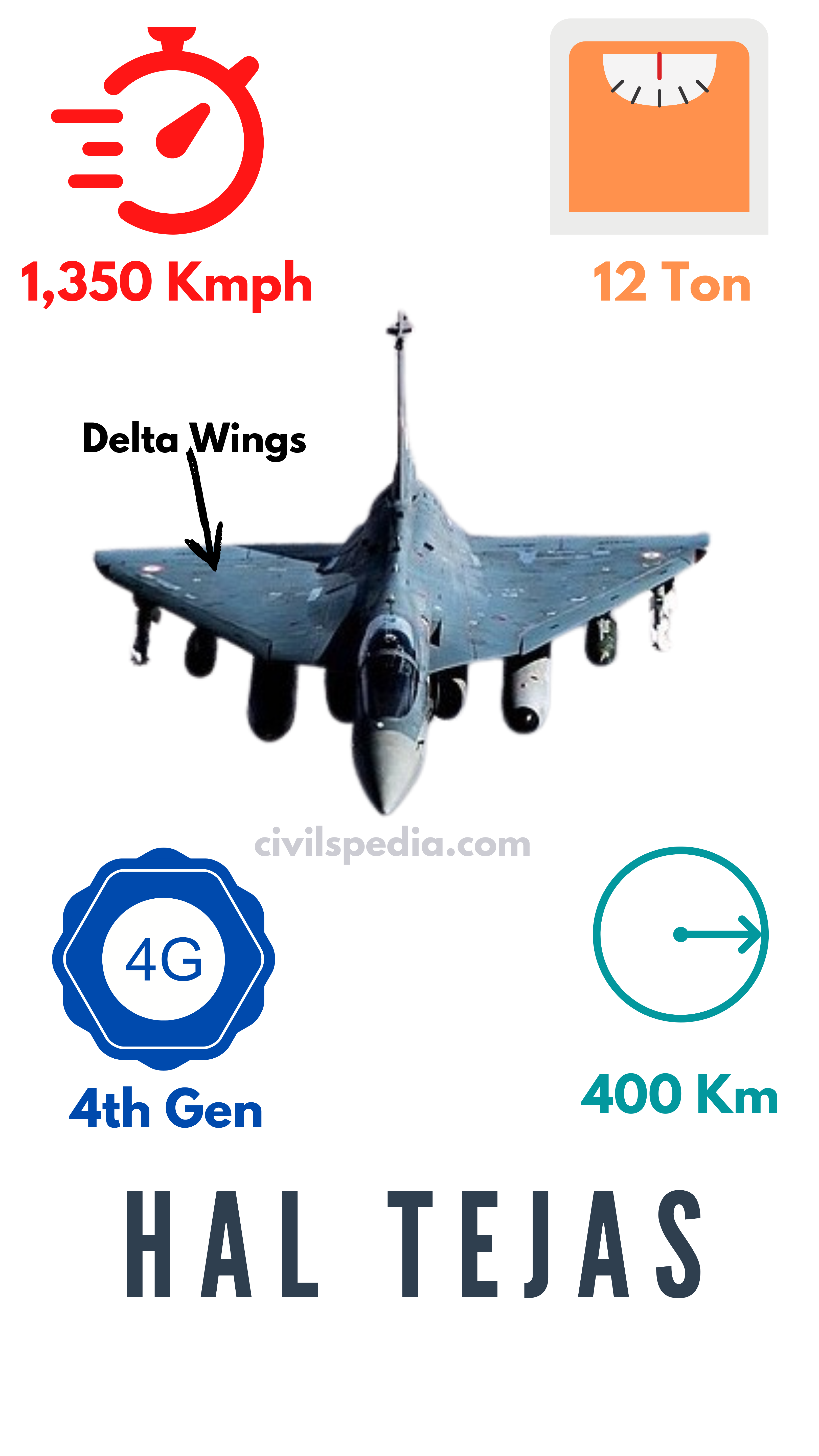
- Type: 4th Generation Light Combat Aircraft (LCA).
- Manufacturer: Hindustan Aeronautics Limited (HAL).
- Objective: To replace India’s ageing MiG-21 fleet.
- Indigenous Content: Around 60%, including avionics, flight controls, and composites.
- Max Speed: ~1,350 km/h.
- Radius of Action: ~400 km (without refuelling).
- Load Capacity: ~12 tonnes.
- Design: Delta wing configuration for stability and agility.
- Key Technologies: Fly-by-wire control, digital glass cockpit, composite airframe, and advanced radar.
- Operational Features: Beyond Visual Range (BVR) missiles, air-to-air refuelling, and STOBAR (Short Take-Off But Arrested Recovery) for naval use.
Side Topic: (LCA) Kaveri
- Kaveri is the name of Tejas’s engine that was to be used, but India couldn’t make it on time to be used in the plane.
- It would have been India’s first indigenous gas turbine engine.
3. Su-30 MKI
- Su-30 MKI is a 4.5 Generation multirole fighter aircraft jointly developed by Russia’s Sukhoi and India’s HAL.
- It forms the backbone of the Indian Air Force’s combat fleet.
- The aircraft was first inducted in 2002, and over 270 units have been produced/assembled by HAL in India.
- It can perform both air superiority and ground attack missions, making it a true multirole platform.
Features of Su-30 MKI
- Two-seater and twin-engine aircraft.
- Maximum speed: Mach 2.0 (~2,120 km/h).
- Combat range: Around 1,500 km (extendable with aerial refueling).
- Can carry up to 8,000 kg of weapons including missiles, bombs, and rockets.
- Equipped with Thrust Vectoring Control (TVC) and Canard foreplanes for superior maneuverability.
- Integrated Indian, Russian, and French avionics systems.
- Compatible with BrahMos supersonic cruise missile, giving it long-range strike capability.
4. Sukhoi T-50 (Fifth Generation)
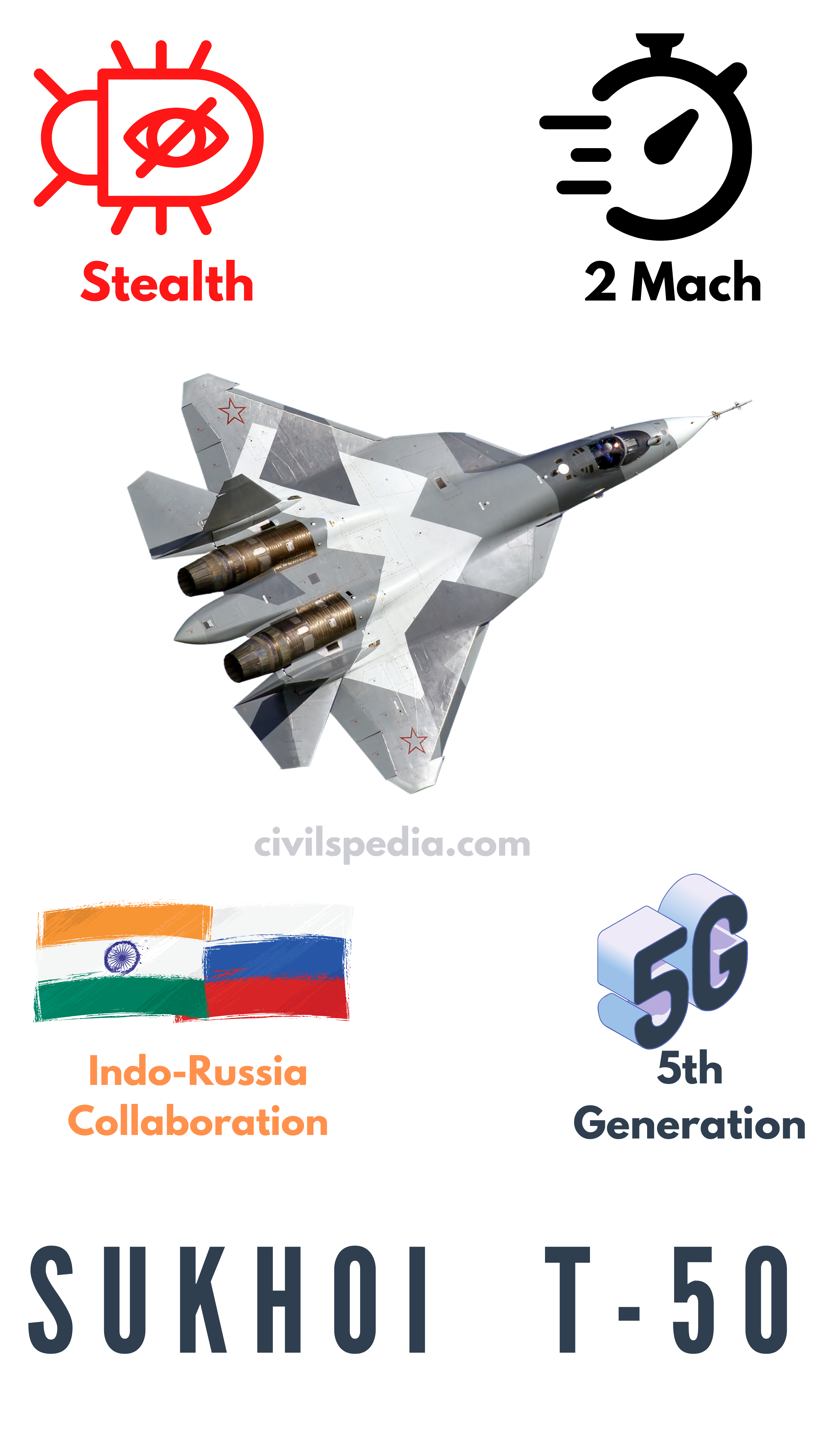
Sukhoi T-50, also known as FGFA (Fifth Generation Fighter Aircraft) in the Indo-Russian version, was conceived as a joint venture between Russia’s Sukhoi Design Bureau and India’s HAL to build a 5th-generation stealth fighter based on Russia’s PAK FA / Su-57 platform.
It will have the following characteristics
- Stealth design – radar-absorbing materials, special airframe shape, and concealed weapons bays.
- Thrust-vectoring engines for superior maneuverability.
- Crew: Single or twin-seat variants.
- Armament: 30 mm cannon + up to 16 weapon hardpoints (8 internal + 8 external).
- Maximum Speed: ~Mach 2.
- Fuel Capacity: ~10,300 kg for long-range missions.
- Advanced Avionics: Integrated sensors, 360° situational awareness, and data fusion.
But in 2018, India has conveyed its unwillingness to Russia to go ahead with this project due to the high costs involved. Russia continued development of its own version, now called Su-57, which entered limited service with the Russian Air Force.
5. Advanced Medium Combat Aircraft (AMCA)
- AMCA is India’s indigenous 5th Generation stealth multirole fighter aircraft, being developed by DRDO and HAL under the Aeronautical Development Agency (ADA).
- It is designed to replace older aircraft like the Jaguar, Mirage-2000, and MiG-29 in the coming decades.

Features of AMCA
- Stealth Design: Radar-absorbing materials and internal weapon bays to reduce radar visibility.
- Twin-engine and single-seat configuration.
- Multirole capability – air superiority, ground attack, electronic warfare, and reconnaissance.
- Maximum speed: Around Mach 2.0.
- Equipped with AESA radar, infrared search and track (IRST), and sensor fusion technology.
- Use of composite materials for lighter weight and durability.
- Supercruise capability – can fly at supersonic speed without using afterburners.
Current Status
- AMCA design finalized; prototype development expected in late 2020s.
- AMCA Mk-1 will use existing foreign engines (GE-F414), while Mk-2 is planned with an indigenous engineunder development.
Detail of Transport Aircrafts in news
1. C-17 Globemaster
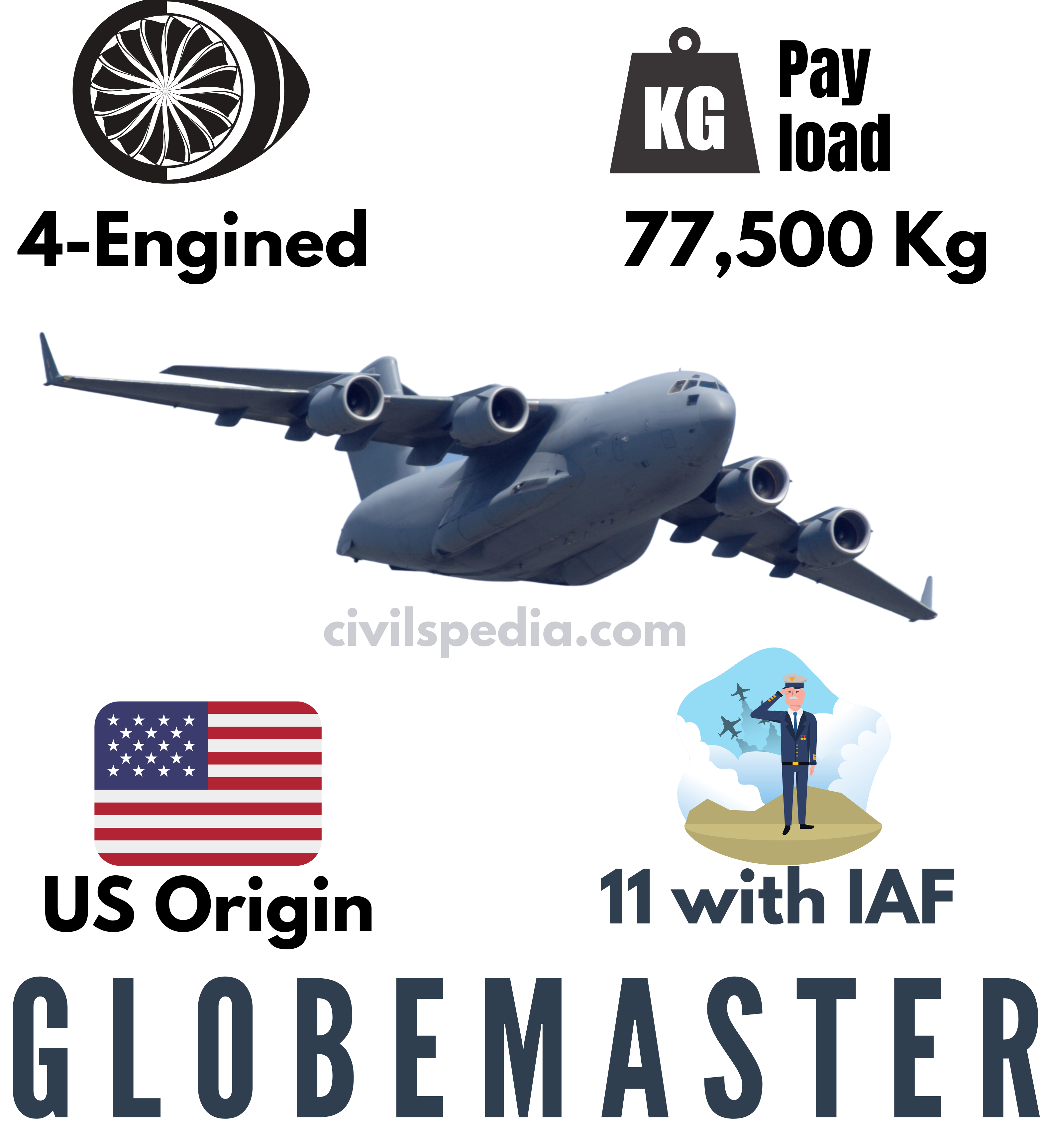
- It is a large military transport aircraft of US origin developed by Boeing.
- Indian Airforce has 11 Globemasters.
- It can be used for
- Transporting troops.
- Maintaining supplies and carrying equipment to small airfields in remote and harsh terrain (E.g., Ladakh)
- Its main features include
- Ability to take off from very high altitudes
- Land on paved as well as unpaved airfields during day and night.
2. Airbus C-295
In September 2021, India formalized a landmark defence deal to procure 56 Airbus C-295 tactical transport aircraft at a cost of ₹21,935 crore to modernize the Indian Air Force’s (IAF) transport fleet, replacing the ageing Avro aircraft that have been in service since the 1960s.
As part of the deal
- The first 16 aircraft will be built in Seville, Spain and delivered in fly-away condition.
- The remaining 40 aircraft will be manufactured in India, at a Final Assembly Line (FAL) in Vadodara, Gujarat, by Tata Advanced Systems Limited (TASL) in collaboration with Airbus Defence and Space.
- The first India-assembled aircraft is expected by 2026, and full delivery will be completed by 2031.
Aircraft Capabilities
- Troop and cargo transport (up to 9 tonnes or 71 troops)
- Maritime patrol, VIP transport, medevac, and airborne surveillance
- Air-to-air refuelling for both fixed-wing aircraft and helicopters
- Armed support and firefighting missions
- Powered by two Pratt & Whitney turboprop engines

Why is this Deal Significant?
- Operational Modernization: The C-295 will replace the outdated Avro HS748 fleet, greatly enhancing the IAF’s ability to carry troops, supplies, and equipment across India’s diverse geography.
- Strategic Industrial Development: This marks the first-ever ‘Make in India’ aerospace project in the private sector. For decades, only state-run HAL had license to manufacture defence aircraft.
Helicopters
Important Made in India Helicopters
1. Dhruv (Advanced Light Helicopter)
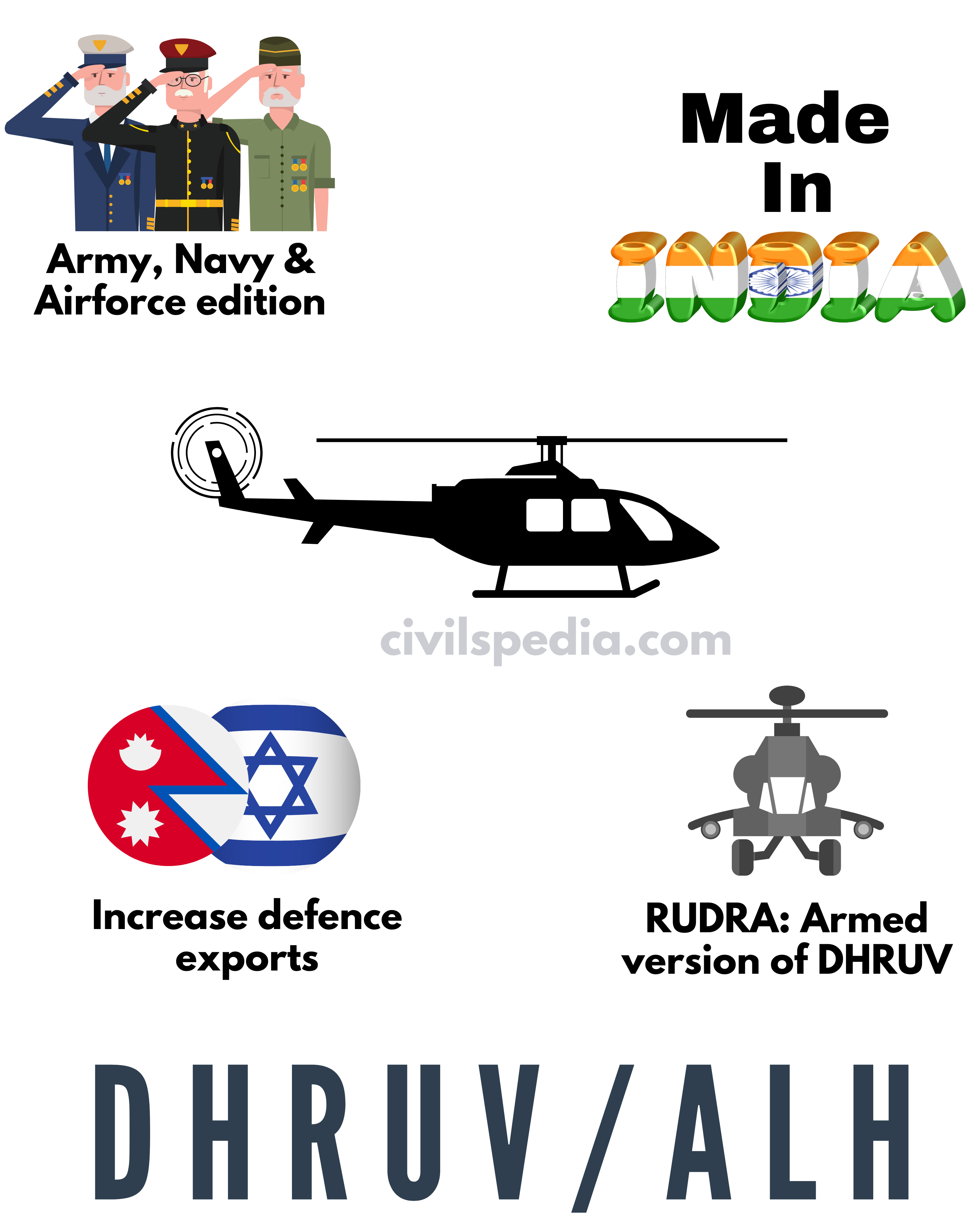
Dhruv features of this helicopter
- Dhruv was designed for the military as well as civilian purposes.
- It is manufactured by Hindustan Aeronautics Limited (HAL).
- It can play multiple roles: logistics, rescue and attack for Army, Navy, Airforce and Coast Guard.
- It’s armed version is called Rudra.
History
- The project was first announced in 1984 & was designed in assistance with MBB of Germany.
- First flew in 1992 but developments prolonged due to budget restrictions and various restrictions placed on India after Pokhran 2 in 1998.
- Entered into service in 2002.
- First exported to Nepal & Israel & is on order by several other countries.
2. Light Combat Helicopter Prachand
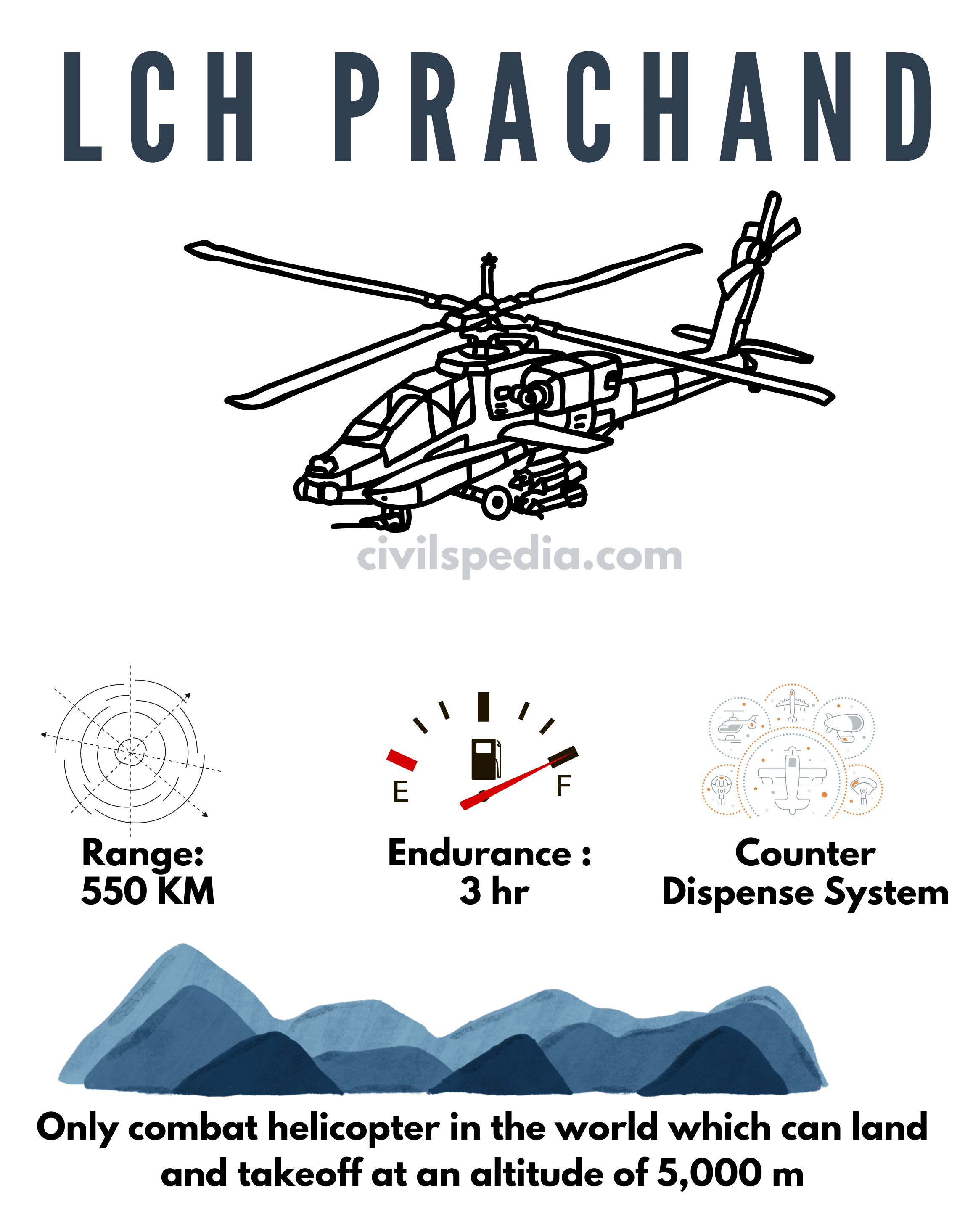
- LCH Prachand is indigenously developed by Hindustan Aeronautics Ltd.
- It is a multi-role combat helicopter. With this, India has become the seventh country to make attack helicopters.
- Features of LCH Prachand
- Range: 550 Km
- Endurance: 3 hours
- Maximum height at which it can fly: 6.5 Km
- It is the only combat helicopter in the world which can land and takeoff at an altitude of 5,000 m.
- Equipped with a ‘COUNTERMEASURE DISPENSE SYSTEM‘ to protect it from enemy radars and missiles.
3. Light Utility Helicopter (LUH)
- Manufactured by HAL
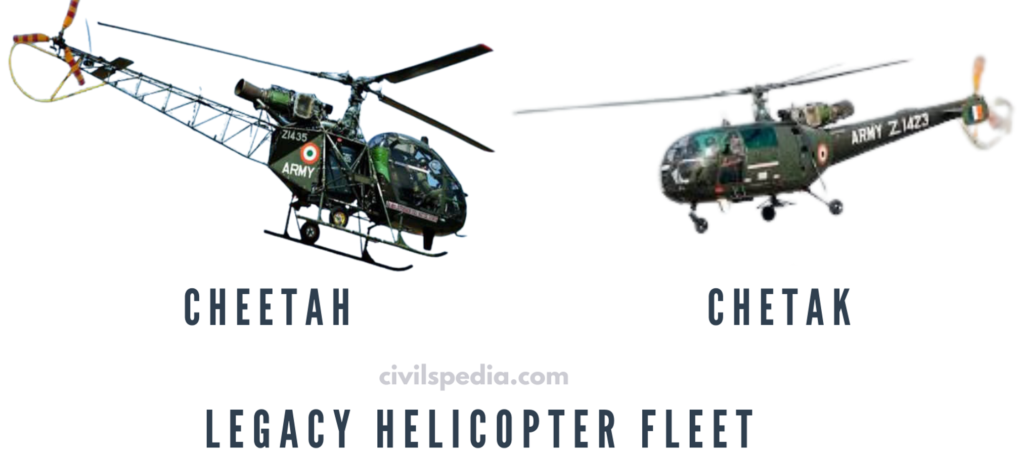
- It will replace ageing Cheetah and Chetak that have been the backbone of India’s light utility operations for decades.
- LUH completes India’s indigenous “3-helicopter family” — LCH (combat), ALH Dhruv (multi-role), and LUH (light utility)
- Features of LUH
- Role: Reconnaissance, Surveillance, Rescue, and Light Transport.
- Crew: 2 (pilot + co-pilot)
- Capacity: Can carry up to 6 passengers or 500–600 kg of payload.
- Engines: Single Shakti-1U turboshaft engine (co-developed with Safran, France).
- Range: ~350–400 km
- Service Ceiling: 6.5 km (can operate in Siachen & Himalayan terrain).
- Cruise Speed: ~235 km/h
- Avionics: Full glass cockpit with digital displays and advanced communication systems.
- Unique Feature: Can take off and land from extremely small or high-altitude helipads — ideal for operations in Siachen, Northeast, and border posts.
4. Legacy Helicopter Fleet- Cheetah and Chetak
HAL Cheetah
- Cheetah is a light utility helicopter used mainly for high-altitude operations like Siachen.
- It is small, agile, and can land where no other helicopter can — but it’s quite old now.
HAL Chetak
- Chetak is a light, multipurpose helicopter used for transport, training, and rescue.
- Based on the French Alouette design, it’s reliable but outdated
Foreign Helicopters bought by India
1. Chinook
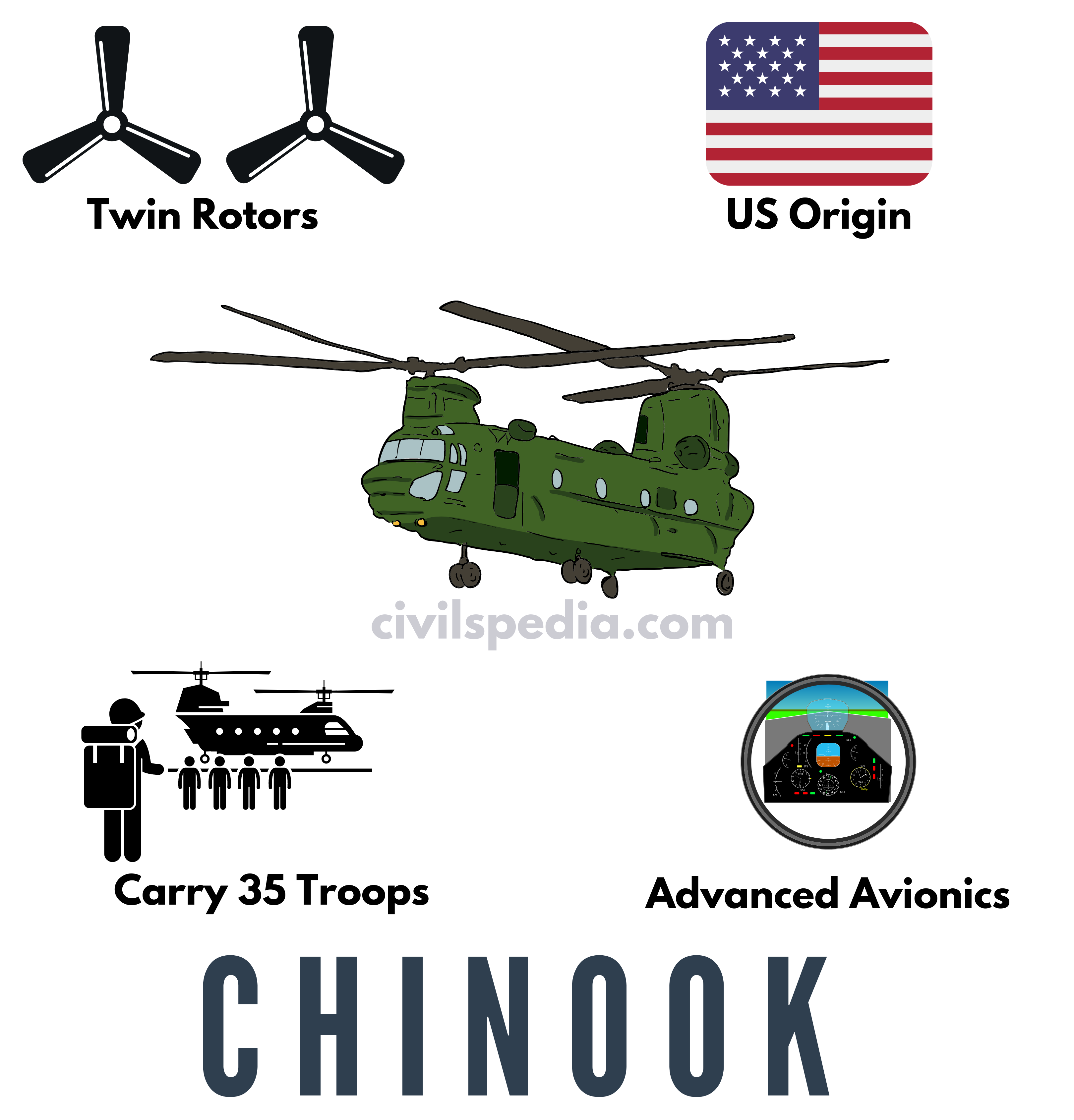
- Chinooks are the heavy-lift helicopters used by the US Army.
- India decided to buy 15 Chinook helicopters from the USA in 2016, and the first batch was delivered in 2019.
- Features of Chinook Helicopters
- Twin Engine with Tandem Rotor.
- Can carry up to 35 troops or 24 stretchers with 3 attendants or 10,500 kg payload.
- Advanced Avionics.
- Advanced M240 Machine Gun
2. Apache
- Apache is USA’s most advanced ‘attack helicopter’.
- India has bought 22 Apache Helicopters.
- Features of Apache Helicopters
- Twin Turboshaft Engines
- Armed with missiles like Hellfire, Spike and Stinger missiles
- Armed with advanced M230 Chain Guns
- Night vision systems
- Advanced avionics
3. Mi-17
- Mi-17 is a Russian origin transport helicopter manufactured by Kazan Helicopters.
- It is one of the most advanced transport helicopters equipped with advanced features such as
- Advanced self-defence system equipped with 23 mm cannon and heat-seeking missiles
- Twin-engine single rotor
- Highly sophisticated navigation and avionics system
- Maximum speed of 250 km/hr
- Range of 675 Km
- Payload capacity of 4,000Kg
- Capacity to transport up to 36 troops.
- It is used for the transportation of VVIPs, including PM and army chiefs.