
Last Update: Jan 2026 (Insurgency in Jammu and Kashmir)
Table of Contents
Insurgency in Jammu and Kashmir
This article deals with ‘ Insurgency in Jammu and Kashmir .’ This is part of our series on ‘Internal Security’, an important pillar of the GS-3 syllabus. For more articles, you can click here.
Introduction
The origin of the Jammu and Kashmir insurgency can be traced back to the partition of India when Pakistan attacked Kashmir to capture it. Since then, India and Pakistan have fought three wars over this.
Many terrorist organizations are active in Kashmir.
- JeM (Jaish-e-Mohammed): Formed by Masood Azhar with the stated objective of uniting Kashmir with Pakistan. JeM was behind various terrorist activities, including the attack on Jammu and Kashmir Legislative Assembly.
- HM (Hizbul Mujahideen)
- HuM (Harkat-ul-Mujahideen)
- LeT (Lashkar-e-Taiba)
- The Resistance Front (shadow organization of LeT)
- People’s Anti-Fascist Front (PAFF): A newer front group linked to Jaish-e-Mohammed that became active in the post-2023 phase of militancy
Reasons for Upsurge
The unrest in Kashmir is not a new incident. The Valley has been the victim of such violence for many years. It started in 1947 with the State’s accession to India but worsened at the end of the 1980s (1988) with the rise in the militant insurgency. Reasons are
- Geographical: The presence of an envious neighbour in the form of Pakistan, which incites the sentiments of the Kashmiri people.
- Historical Background: The demand for a plebiscite has been there since 1947, which the people feel is their legal right as per the instrument of accession. However, due to the actions of Pakistan and changed conditions since 1950, a plebiscite cannot be performed in the Valley. It has enraged generations of Kashmiri people.
- Economic reasons
- Unemployment is a significant reason for youth frustration. Tourism has been down due to the disturbed security situation.
- Kashmir has limited industries and enterprises. Due to harsh weather conditions, there are limited days of productive work.
- Mujahideen Infiltration: After the victory over the Soviet Union in Afghanistan, Mujahideen fighters, with the aid of Pakistan, slowly infiltrated Kashmir to spread a radical Islamist ideology.
- Political Reasons :
- Perceptions of the domination of politics in the State by one or two families (i.e. Abdullahs and Muftis)
- The immediate reason was the widely perceived rigging of state elections in 1987.
- Laws like AFSPA, regular curfews, presence of armed forces, allegations of human rights violations
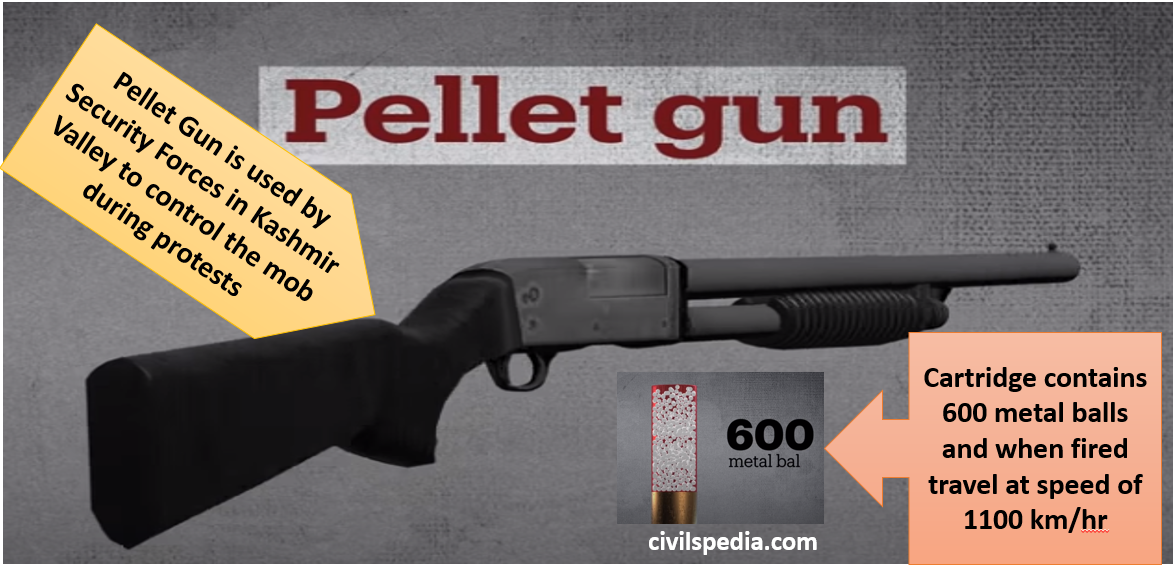
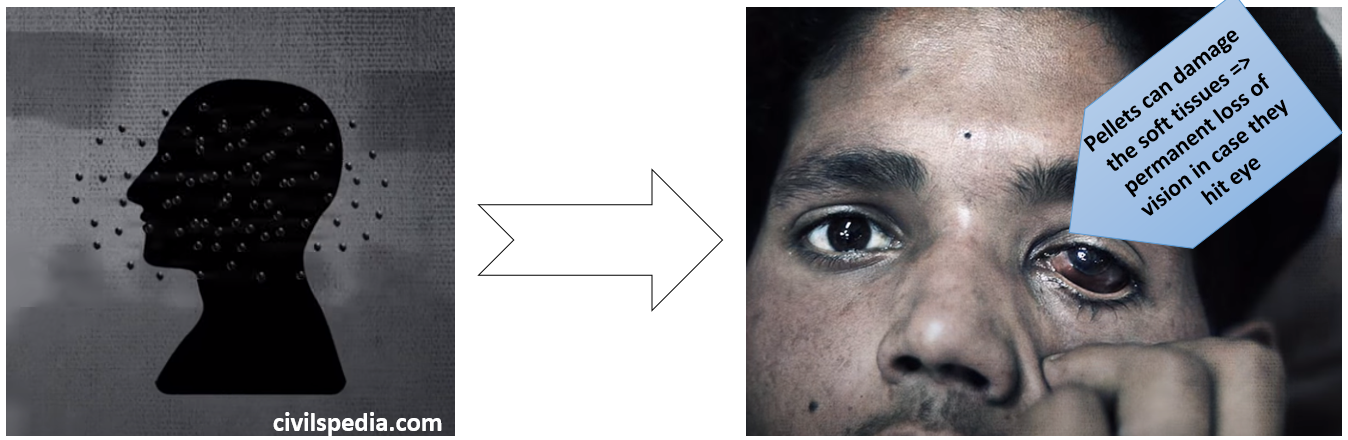
- Use of pellet guns on the protestors, including children.
- Weakening of Decentralization: History shows that Pakistan has tried to foster an anti-India jihad in Jammu and Kashmir since 1947 but without much success until the late 1980s. In the 1980s, they succeeded because, till that time, Article 370 of the Constitution had been rendered a dead letter.
- Social Cause/Wahhabization of Kashmiris: Increasing radicalization has choked the more tolerant Sufi tradition and introduced a new Wahhabi culture in the Valley.
- New Generation raised in troubled times: The present generation of Kashmir was raised during troubled times that started in the 1990s. Hence, they feel alienated from the political establishment.
- Social Media: The new generation having access to the internet has been radicalized by anti-India propaganda spread on the internet. Messaging apps such as Telegram and WhatsApp have helped the militants to mobilize the crowds and indulge them in stone-pelting incidents.
- Lone-Wolf Trend: Security agencies have observed a shift from large terror modules to small, tech-enabled cells and self-radicalised youth. Online propaganda, encrypted platforms and cross-border handlers now play a bigger role than physical training camps, making detection more difficult.
- “Doval Doctrine” which posits that under no circumstance should the State be seen as yielding, either tangibly or symbolically
Recent Developments
Resurgence of Cross-Border Terrorism (2024–25):
Despite a decline in mass protests after 2019, Pakistan-backed groups shifted strategy towards:
- Targeted killings of minorities and non-local workers
- Attack on the tourists (epitomised by Pahalgam Massacre)
- Attacks on security convoys and infrastructure projects
- Use of hybrid militants (locals with clean records)
Operation Sindoor (2025)
In response to a series of major terrorist attacks traced to Pakistan-based terror groups, India launched Operation Sindoor in 2025 as a calibrated military response against terror infrastructure across the border.
- The operation involved precision strikes on terrorist launch pads and training facilities in Pakistan and Pakistan-occupied Kashmir (PoK).
- It marked a shift from defensive counter-insurgency to offensive counter-terror deterrence.
- India justified the operation under the doctrine of pre-emptive self-defence against cross-border terrorism.
Side Topic: Over Ground Workers (OGWs)
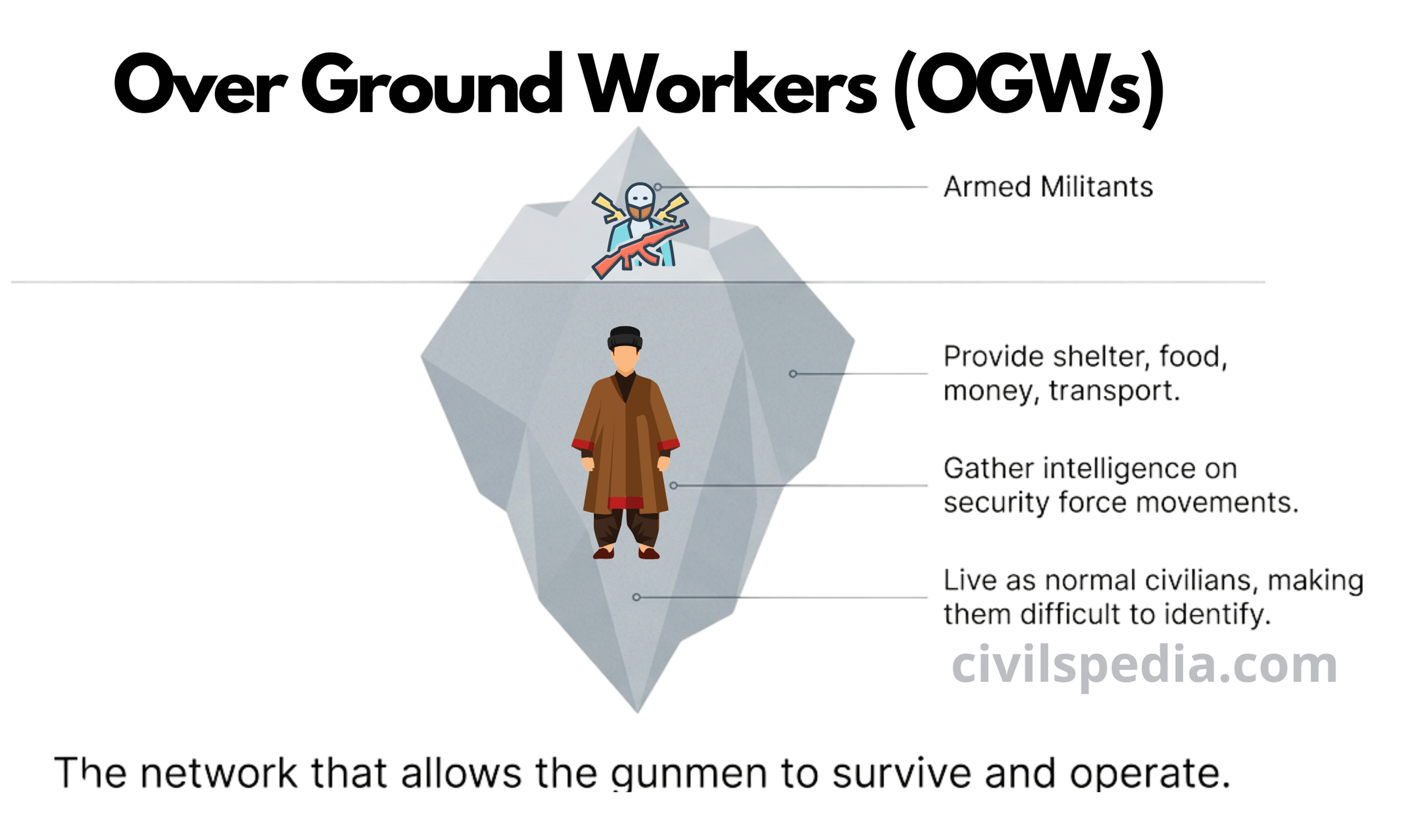
- In Kashmir, Over Ground Workers are ordinary local civilians who secretly help terrorists by providing shelter, food, money, transport and information, even though they do not directly take part in attacks.
- They form the hidden support system of militancy in the Valley, because without their help militants cannot survive, move safely or plan operations.
- OGWs are difficult to identify as they live like normal people within society, which has made terrorism in Kashmir more network-based than open warfare.
- Operations like Operation Sindoor targeted not only armed terrorists but also these local support networks, showing that defeating terrorism in Kashmir today means breaking the entire terror ecosystem, not just eliminating gunmen.
Ways to address the Problem
Multi-pronged approach consisting of Security, Development and Engagement (with all stakeholders is required). Although the government is looking after the first two, Engagement with Kashmiris is almost missing. As a result, the people of Kashmir feel alienated.

- Dialogue: Provide political healing touch to Kashmir using Prime Minister Atal Bihari Vajpayee’s Principles of “Kashmiriyat, Insaniyat, Jamhooriyat” (Kashmir-ness, humanity, democracy). Pursue dialogue with the separatists under the ambit of Insaniyat, which was supposed to be more accommodating than the Indian Constitution.
- Take comprehensive confidence-building measures.
- Development, especially economic development of the Valley in the field of Tourism, Timber industry, Saffron development, Fruits etc.
- Youth Engagement & Job Creation: Although the government is already running various schemes like Nai Manzil, USTAAD etc., only creating more jobs will help take youth away from radical elements.
- Tight security and proper border management to stop infiltration
- Stop the use of Pellet Guns: TVSN Prasad Committee report recommended the use of alternatives like PAVA (Pelargonic Acid Vanillyl Amide) Shells for crowd management instead of Pellet guns. PAVA Shell is chilli-based non-lethal ammunition which can temporarily immobilize and paralyze a victim.
- Take steps for Nation-Building: Kashmiri youth feels alienated and, for many reasons, don’t see themself as part of the Indian nation. Some instances like discrimination faced by Kashmiri youth in mainland India alienate them further. Government should take steps towards their integration.
- Control on Irresponsible Media: The situation has worsened due to the presence of social media, incitement by local media and irresponsible coverage by national media.
Steps taken
- Abolition of Article 370: To usher in peace and development, and pave the way for the closer integration of the Kashmir Valley with the rest of India.
- Infrastructure Development: The government has inaugurated various infrastructure development projects aimed at enhancing the security and economic development of Jammu and Kashmir. These include
- Sonmarg Tunnel: To ensure year-round connectivity to the tourist resort of Sonmarg
- Vande Bharat Train between Jammu and Srinagar
- Centre launched a new industrial scheme in 2021 promising incentives to attract investments. Proposed investments in J&K now total Rs 1.63 lakh crore, of which more than Rs 50,000 crore is in various stages of operationalisation.
- Operation Sindhoor: Explained above.
Previous Year Questions
- Winning of Hearts and Minds’ in terrorism-affected areas is an essential step in restoring the trust of the population. Discuss the measures adopted by the Government in this respect as part of the conflict resolution in Jammu and Kashmir. (UPSC CSE 2023)