
Last Updated: November 2025 (UAVs)
Table of Contents
UAVs
This article deals with the ‘UAVs.’ This is part of our series on ‘Science and Technology’ which is an important pillar of the GS-3 syllabus. For more articles, you can click here.
Introduction
- UAV is an aerial vehicle without a pilot on board.
- UAVs can be remote-controlled aircraft (e.g. flown by a pilot on the ground) or fly autonomously based on the program.
Applications of UAVs
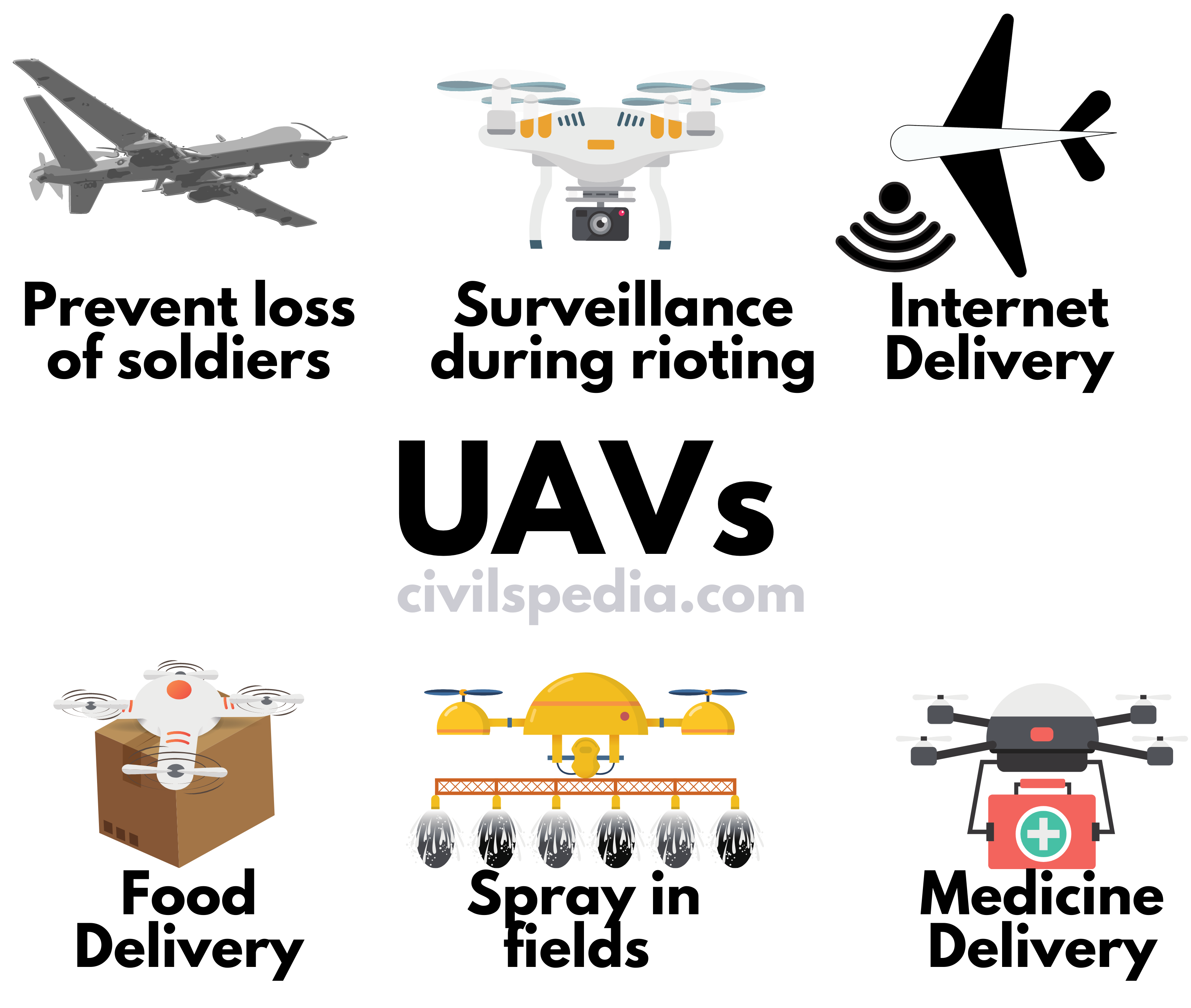
- UAVs can be remotely controlled. Therefore, it saves any loss of soldiers.
- In modern warfare, Armies use them in operations to have a view from above and coordinate the movement of Soldiers.
- Police are using them during rioting and monitoring people’s assembly during Strikes. E.g., Chandigarh Police
- Border Security: UAVs can be used for real-time surveillance of rugged terrain.
- Companies like Facebook plan to use it for internet delivery (Aquila).
- Logistics companies are using drones to deliver products. E.g., Zomato is working on a hybrid drone for food delivery. Earlier, Amazon too tested such drones.
- Healthcare: Drones can be used to improve the delivery of medicines. E.g., the Telangana government’s ‘Medicine from the Sky’ project, under which medicines (especially vaccines) are transported from district headquarters to PHCs using a drone named Marut.
- Agriculture: Drones have applications in agro-management, especially in spraying pesticides, crop nutrients, etc. In an experiment conducted in Brazil, the use of drones helped reduce the use of pesticides.
- Tool for ‘Psychological Warfare’: The constant presence of UAVs in conflict zones creates a sense of unease and helplessness among enemies, creating psychological pressure.
Challenges
- Regulatory Loopholes: There are policy and legal loopholes wrt the regulation of drones in India.
- Quality Control: Most of the drones are imported in India.
- Privacy Issues: Drones can collect images and data of common citizens, infringing their right to privacy.
- Use by Terrorists: These drones can be easily procured and used by terrorists for carrying out their nefarious activities. For example, drones are used to drop weapons and drugs along the Punjab border.
- Issue with Air Traffic Management: Drones can’t be detected by conventional radars and puts conventional air traffic in danger.
UAVs as a threat to National Security
Drones have changed the way wars are fought and have posed new challenges to security agencies.
Recent developments in this regard include
- In 2021, Azerbaijan defeated Armenia’s much more potent force using drones (notably Turkish Bayraktar TB2), which have completely changed the ways warfare is fought.
- During Operation Sindoor (2025), India extensively employed surveillance and tactical drones such as Heron-TP and SWITCH UAVs for real-time intelligence, target acquisition, and coordination of artillery strikes, demonstrating the growing integration of unmanned systems into India’s battlefield operations.
- During Operation Sindhu Sudarshan (2023), the Indian Army extensively deployed UAVs for real-time battlefield surveillance, precision targeting, and coordinating artillery fire — marking a doctrinal shift towards drone-centric warfare.
- Insurgents in North East India are using drones to drop explosives.
- In 2021, Kashmiri terrorists dropped IEDs over an Indian Airforce Base using UAVs.
- Pakistan use drones to smuggle drugs to India— BSF intercepted 100+ drone incursions in 2023 alone.
- Iran supported Shia Houthi rebels used drones to successfully attack Saudi Aramco oil infrastructure in 2019 and UAE refineries in 2022, bypassing modern defence systems.
- The US killed Iranian General Qasim Soleimani in a drone attack in 2020 in targeted drone strike, raising debates on international law and sovereignty.
Ways to Defend against Drone Attacks
The best way to defend is the installation of Anti-Drone systems. These includes
- Foreign Anti-Drone systems include
- Iron Dome (Israel)
- S-400 (Russia)
- DroneHunter (USA)
- SkyWall Patrol (UK) – Uses compressed air to launch a net to capture rogue drones mid-air.
- AUDS (Anti-UAV Defence System) – Used by NATO countries
- India is also making indigenous anti-drone systems. These include
- High Power Laser-based Directed Energy Weapon (DEW): India successfully tested its vehicle-mounted High Power Laser-based Directed Energy Weapon (DEW) MK-II(A) capable of destroying fixed-wing and swarm drones within a 3 km range, making India one of the few nations with such advanced counter-drone technology.
- D4 System (Drone, Detect, Deter and Destroy)
- It is an Indian Anti-Drone system developed by DRDO.
- It can detect, track and identify rogue drones within a 5 km range.
- It can jam micro drones (soft kill) and use a laser-based kill mechanism to destroy drones (hard kill)
- DRDO’s ‘Anti-Drone System” can neutralize drones in the range of 3 km and destroy using laser technology.
- Grene Robotics of Hyderabad has developed an Anti-Drone System named ‘Indrajaal‘.
- Naval Anti-Drone System (NADS): First indigenously developed comprehensive anti-drone system developed by DRDO. It has capabilities for both hard kill (attacking vital drone components) and soft kill (misguiding, signal jamming, etc.). It is installed on INS Vikramaditya, INS Viraat, and naval bases.
- Low-Level Light Weight Radars (LLLR): It is a 3-dimensional radar that can operate in all terrains (mountains, deserts, coasts, etc.) to detect all aerial targets within a 50km range.
- Drone Commandos: BSF has trained its soldiers with Drone Warfare and created specialised soldiers called Drone Commandos. Special school for drone warfare has been established at Tekanpur
- Israel’s SMASH 2000 Plus System: Being used by the Indian Navy, this system is installed mainly on assault rifles, providing a hard kill option.
Note: After Operation Sindhoor, the Indian Army is set to undergo a significant organizational overhaul that will include integrating Unmanned Aerial Vehicles (UAVs) and counter-UAV as standard weapon systems at the battalion level across most of its arms.
Drones of India
#1. Indian Drones
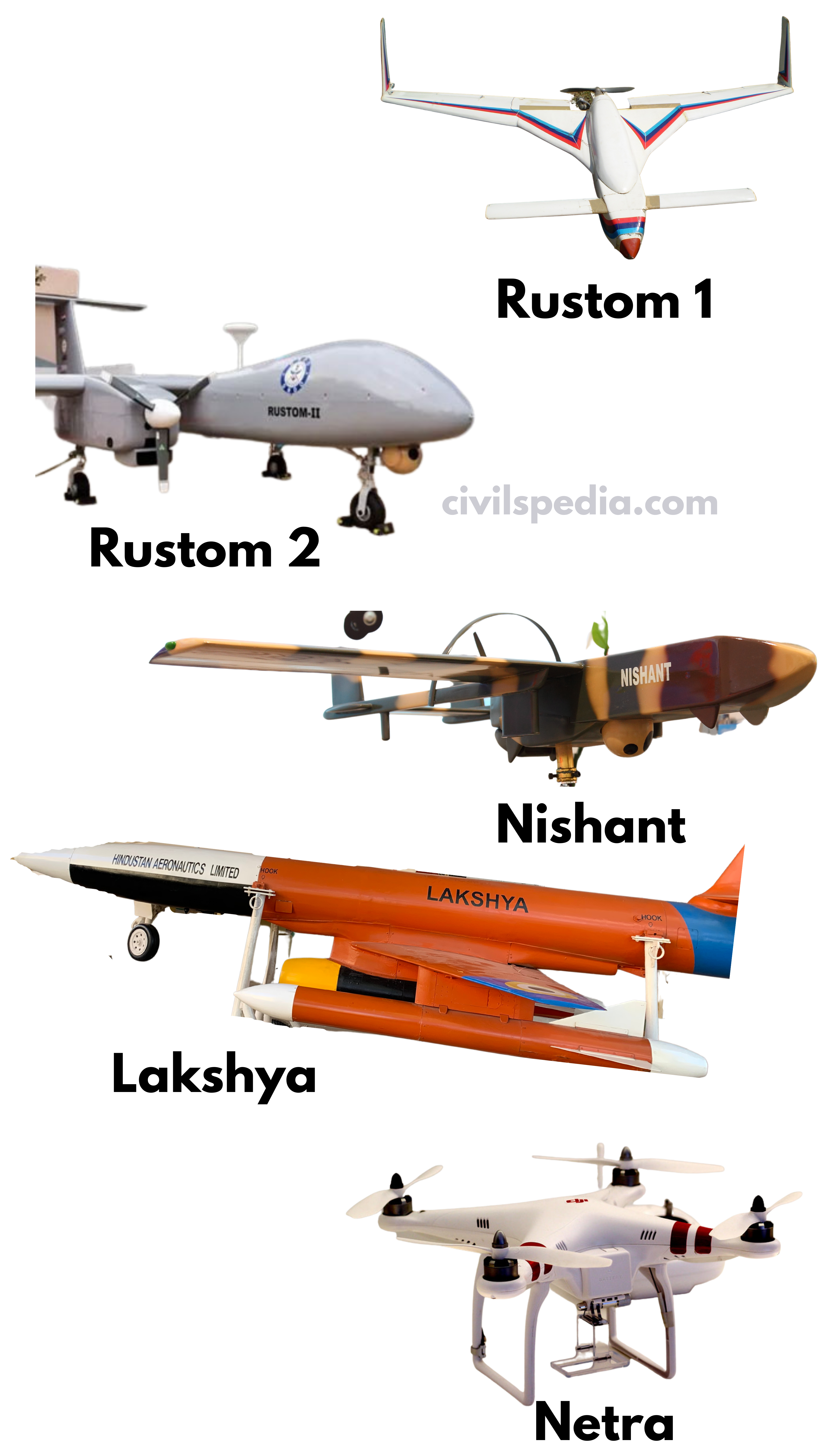
1.1. Rustom
- Rustom is developed by the Aeronautical Development Establishment (ADE) of Bangalore under DRDO.
- It comes in two versions – Rustom 1 and Rustom 2.
- Use: Intelligence, Surveillance and Reconnaissance (ISR)
Features of Rustom
| Rustom-1 | Rustom-2 | |
| Weight | 95 Kg | 350 Kg |
| Endurance | 12-15 hours | 24 hours |
| Range | 250 km | 250 km |
| Speed | 125-175 km/hr | 125-175 km/hr |
1.2 Nishant
- It is developed by the Aeronautical Development Establishment (ADE) of Bangalore under DRDO.
- Primary use: Intelligence gathering, surveillance, target designation and damage assessment.
- Features
- Endurance: 4 hours and 30 minutes.
- It has a range of 100 Km.
- It can reach up to a speed of 216 km/h.
- It is launched using a catapult and doesn’t need a runway.
- It has day and night flying capability.
1.3 Panchi
- It is the wheeled version of Nishant.
1.4 Lakshya-I
- Lakshya-1 is pilotless target aircraft.
- It is manufactured by HAL.
- Primary use: Used to perform discrete aerial reconnaissance of battlefield and target acquisition.
- Features
- Maximum Speed: 0.7 Mach
- Range: 150 km
- Its launch is rocket-assisted, while recovery is made using a two-stage parachute.
- Later, the Nirbhay missile was also made from its design.
1.5 NETRA
- It is a Mini-UAV.
- It is developed by DRDO.
- Its use includes following
- CRPF use it to fight Naxals.
- BSF in counter-insurgency.
- It has the following specifications
- Range of 4 to 5 km.
- Endurance of 40 to 60 minutes.
- It weighs around 6 kg.
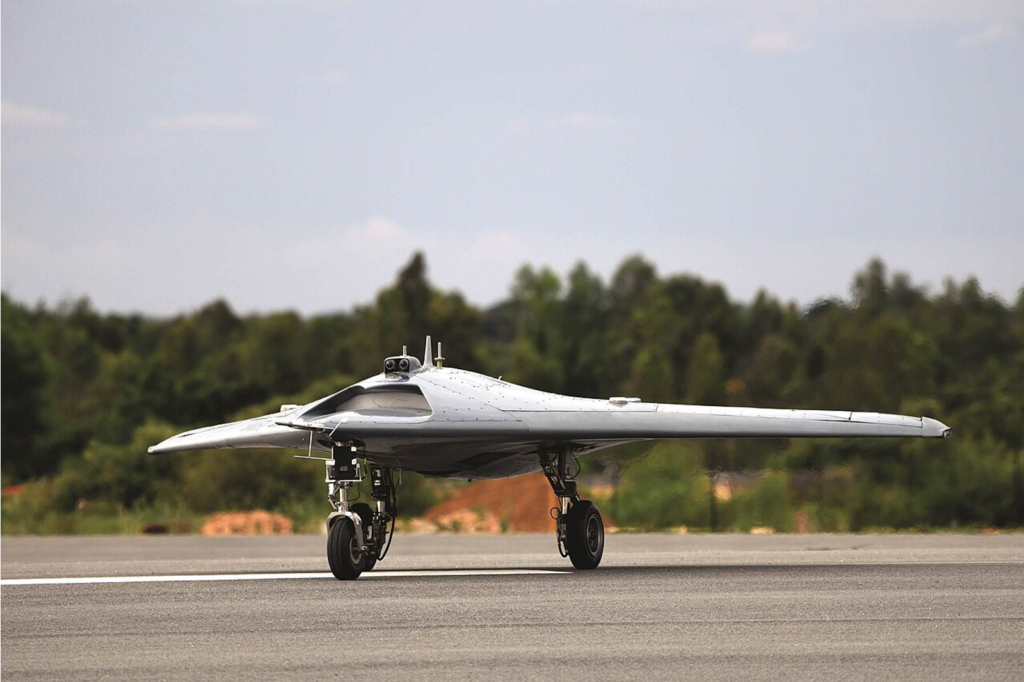
1.6 DRDO Ghatak (Under Development)
- Designed by the Aeronautical Development Establishment of DRDO.
- Role: Stealth UCAV (Unmanned Combat Aerial Vehicle)
- Expected to have stealth features and turbofan engine.
- It can carry missiles.
#2. Foreign UAVs bought by India
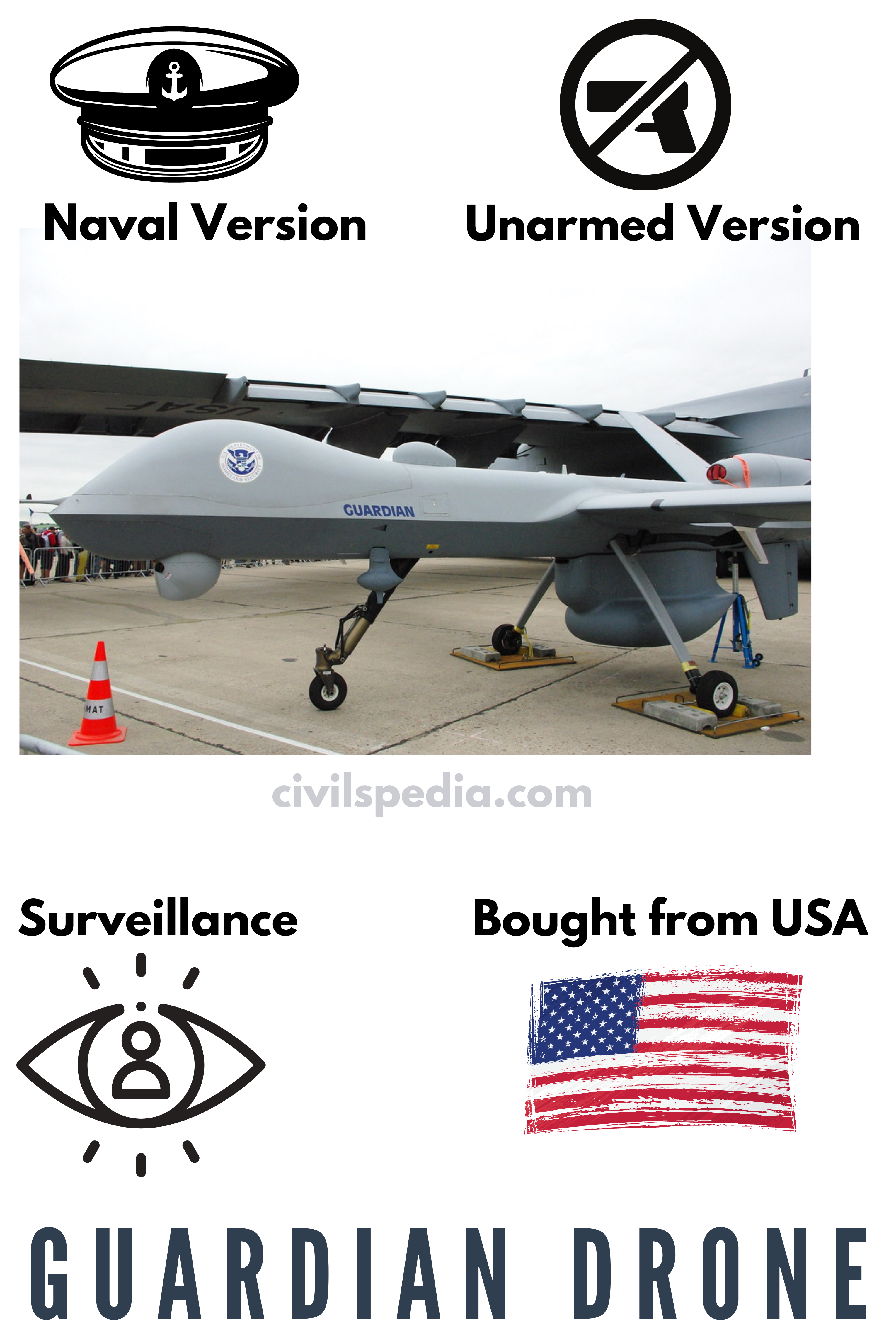
2.1 Guardian Drone
- India has bought Guardian Drones (naval & unarmed version of Predator UAVs) from the USA.
- It has provided enhanced Indian capabilities in maritime defence.
2.2 Predator Drones
In 2024, US has approved sale of 31 Predator drones to India.
Features
- Can carry lethal and non-lethal payloads (armed version of Guardian)
- Can fly continuously for 35 hours
- Can fly 2,000 miles without refuelling
- Can carry payload of 1,700 kg.
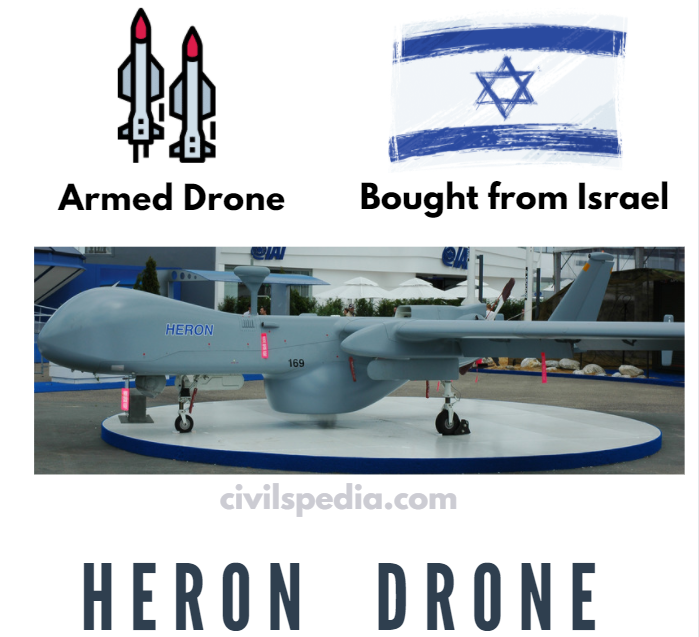
2.3 Heron TP
- It is an Israeli Armed UAV.
- India has bought this UAV.
- It is India’s first armed drone, significantly expanding the aerial offensive capabilities of the military.
2.4 Harpy and Harop
- These UAVs are bought from Israel.
Other Important International Drones
1. Bayraktar TB2 (Turkey)
- Famous for: Use in the Ukraine-Russia war, the Nagorno-Karabakh (between Armenia and Azerbaijan)conflict
- Role: Surveillance and precision strikes
- Known for: Changing warfare dynamics due to low cost & effectiveness
2. Predator (USA)
- Iconic US drones used in Afghanistan, Iraq, and anti-terror operations
3. Shahed-136 (Iran)
- Type: Kamikaze drone (Suicide Drones)
- Use: Extensively used by Russia in the Ukraine war
- Known for: Swarm attacks and psychological impact
4. CH Series (China) – CH-3, CH-4, CH-5
- Widely exported by China
- Competitor to the US MQ-1 Predator
- Used by Pakistan and several African countries
Initiatives regarding Drones in India
1. Drone Rules, 2021
- Guidelines by the Directorate General of Civil Aviation (DGCA) for the use of civil drones.
- Classifies airspace into Green, Yellow, and Red zones for operational ease and places restrictions on operating drones in certain areas (Red Zones (e.g. near military bases, borders, and airports).).
- Provides for the registration and licensing of drones and the training of operators.
- It follows the principle of No Permission – No Take-off (NPNT), and permission is required before every operation of a drone.
Drone (Amendment) Rules, 2022
- Removed the requirement of a Remote Pilot License for drones under 2 kg used for non-commercial purposes.
- Increased number of Green Zones (where no prior permission is required).
- Created a Digital Sky Platform for real-time tracking and registration.
- Banned the import of foreign drones (except for R&D, defence, and security), to promote domestic drone manufacturing.
2. Drone Shakti Scheme
- This scheme was launched in the Union Budget 2022-23.
- Its main aim is to
- Promote the use of drones in India, especially by supporting startups
- Encouraging a model called Drone-as-a-Service (DrAAS) – where people can hire drones like a service.
- NABARD (National Bank for Agriculture and Rural Development) will give financial help to farmers so they can use Kisan Drones in farming.
Kisan Drones
- Kisan Drones are a new type of drone developed specially for farmers.
- They are used to make farming smarter and easier, especially in:
- Monitoring crop health
- Precision farming (using data to improve productivity)
- Spraying fertilisers and pesticides safely and efficiently
3. Private Drone Startups
India is emerging as a drone hub with many startups like
- IdeaForge – India’s first drone IPO (2023), key supplier to Indian defence forces
- Garuda Aerospace – Supplied drones for agriculture and flood monitoring
- Throttle Aerospace – Works on cargo delivery drones
- BotLab Dynamics – Known for 1,000 drone light show during Beating Retreat Ceremony, 2022
Side Topic: Swarm Drones
- The Indian Army has inducted swarm drones
- Swarm drones are several UAVs operating in coordination. These are useful in combat operations for surveillance inputs and undertaking close reconnaissance.