Ethics in Private and Public Relationships

Last Updated: June 2023 (Ethics in Private and Public Relationships)

Ethics in Private and Public Relationships

This article deals with a topic titled ‘Ethics in Private and Public Relationships  .’ This is part of our series on ‘Ethics’. For more articles, you can click here.

Ethics in Private and Public Relationships

Ethics in Worklife

  • Every employer wants his employees to work efficiently, honestly and at their full capacity. It is a rightful expectation for an employer because he pays a salary to workers & in return, employees must also reciprocate. 
  • The employee must develop loyalty to the organization. Loyalty to the organization means an employee should always work in the organization’s interests over his self-interests. 
  • The organization should also look into the grievance redressal of the employees. Hence, a good organization must have a good grievance redressal mechanism. The grievance can be against salary, work conditions etc.
  • The employee must have a sense of responsibility. When a person is promoted, it means that the person’s responsibility has increased. But the irony of the situation is when a person is promoted, he only looks at the salary & authority and forgets responsibility. 
  • The arrogance of power should be guarded against. Whenever we rise in an organization, various powers and authorities are vested in us. Typically, people develop arrogance of power in this process. Hence, this is the one area that one should look into. 
  • Senior members should also display honesty and integrity because they are the torchbearers of the organization and act as role models for their juniors. 

Worklife also has some minor virtues, which include

  1. One should be cheerful.
  2. One should be polite. 
  3. One should be courteous. 
  4. One should be punctual. 

Ethics in Public Relationships

  • It refers to the moral principles that a person may follow when interacting with others and conducting business in their professional life.
  • Public life has to be in an ethical framework. When somebody enters public life, whether as MLA or MP, i.e. through the election system or as Civil Servant, i.e. through Selection System, he can’t say that they will conduct their life normally. There has to be some special ethics for such persons. Hence, a special ethical framework is prepared for the people in public life. They are supposed to be strictly guided by that ethical framework.

Principles in Public Relationships

  1. Selflessness: Holders of public office should act solely in the public interest. 
  2. Integrity: Holders of public office shouldn’t obligate themselves in any way, whether financially or otherwise, to outside individuals or organizations
  3. Objectivity: Public officials should take decisions based on merit
  4. Accountability: Holders of public office should be accountable for their actions taken by them.
  5. Openness: Holders of public office should be as open as possible
  6. Honesty: Holders of public office must declare any private interests relating to their public duties 
  7. Loyalty to the Organization 
  8. Spirit of Service
  9. Fairness & Justice  

But in previous years, moral erosion of public servants has been observed. Reasons for moral erosion are 

  • Lack of accountability and responsibility: If anything goes well, there is no shortage of people to claim that they are behind that. But if anything goes wrong, nobody is ready to take responsibility. 
  • Sacrificing ethics, values, integrity and spiritualism: These things are sacrificed in comparison to materialism & worldly success. 
  • Social Acceptance: Society as a whole has started to accept corrupt people.  
  • Failure on the part of family, schools, society and institutions to inculcate values
  • Mega Administration, slow methodology and decision-making delay: Each department and institution has grown vertically and horizontally. It has created confusion in the hierarchy leading to delays in decision-making. 
  • Soft Society, tolerant public opinion and politico-business-bureaucracy nexus: The public doesn’t resent wrongdoings. It gives decision-makers more liberty to commit such crimes in future.

Ethics in Private Relationships

  • It refers to the ethical principles that a person adheres to when dealing with other people and situations in daily life. It primarily involves relations with family & friends. 
  • They are informal in nature since they are built on emotional ties rather than any formal procedures that govern them.

Principles in Private Relationships

Although private ethics differ from person to person, some common principles are shared and accepted by society. For example –  

  1. Honesty: Being truthful and transparent in your personal relationships is important.
  2. Respect: Respecting the boundaries, beliefs, and opinions of others is essential in maintaining healthy relationships. 
  3. Fairness: Treating others with fairness is important. 
  4. Confidentiality: Maintaining confidentiality and privacy in personal relationships and not sharing personal information without their consent.
  5. Empathy: Demonstrating empathy and compassion towards others by listening to and understanding their concerns.
  6. Communication: Effective communication is essential in maintaining healthy relationships.
  7. Loyalty: Loyalty to the partner and family members is essential. 

Relation between Private Ethics & Public Ethics

  • The distinction between private and public ethics is dubious because, in public and private lives, a person lives by the same ethical values in general. Moreover, no sharp line can be drawn between where private life starts, and public life ends for a Civil Servant. The very philosophy of Civil Service says that when a person becomes Civil Servant, he loses his individuality and becomes part of larger order.  
  • Furthermore, one cannot expect someone who lacks moral character in public life to be ethical in their private life and vice versa. How a civil servant treats women in his family is reflected in how he handles female co-workers.
  • There should be no conflict between personal and professional ethics as it may lead to frustration, guilt, confusion & dissonance in the mind of some persons.
  • But at the same time, Ethics in public life places a greater responsibility & a person cannot always follow his personal ethics. For example, personally, one may feel abortion is morally wrong, but as a doctor, he needs to do an abortion according to professional ethics. When performing a role in public, one must separate his personal life and strictly follow a professional code of conduct.
  • A person’s private life can act as a motivating factor but many times can be depressing. The environment from which a person comes to the office daily certainly influences his behaviour for the rest of the day. 
  • His personal affiliations, the ideology of his family and his convictions can stop him from taking rational decisions 

How to ensure that both lives remain separate

  • Take decisions rationally and objectively based on facts and merits only. 
  • Go by the code of conduct when faced with dilemmas.
  • Be impartial always and ensure that your actions aren’t only impartial but look to be impartial too.
  • When with family, spend quality time with them and don’t bring your office between you and them. Make them feel that you are not ignoring them, so they are helpful when you are in important public concerns and do not bother you. 
Temple Architecture

Temple Architecture

This article deals with the topic titled ‘Temple Architecture .’ This is part of our series on ‘Culture’. For more articles, you can click here

Introduction

  • Earlier Hindu temples were rock cut temples . When construction of stupas started , construction of free standing hindu temples also started
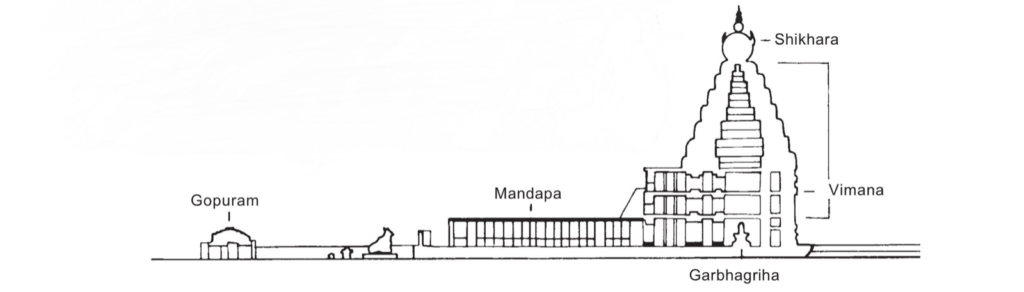
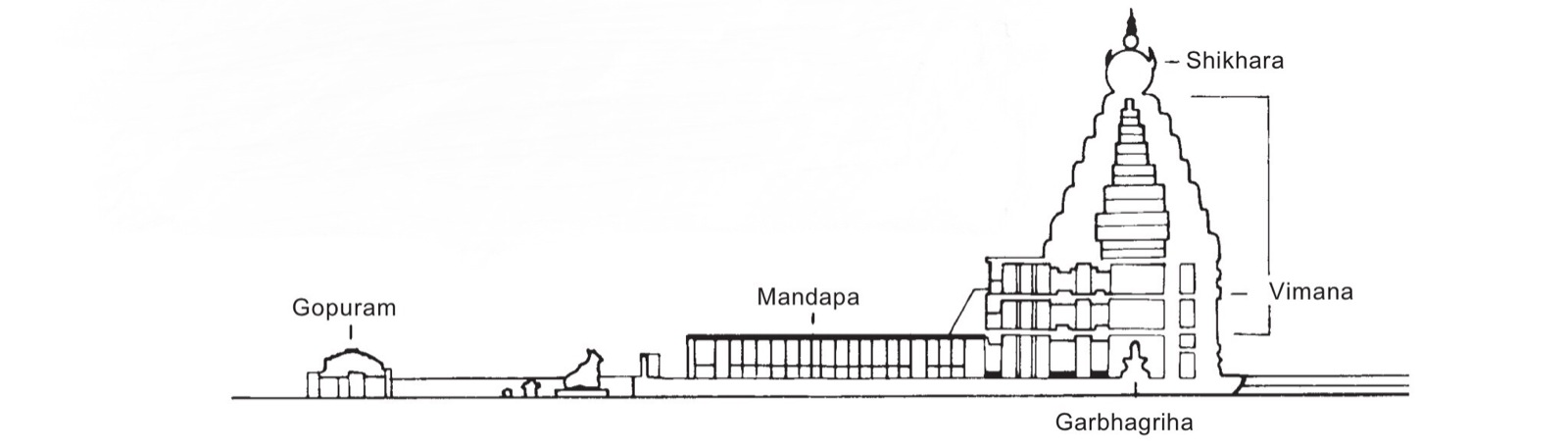
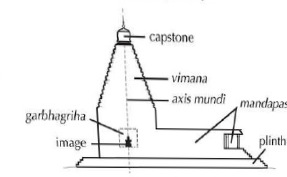
  • Basic structure of Hindu temple – Consist of following four parts
Garbhagriha – Garbhagriha literally ‘womb-house’
– Main icon of the presiding deity of temple was placed in it.
– It was a small cubicle with a single entrance in Early Temple . Later, it grew into a larger chamber  
Mandapa Entrance to the temple which may be a portico or colonnaded hall   
Shikhara /Vimana – From the 5th century CE onwards, freestanding temples started to have a mountain- like spire. They are of two types
1. Curving Shikhar in North India
2. Pyramidal tower, called a Vimana, in South India
Vahana – Mount or vehicle of the temple’s main deity
It is placed axially before the sanctum (like Nandi Bull in Brihadeshwar Temple)

And the entry of temples was East-facing


Different styles of Temples

Nagara Style Tower is SHIKHRA : shaped like beehive & made up of layer upon layer (curvilinear)
Dravida style Tower is VIMANA :  progressively smaller storeys of pavillions
Vesara style Has both Nagara & Dravida components

Images in Temples

  • Every region and period produced its own distinct style of images with its regional variations in iconography. The temple is covered with elaborate sculpture and ornament that form a fundamental part of its conception.
  • The placement of an image in a temple is carefully planned: for instance,
    • river goddesses (Ganga and Yamuna) are usually found at the entrance of a garbhagriha in a Nagara temple,
    • dvarapalas (doorkeepers) are usually found on the gateways or gopurams of Dravida temples, similarly, mithunas (erotic images), navagrahas (the nine auspicious planets) and yakshas are also placed at entrances to guard them.
  • Various forms or aspects of the main divinity are to be found on the outer walls of the sanctum.
  • Subsidiary shrines around the main temple are dedicated to the family or incarnations of the main deity.

1 . Nagara School of Architecture

  • Became popular in North India  & central parts (except Peninsular India).
  • The entire temple built on a stone platform with steps leading up to it.
  • Unlike in South India, it does not usually have elaborate boundary walls or gateways.
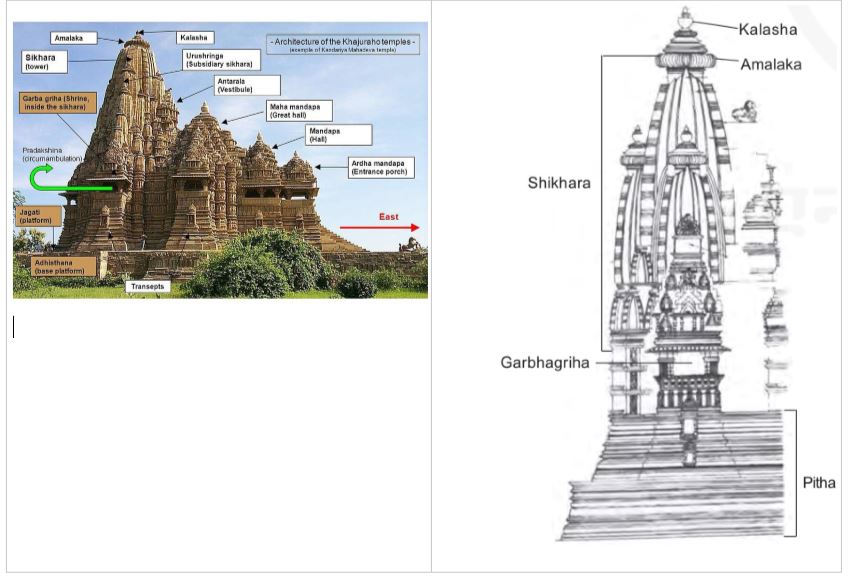
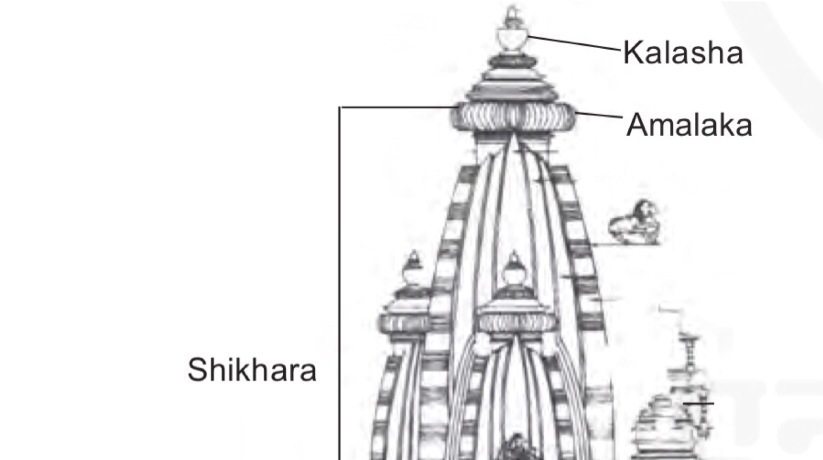
  • Tower (sikhara) gradually curves inward and  is capped by a spheroid slab with ribs round the edge (Amalaka) ending with Kalasha  give the elevation. This Shikhar was representation of Hill especially Mt Meru .
  • Earliest temples had just one tower, or shikhara, later temples had several. The garbhagriha is always located directly under the tallest tower.
  • Absence of tank in temple (unlike Dravida Style).
  • Raised but no outer wall (southern temples have wall around them)
  • Plan maybe square or rectangular.
Nagara Architecture
Nagara School

3 sub-schools were gradually developed under Nagara Style

  1. Odisha School/ Kalinga School (some consider this as a separate school while others as sub-school of Nagara)
  2. Khajuraho School
  3. Solanki School

and many other minor sub-schools like that which developed in Hills, Assam, Bengal etc.

1.1 Kalinga  School of Architecture

Main features

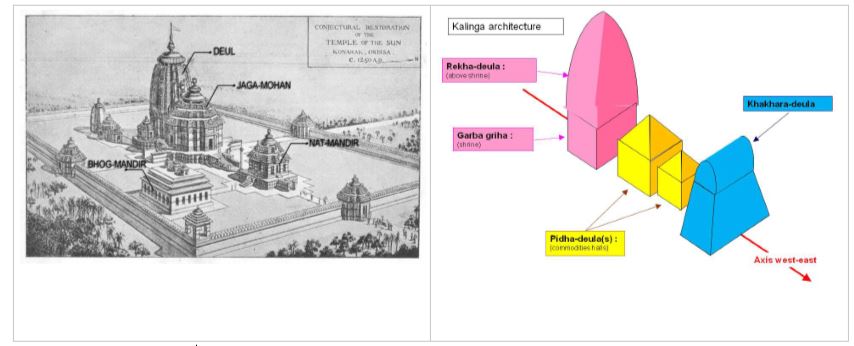
  • Two main parts
Deul Main Building with Tower
Jagmohan Hall

Both are lavishly sculpted with architectural motifs & figures

  • Deula means shrine in odiya &  there are three  types
Rekha Deula – Tall building + different parts in it are in line(rekha= line)
Eg : Lingaraj Temple
Pidha Deula Square building with pyramid shaped roof
– Mainly Jagmohan of temple are made like this.
Khakra Deula Rectangular building with truncated pyramid shaped roof like gopuras
– Closely resemble with Dravidian Gopuram  style
– Temple of feminine  deities are made like this .
– Eg Gauri temple in Bhubaneswar & Baitala deula in Bhubneshwar dedicated to Chamunda
  • Mostly plan of temple is square except Khakhra Deula where it is Rectangular
  • They have outer boundary
  • Characterised by Kalash
Kalasha 
Amalaka 
Shikhara

Main temples

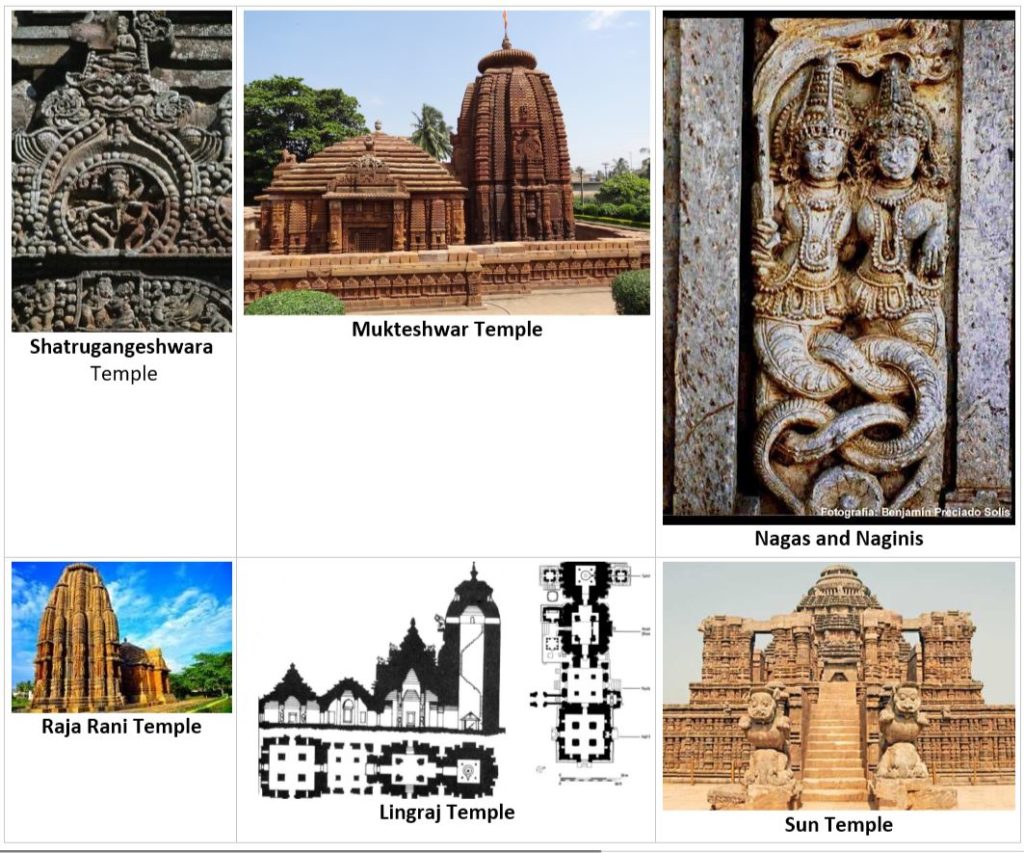
Shatrugangeshwara temple Oldest surviving structural temple in Odisha
– Dedicated to Pashupata sect of  Shivaism
– Noted for Bho feature (=temple feature that consist of Chaitya Arch with Kirtimukha above )
   
Mukteshwar Temple, Bhubneshwar – Built in 10th century
– Represent full development of Kalinga architecture
– Small with deula less than 35 feet ( will keep on getting higher in gradual phases)
– Structure is profusely carved Nagas & naginis can be seen with their long serpent tails (favourite theme of Odiya sculpture )
 
Rajarani temple, Bhubneshwar – Built around 1000AD
Unique as this temple led to  development of architecture of other temples especially at Khajuraho 
– Called love temple because of erotic carving of maidens & mithuns
– Jagmohan has pidha roof & deul has many clusters of tower built around it
– Entrance of jagmohan has nagas & naginis and Yaksha & Yakshinis
   
Lingaraj Temple, Bhubneshwar – Built in 12th century
– It represents zenith and deula is 150feet high + balance & proportion of various parts is perfect
Originally presiding deity of Temple was Linga (aniconic form of shiva) & was built by Somavanshi dynasty but when Vaishnavite Ganga Dynasty came, they remodelled it & present deity is Harihara (Hari=Vishnu& Hara=Shiv)
– Built in Rekha Deula style with all components in line ( ie vimana+ Jagmoham+Natamandira(festival hall)+ Bhogamandapa(offering hall) )
   
Sun Temple,Konark – Made in 13th Century
– Also called Black  Pagoda
World heritage site
– Built  by Narsimhadeva I of Ganga dynasty.
– Very special design . Deul & Jagmohan was designed to be Chariot of Sun & has 24 wheels& 7 horses in front
Main High Deul behind Pidha Deula is already broken now . Earlier it was present. Hence, it is very much similar to other Temples of Kalinga School
– Three types rocks used ie Chlorite+Laterite + Khondalite(all transported here by rafts on water)
Kalinga Architecture

1.2 Solanki School of Architecture

  • Sub-type of Nagara School of Architecture but has certain regional features too. Prominent among regional features was use of white marble because that was easily available in Rajasthan.
  • In Gujarat & bordering districts of Rajasthan
  • Solankis were Branch of Chalukya  Rulers (10th to 14th Century)

Features

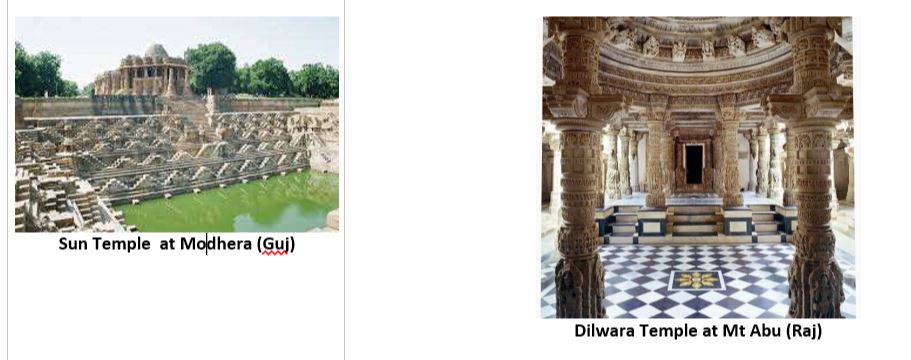
  • Massive rectangular stepped tank . On steps there are small temples
  • Influence of the woodcarving tradition of Gujarat is evident in the lavish carving and sculpture work.
  • However,the walls of the central small shrine are devoid of carving and are left plain as the temple faces the east and, each year, at the time of the equinoxes, the sun shines directly into this central shrine
  • Most of these temples are dedicated to Jain Tirthankaras  . Hence, erotism is missing in this school.
  • Eg : Vemela Temple at Mount Abu (11Century) , Somnath Temple in Kathiawar (12th Century)

Examples of temples

1.2.1 Dilwara Temple at Mt Abu (Raj)

  • Five legendary marble temples of Dilwara
  • Sacred pilgrimage place of the Jains.
  • Marble temples have an opulent entrance-way but simplicity in architecture reflecting Jain values like honesty and frugality. 
  • These Jain temples were patronized by two Generals of Chalukyas ie Vastupal & Tejpal

1.2.2 Sun Temple  at Modhera (Guj)

  • Dedicated to Sun God
Solanki School of Architecture

1.3 Khajuraho School of Architecture

  • Subtype of Nagara School
  • Ancient time=  Kings didn’t  directly patronised any temple building
  • Medieval times= Kings started directly building temples to commemorate victory or fulfil order of  deity 
  • Bhundelkhand/Jejabhukti has long history of temple building with Barhut stupa & temples at Deogarh . In Medieval India , two dynasties ruled here –Chandelas & Kalachuris & both were constantly in touch either as friends or foes
  • In 10th & 12th century, there was peace in this region. Hence, art & culture flourished here

Main features

  • Standard type of Khajuraho temple has a shrine room, an assembly hall, and an entrance portico. These entities were treated as a whole, whereas in the Odishan style they were concieved as separate elements joined by vestibules.
  • Shikhara is curved for its whole length, and miniature sikharas emerge from the central tower. The halls and porticos of the temple are also crowned with smaller towers which rise progressively to lead the eye upto the main tower, and give the impression of a mountain range.
  • Both interior & exterior walls were lavishly decorated . Sculptures were based on erotic themes of Kamasutra
  • Most of them follow Panchyatana Style (note – Dashavatara Temple in Deogarh is nearby)

Why so many temples at same place?

  • Almost all temples are strikingly homogeneous & built over small time
  • Speaks of dynasty’s desire to create grand center of worship & learning at Khajuraho

Erotic element

  • Khajuraho’s temples are also known for their extensive erotic sculptures
    • Erotic expression is given equal importance in human experience as spiritual pursuit, and it is seen as part of a larger cosmic whole. Sex was not seen as taboo but as part and parcel of life  in that age
    • These brahmanical religions were trying to survive in that age & avoid people from adopting Brahmacharya and Shrmana traditions. If whole society would have become monk by giving up peasures of life, it would have brought end to the social structure. Hence, kings were very much concerned to bring people back to fold of life (we can observe that such eroticism was absent in Buddhist & Jaina monastries because they wanted people to give up everything and become monk in search of truth)

It is also worth noting that only 10% of the carvings contain sexual themes and rest depict every day life of common persons

Main temples

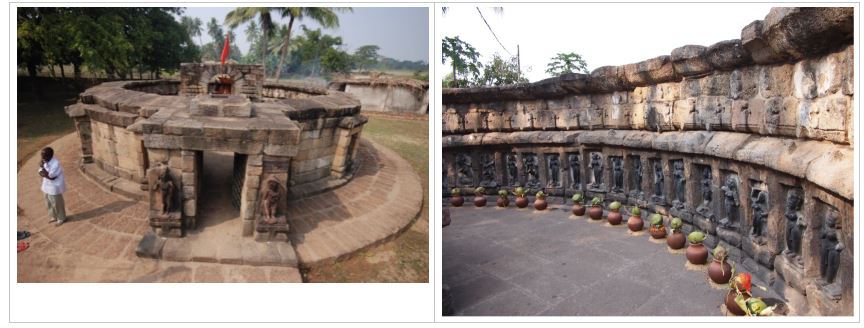
1 . Chausath (64) Yogini temple

  • Built by Harshvardhana(not Chandelas) & first temple to be built here in Khajuraho
  • Dedicated to Goddess Durga & she is attended by 64 yoginis 
  • Associated with the rise of Tantric worship
  • Lava stone used & plundered by Muslim invaders

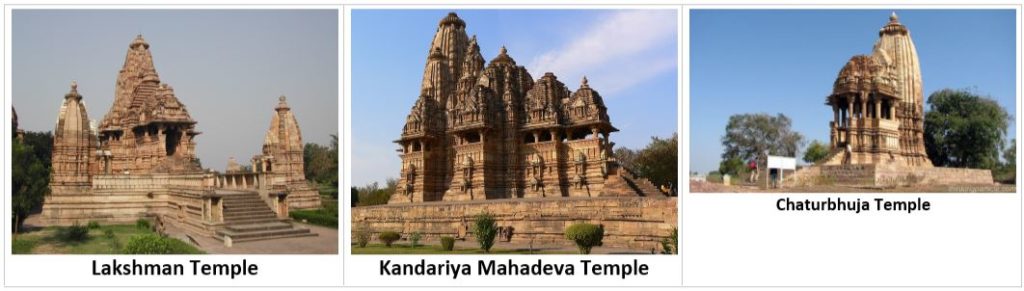
2. Lakshman Temple

  • Dedicated to Vishnu Chaturmurti & Built by Dhanga in 930 to 950
  • Grandest of all.
  • Panchayatan style
  • Apsaras & Nayikas have won universal admiration for their grace & charm

3. Kandariya Mahadev Temple

  • Largest & most ornate temple of Khajuraho
  • 1017 to 1029 AD & dedicated to Shiva
  • Towering Shikara (which is almost 100feet high) & its subsidiary replicas present grand analogy to Mt.Kailasha(shivas abode)
  • Panchayatana style & layout similar to Kalinga 

4. Chaturbhuja Temple

  • Situated 5 kms from Khajuraho
  • Modest platform with mandapa & paridakhshinapatha & has only sanctum
  • In this temple, Lord Vishnu is depicted like earlier statues of Buddha
Khajuraho School of Architecture

1.4 Other Schools in Nagara Style

1.4.1 Ahom Style

  • Ahom Style developed in and around Guwahati.
  • Kamakhya temple, a Shakti Peeth, is dedicated to Goddess Kamakhya and was built in the seventeenth century is good example of this architecture
  • Main characters
    • Main material used is terracotta
    • Shikhara has influence of buddhist Pagoda in them
    • Roofs adapted for heavy rainfall

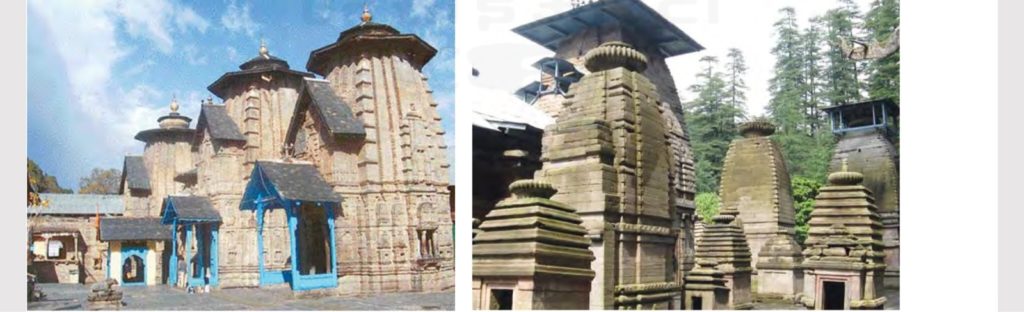
1.4.2 Hilly Areas

  • Brahmin pundits and Buddhist monks frequently travelled there and as a result, Buddhist and Hindu traditions began to intermingle and spread in the hills.
  • The hills also had their own tradition of wooden buildings with pitched roofs. At several places in the hills, therefore, you will find that while the main garbhagriha and shikhara are made in Nagara style but mandapa is of an older form of wooden architecture. Sometimes, the temple itself takes on a pagoda shape.


2. Vesara Style /Chalukya Style

  • Developed under the patronage of Chalukya dynasty during 7-8th Century CE  around Aihole, Badami & Pattadakal .
  • Vesara /Hybrid/Karnataka Style  of Temple architecture combines the Nagara & Dravida styles .
  • In this , both styles competed with each other for influence to make new type in each temple but at the same time,  none overpowers other . In every temple, level of influence of both schools is in different proportion . Hence, each temple is unique in itself as far as architecture is concerned.
  • Found in Deccan region
  • Attained its ripest expression under the Hoysalas of Dwarasamudra (Halebid) . During Hoysala Period star shaped plans were executed on platforms.
  • Time Period – 8th to 14th Century
  • Stones were perfectly joined without the use of mortar
  • Several cave temples related to Jains , Buddhists & Hinduism were constructed
  • Vesara Style passed through three  phases
    • First Phase at Aihole and Badami by Chalukyas
    • Second phase at Pattadkal
    • Third Phase under Western Chalukyas & Hoysala Dynasty

2.1 1st Period- Famous Temples

Temples at Aihole

Aihole is often called City of Temples

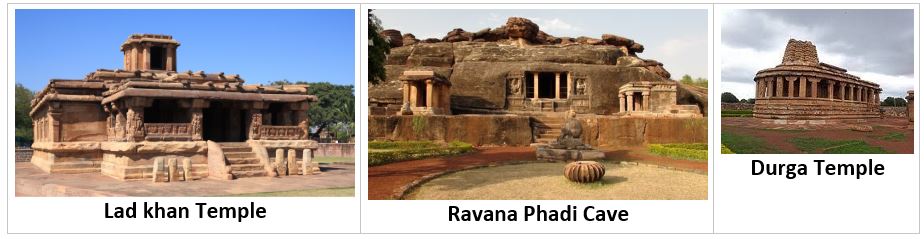
Ladkhan temple, Aihole – Earliest temple built in 5th century
– Not knowing how to built a temple, mason made it in Panchayat hall kind of design with large hall & 12 pillars
– It has inclined roof to allow water runoff & is imitation of wooden frame structure 
– Dedicated to Durga & Shiva linga also present
– Lad khan is the name of Muslim Prince who later converted this into his residence   
   
Ravana Phadi Cave – In Aihole & built around 550 AD
– Dedicated to Shiva Earliest rock cut temple in Aihole (later 70 more built )
 
Durga Temple – Dated to 6th Century CE & Influenced by Buddhist Chaitya style
– Not dedicated to Durga but Durga word denote FORT. It was in vicinity of fort and hence called Durga Temple .
– Dedicated to Vishnu
– Standing on high platform with Shikhara which is broken now  .
– It is the most elaborately decorated temple in Aihole.        
Hacimali Gudi Similar to Durga Temple but smaller than that
Meguti Temple Unfinished Jain temple
Temples at Aihole

Temples at Badami

  • Built by carving red sandstone cliffs present there
  • Total of 4 temples present there
    • 3 Brahmanical Temples
    • 1 Jain Temple

2.2 2nd Phase – Pattadakal

Due to frequent raids by Pallavas as a result of ongoing feud, Chalukyan capital was shifted to Pattadakal from Aihole.

  • 10 temples are present here out of which  4 are in predominantly Nagara Style and 6 in predominantly Dravidian Style
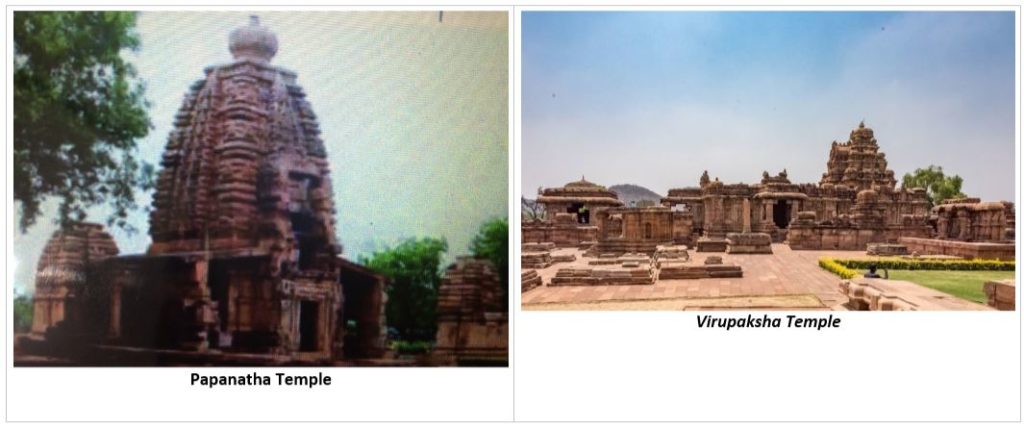
Papanatha Temple – Started in Nagara Style but later changed to more balanced Dravidian Style
– Sculptures speak of scenes of Mahabharata & Ramayana
– This temple has many similarities with Navabrahma temples in Alampur built by same dynasty
 
Virupaksha Temple – Dravidian Style Built by Queen Lokamahadevi in 745 AD to commemorate her husband’s victory (Vikramaditya II) over Pallavas of Kanchi . It resembles the Kailashnatha temple in Kanchi (made what victors saw there)
– Rich in sculptures like those of Lingobhava , Nataraja , Ravanugraha & Ugranarsimha
– Has wonderful Nandi porch in front  
Sangameshwar Temple Dravidian Style

2.3 3rd Phase – Western Chalukyas and Hoysalas

2.3.1 Western Chalukyas

  • Their buildings are wide spread unlike earlier Chalukyas of Badami
  • Mixture of both Nagara & Dravidian architecture (ie Vesara or Central Indian style)
  • Most temples dedicated to Shiva & some to Vishnu & Jain tirathankars
  • Ornate columns present ( called Gadag style as most commonly found in temples of Gadag )
  • Temples were either Ekakuta or Dvikuta
Ekakuta One Mandapa of one shrine
Dvikuta One Mandala(common of two shrines)
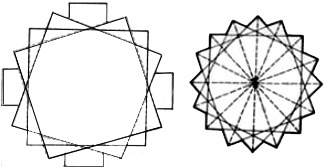
  • Earlier Grabagrihas were simple square shaped but this period saw departure & more complex star shaped came to existence(zenith during Hoysala time) like 6 edged ,12 edged & most complex 24 edged were also found

Important Temples

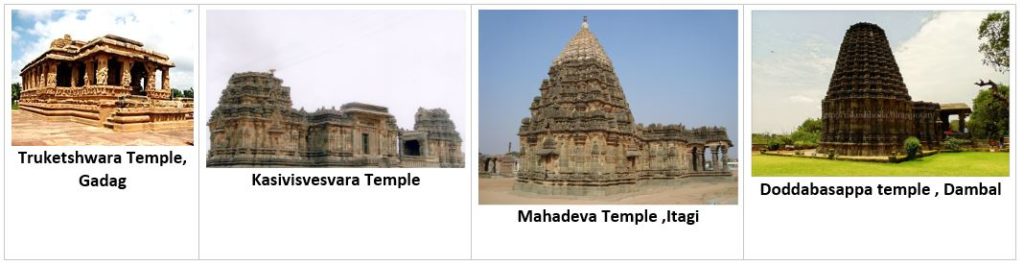
Truketshwara Temple, Gadag – Recognised by ornate columns 
– Ornate columns style is known as GADAG STYLE because such temples are found in Gadag
– Dedicated to Shiva & three lingas on one stone is present here
   
Kasivisvesvara Temple – One of the most ornate temple
Dvikutta Temple
– Initially built by western Chalukya but later additions by Hoysalas
Mahadeva Temple ,Itagi Fine example of Dravida articulation in Nagara style
Doddabasappa temple , Dambal Difference from previous that previous that it is 24 interrupted star shaped temple (earlier 6 or 12 only)

2.3.2 Hoysala Dynasty

  • Star shaped platforms became prominent
  • The temples have highly ornamental porches , additional open Mandapa , very artificially carved doorways , scenes on panel shown densely carved images of gods, animals & demons.
  • Shikharas aren’t very high
  • Minute carvings are well integrated into architecture
  • Examples – temples at Somnathpur, Belur & Halebid.

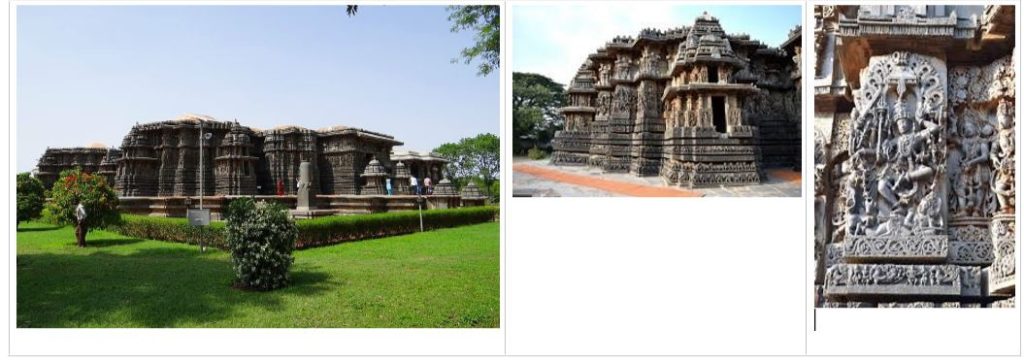
Important Temple : Hoysaleshwar temple, Halebid

  • Built by Vishnuvardhana
  • Halebid = Capital of Hoysalas
  • Ornate style & Dvikuta temple
Hoysaleshwar temple, Halebid

3. Dravida School of Architecture

  • It is the oldest school of architecture
  • This style developed under Pallava Patronage and continued to flourish under Imperial Cholas .
  • Plan include a small sanctum sanctorium within a square enclosure serving as Pradakshina . Other features include pillared halls, corridors & majestic gopurams (later additions)
  • The shape of the main temple tower known as vimana in Tamil Nadu is like a stepped pyramid that rises up geometrically rather than the curving shikhara of North India. In the later period , Vimana became so compressed that they almost appear hidden under the preceding one.
  • In the South Indian temple, the word ‘shikhara’ is used only for the crowning element at the top of the temple which is usually shaped like a small stupika or an octagonal cupola— this is equivalent to the amlakha and kalasha of North Indian temples.
  • Shikhar is crowning element at the top of temple . It is shaped like an octagonal cupola (Vimana de uppar jehda gola a , oh Nagara Style de Gole to alag a, observe below ) . It is equivalent to Amalak & Kalash of Nagara style
  • Entrance of temple‘s Garbhagriha has sculpture of Dwarapalas guarding the temple (whereas in Nagara style there are images of Mithunas & river Goddess Ganga & Yamuna)
  • There is only one Vimana in Dravidian School ( whereas in Nagara School there are multiple Shikharas  also on subsidiary shrines )
  • Gopurams (entrance gate) are the principal features in the quadrangular enclosures that surround the more notable temples.
  • Pillared halls  used for various purposes


Plan of Dravida Temple (taking example of Brihadeshwar Temple)

3.1 Pallava Architecture

  • Dravida style developed under the royal patronage of Pallava kings and continued to flourish under Imperial Cholas
  • There are 4 stages of its early development

Stage 1 : Mahendra Group

  • Built under patronage of Mahendravarman I (600-625 AD)
  • Influenced by  Cave style architecture
  • But Pallava caves and shrines are less complex and smaller than those at Ajanta & Ellora & relatively plain 
  • The cave façade is generally plain with Dvarapalas usually marking the ends
  • Example :Mandagapattu temple Villupuram,TN
    • Rock cut temple & built by Mahendravarman
    • Built by cutting single rock & no metal or wood is used
    • First to have icons of Dwarapalas which later became tradition in south indian temples

Stage 2 : Narsimha Group

  • Narsimhavarman I (625 – 670 AD) / Mahamalla
  • Several Rathas or small monolithic temples & more elaborate caves were carved out
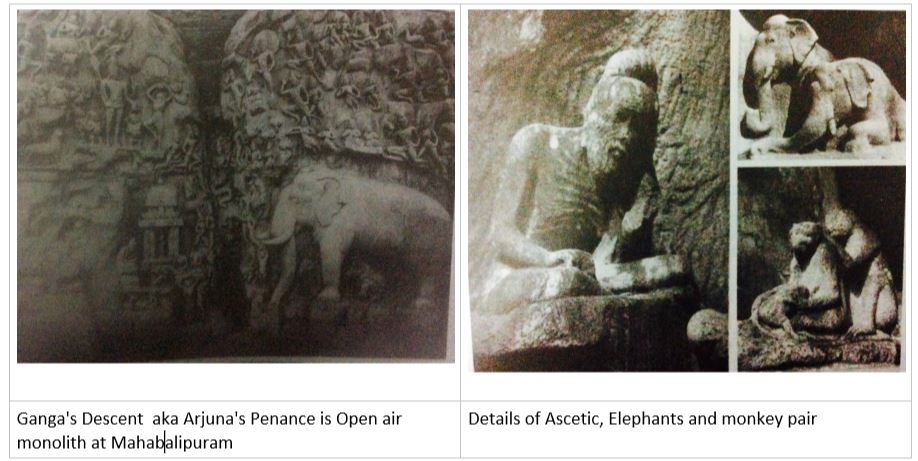
  • More elaborate Pallava caves are located in Mamalapuram (aka Mahabalipuram) named after Pallava king Narsimhavarman I aka Mahamalla (the great hero)
  • Some caves like Adi varaha caves are preceded by Tanks
  • Rockcut caves at Mahabalipuram have many mythological scenes carved in relief including Vishnu rescuing the earth , Vishnu taking three strides , Gajalakshmi and Durga , Mahishasuramardini in Durga cave and Krishna lifting Govardhana Mountain (Pancha Pandava Cave)
  • The main figures are slender, delicate and elegant . Their headdress and crowns are quite plain and they wear little or no jewellery

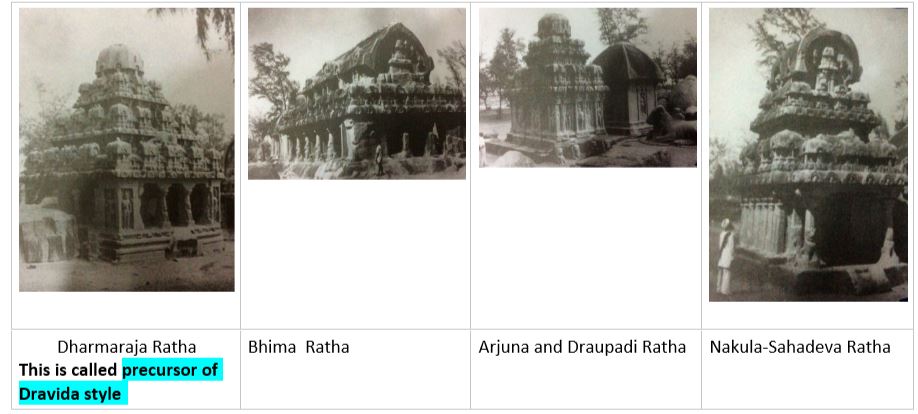
Panchratha Temples

  • At Mahabalipuram , there are 9 rock cut temples of which 5 are clustered together . The name of great Pallava builder king Mamalla was in later time misunderstood as referring to 5 Pandava heroes and these temples came to be associated with 5 Pandavas and Draupadi.
  • They have no religious significance either, as they remained unfinished and unconsecrated; the uncut rock parts at the base and top of the rathas are still visible. 
  • Work on these five rathas was discontinued following the death of Narasimha Varman .The purpose of their construction is not known as the structures were not completed

Stage 3 : Rajsimha Group

  • Narsimhavarman II Rajasimha (700-728 AD)
  • Development of real structural temples (rockcut replaced by structural temples)

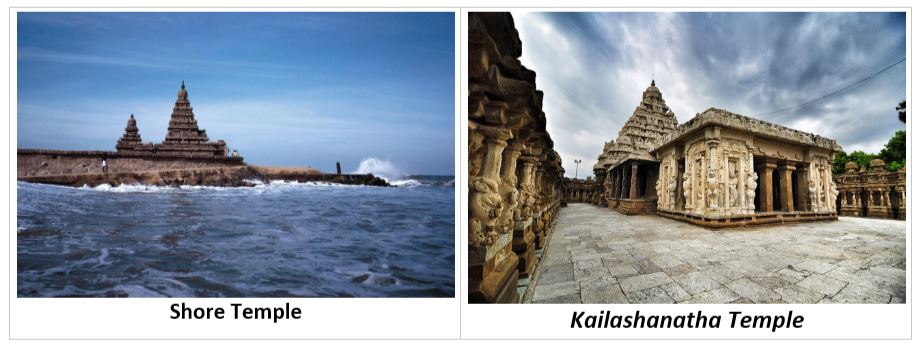
Shore Temple , Mahabalipuram

  • Assigned to reign of Rajsimha but additions may have been made in later times too
  • This has three shrine areas containing a stone Shiva Linga , Somaskanda (Shiva with Uma & Skanda , a popular theme in the Pallava period) and Vishnu
  • The relief sculpture of the temple are very eroded due to the effects of the sea breeze and sand

Kailashanatha Temple at Kanchipuram

  • Within a large rectangular enclosure is a complex consisting of a square sanctum enshrining a linga
  • The Shikhara is in the typical southern style .
  • The enclosure walls of the complex are heavily ornamented with sculptures 
  • Has large number of Lion sculptures (lion was the insignia of Pallavas)

Stage 4 : Nandivarman Group

  • Development of small temples
  • Dravidian style continued

3.2 Chola Architecture

  • Dravidian style got fully developed during Chola period
  • Early chola temples were made on banks of Kaveri river which are smaller & brick made while Imperial Cholas had colossus buildings (post 850 AD)
  • Ganas among temples are most memorable figures

Brihadeshwara Temple, Tanjore

  • Magnificent Shiva temple of Thanjavur, called the Rajarajeswara or Brihadiswara temple, was completed around 1009 by Rajaraja Chola, and is the largest and tallest of all Indian temples.
  • Biggest of all Dravida Temples
    • Multistoreyed Vimana 200 ft tall
    • Monolithic Shikhara
    • Two large gopurams at entrance (first temple to have Gopurams)
    • Huge Lingam in two storeyed Sanctum
    • Nandi is carved out of single rock is placed in Nandi Mandapam
  • Was dedicated to Lord Shiva by Rajraja Chola I ,when he triumphed ILAM(Sri Lanka)Island
  • Wonder is that the vimana has withstood six recorded earthquakes – in 1807, 1816, 1866, 1823, 1864 and 1900

3.3 Vijayanagara Architecture

  • Last bastion of Hindu Empire after Sultanate attacked India.
  • Rulers built magnificent cities & beautified them with temples & splendid houses ,grand palaces, public offices, irrigation works. This was testimony of wealth & prosperity of the times
  • Numerous temples built which stand as testimony to general conscious of rulers as custodians of Hindu religion & culture
  • Temples were also the institutions through which significant political control was established & played important role in legitimising & sustaining kingship
  • Temple enclosure became more spacious
    • Temple walls had painted relief panels from Mahabharata & Ramayana
    • Puranic themes were used for decorating the Gopurams
    • Gopurams grew in size and number both
    • Major elements  of the temples included impressive Gopurams , Kalyanamandapas , Garbagrihas & Amman Shrine
Kalyanmandapam – Ornate pillared pavilion with an elevated platform in the centre , used for placing the image of diety & his consort for ritual purposes on ceremonial occasions .
– In this, deity moved from garbagriha to this place and worshiped .
– Marriage also take place here
Garbagriha Sanctum Sanatorium
Amman Shrine Subsidiary temple for the consort of deity of Garbagriha
Gopuram – Vijayanagar rulers  are famous for Gopurams(Colossal Towers) formed at the entrance to temple .
– It added to picturesque grandeur of temple . 
– Most  famous gopuram is of Ekambarantha Temple (188 feet high & 10 storeys with exquisite sculpture on it)  
Monoliths – Huge monoliths of Hanuman & Narsimha are architectural marvel
– Resembles Nandi bull of Cholas    
  • Use of Pillars increases
  • Horse is the most popular animal to be depicted  (because of extensive horse trade happening here)
  • Secular buildings have Indo-Islamic features like the use of dome which was present on every elephant stable.
  • Example – Ruins at Hampi having
    • Hazaraswamy Temple
    • Krishnaswamy Temple
    • Vitthalswamy Temple
    • Parvati Temple at Chidambaram
    • Talkanteshwar Temple at Vellore
    • Vardaraja & Ekambarnath temple at Kanchipuram
  • Krishnadeva Raya built temple city of Nagalpura in the honour of his mother Nagamba

Important Temples

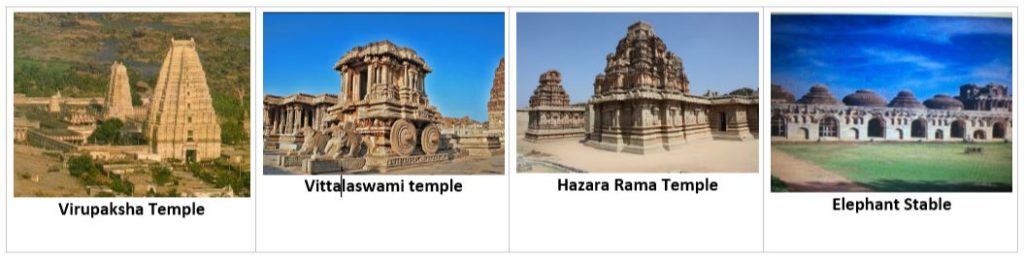
Virupaksha Temple – Oldest & principle temple of Hampi
– Three towers & eastern tower reaches to height of 160feet & is 9 tired
Dates back to 15th century & was renovated in 16th century by Krisna Deva Raya
– Principle Deity is Shiva also called Virupaksheshwara
– Gopuram is massive   
Vittalaswami temple – Fine example of magnificence in floral sculpture
– Patronised by Vijayanagar court
– Resembles Konark temple on small scale
 
Hazara Rama Temple – Its walls & pillars illustrates main events from Ramayana
 
Elephant Stable – Most noticeable part is dome over it
– Islamic architecture started to mix due to Sultanate impact  
Vijayanagara Temples

About City Of Vijayanagar

  • Studded with number of grand palaces , public offices & irrigation works
  • Royal palace  according to Paes (travellor)  was even greater than Palace of Lisbon
  • Lotus Mahal –  example of Indo Saracenic Temple
  • Krishna deva raya built huge tank for water supply to city & irrigation
  • Unfortunately most of city was destroyed in acts that followed after Battle of Talikota . Today city of Hampi which is also a UNESCO world heritage site remains merely a vast open museum

Gupta Architecture

Gupta Architecture

This article deals with topic titled ‘Gupta Architecture .’ This is part of our series on ‘Culture’  . For more articles , you can click here

Introduction

  • In Gupta age ,  Rock cut architecture was at its  zenith &  also marks the starting of free standing temples.
  • Many art historians prefer to call Gupta period Art as Religious Art
    • Utilitarian Art during Harappan Civilization
    • Court Art during Mauryan Period
    • Religious Art during Gupta Period.
  • Art and architecture becomes complex. The earlier designs displaying simple pleasures of life gave way to contemplative & spiritual vision.
  • Large scale temple construction took place.
  • For the first time , a clear & distinctive development between Sculpture, Architecture & Painting can be seen.
  • Major centers of Gupta art were
    • Sarnath
    • Mathura
    • Nalanda

Free Standing Temples

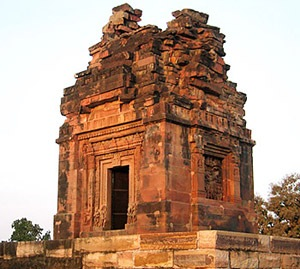
1 . Dashawatara temple

  • Location : Deograh near Jhansi of UP
  • Discovered by Captain Charles Strahan & named by Sir  Alexander Cunningham
  • Made of sandstone.
  • Panchayatana style ie main shrine built on rectangular plinth with four smaller subsidiary shrines at four corners
    • Panch = 5
    • Yatana = Square
  • Temple depicts Vishnu in various forms and named so because of this
  • Due to this, it is assumed that four subsidiary shrines must have housed Vishnu’s avatars but not known to whom four shrines were originally dedicated
  • Temple is west facing (all other modern temples east facing)
Dashawatara Temple

Sculpture at Dashawatara temple

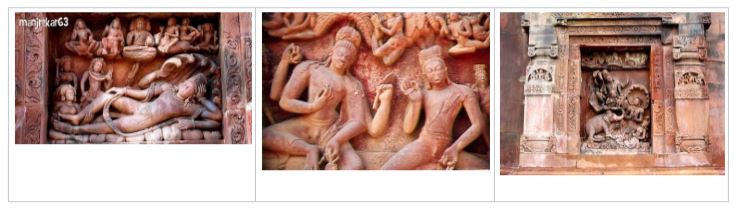
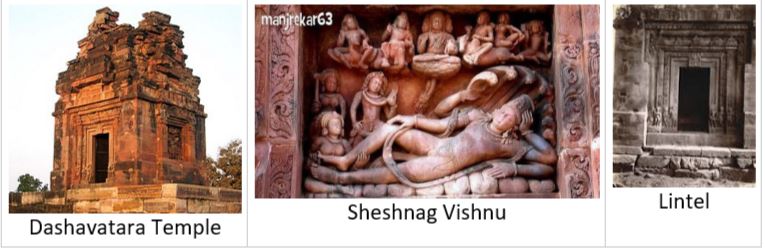
There are three main reliefs of Vishnu on the temple walls: Sheshnag on the south, Nara- Narayan on the east and Gajendramoksha on the west.

Sheshnag   Vishnu – Headgear, ornamentation of Vishnu are important to notice  
Nara Narayana Vishnu – Shows the discussion between the human soul and the eternal divine.  
Gajendramoksha – Is the story of achieving moksha, symbolically communicated by Vishnu’s suppression of an asura who had taken the form of an elephant  

2. Bhitargaon temple

  • Situated in Kanpur, UP
  • One of the Oldest remaining Hindu temple & built by Guptas

Stupa Architecture

  • Although they favoured Brahmanism with Vishnu as their principle deity, but they continued to patronage Buddhism as well.
  • Three famous stupas of their age were
    • Sarnath (UP)
    • Ratnagiri (Odisha)
    • Mirpur Khas (Sind)
  • Older idea of hemi spherical shape changed to new shapes
  • Large use of brick and less use of stone (bricks are not in Harappan posture and smaller than Harappan Period)

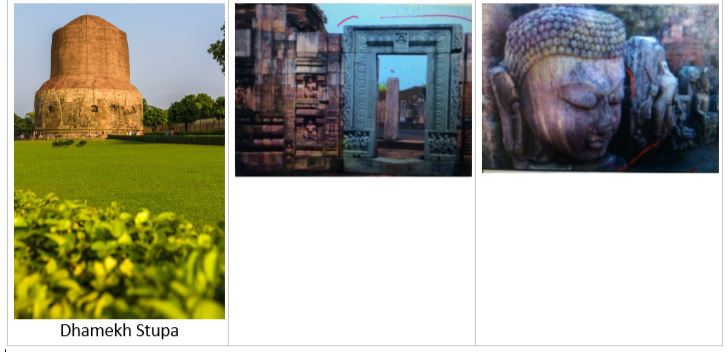
1 . Dhamekh Stupa

  • Location Sarnarth at Deer Park where Budha gave first sermon
  • Inscription dated 1026 says its older name is Dhammachakra Stupa
  • Beneath this another stupa having Mauryan bricks is found
  • Dhamek Stupa was built in 500 CE to  replace an earlier structure commissioned by the great Mauryan king Ashoka in 249 BCE

2. Ratnagiri Stupa

  • In Odisha
  • Is in ruins
  • Large number of votive stupas in stone are also found here from where shape of main stupa can be easily judged
  • Shape of Gateway was also different than those of Sanchi
  • Several Giant head structures of Buddha are also found here

Mauryan Architecture

Mauryan  Architecture

This article deals with topic titled ‘Mauryan Architecture .’ This is part of our series on ‘Culture’  . For more articles , you can click here

Introduction

  • Major architectural input of Mauryan Art was  wood. Hence,remains are very scant
  • Reminiscent of Persian Achaemenid Architecture.
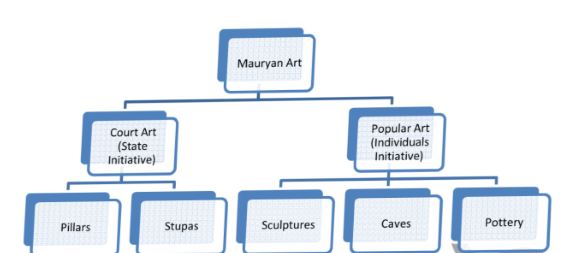
  • Ananda Coomaraswamy has divided Mauryan Art in following way

Mauryan Palace

  • Remains are scanty because timber was the main material
  • Pillar fragment was discovered in Kumrahar (place in Patna) in 1903 .  72 pillars found in 1903 were arranged in neat chessboard pattern & 8 pillars were discovered later . Pillars were made of buff colored Chunar sandstone & smooth polished surface
  • Although they were made of same stone as free standing Ashokan pillars but they were thinner & shorter. All have hole on the top clearly for metal dowels that connected shaft to capital which in turn supported roof.
  • Some marks were found on their bases including crescent on hill (insignia of Mauryas) .
  • Discovery of large quantity of ash & pieces of burnt wood indicated that floor & roof were made of wood & structure was subjected to fire
  • There were no traces of walls & hall seems to be open on all sides
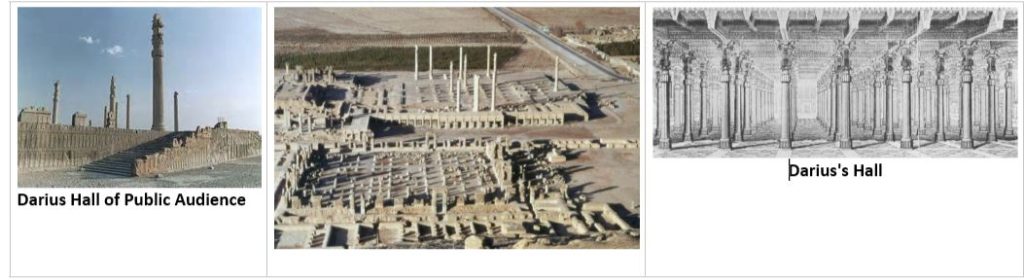
  • Spooner was struck by similarity between pillared hall at Kumrahar  & Darius’s hall of Public audience at Persepolis in Iran but Maurya structure is less elaborate than persian palace . Along with that, precise function of 80 pillared Mauryan hall is unknown
Darius Hall at Persepolis

Stupas

  • Stupas were known before the time of Ashoka too but Ashoka divided the existing body relics of Buddha & erected Stupas to enshrine them . Hence, Stupa became object of cult worship
  • In Buddhist Tradition, originally 9 stupas were erected – 8 over relics of Buddha & 9th on vessel in which relics were originally kept at Rajagriha, Vaishali, Kapilvastu, Allakapa, Ramagrama, Vethadipa, Pava, Kushinagar and Pippalvina.
  • Material used in initial Stupas
Core of Stupa Made up of Unburnt Bricks
Outer Face Made of Burnt Bricks & covered with thick layer of plaster
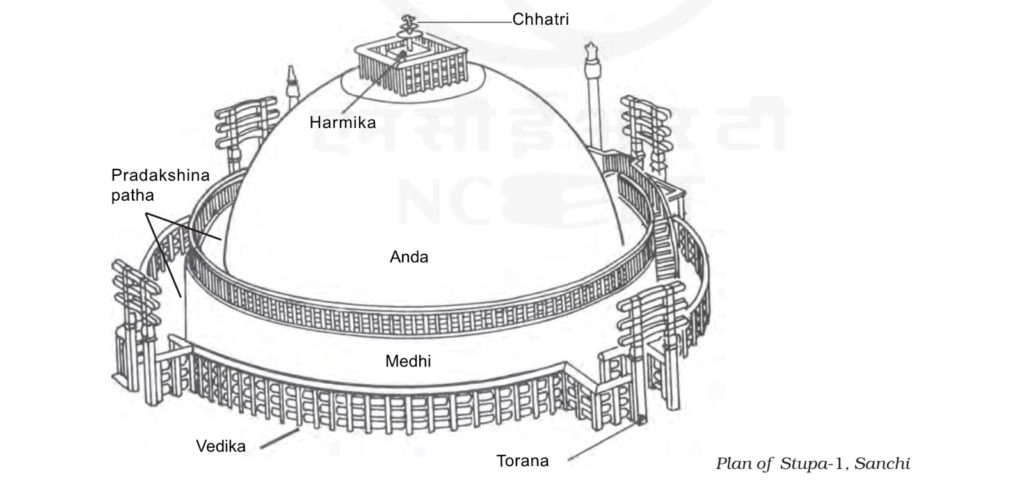
  • In subsequent century, stupas were elaborately built with certain additions like the enclosing of the circumambulatory path with railings, gateways & sculptural decoration. Thus, with the elaborations in stupa architecture, there was ample space for the architects and sculptors to plan elaborations and to carve out images
  • Three chhatra on the stupas represent triratnas of Buddhism i.e. Buddha (The enlightened), Dhamma (doctrine) and Sangh (order)
Pradakshina 
patha 
Vedika 
Chhatri 
Harmika 
Anda 
Medhi 
Torana 
Plan of Stupa-l, Sanchi

1 . Barhut Stupa

  • Barhut is situated in eastern part of MP
  • Stupa at Barhut was made by Ashoka around 300BC but improvised & beautified by Shungas
  • Unlike Mauryan imperial art, inscription on railings were made by lay people&monks
  • Earliest stupa railings (vedika) to have survived
  • Sculpture mainly include Yaksha & Yakshinis
  • Has nine feet railing (vedika) & gateway(torana) made in imitation with wooden architecture
  • On railings are depicted stories of virtuous qualities of Budha & Jataka stories
  • Sculpture done here is low in relief and narratives are few in words
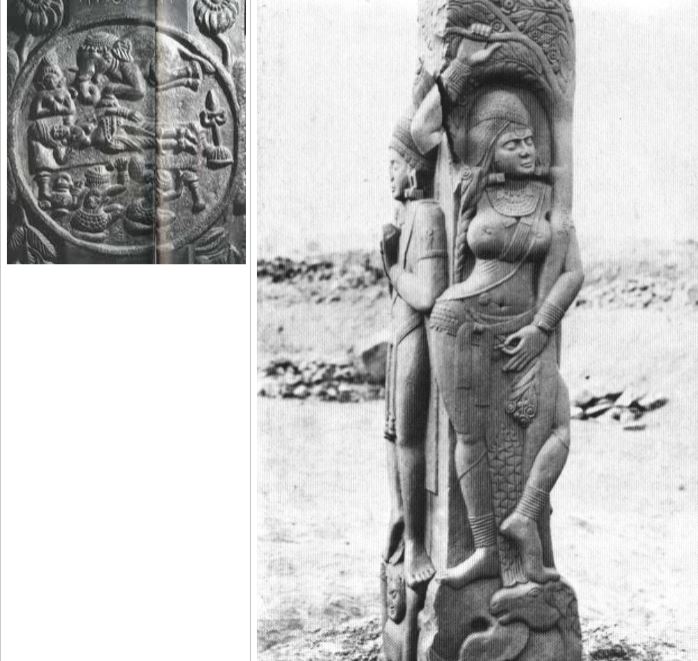
  • In one sculpture, story of Queen Mahamaya (mother of Buddha) is depicted where she is reclining on bed and elephant is shown on top heading towards womb

2. Sanchi Stupa

  • Sanchi is in  MP
  • Monuments present in the complex : Two stupas+ some temples  + Pillar edicts + monasteries
  • Stupa is the Oldest stone structure
  • It has long history
    • It was commissioned by Ashoka
    • Later , Pushymitra Shunga of Shunga Dynasty vandalised it
    • Again it was rebuild by Agnimitra Shunga who also added Railings (Vedika) to it
    • Later, it was repaired by Satavahanas who also added Toranas (Gateway) to it.
  • Nucleus is hemispherical brick structure built over relics of Buddha
  • Has upper & lower Paradakshinapatha or Pathways
  • It also has Four beautifully decorated Toranas depicting various life events of Buddha & Jataka stories
  • In contrast to Barhut, relief in it’s railings is high &  more naturalistic . Carving technique is also more advanced than Barhut

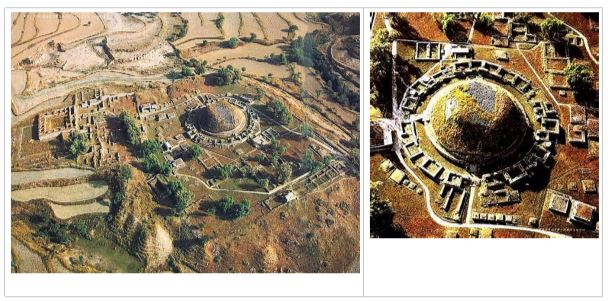
3. Dharmarajika Stupa (Taxila)

  • Several Stupa-Monastery sites are there in Taxila out of which Dharmarajika  (locally called Chir Tope) is most important
  • Belong to Maurya period

Rock Cut Architecture

Rock Cut Architecture

This article deals with topic titled ‘Rock Cut Architecture .’ This is part of our series on ‘Culture’  . For more articles , you can click here

Introduction

  • There are around 1500 Rock Cut Architectures in India and most of them religious
  • Built mainly by Indian sculptures,monks and general public
  • Two types of caves (mostly both were present at one site)
Chaitya Prayer Hall for Monks
Vihara Residence /Rest place for Monks

1 . Barabar Caves

  • Oldest example of rock cut caves
  • Located in Barabar Hills,Bihar
  • Caves date back to reign of Ashoka and his son Dasratha
  • Initially built for Ajivika sect. Later for all Buddhists, Jain & Brahmanical traditions

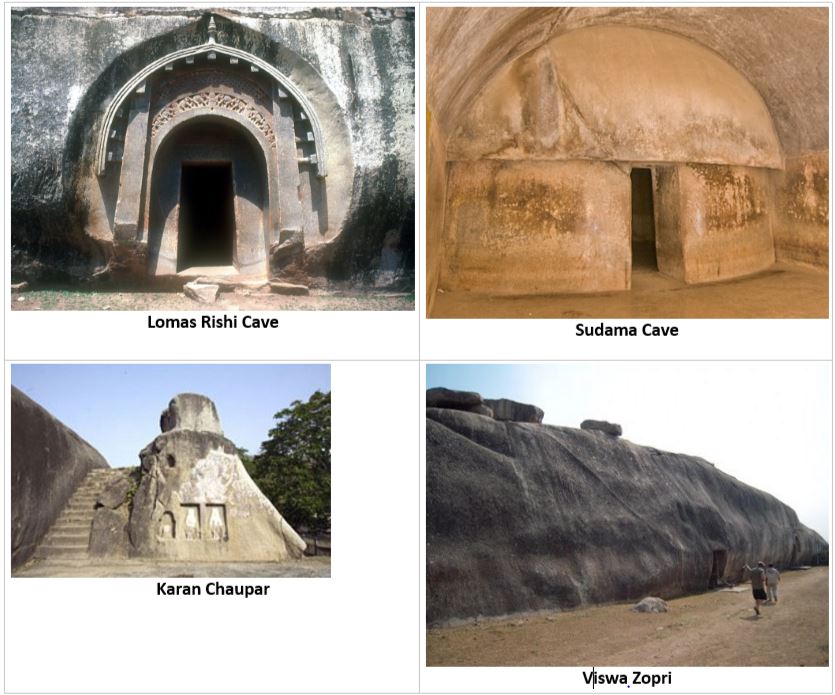
Main caves at Barabar

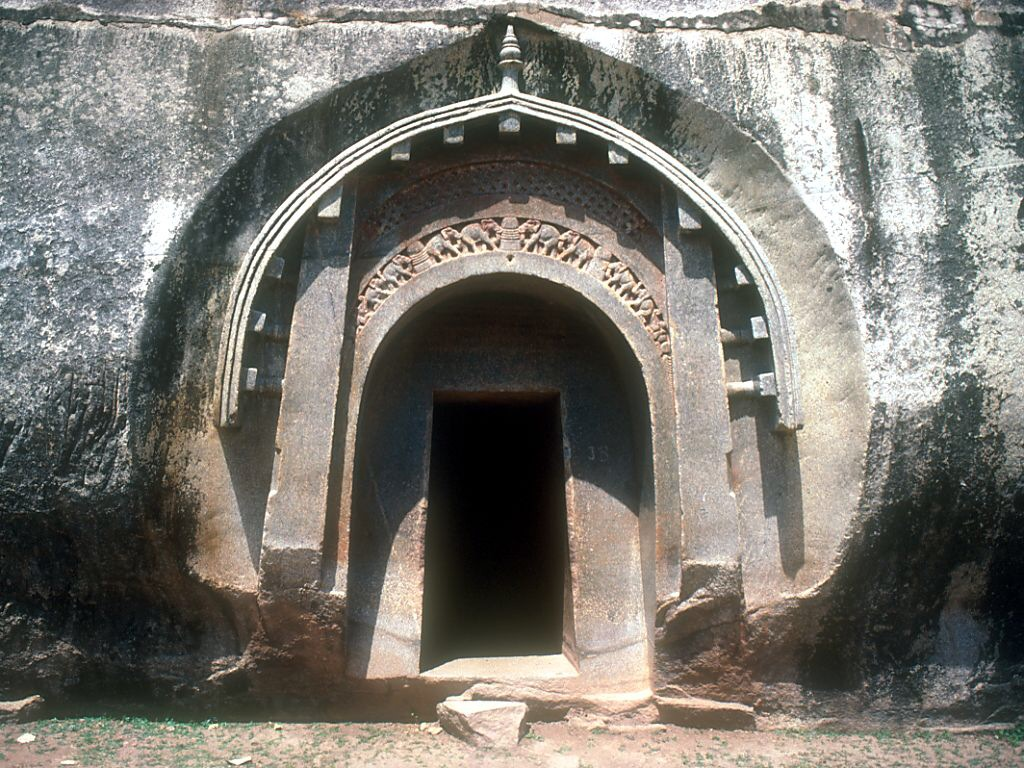
Lomas Rishi Cave – Known for horse shoe type façade
– It imitate contemporary timber architecture of that time
– Polished from inside is it’s marked feature  
Sudama Cave – Known for bow shaped arch
– This and Lomas Rishi cave are the oldest rock cut caves  
Karan Chaupar – Single rectangular room with polished surfaces
– Contains inscription dating back to  Mauryan era  
Visva Zopri There are two rectangular caves there
Caves at Barabar Hills

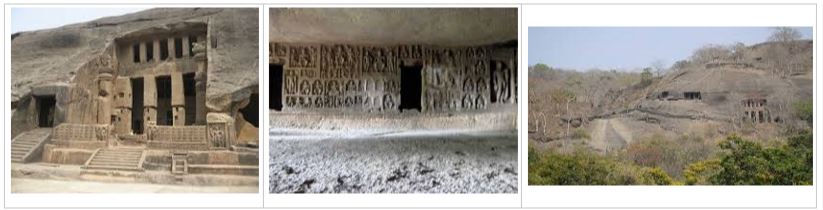
2. Kanheri Caves

  • Location- Kanheri, north of Borivali Mumbai within Sanjay Gandhi National Park
  • Early caves excavated in 1st & 2nd century BC
  • Caves continuously occupied by Buddhist monks & inland traders as stop  till 7th century AD
  • Have both Chaityas & Viharas
  • It’s Chaitya is the 2nd largest Chaitya after Karle Caves

Significance of these caves

  • Site provides view of development of Buddhist art for a thousand years from 1st century BC as its proximity to sea & thriving ports ensured continual patronage by mercantile class
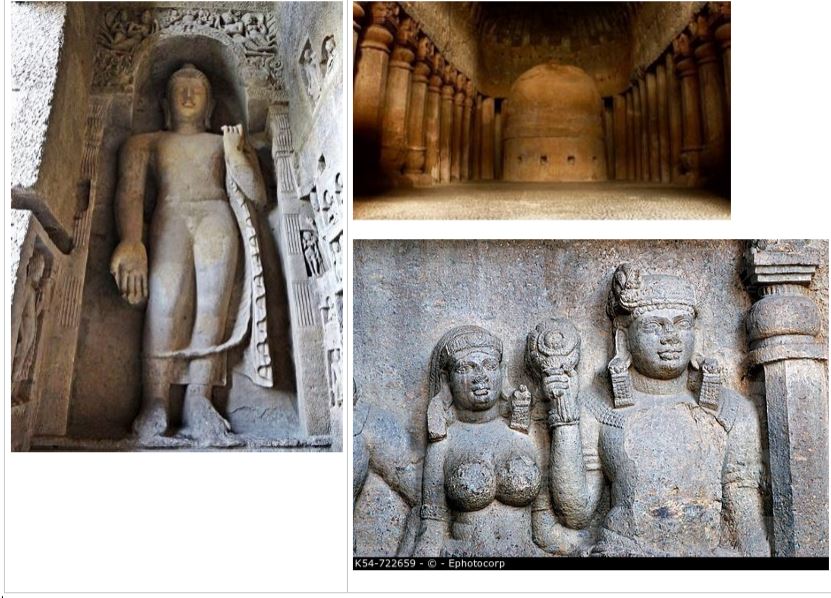
  • Kanheri temple presents last expression of early rock cut tradition of western India
  • These are home to colossal Buddha statue and mark the beginning of long tradition of colossal Buddha which became popular in Tibetan & central asia
Kanheri Caves
Kanheri Caves

3. Karle Caves

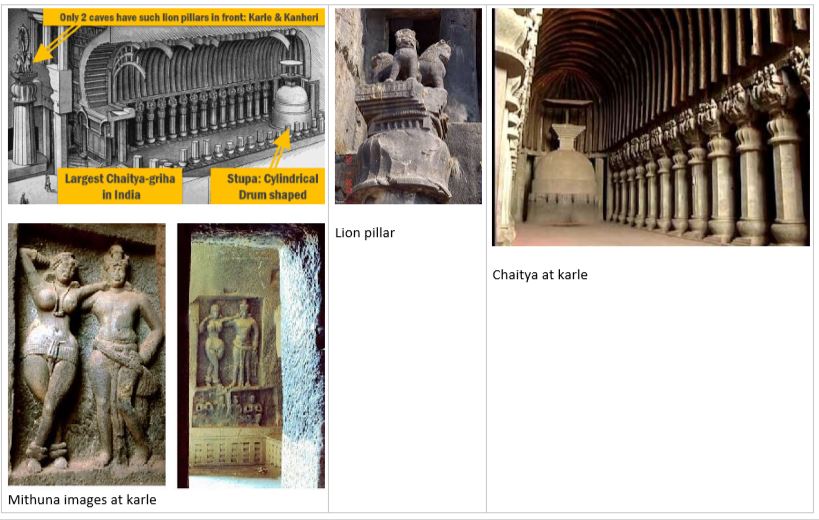
  • Location – near Lonavala,Maharashtra(between Mumbai & Pune)
  • Shrines developed over two periods
First Phase 2century BC to 2century AD
Second Phase 5century to 10th century AD
  • Caves provided lodging houses to travelling traders thus ensured continued patronage
  • Associated with Mahasamghika sect of Buddhism
  • Largest rock cut Chaitya in India
  • Sculptures include Mithuna and animals such as lions & elephants
  • Roof is given shape like that of wood (hence, giving wooden look to stone cut cave was still prevalent)
Karle Caves
Karle Caves

4. Bhaja Caves

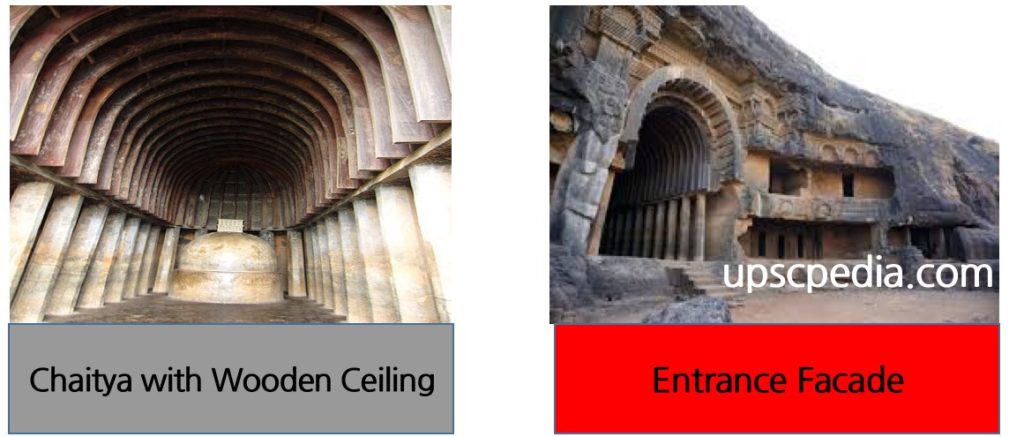
  • Belongs to Hinayana faith
  • It has Wooden ceiling over Chaitya-griha.
  • Stupa has a hole on top, for inserting wooden umbrella.
Bhaja Caves
Bhaja Caves

5. Bedsa Caves

  • Location -Pune
  • Known for chaitya and viharas of 1st century BC
  • Chaitya is partly hidden from profane world. Belief was that one should learn truly only when one made a special effort for that purpose

6. Ajanta Caves

  • Situation : 100 km from Aurangabad in horse shape gorge of Waghora river
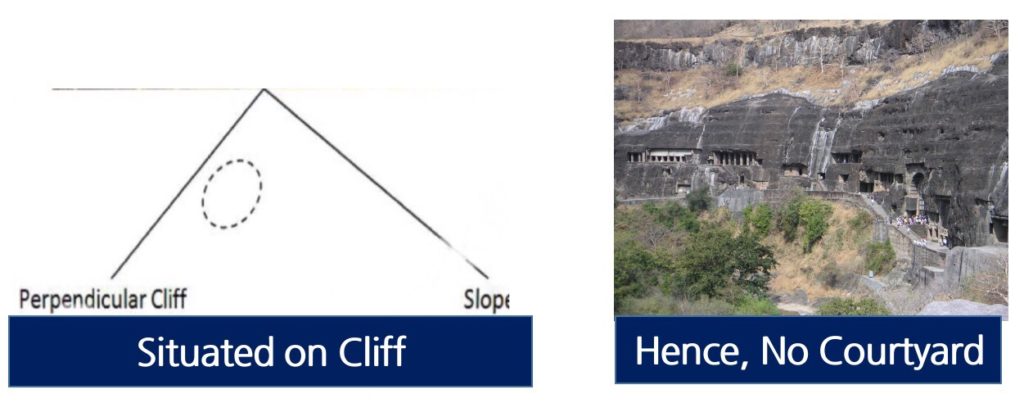
  • These caves are carved on a perpendicular cliff. As they are on perpendicular side, there are no courtyards
Perpendicular Cliff 
Situated on Cliff 
Slopc 
Hence, No Courtyard
  • All the three forms of Art are combined in these caves : Architecture, Sculpture, Paintings
  • Were discovered in 19th century (1829)
  • Total 29 caves(according to NCERT) : Made in two phases
    • These all caves are Buddhist in theme
    • 4 Chaityas & 25 Viharas
Satavahana Phase – Built in 2nd century BC
– Patronage of Satavahana Kings
Hinayana phase ie Buddha represented figuratively
– Less figurative sculpture & emphasising on stupa instead  
Vakataka Phase – Period:5th & 6th century AD
– Patronage:Vakataka Kings
Mahayana phase ie Buddha depicted as human
– Human representations of Buddha found in both facades and interior
– Murals present in this period which is great artistic achievement  
  • Chinese Buddhist traveller Fa-Hien & Huen Tsang refer to Ajanta in their accounts
  • 5 Caves belong to Hinayana & 24 to Mahayana
  • Chaitya caves –  earlier phase : Cave Nos. 10 and 9 and  later phase : Cave Nos. 19 & 26. Cave no 19 & 26 are profusely decorated.

Notable paintings and sculptures at  Ajanta

  • Figures in these caves are painted with considerable naturalism and there is no over -stylisation
  • It may also be observed that various skin colours are used in the paintings such as brown, yellowish brown, greenish, yellow ochre, etc. which represent a multicoloured population.
  • Paintings of Cave Nos. 16 and 17 have precise and elegant painterly quality. They do not bear the ponderous volume of the sculptures in the caves.

Cave 1

  • Consists of a hall sided by 14 cell
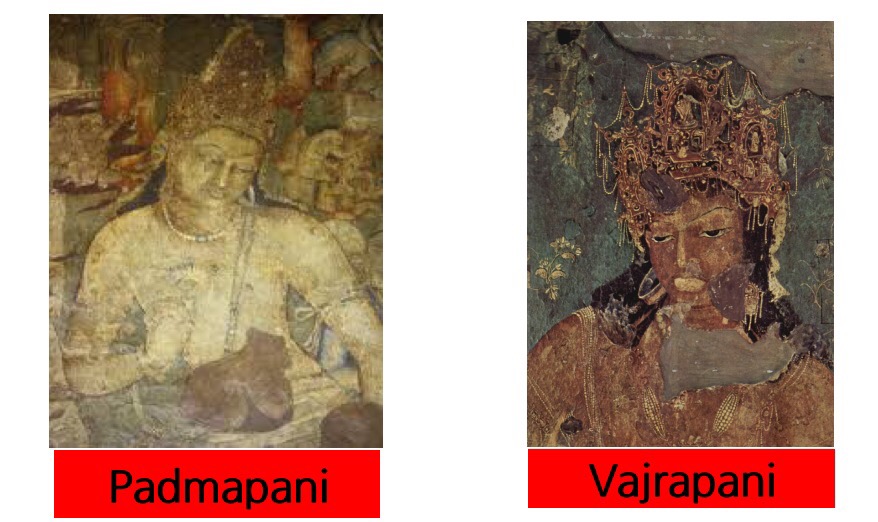
  • Famous Paintings of Vajrapani and Padmapani situated here (many times asked in UPSC)

Cave 16

  • According to an inscription found here, the excavation of this cave was caused by Varahadeva, the minister of Vakataka king Harishena 
  • Largest and most finest and interesting monastery (vihara ) of all Ajanta caves
  • Consist of Colossal hall ,ornate doors ,beautifully painted galleries ,ornamental pillars. Central hall is surrounded by 14 cells on three sides and sanctum housing buddha image as shown in Pralambapadasana
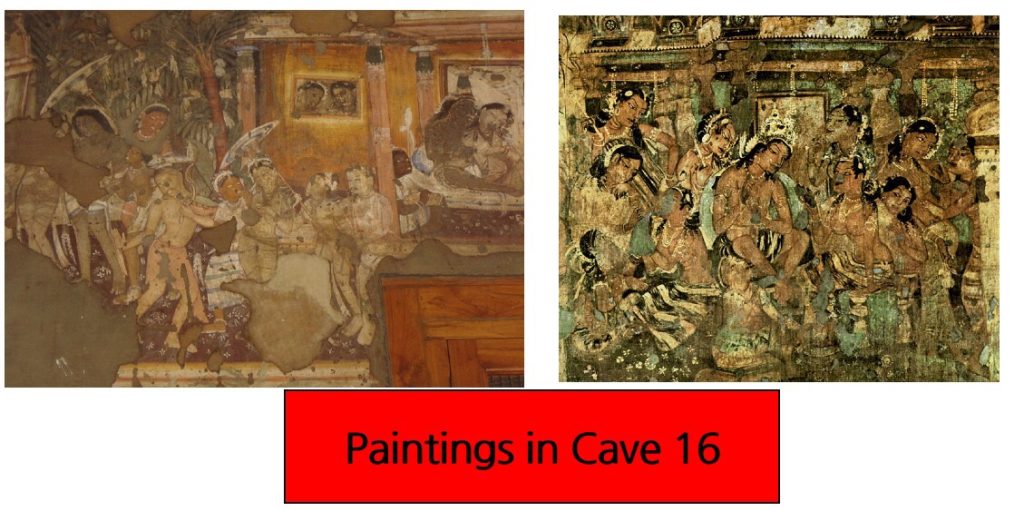
  • The important painted themes depicted are the conversion of Nanda; Miracle of Sravasti; Maya’s dream; and certain incidents from the life of Buddha. The Jataka stories depicted are Hasti, Maha-ummagga, Maha-sutasoma. 
Paintings in Cave 16

Cave 17

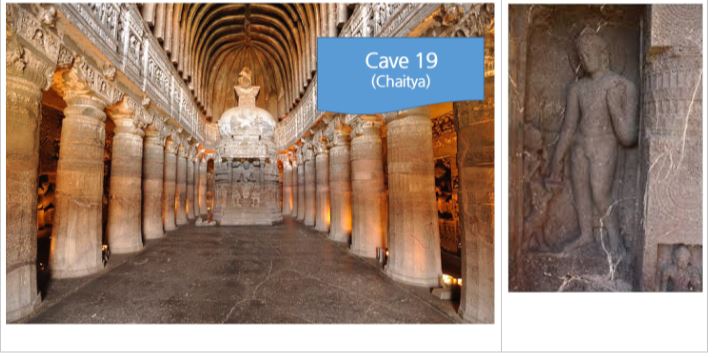
Cave 19

  • It is chaitya & most perfect specimen of buddhist art in India
  • Built during 5th century AD
  • Total 17 pillars in chaitya with single door entry & at centre stands globular buddha
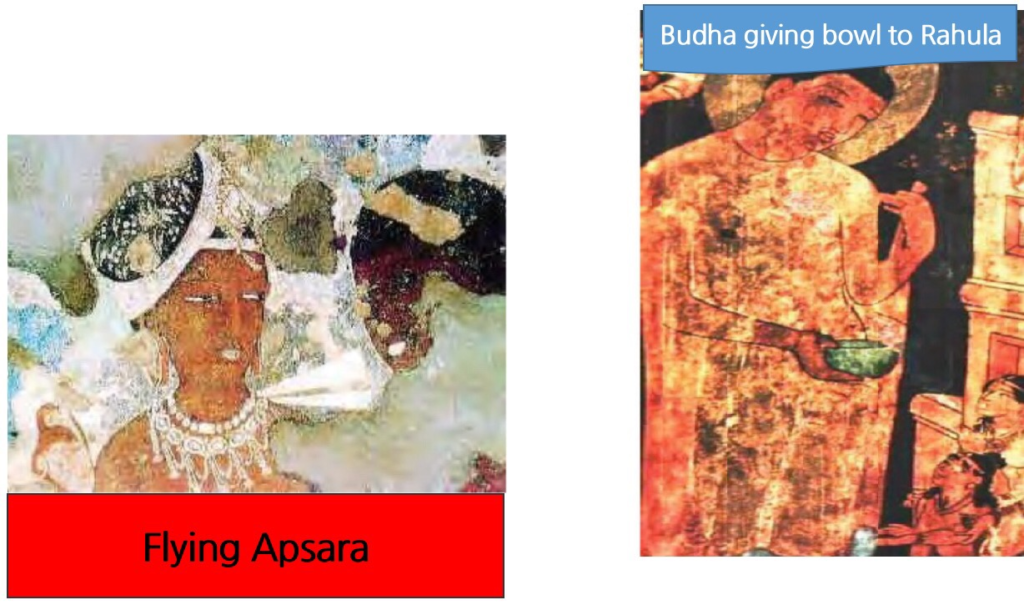
  • Other sculpture Buddha offer begging bowl to his son Rahula

7. Ellora Caves

  • Location :Aurangabad district  in Maharashtra( 100 km from Ajanta )
  • Built by: Rashtrakutas (5th to 12thcentury)
  • Epitome of Indian rock cut architecture and one of World Heritage sites
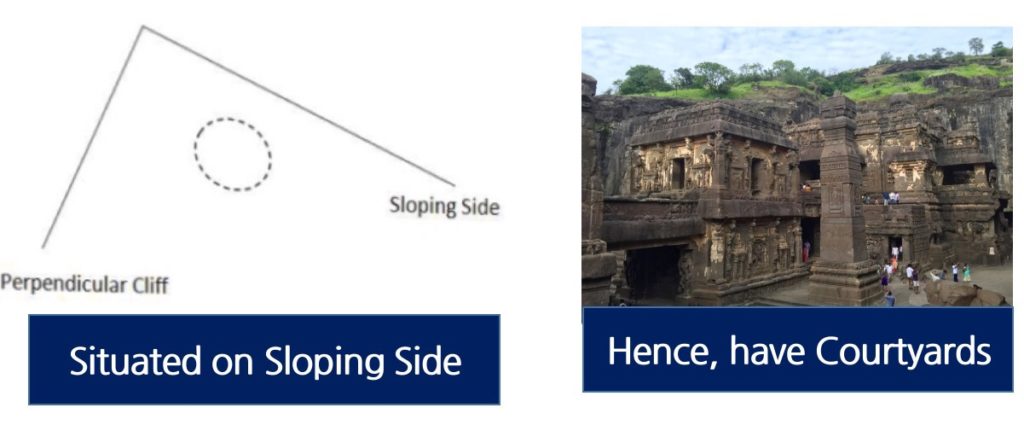
  • Unlike the Ajanta caves,Ellora cave temples were carved out on the sloping side of the hill. Hence most of the temples have courtyards.
Sloping Side 
Perpendicular Cliff 
Situated on Sloping Side 
Hence, have Courtyards

  • Ellora has even 3 storey  buildings but Ajanta double storeyed only 
  • Was on trade route from Paithan to Ujjain in central India
  • Total : 34 caves  (dominant Hindu caves)
Buddhist 12 (mainly Vajrayana)  1-12
Hindu 17 13-29
Jaina 5 30-34

Demonstrate generous attitude of rulers towards worshipers of all divinities

Important Caves and Temples within Ellora

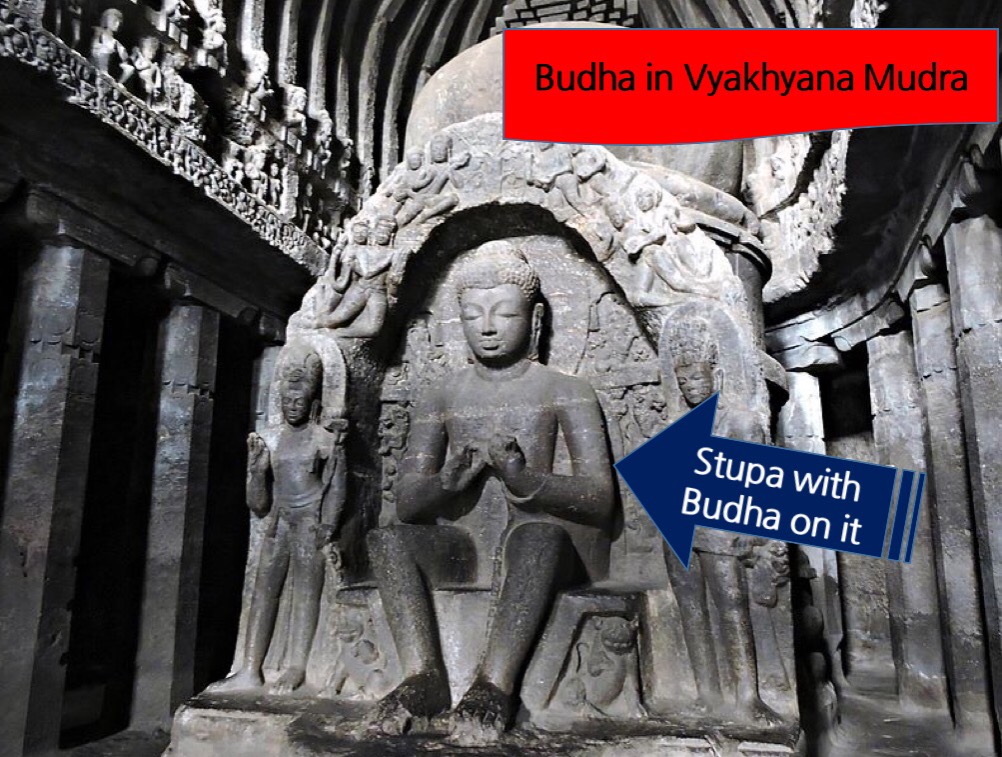
Carpenters Cave /Vishvakarma Cave at Ellora : Cave no 10

  • Only Chaitya in Ellora rest all are viharas
  • Locally known as Vishwakarma ie “celestial architect” or Sutar ka jhopda ie “carpenter’s hut”
  • Sculptors have tried to give wooden look to stones
  • It is cave no 10 and most famous Buddhist cave at Ellora
  • Chaitya hall has stupa on the face of which is a colossal Budha – 3.30 m high & seated in Vyakhyana mudra
Budba wyakhya0ö 
Stupa with 
Budha on it

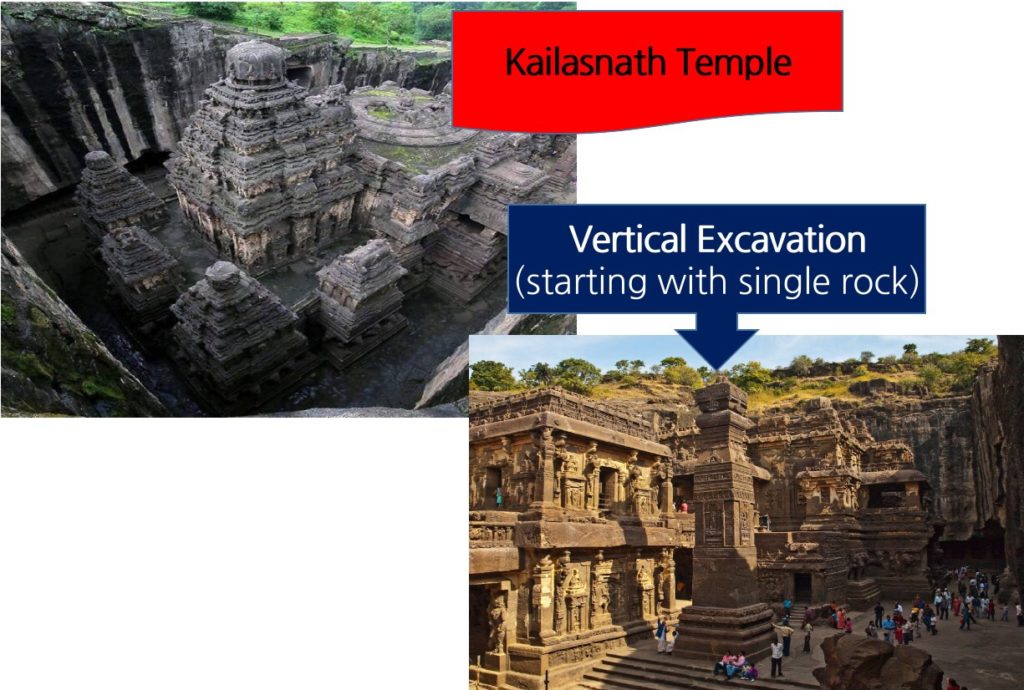
Kailasnath Temple : Cave no 16

  • Vast multi-storey structure carved inside and outside 
  • Carved out of single rock
  • Built by Rashtrakuta king -Krishna I in 8th century AD
  • Remarkable example of Dravidian Architecture
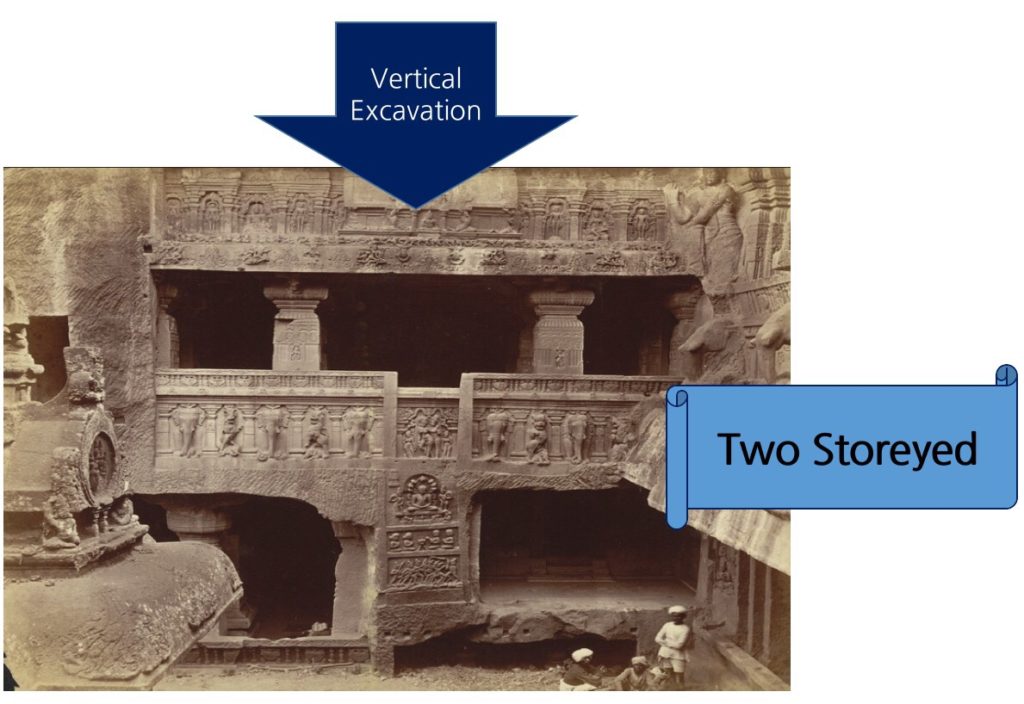
  • Vertical excavation- carvers started at the top of original rock and excavated downward.
Kailasna 
Vertical Excavation 
(starting with single rock)
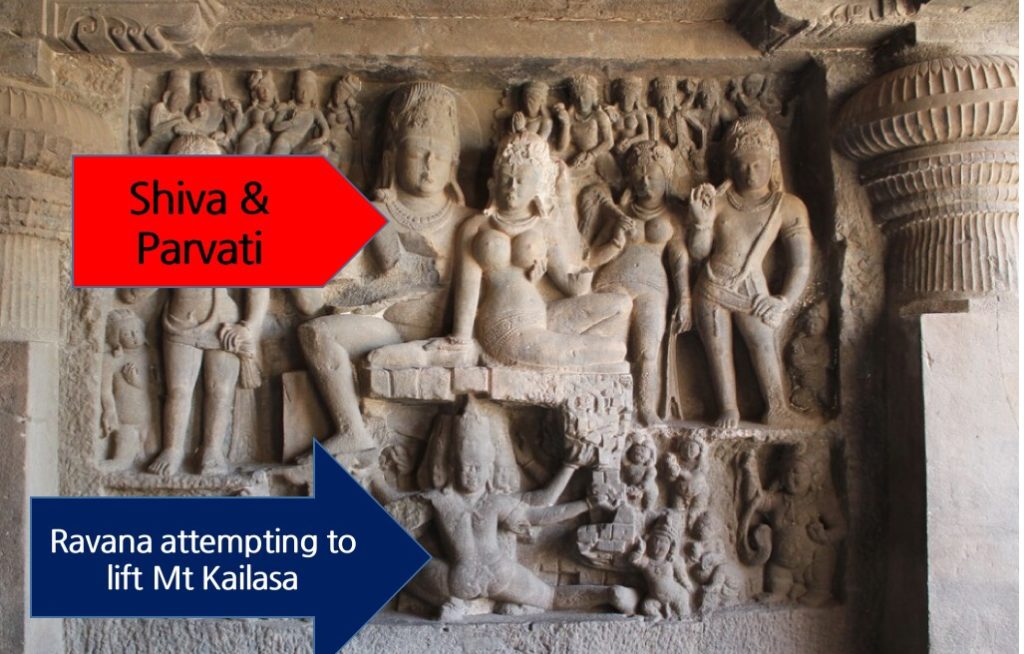
  • It has images of deities ,mithunas and other figures.
  • Grand sculpture of Ravanna attempting to lift Mt.Kailasa ,abode of Lord Shiva with full might is landmark in Indian art
Shiva & 
Parvati 
Ravana attempting to 
lift Mt Kailasa

Dashavatara Cave : Cave no 15

  • Began as Buddhist cave
  • Closely related to Cave 12
  • Shows Vishnu in his 10 Avatars

Indra Sabha (Jaina) : Cave no 32

  • There are Five Jain caves at Ellora
  • Belonging to Digambara sect

Notable ones are:

  • Chhota Kailash
  • Indra sabha
  • Jaganatha sabha

Out of them , Indra sabha is two storeyed cave with one more monolithic shrine in its court

Vertical 
Excavation 
Two Storeyed

8. Udaigiri Caves

  • In Vidisha  (there are two Udaigiri Caves, other are Jain Caves in Odisha)
  • Developed during reign of Guptas
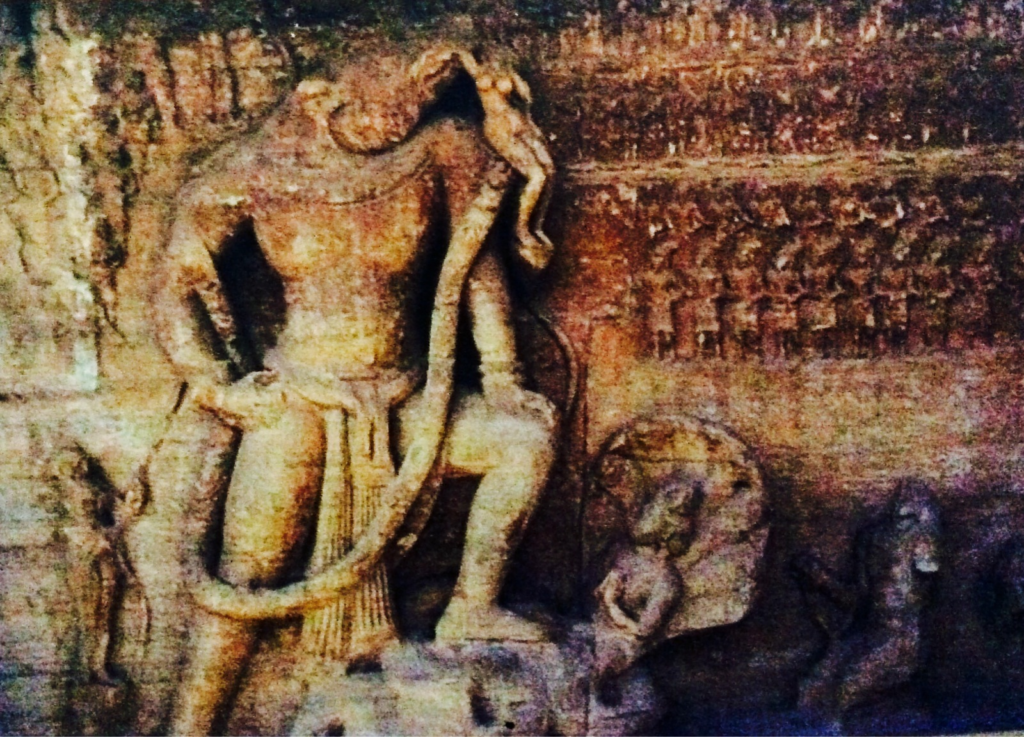
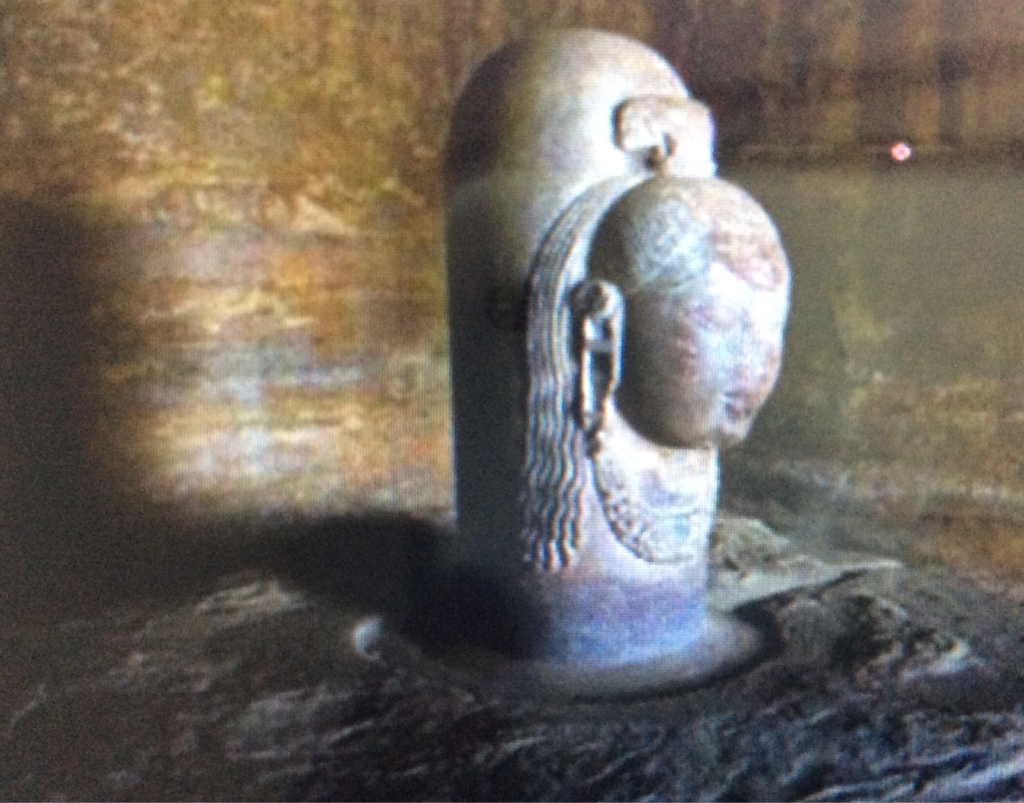
  • Here all the caves (except for one Jaina cave) depict Hindu deities although most of the sculptures are carved outside the caves. These include Four armed standing Vishnu (Cave 6) , Kumara (Cave 3), an eka-mukha linga (Cave 4), pratiharas /Doorkeepers (Cave 6) & Durga Mahishasuramardini( Cave 4,6) .
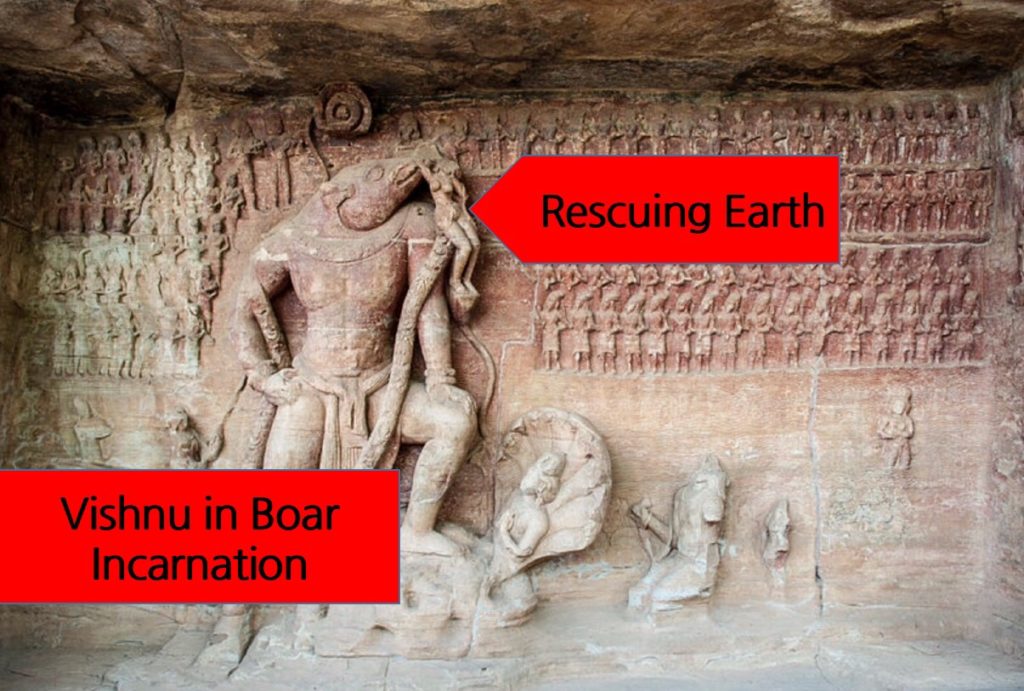
  • A particularly powerful relief shows Vishnu in his boar incarnation rescuing the earth from waters

9. Elephanta Caves

  • Built under the patronage of Vakataka
  • Situated at Elephanta Island in Mumbai Harbour (named so by Portuguese due to presence of Elephants)
  • It has two group of caves
    • First Group : 5 Hindu Caves
    • Second Group : 2 Hindu Caves
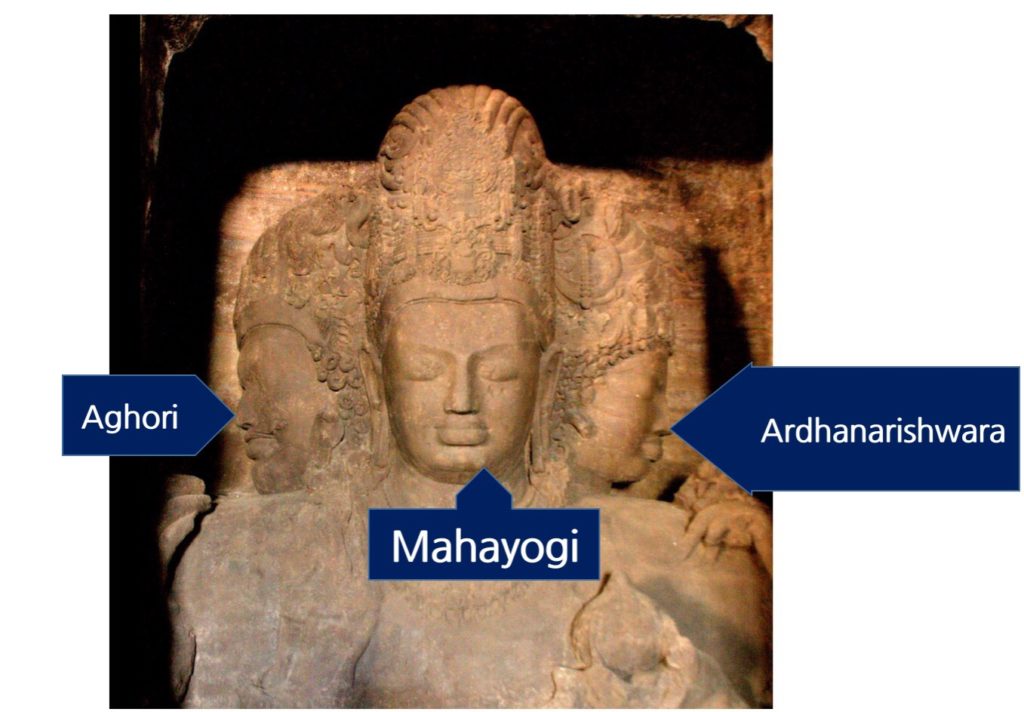
  • Hindu caves are dedicated to Shiva . Central Attraction here is 20 foot statue of 3 headed Shiva . Three heads represent
    • Aghori : Aggressive form
    • Ardhanarishwara  : Half man and half woman
    • Mahayogi : Meditative Aspect
Aghori 
Ardhanarishwara 
Mahayogi

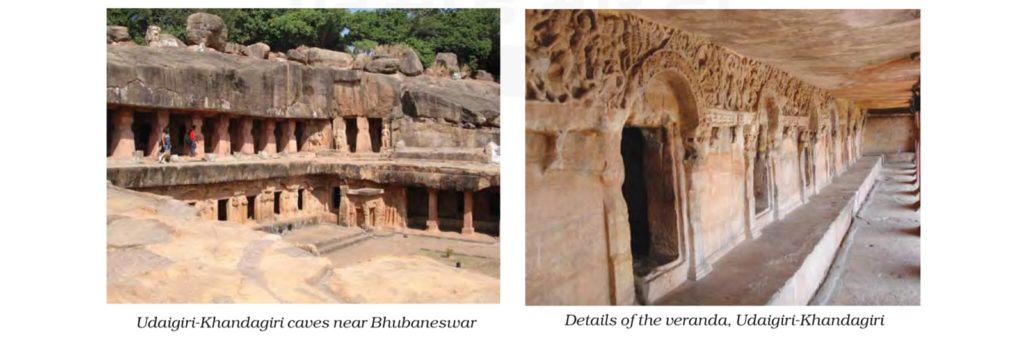
Caves in Eastern Ghats – Udayagiri & Khandagiri

  • Udayagiri & Khandagiri hills  in Puri District of Orissa 6 km from Bhubaneswar & not far from site of Shishupal Garh
  • One of the oldest Jaina rock cut caves are present here
  • Sandstone present in these caves are easy to excavate but not very suitable for intricate carving . Stone of these caves are brittle & suffered lot of weathering
  • Hathigumpa inscription , carved over an overhanging rock in front of Cave 14 connects it with Mahameghavahana or Chedi Dynasty of Kalinga dated 1st century BC . This dynasty  extended patronage to Jainism & hills continued to be occupied by Jaina Ascetics with a few breaks right upto present date
Udaigiri-Khandagiri caves near Bhubaneswar 
Details of the veranda, Udaigiri-Khandagiri

Differences with Buddhist Caves in Western Ghats

  • No congregation hall or rock cut shrines present here (in later period although some of the cells were enlarged to make shrines)
  • Tiny cells graphically represent hard ascetic regimen of monks who lived here . With few exceptions , they were not high enough to permit man to stand up
  • Interior of cell was stark & plain but outer brackets sometimes had carved ornamentation
  • Generally single storeyed  . Only one is double storeyed ie Ranigumpha (Queens cave) . Ranigumpa is largest & best preserved

Indus Valley Architecture

Indus Valley Architecture

This article deals with topic titled ‘Indus Valley Architecture .’ This is part of our series on ‘Culture’  . For more articles , you can click here

Introduction

  • Sophisticated  town planning with flourishing urban structure
  • Well planned grids with broad main roads & smaller lanes intersecting at right angles
  • Sophisticated drainage system
  • Houses were made of bricks
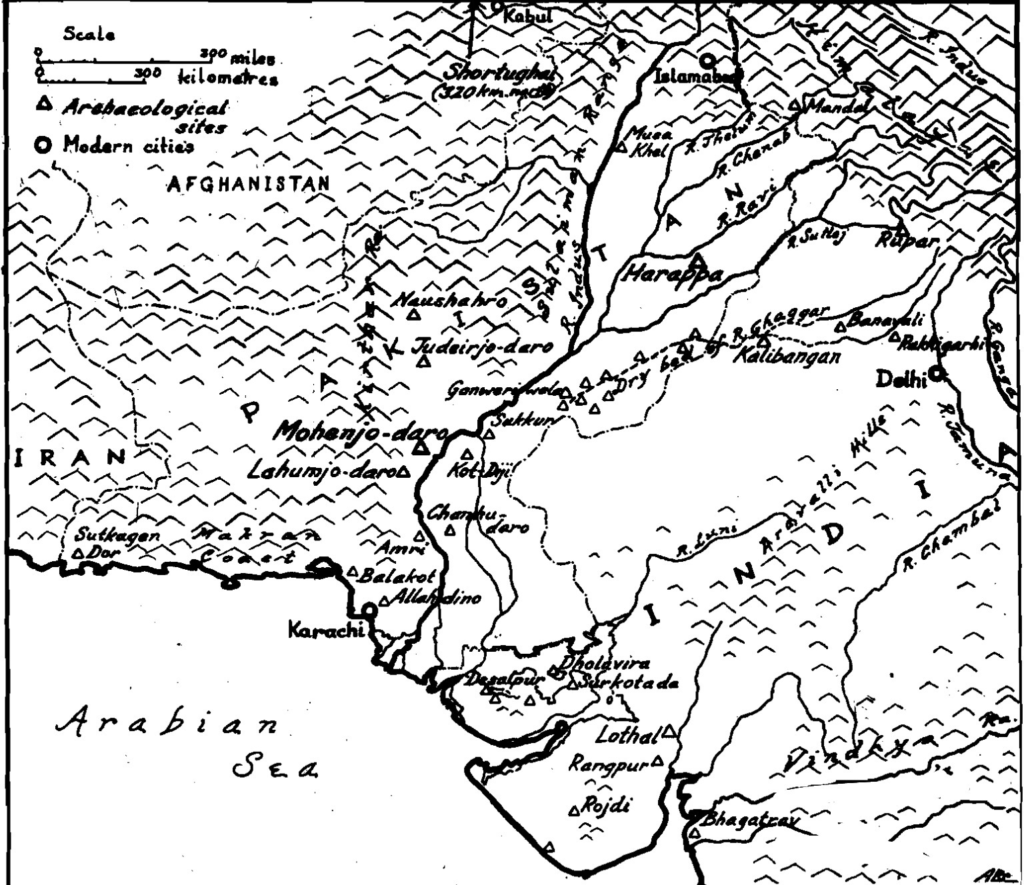
Various Centers of Indus Valley Civilization

Characteristics of Town planning

1 . Grid pattern

  • Cities were laid out in grid pattern
  • Streets oriented from East to west with broad main roads & smaller lanes intersecting at right angles

2. City walls / Fortified Cities

  • Harappan Cities were fortified . Fortification serves two purposes.
    • It exclude outsiders and the underprivileged.
    • They indicate that communities inside  had something to protect.

Thus it give clue to socio-political hierarchy. It helps the powerful to control activities inside the fortification. It also helps them keep an eye on the outsiders. If traders bring goods from places faraway they can collect their share for allowing them access to potential buyers inside the fortification

3. Acropolis & lower cities

Typical city would be divided into two sections ,each fortified separately

Acropolis / Citadal – Located on artificially raised mound
– Important buildings like Assembly Halls , Religious Structures , Granaries , Great bath of Mohenjodaro situated here
Lower section – On level ground
– Housing for inhabitants 

4. Residential buildings

  • People lived in houses of different sizes ie stratification was present in society
    • Opening of houses never in main streets
    • Staircases was present – may have led to roof
    • Floors made of high packed earth often replastered or covered with sand 
    • Roofs often made with timber  beams
    • Clay models of houses show that doors were sometimes carved or painted with simple designs
    • Small houses attached to large ones may have been quarters of service groups working for wealthy city dwellers
    • Toilets & Bathrooms – many houses or group of houses had separate bathing & toilet areas . Floor of these was made of tightly fitted bricks . Although some people may have relieved themselves outside city but toilet was present in almost all houses especially in Harappa
    • Houses were without much decoration. In general it was plain & un-decorative. This shows utilitarian outlook of Harappan people .

5. In -house wells

  • House  had its own wells, drains & bathrooms
  • In house well is a common & recognisable feature of Indus Valley civilisation

6. Drainage system

  • Impressive drainage system : It was the most complete ancient system as yet discovered.
    • Every house was connected to the street drains.
    • Main channels were made of bricks set in mortar and were covered with loose bricks that could be removed for cleaning.
    • House drains first emptied into a sump or cesspit into which solid matter settled while waste water flowed out into the street drains
    • Sewage chutes & pipes were separate from drains for collecting rain water
    • Drainage systems were not unique to the larger cities, but were found in smaller settlements  as  well.  Eg : At  Lothal , while houses were built of mud bricks, drains were made of burnt bricks.

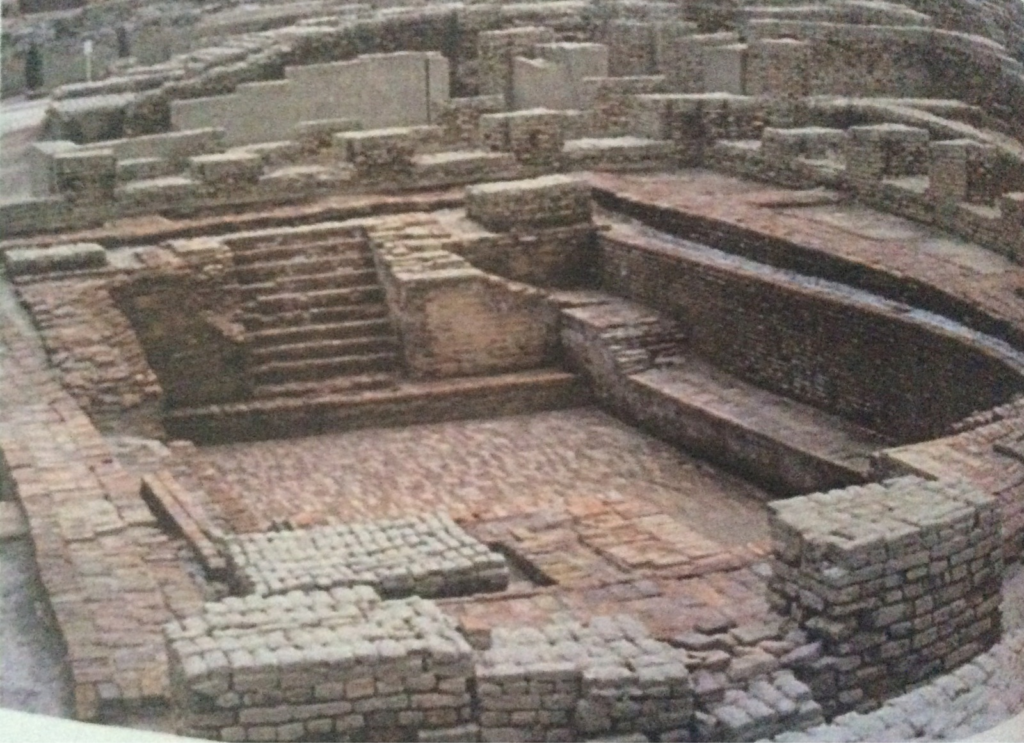
7. Great Bath

  • Rectangular measuring 14.5X7 m & 2.4 m deep at Mohenjodaro . Wide staircase leads down into tank from North & South . It was made water tight by finely fitted bricks . But purpose of the Great Path is matter of debate
Irfan Habib Was meant for only elite class (not for common people)
DK Chakraborty Was equivalent of tank accompanying a typical Hindu temple where one takes ritual dip before entering temple

There are series of rooms along the eastern edge of buildings. One of them has well that may have supplied water to the tank

Great Bath
Great Bath

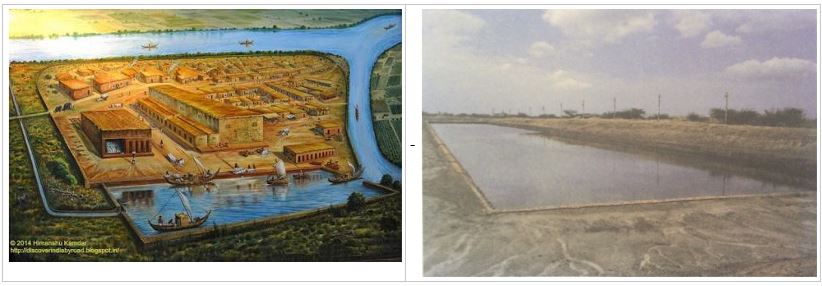
8. Dockyard

Huge Basin / Dockyard that was placed in centre of city & measured 770 feet in length & 120 feet wide & 15 feet deep with two openings on each side . Most probably it was used for docking ships ( but some historians feel that Basin was water reservoir for irrigation or for use of city )

Dockyard at Lothal
Dockyard at Lothal

9. Granaries

  • Largest building at Mohenjodaro (150ft long 75ft wide 15ft high )
  • Well ventilated
  • Used to store surplus grains and indicate centralized control

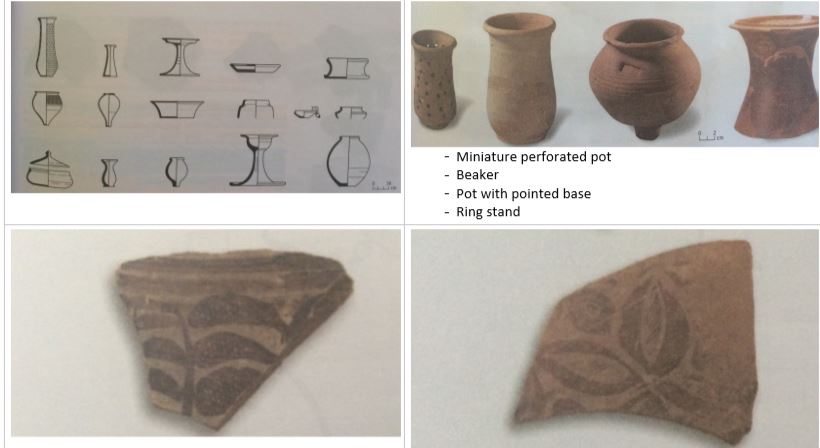
10. Pottery

  • Red and black pottery .
    • Red to paint the background and
    • Black colour to draw the designs of trees, birds , animals , human figures , other geometric patterns
  • Mainly wheel made . Very few hand made

Use of pottery

  • Utilitarian : Used in household purposes like storing water and food grains , cook food , eat food etc
  • Decoration : Vessels with designs were for decoration purpose  

11. No temples

12. Cemeteries

  • Disposal of the dead has been an important religious activity of the human group . This is because the attitude towards the dead is linked up with the human beliefs regarding this life & life after death. Harappan civilisation hasn’t yet yielded a monument for the dead who could equal Pyramids of Egypt or Royal Cemetery of the Mesopotamian city of Ur
  • Archaeologists generally use certain strategies to find out whether there were social or economic differences among people living within a particular culture. These include studying burials. Some graves contain pottery and ornaments, perhaps indicating a belief that these could be used in the afterlife. Jewellery has been found in burials of both men and women. In some instances the dead were buried with copper mirrors. But on the whole, it appears that the Harappans did not believe in burying precious things with the dead
  • Located at sites eg Harappa , Kalibangan , Lothal , Rakhigarhi & Surkotda. In this, Harappa has maximum burials and require particular study.
  • Types of burials
Common – Place body of deceased in extended position with head in north
– Simple pit or Brick chamber
– Grave goods include food, pottery , tools but they were never too lavish 
Symbolic Burials With grave goods but no skeletons
– Found at Kalibangan
Fractional burials Body exposed to elements & bones then gathered and buried
– In Harappa & Mohenjodaro
– These two sites also have urn burials – suggestive of cremation
Urn Burials Body burned and then ash placed in Urn and buried
– In Harappa & Mohenjodaro
Multiple Burials Of male & female Discovered at Lothal
  • A study at Kalibangan show different kind of burials found at same settlement. This shows different kind of religious beliefs & practices even in the same settlement.

Side Topic : Water Management System of Indus Valley Civilization

  • Ancient Indus Systems of sewerages and drainage that were developed & used in cities throughout Indus Region were far more advanced than any found in contemporary urban sites in the Middle East
  • Within the city, individual homes or groups of homes obtained water from wells. From a room that appears to have been set aside for bathing, waste water was directed to covered drains, which lined the major streets.
Mohenjodaro – Almost all houses had private wells (700 wells found in city)
Great Bath also found there
Lothal Port at the Arabian Sea with a dockyard
Dholavira System of water management was architectural marvel which was crucial in an area, which is prone to frequent droughts.
– Rain water in the catchment areas of the two seasonal streams – Manhar and Mansar – was dammed and diverted to the large reservoirs within the city walls.
– Apparently, there were 16 water reservoirs within the city walls, covering as much as 36 percent of the walled area. 
Shortughai Canal for irrigation of fields drawing water from nearby Kokcha river

Metal Architecture

This article deals with topic titled ‘Metal Sculpture .’ This is part of our series on ‘Culture’  . For more articles , you can click here

Introduction

  • Lost wax (Cire-Perdu) technique is known to Indians since Indus Valley & bronze from 5,000 years
  • Earliest Bronze sculpture is dancing girl from Mohenjodaro. Similar group of bronze statues have been discovered on archaeological excavation at Daimabad (Maharashtra) datable to 1500 BCE.
  • Bronze sculptures & statues of Buddhist,hindu and deities of 2nd to 6th century have been found which were mainly used for ritual worship

Jain Images

  • At Chausa (Bihar) , Bronze Images of Jain tirathankaras belonging to kushana period have been found
  • Most remarkable is depiction of Adinath who is identified with long hairs (all other tirathankaras have short hairs)

Buddha Images

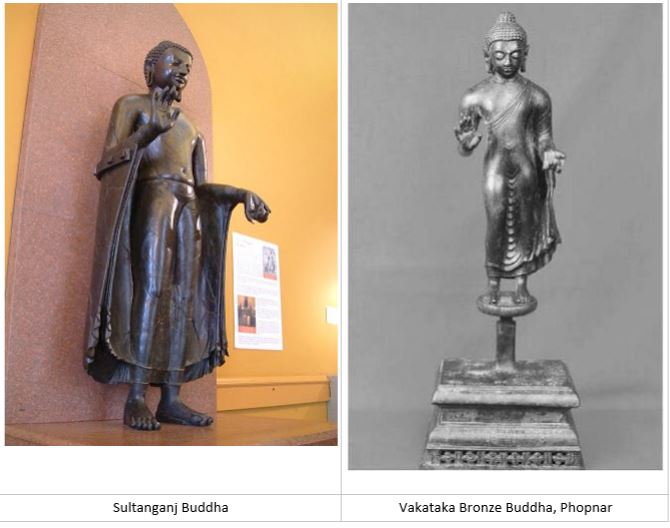
  • Most metal Buddha images in North are in Abhayamudra
  • Commonly found in UP& Bihar from Gupta & post gupta period & also in Maharashtra from Vakataka (Guptas & Vakatakas were contemporary)
  • In Abhayamudra right hand is free so that drapery(cloth) clings to right side of body. Result is continuous flowing line on this side of figure. At level of ankles of Buddha figure the drapery makes curvilinear turn as it is held by hand
  • Two such bronze statues are very famous  ie Sultanganj Buddha & Phopnar Vakataka Buddha
  • Advantage of these- monks can carry them from one place to other as they are portable for purpose of worship

About Sultanganj Buddha

  • Epitome of metal sculpture of that time
  • Dated between 500-700 AD
  • 2.3 m in height & 1 m wide , weighing 500 kg
  • Made using lost wax technique
Budha Images

Utsava Murtis Tradition of South India

  • In medieval times , this tradition emerged
  • In this deity leaves the sanctum & becomes approachable to all
  • Deity in many manifestations of human forms comes to street. Sometimes perform the journey to a place of pilgrimage or even to seashore to enjoy the breeze

Taalamana System of Tamil Nadu

  • During Chola period from 10th to 12th century , Bronze Murthis became extremely popular
  • Tradition of modelling followed in India & especially South India was entirely different from European tradition using Models
  • In India , images were made using mnemonic technique . In this craftsmen were meant to memorise dhyana shaloka which describe the attributes of various goddesses and gods & they used taalamana system of measurement to essentially visualise image & then sculpt it out of their own imagination rather than using models
  • Taalamana system of Iconography is derived from Shilpa Shastra
  • Taalamana system is system of measurement by Taala (ie palm ) & scale of 1 taala to 10 taalas was used

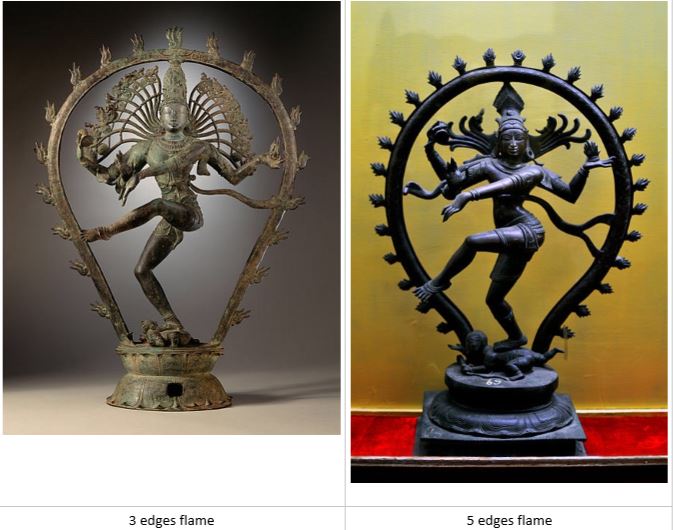
Nataraja Image

  • Most magnificent image in Bronze
  • Nataraja represents Shiva in his cosmic Dance ie Dance with which he destroys and creates world
  • One of the greatest icons created by man
Nataraja Image for UPSC
Nataraja Image

What different things represent

1 . Ring of Cosmic Fire

  • Oval Ring around original figure
  • Represents cosmic fire which he uses to destroy the universe as part of cycle of destruction and creation
  • Three edged but in 12 th century 5 edged were also produced

2 . Third Eye

  • Represents his cosmic knowledge

3. Multiple arm

  • Hindu deities are represented with multiple arms to represent their divine powers
  • His four arms take different positions or hold symbolic objects showing his strength & constellation of skills

4. Cloth

  • Veshti around waist
  • Yogyopeeth ie Janeau across torso

5. Earrings

Right ear Earring depicting Makara(=mythical water creature )
Left ear Circular earring worn by women
  • Represents Shiva’s male & female aspects (Ardhinarishwar)
  • Half male half female form illustrating balance of male & female energies

6. Hands & different things in it

1 Left hand Points downward => pointing sanctuary of the soul of the devotee
1 Right Hand Open palm in Abhyamudra => worshipper needn’t fear
2 Right Hand Damru => that Shiva beats to bring universe into creation
2 Left. Hand Cosmic fire to end cycle of creation and destruction
Metted locks of Jatta Reflect his role as yogi
Moon in Hair Shiva is associated with moon in number of narratives

7. Feat & Apasmara

  • Balancing on right leg & suppressing Apasmara (=demon of ignorance or forgetfulness)
  • Left leg raised in Bhujangatrasita stance which represent kicking away veil of maya or illusion from devotees mind

Gupta Sculpture

Gupta Sculpture

This article deals with topic titled ‘Gupta Sculpture .’ This is part of our series on ‘Culture’  . For more articles , you can click here

Introduction

  • Art and architecture becomes complex. The earlier designs displaying simple pleasures of life gave way to contemplative & spiritual vision.
  • Many art historians prefer to call Gupta period Art as Religious Art.
    • Utilitarian during Harappan Civilisation to
    • Court Art during Maurayan Period
    • Religious Art during Gupta Period.
  • Large scale temple construction took place.
  • For the first time , a clear & distinctive development between Sculpture, Architecture & Painting can be seen.
  • Major centres of Gupta art were
    • Sarnath
    • Mathura
    • Nalanda

1 . Sculpture at Dashawatara Temple Deogarh ( U.P.)

Sheshnag   Vishnu – Sheshnaag Vishnu at Deogarh is important specimen of sculpture during Gupta Period
– Headgear, ornamentation of Vishnu are important to notice  
Sculpture on Lintel – Lintel has detailed artistic sculpture on it
– Geometric precision is noticeable.  
Dashavatara Temple
Dashavatara Temple

2 . Sarnath Standing Budha

Already explained in other article. Refer here

Sarnath School

3. Udayagiri Cave , Vidisha

  • Great Boar (Varaha) at the entrance of Udayagiri Cave
  • Here at entrance of one of the Cave, particularly powerful relief shows Vishnu in his boar incarnation rescuing the earth from waters
Varaha at Udayagiri Cave

In the Udayagiri caves of Vidisha , Mukhalinga belonging to Gupta rule is also present

4. Terracotta

  • Includes small figurines and plaques found at many places including Kaushambi, Rajghat, Bhita and Mathura
  • These represent animals , ordinary people and gods & goddesses such as Durga, Kartikeya & Surya .
  • Among the remarkable pieces of monumental terracotta sculpture are almost life size images of the goddesses Ganga and Yamuna found at Ahichchhatra . Such images were placed in temple niches

5. Bronze Sculpture

  • Used Lost Wax Technique (aka Cire Perdue Method)
  • Copper and Bronze images of Buddha found at many places especially Nalanda (Bihar)
  • 2.3 m high Copper-Bronze Buddha image from Sultanganj (refer next article)
  • Mehrauli Iron Pillar – Very interesting because first such thing & it hasn’t rusted yet.

Post Mauryan Sculpture

Post Mauryan Sculpture

This article deals with topic titled ‘Post Mauryan Sculpture .’ This is part of our series on ‘Culture’  . For more articles , you can click here

Introduction

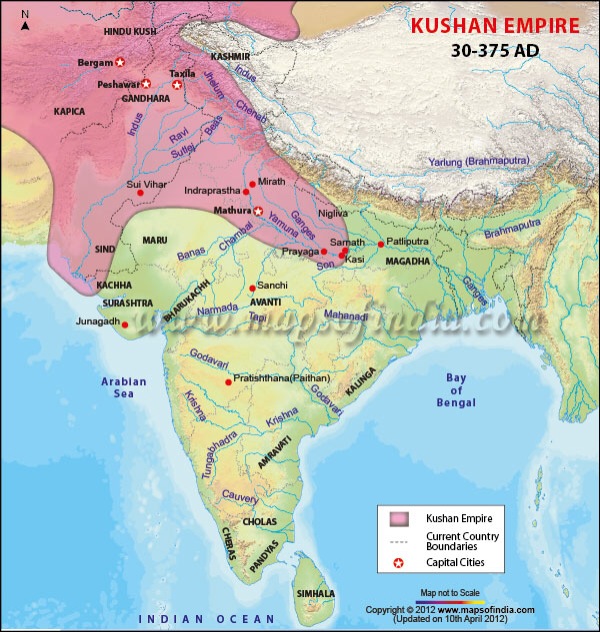
  • In Post Mauryan Phase, Shungas, Kushanas & Satavahanas ruled. 
  • This phase paved the way for different schools of sculpture (like Mathura School of Art, Gandhara School etc & these School of arts gave way to Temple architecture) 
  • Factors which developed art and culture in this phase
    • Geographical expanse of respective kingdoms
    • Local available material
    • Local traditions of craftsmanship
    • Political requirements
    • Tastes of royalty (Satavahana queens gave donations to Buddhist monks in Western Ghats and various caves like Karle, Kanheri etc came up there)
    • Religious inclination of the dynasties (these three dynasties patronised Brahmanism but at the same time kept on patronising Buddhism and Jainism although not at that great scale as Ashoka)
  • In this phase, although state patronage continued ( on lesser scale) but local players like Guilds and common people started to play important role in Art and Sculpture .
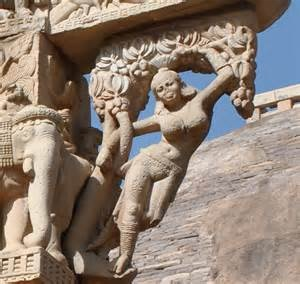
  • In this age, different motifs of yakshas&  yakshis became very favourite. Shilabhanjika motif ie grasping the tree motif was very popular during this age
 Shilabhanjika from Torana of Sanchi


Shilabhanjika from Torana of Sanchi

Kushana Period

  • Art & sculpture developed in this period at great pace. This was beginning of Golden phase of Indian Art
  • Kushana rule opened the gateway for active interaction of Indian Culture with those of Central & Eastern Asia . These further paved the way for exchange of ideas with other advanced traditions of ancient world like Graeco-Roman Traditions
  • Development of various schools of art took place in this period
  • Era of excellence in several fields including religion , philosophy & literature.
  • Most important development took place in Buddhism . During Kushana rule , first major Schism took place in Buddhism when Buddhism divided to Hinayana & Mahayana . Mahayana provided  great impetus for development of sculpture because Buddha in this school can be shown in human form.  

Mathura & Gandhara school of Art

  • Both Gandhara & Mathura were part of Kushana rule
  • First Buddha appeared  in Mathura & later spread to other places including Gandhara
  • Both developed under political hegemony of Kushanas
  • In due course of time both schools merged

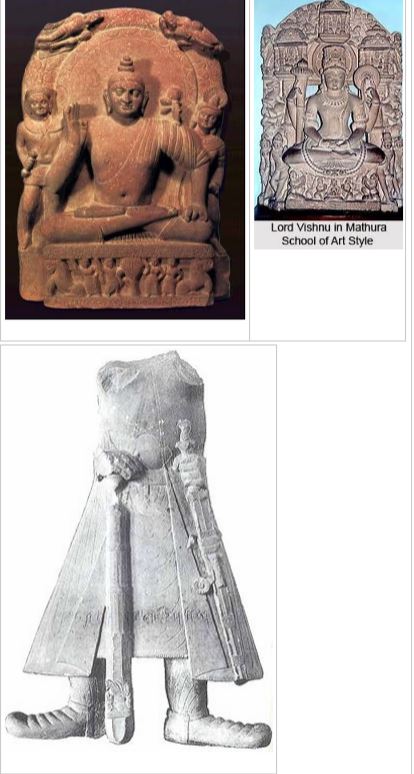
1 . Mathura School of Art

Origin – In heartland of India & percolation of foreign influence was almost none.
No foreign influence,but later fertilised with Gandhara School
Initial development took place indigenously inspired by Yakshas
Material Spotted red sandstone (from Sikri mines)
Features – Mathura image makers didn’t  intend to sculpt anatomically correct Budha & were images were generally disproportionate.
– Images were compositions of 32 major & 80 minor laksana.
Images were very inexpressive Buddha has been shown sitting cross legged.
Boldness in expression . Images express more of power & less  of compassion
– Hair aren’t dressed.
– Drapery and clothes are shown in simple manner
– Images are mainly in Abhayamudra
Centes Mathura, Sarnath, Kosambi  
Images Buddha
Jain Tirathankaras
Images of hindu gods and goddesses like Vishnu, Shiva, Parvati, Kuber etc
Image of Emperors – most important being that of Kanishka  
Patrons Developed under Kushanas & Zenith during the Gupta period 325-600 AD
Mathura School of Art

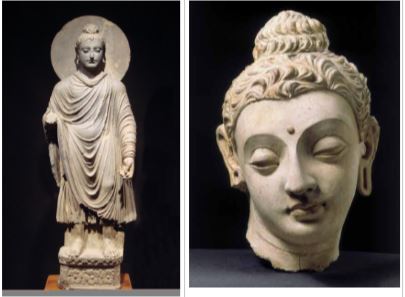
2. Gandhara School of Art

Origin – Gandhara region is in North West of Subcontinent and Silk Road passes through it. Also it is on border of Subcontinent. Hence , ideas from different regions like from China, Greek, Roman, Persian kept on coming in this region. As a result of mixing of all ideas along with Indian ideas, totally different school came up here.
Strong Greeko-Roman influence- based on greco- roman norms (but influence of  Indian Traditions was strong as well) Also known as  Greco-Buddhist school of Art
Material Black stone & Stucco
Features – Closely connected with Mahayana Buddhism
– Has distinct influence of old Greek School of Art. => It used the Indian themes but used the material (Stucco)  & ideas of Graeco -Romans
– Main theme of this school was Buddha & Bodhisattvas.
Image Features – Finer details and realistic images
– Buddha carved out in various mudras
Curly/wavy hair,anatomically accurate,spatial depth.
– Wrinkles on skin, compassion and muscular frame of body
– Transparent garments , fold of garment very natural , flowing drapery Images are very expressive & muscularity of body is depicted very well (Greek gods are also depicted in masculine posture) 
– Buddha is depicted like Greek God Apollo
Centres Taxila,Begram, Bamiyan & Peshawar (Afghanistan & NW India)
Patrons Shakas & Kushanas
Gandhara School of Art

Greek , Roman and Indian Influence

Greek – Depiction of Buddha as a ‘man-god’ in Gandharan sculpture is inspired from Greek mythology. Greek sculpture believed in mythological and idealist statues, while the Roman sculpture was more realistic (Greek Sculptures = God | Roman Sculptures = Mainly used to make statues of Kings and Generals)
Stucco plaster, which was commonly used in Greek art, was widely used in Gandharan artwork
Wavy hair (Romans have adopted wavy hair from Greek)
Masculinity ( Greek gods were always shown muscular)
Roman – Roman Sculpture developed from Greek Sculpture. Hence, there was large similarity in them but differences were visible as well.

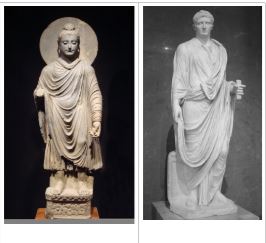
Drapery     Drapery of the robes on Buddha was also very similar to the drapery on Roman imperial statues. (refer image below)
Indian – Jewelry indicated was Indian
– Idea of Buddhism is Indian. 
Drapery of Budha and Roman Imperial Statues

Mathura vs Gandhara School of Art

This type of question is very important for State Level PCS examinations.

Mathura school Gandhara school
Origin No foreign influence & indigenous development (although  later cross fertilised with Gandhara schools ) Strong Greek-Roman influence . Graeco Buddhist school of art . Initially inspired by Hellenistic features.
Material used Spotted red sandstone Stucco
Religions All 3 = Buddhism , Jainism & Hinduism Only Buddhism
Image feature – Not much attention to detailed sculpting
– Buddha is stout
– Finer details
– Realistic images
– Buddha in various mudras  
Area Mathura, Kosambi Taxila, Bagram, Bamiyan  etc
Patronage Kushanas & later Guptas Kushanas & Shakas

Amravati School of Art

During the time of Satavahanas , Amravati & Nagajunakonda developed as center of art popularly known as Amravati School of Art aka Vengi School of Art. 

Location – Amravati is in Guntur dist of AP.
– Aka Vengi School of Art & developed in lower valleys of Krishna -Godavari region
Patrons Satavahans & Ischvakus
Material White Marble
Place Andhra Pradesh (Krishna -Godavari Valley)  
Theme – Buddha life & Jataka stories
– Both Mahayana & Hinayana
– There is emphasis on the narrative element with stories from the life of Buddha and Bodhisattva dominating such episodes relating to the Birth, the miracles, Enlightenment   
Features Curly hairs of Buddha influenced by greeks
Kings,princes,palaces have got prominence
– Its gateways has images of lion
– Amravati figures are lean, beautiful, curvy & mobile even when resting (in this respect close to Gandhara)
– Flowers & lotus motifs are carved frequently
– Various postures create an interest in activities of each individual \- Most of sculptures are joyful.
Female figurines are made in different postures. Feminine beauty is better depicted in Amravati than in Mathura School of Art.
– Amravati School of Art had a great influence on the later period sculpture of South India and even Sri Lanka & South East Asia.
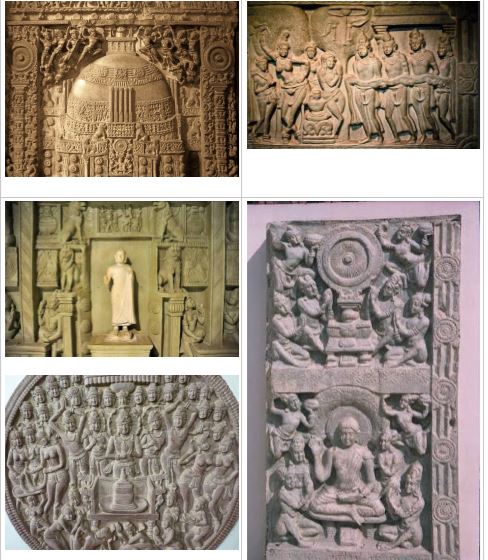
Amravati School of Art

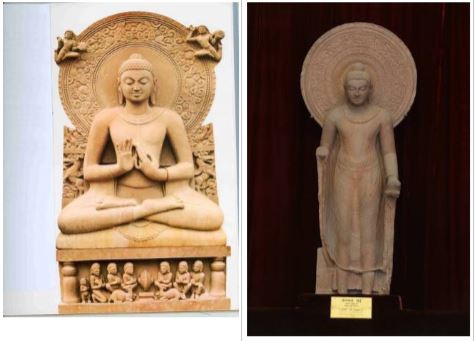
Sarnath School

  • Sarnath is place near Varanasi and is famous as place where Buddha delivered his first sermon
  • Sarnath School developed much later than Gandhara & Mathura School and some scholars opine that development of Sarnath school is closely associated with the Gupta Period.
  • It is also associated with Buddha (and Boddhisatvas are also shown)
    • Halo is very much developed . 
    • Hair are developed than Mathura (but lesser than Gandhara) – small dot like structure
    • Drapery isn’t developed – Flows are simple and not showing natural cloth like Gandhara . Almost transparent
    • Made of Red Sandstone
    • Calm & inner tranquility is shown
    • Very popular for preaching Buddha ie Dharmachakramudra is most common in this .
    • Here Stupa Architecture was very much different than other places like Sanchi . Eg Dhamekh Stupa & Chaukhandi Stupa both belonging to this school.
Sarnath School
Sarnath School

Mauryan Sculpture

Mauryan Sculpture

This article deals with topic titled ‘Mauryan Sculpture .’ This is part of our series on ‘Culture’  . For more articles , you can click here

Introduction

  • Dr.Ananda Coomarswamy  differentiated Mauryan sculpture to
Court Art Palaces, Pillars & their capitals
Popular Art Yakshas & Yakshinis, Pottery.
  • Maurayan Empire has great role in promoting Indian Sculpture.
  • Why Maurayans were Patronisers of Art & Architecture
    • Maurayans gave secured borders to India and in times of peace, art and architecture saw phenomenal growth.
    • Other reason was that because of such a huge area under control and surplus revenue, emperors could easily patronise art
    • Role of religion was also there. Pillars to spread message of Ashoka’s Dhamma & along with this, Stupas & Monastries came up due to spread of Buddhism.
  • From Utilitarian Art of Indus Valley Civilization , in Maurayan Period it became Court Art.
  • Uniformity in styles of pillar capital tells us that craftsmen were  from same region

Influence on Mauryan Art

Mainly influenced by two things

Religious influence – Buddhism became most popular social & religious movement
– Concept of religious sculpture prominent  
Foreign Influence – First three Mauryan emperors Chandragupta,Bindusara & Ashoka known to have friendly relations with Hellenistic west and Achaemenids of Iran
– Adaptation of Achaemenids seen in Edicts & imperial palace of Pataliputra  

Court art

It mainly consist of Edits and Pillars made by the royal court on the direct orders of king himself.

Location of Edicts
Location of Edicts

General Outline

Consist of

  • Shaft : Monolithic & Freestanding
  • Bell/Lotus Base : Act as Joint between pillar & capital
  • Drum : On bell base. Can be rectangular, square or circular
  • Capital : Placed on Drum eg Lion, Bull, 4 headed Lion etc.

General Features of Ashokan Pillars

  • Inscriptions on Stone  ie Ashoka’s Message to his subjects
    • In middle of Pillars . If seen with bare eyes, these inscriptions cant be read properly. That is the reason , why Dhamma Mahamatras were there in Ashokan Period who periodically visited these places and read out the message of Emperor to people.
    • Mostly written in Brahmi Script and Pali or Prakrit Language. In North West , Greek language and Aramaic script was used.
    • Important to note that any Pillars don’t mention Ashoka but Devnampriya Priyadarshi
  • Monolithic & free standing structures (ie without support)
    • All the Ashokan Pillars are carved out of single stone with no breaks
    • They are not supported with any material
    • Prof Jaiswal of BHU argues that many a times, these arent monolithic but joined and polished from above so that joints arent visible . Nevertheless most of them are monolithic.
  • Use of Chunar Sandstone
    • Chunar is place in Mirzapur district & there are naturally existing mines of Sandstones there.
    • All the pillars were mined out of that place and transported to different places.
  • Polished surface
    • Surface of these Pillars is very shiny and archeologists called it Polish
    • Actually it is mixture of animal fat with lime, gypsum and sandstone .
  • Animal capitals
    • Every pillar has capital made of same stone
  • Transportation Technique
    • Since these pillars are massive structure several feet in height and very heavy. In those days, transportation was not that effective as that of modern time
    • Inland navigation was used for this. River Ganga was used extensively. This is the reason that most of these pillars are found in Ganga Valley.

  • They are placed either to mark a sacred site associated with Buddha’s life or to commemorate a great event. On many of these pillars are inscribed the famous edicts of Ashoka propagating the Dhamma (laws of the Buddha) or the imperial sermons of Ashoka to his people.
  • Some were of spotted red and white sandstone from the region of Mathura, the others of buff colored fine grained hard sandstone usually with small black spots quarried in Chunar near Varanasi.The uniformity of style in the pillar capital suggests that they were all sculpted by the craftsmen from the same region.

Various Pillars

1 . Lion Capital

The Lion Capital
The Lion Capital
Place Sarnath (now our national symbol without crowning wheel)

Note :  there is one Lion capital similar to this at Sanchi too but that is not our national symbol because in it’s drum base  is different  
Components For all these are same 5 in number (now only 4 remains)
1.shaft Broken into many parts now
2.Bell base Artistic beauty and act as joint between pillar and capital
3.Drum on Bell Base Circular in shape Has drum shape with 4 animals -elephant,horse,bull &lion
4Lions – 4 voluminous roaring lion figures back to back
– Indicate spread of dharma in all direction
– Reminiscent of Persian tradition
5.crowning Element – Dhammachakra, a large wheel
– Lions originally supported this and it is important symbol of cosmic order; in Buddhism it represents Dhammachakraparivartan (first sermon by Buddha)
– This wheel is lying in broken condition &displayed in museum

2. Pillar at Vaishali

How different Only one lion capital
Direction of lions face North
Why north Direction buddha took on his last voyage
Location of pillar Contiguous to site of monastery

3. Allahabad pillar

  • First erected at Kausambhi (30km from Allahabad) capital of Koshala Kingdom
  • Located inside Allahabad fort now
  • Earlier inscriptions from Ashoka (Brahmi Language dated around 232 BC)
  • Later inscriptions attributed to Samundragupta &  Jahangir
  • Too has single lion capital

4. Lauriya-Nandangarh

Lauriya Nandangarh
Lauriya Nandangarh
Location 23km from Bettiah in West Champaran,Bihar
Feature – Single lion capital
– Hump and hind legs of lion go beyond abacus

5. Lauriya-Areraj

Location East Champaran , Bihar
Speciality Devoid of any capital

6. Rampurva

  • Bull Capital in Rampurva ( Bihar)
  • Presently, it is in Rashtrapati Bhavan

Comparison with Persian Pillars

  • Most of the Colonist/Imperialist Historians gave theory that Indian Art was highly influenced by foreign Art & Ashokan Pillars were simply a copy of the Pillars of Persian Empire of Darius I because they wanted to show that Indians weren’t capable of such artistic endeavors . 
  • Yes, these two types of pillars are of same period and ideas do match but we cant say that one is the simple copy of other. Idea of these pillars was very much prevalent in Persia & India both of which came in same cultural zone in those time but developed in both places  with local artistic craftsmanship. It cant be said that one copied from other.

Popular Art of Mauryans

1 . Yaksha & Yakshini

Yaksha Nature spirits usually benevolent also known as fertility spirits
Yakshini Female counterpart of male yaksha
  • Both attend to Kubera ,hindu god of wealth who rules mythical Himalayan kingdom-Alaka
  • They were deities of common people (ie symbolize common belief of people)  but gradually other religions took them into their fold
  • Both caretaker of natural treasures
  • Have prominent place in Hindu, Jain & Buddhist literature
  • Most common element- polished surface & clear physiognomic details

2. Didarganj Yakshini

Place – Didarganj (Bihar)
– In Patna museum presently.
Material Sandstone with polished surface ,reflecting sophistication in treatment
Features – Tall, well built, well proportioned, free standing sculpture
– Yakshini holds chauri (flywheel) in right hand & left hand is broken
– Shows sculptures sensitivity towards round muscular female human body- folds of muscles are properly rendered & tightening of garment around belly creates effect of bulging belly.
– Lower garment has been rendered with  great care. Each fold of garment on legs is shown by protruding lines clinging to legs ,which create transparent effect
– Heaviness of torso is depicted by heavy breasts and impressive back

3. Elephant Sculpture

Place – Dhauli near Bhubneshwar
There is rock-cut elephant above the Edicts which  is the earliest Buddhist sculpture of Odisha.
Features – Represent fore-part of elephant carved over edicts of Ashoka
– Different from animal figures surmounting pillar capitals
– Fine delineation of bulky volume & living flesh, natural to that animal along with dignified movement and linear rhythm that has no parallel

4. Facades of Lomus Rishi cave

Place Rock cut cave of Lomus rishi in Barabar Hills near Gaya,Bihar
Feature Decorated with semicircular chaitya arch at entrance resembling that of wood work
Patronage By Ashoka for Ajivika sect

5. Pottery

  • Pottery is known as Northern Black Pottery Ware (NBPW)
  • Black color was used
  • Highly lustrous polish was used
  • It was a Luxury ware showing maturity
  • it shows highest level of pottery making
  • Was considered precious item => because archaeologists found broken NBPW pottery that was repaired