Revenue Systems of British Raj

Revenue Systems of British Raj

This article deals with ‘ Revenue Systems of British Raj – UPSC.’ This is part of our series on ‘Modern History’ which is important pillar of GS-1 syllabus . For more articles , you can click here


Changes in Revenue system during British Empire

  • Pre Colonial Indian society was a feudal society & in its place was established semi-feudal & semi-colonial structure
  • Old feudal structure was mostly dismantled
  • Land now become a commodity ie it became alienable private property & peasant’s occupancy right of land was totally abolished
  • Extraction of maximum surplus from the peasant’s produce became the basis of early system of colonial plunder
  • Indian economy & agriculture was converted into a raw material supply appendage to metropolitan Britain


Three important land revenue settlements were introduced in three different regions

Permanent Settlement Bengal , Bihar & Orissa By Cornwallis
Ryotwari Settlement Bombay & Madras Presidency By Munro & Elphinstone
Mahalwari Settlement North + North West + Parts of Central India By Mackenzie

These systems differed only in nomenclature but aim was same – plunder of India & maximisation of revenue


Main Characteristics of these Systems

  • British land revenue settlement  introduced in India the notion of private property in land. Such kind of land- proprietorship meant that its holders were granted ownership rights. Although, in the pre-colonial times, a massive and pyramidal structure of leasing and sub- leasing of revenue functioned and cultivators also enjoyed certain rights in land according to local customs, yet, there were no well-defined proprietary rights. The British invested such rights in certain groups in accordance with the local conditions. Thus they favoured certain groups of landed magnates who were integrated into the colonial agrarian structure & such groups were to become the powerful allies of the British.


  • Overassessment of revenue and inflexible method of collection :  attempt to maximise the land-revenue demand. Revenue demands were fixed in cash rather than on a proportion of produce, or kind and  assessments were generally exorbitant.


  • Impetus to Money lending and usury : As a result of exorbitant land-revenue demands, peasants borrowed money from rural creditors and grain dealers in order to avoid defaults. Sale and auction of land tended to increase as cultivators usually borrowed money on the security of their newly acquired proprietary rights in land. This created agrarian tensions.


  • Commercialization of Agriculture

During Dual Government in Bengal

  • 1765 :  Under Treaty of Allahabad , East India Company got Diwani Rights of Bengal, Bihar & Orissa from Mughal Emperor
  • But Clive & his successors continued old system of revenue collection i.e. through intermediaries or zamindars in which revenue official after deducting 10% of revenue  deposited remaining in treasury . Collected amount increased from 81 lakh in 1764 to 2.3 crore in 1771
  • East India Company’s administration wasn’t concerned with how revenue would be collected & what impact it will have on common people. They increased their demand every year , collectors in turn demanded more from peasants
  • Peasants were the main sufferers & many of them left land


Ijaredari System

  • Farming System : Warren Hastings in 1772  introduced the farming system by which agriculture estates were auctioned out to highest bidder for leases not extending beyond 5 years
  • Obviously, such contractors (they were called ‘farmers’ in those days), would try and extort as much as possible during the period that they held the contract; it would not matter to them if people were ruined &  production in the later years declined.
  • As there was no permanence of tenure, the farmers took no binding interest in the development of land & it proved disastrous
  • Colonial officials began to feel that a sound administration must have security as its basis & nothing but a Permanent Settlement could ensure that
  • Appointed Amini Commission(first commission in British India) in 1776 to enquire real value of land which submitted report in 1778


Permanent Settlement

Introduction

  • Cornwallis realised that the existing system was impoverishing the country, ruining agriculture and was not producing the large and regular surplus that the Company hoped for. Company’s trade also suffered, because of the difficulty in procuring Indian goods for export to Europe. Production of silk or cotton, two of the Company’s major export items, was mainly agro-based
  • Was introduced by Lord Cornwallis but it was not his brainchild . Even before  Cornwallis, number of  officials were advocating for tax being permanently fixed eg Alexander Dow in his book History of Hindostan & Pitts India Act of 1784 also laid down directions for Permanent Settlement of land revenue
  • Introduced by Cornwallis as decennial (10 years) settlement & made permanent in 1793
  • Introduced in Bihar, Bengal , Orissa & some parts of Varanasi & some parts of Madras


Move towards Zamindari System

  • Lord Cornwallis came to India as Governor General in 1786 & land revenue has created many problems . Different English officials were expressing different opinions
  • There were two schools
James Grant State was the owner of land & Zamindar was just rent collecting agent . Zamindars have no permanent rights whether as proprietor of soil or as official who collected revenue
John Shore Proprietary rights belonged to Zamindars & state was entitled only to demand customary revenue from them


Cornwallis , who himself was English landlord accepted the version of John Shore


Cornwallis also got Instructions from Court of Directors which said that after assessing the records for past years , a settlement should be made with zamindars for some years that could be made permanent in future. Hence, Lord Cornwallis introduced the Permanent Settlement   in 1793


Main motives behind Permanent Settlement

  • Security of revenue
  • Creating politically reliable landed elite to act  as pillar of colonial rule
  • Since it was Permanent Settlement and state would not increase its demand if land under cultivation increased =>  these Zamindars would invest in land to bring more land under cultivation to increase their income.
  • To solve bullion issue (Indian revenue would be used for trade instead of bullion from Britain)
  • Failure of farming system
  • Capital formation: capital would flow from rural to urban areas(which would increase trade )  & agriculture development
  • Physiocratic school of thinking that assigned primacy to agriculture in a country’s economy


From minutes of Cornwallis

  • The improving landlords would bring the waste lands under cultivation , improve their tenure by better system of embankment & drainage & encourage scientific farming


Main Features

  • Zamindars had several (sometimes as many as 400) villages under them. In Company calculations, the villages within one zamindari formed one revenue estate. The Company fixed the total demand over the entire estate whose revenue the zamindar contracted to pay. The zamindar collected rent from the different villages, paid the revenue to the Company, and retained the difference as his income.
  • Zamindars were made landowners & proprietary  rights were given to them . They were not only to act as agents of government collecting revenue but also became owners of land
  • Ownership of land was hereditary & transferrable
  • Cultivators were reduced to level of mere tenants & use of pasture lands , irrigation lands , fisheries etc were all given to zamindar . Main motive –  zamindars might pay land revenue on time
  • Zamindar were expected to improve condition of tenants & agriculture
  • State kept no direct contact with peasants
  • Zamindars were made proprietors of land & they have to pay give 10/11 of the assessed rental to the colonial state and keep 1/11th of the rental for themselves.
  • In case of excess rental due to extension of farming or greater extraction, zamindar could keep entire increased amount
  • In 1794, Sales Law/ Sunset Law was introduced under which Zamindari rights would be auctioned in event of failure to pay revenue
  • Regulation of 1799 & 1812 – Zamindar was given right to seize property of tenant in case of non payment of rent (the permanent assessment was the largest sum that could be got from the land. It was a heavy and oppressive assessment.  Such oppressive taxes could only be collected by oppressive methods. If the zamindars were not allowed to oppress the peasants then they would not be able to meet the demands of the State)
  • Initial fixation of revenue was made arbitrarily & without consultation with zamindars . Attempt was to secure maximum amount as a result rates of revenue were fixed very high


Impacts

  • Initially, Zamindars were to give 10/11 of the assessed rental to the colonial state and keep 1/11th of the rental for themselves. However, the sums to be paid by them as land-revenue were fixed in perpetuity. If the rental of a Zamindar’s estate increased due to the expansion of cultivable area or rise in agricultural productivity or simply due to his capacity to extract more from the tenants, he was entitled to keep the entire amount of the increase. This would constitute loss to income of East India Company / State
  • As a result of this settlement, most of the tenants including the pre-existing Khud-khast tenants enjoying occupancy rights in their lands were reduced to the status of mere tenants-at-will of the Zamindars who could easily evict them and enhance their rents.
  • No margin was left for shortfalls due to flood, drought or other calamity. As a result, many zamindars had their zamindaris taken away and sold in the decades immediately after the Permanent Settlement. In Bengal alone, it is estimated that 68 per cent of the zamindari land was sold between 1794 and 1819.
  • Village based zamindars were replaced by rich people from Calcutta who went on buying spree of agricultural estates of old zamindars who fell prey to Sunset Law
  • There is a view that this is the reason why Bengali people didn’t invest in industry because they found investing in land more profitable
  • Process of Sub-infeudation started – Finding it difficult to pay amount, Raja of Burdwan(others followed too)   divided most of his estate into ‘lots’  called Patni Taluqs. Each such unit was permanently rented to a holder called a Patnidar, who promised to pay a fixed rent. If he did not pay, his Patni could be taken away and sold.


Merits

  • Secured fixed & stable income for the state
  • Expenses of frequent assessment of lands were saved
  • Made a class of Indians who were loyal to British empire & their existence depended on continuance of British empire
  • Before settlement East India Company was required to maintain big establishment of collectors which weren’t required now
  • Judicial services improved because Permanent Settlement set free ablest servants of Company for judicial services
  • Value of land increased because zamindars devoted their attention towards improvement of soil & many wasteland & forests were converted into cultivable land
  • Britishers envisaged that it would be helpful in spreading education as zamindars would act as natural leaders & show public spirit in spreading education & charitable work


Demerits

  • Permanent Settlement was  a great blunder & it affected adversely the interests of East India Company , zamindars & worst of all that of Peasants
  • System overlooked interests of peasants
        • They were not owners of land
        • Could be expelled from land
        • Couldn’t appeal anyone against rise in taxes
        • Rights over pastures ,forests & canals were abolished as well
        • In 1799 : Zamindars were given right to court & zamindar could also take away their property even if peasant was not able to pay tax due to calamity


  • Created feudalism at top & serfdom at bottom
  • No improvement in agriculture happened . Most of the landowners didn’t take any interest in improvement of land but were merely interested in maximum possible extraction of the rent.
  • Politically although class loyal to them was created but East India Company alienated masses to gain loyalty of few
  • Disadvantageous for Company as although Company’s expenses were increasing, revenue remained same & they lost contact with peasants


Ryotwari System

Reasons for introduction of Ryotwari System

Lord Cornwallis wanted to extend Permanent Settlement to other areas & Wellesley shared same idea & gave orders for extension to Madras presidency but there were problems

  • There wasn’t sizeable Zamindar class in Madras as in Bengal . Still between 1801 to 1807 Permanent Settlement was introduced by recognising Poligars as local zamindars & where poligars were not found , villages were aggregated into estates & sold to highest bidder
  • Scottish enlightenment – They insisted on primacy of agriculture & celebrated importance of farmers within agricultural societies . Thomas Munro & Elphinstone were Scots
  • Nature of Permanency in Permanent Settlement : After 1810, agricultural prices rose, increasing the value of harvest produce, and enlarging the income of the Bengal zamindars. Since the revenue demand was fixed under the Permanent Settlement, the colonial state could not claim any share of this enhanced income. Keen on expanding its financial resources, the colonial government had to think of ways to maximise its land revenue. So in territories annexed in the nineteenth century, temporary revenue settlements were made.
  • David Ricardo’s theory began to influence .  It says that – Rent was surplus from land ie Income – (minus) cost of production – (minus) labour & state has legitimate claim over that at expense of unproductive intermediaries . This  argument was used to eliminate zamindars
  • Most important cause was Financial pressure due to wars   – financial crisis of Madras Presidency worsened by rising expenses of wars .


Experiments in Ryotwari Settlement

  • Started by Alexander Reed in Baramahal in 1792 & continued by Thomas Munro from 1801. But after 1807, System was almost abandoned with departure of Munro back home.


  • 1820 : Munro returned &   he argued
        • Ryotwari was ancient land tenure system & best suited to Indian conditions
        • Security & administration of empire need elimination of overmighty poligars & zamindars
        • Historically land in India was owned by state which collected revenue from individual peasants through hierarchy of officials . When military power of state declined , these poligars appropriated land & usurped sovereignty . Hence, there is need to reverse it now


  • Its adoption was due  to one main reason – it resulted in a larger revenue than any other system could have produced. This was because there were no zamindars or other intermediaries who received any part of the agricultural surplus – whatever could be squeezed from the cultivator went directly to the State. The Madras government was chronically short of funds, and such a system would naturally appeal to it.


  • In Bombay : Introduced by Elphinstone in 1819 after defeat of Marathas . There was no large Zamindars here too


  • Instead of collecting from the zamindars, they began to collect directly from the villages, fixing the amount that each village had to pay. After this they proceeded to assess each cultivator or ryot separately – and thus evolved what came to be known as the ‘Ryotwari’ system.


Main features of Ryotwari Settlement

  • Revenue was assessed for each cultivator or ryot separately
  • It created individual property right in the land & it was vested in peasants rather than in zamindars .
  • It was a temporary settlement & was to be revised periodically (20 years )


Rate

Madras
Unirrigated Dry Land 50% of Gross Produce
Irrigated Wet Land 2/3rd of Gross Produce
Bombay
  • Land revenue was not assessed as in the case of Madras on basis of gross agriculture produce 
  • Fertility of land & market price of agricultural produces were given priority in assessing land revenue upon ryots


But in order to be attractive & equitable , it required detailed land survey, quality of land , area of the land, average produce of every piece of land had to be assessed but in practice these estimates were often guessworks & hence revenue demand often was very high .


Impact in Madras

  • Peasants soon discovered that large number of zamindars were replaced by one giant zamindar ie Colonial state
  • Raised revenue income of government but put cultivators in great distress . In many areas no survey was carried out & tax of a ryot was assessed on an arbitrary basis based on village accounts
  • Revenue to be  paid by ryot was fixed on entire farm & not on each field which might have varying irrigation facilities & hence different levels of productivity
  • Contrary to Munro’s insistence that cultivator would be given freedom to take as much or as little land as he choose , this provision was dropped in 1833 . Government  officers began to compel the cultivators to hold on to (and of course, pay for) land that they did not really want to cultivate. Since cultivation was not voluntary, it was always difficult to collect the revenue, and so the use of beating and torture to enforce payment was also widespread. These methods were exposed by the Madras Torture Commission in 1854. After this certain reforms were introduced. A scientific survey of the land was undertaken, the real burden of tax declined, and there was no need to use violent and coercive methods to collect revenue.
  • Even  Ryotwari system didn’t eliminate village elites as intermediaries between government & peasantry . Privileged rents & rights of the Mirasidars were recognised & Mirasidars were pivotal to  British ideal of sedentary agricultural community .


Impact of Ryotwari System in Bombay

Impact of Ryotwari in Bombay is subject of major controversy as it give rise to rural uprising in Bombay Deccan in 1875 aka Deccan Riots , in which marwaris & banias were attacked because of alienation of peasant’s land.


Historians differ on the impact of Ryotwari

Neil Charlesworth
  • It  reduced village Patil to ordinary peasant & a paid employee of government reducing his power . In other regions eg Gujarat where superior rights of Bhagdars & Narwadars were respected , there was stability.
  • Hence,   power vacuum was created


Ian Cataunch
  • Dispossession of land did occur but that didn’t necessarily cause Deccan riots


Ravinder Kumar


  • Significant social upheaval was being caused by Ryotwari system which undermined the authority of village headman & thus causd a status revolution or redistribution of social power in the villages of Maharashtra”  & ultimately propelled into Deccan riots .
  • Kumar further argue that there were combination of factors such as
      • the dislocation of the economy by the American Civil War,
      • an ill-conceived revision of land tax,
      • agitation initiated by the Poona Sarvajanik Sabha
      • And finally the longstanding hostilities between the Kunbi peasants  and money­ lenders.

Mahalwari  System

  • Introduced in 1822
  • Introduced in parts of Central India, Punjab & parts of UP
  • First serious attempt towards this by MACKENZIE (Secretary to govt in territorial department)
  • It was a modified version of the Permanent Settlement
  • The new regulation permitted the government officials to form settlement with all co-sharers in mahals or estates jointly owned by the village communities
  • Total revenue thus fixed was to be shared by the members of co-sharing body
  • In this , revenue was to be collected through Pradhan or village headman or Lumbardar (influential landowners) .In the records the word used for a fiscal unit was a ‘mahal’, and the village wise assessment therefore came to be called a mahalwari settlement.
  • Joint proprietary rights in land were vested in the village communities .
  • There was problem of over assessment in this system too so that maximum share can be extracted from peasants
  • Was not permanent & was revised periodically but peasants were made to go through same kind of oppression


UNSC Reforms

UNSC Reforms

This article deals with ‘UNSC Reforms – UPSC.’ This is part of our series on ‘International Relations’ which is important pillar of GS-2 syllabus . For more articles , you can click here


UN  reform  is  a  long  drawn  process  which  encompasses  five  key  issues:

  1. Categories  of  membership
  2. Question of  the veto  held  by  the  five  Permanent  Members
  3. Regional  representation
  4. Size  of  an  enlarged  Council  and  its working  methods
  5. Security  Council-General  Assembly  relationship. 

Inclusion  of  new  members  is  part  of this reform  process.


Any  reform  of the  Security  Council would  require

        • Agreement of at  least  2/3 of  UN member  states
        • Agreement of  all the  Permanent  Members of  the UNSC  enjoying  the  veto  right.


Why UNSC Reforms are needed?

  • UNSC represents  post WWII realities . After 7 decades, the realities of world dynamics have changed a lot


  • In economic sphere , bodies like NDB , AIIB etc came up as Bretton Woods organisations (WB & IMF)   representing post WWII realities failed to accommodate legitimate interests of new economic powers eg India, Brazil, China etc.  If similar thing happened in case of UN , that will be detrimental to world peace. 


  • UNSC isn’t  representative enough
        • No permanent member from Africa despite 75% of UN work focusses on Africa
        • No islamic nation


  • Not responsive to new issues that are emerging like terrorism & climate change .


  • Also parties are going to alternate forums or try to adjust other powers than P5 to reach at consensus. Eg to deal with Iran P5+1 platform was made


  • It has failed to tackle the recent crisis of Syria, Gaza and Ukraine. Need to make it efficient, effective, and credible and a legitimate body.


  • Numbers of members since formation of UN has increased from 51 to 193 but that is not reflected in UNSC .


Various Proposals for UNSC Reforms

G-4
  • Economically strong states along with one from Africa should get permanent seats
  • This proposal has support of many nations

Dealt in detail below.


African Union
  • Increasing the number of both permanent & non-permanent members where 2 permanent & 5 non-permanent members from Africa should be included


United for Consensus (UfC)
  • Aka Coffee Club
  • Mainly created to counter the proposals of G-4 .
  • 40 members like Italy (against Germany) , Pakistan (against India), Columbia(against Brazil) , S Korea (Japan) , Nigeria & Egypt (against SA)  etc
  • They propose
        • Enhancement of non permanent members to be increased from 10 to 20 members.
        • Later they proposed idea of regional representation rather than national representation. This has benefit of giving representation to bigger body (but not all the regions have strong regional organisations eg Asia .


Other suggestions

  • Member states that have demonstrated credibility and capacity to shoulder the responsibilities of the principal UN organ should have a presence in form of “semi-permanent” seats with term of  six-eight years 


  • Veto Reforms:  There shouldn’t be any Veto power.


Variants of the veto provision have been suggested, such as the requirement of double veto, i.e. at least two permanent members must exercise veto for it to be valid.

G4 and its issues

  • Comprises of  Brazil, Germany, India & Japan . These 4 countries support each other’s bids for permanent seats on UNSC
  • The G4’s primary aim is the permanent member seats on the Security Council.


Claims of different nations of G4

Germany
  • 3rd largest contributor to UN funding
  • Several times elected to Security Council
  • Biggest economy in Europe
  • UK & France support Germany’s claim
  • But Italy & Spain which are part of UfC oppose Germany
Brazil
  • Largest country in Latin America in terms of population, territory & economy
  • It has been elected to Security Council many times
  • 10th largest contributor to UN funding
  • UK, Russia & France support
  • But Mexico & Argentina oppose due to regional dynamics
Japan
  • 2nd largest contributor to UN budget
  • One of the largest contributor to Official Development Assistance
  • Many times elected to Security Council
  • US, UK , France & Russia supports
  • China (having veto) opposed to it

India & Permanent  Membership ?

India’s Claim

  • Biggest  democracy  in the  world  &  represent 1/6th of humanity
  • Second-largest and one of the largest constant contributors of troops to United Nations peacekeeping
  • It   frequently  serves  as  a  non-permanent  (rotational)  member (7 times till now )
  • It  has  the support  of  some  major  players  (France,  Russia,  United  Kingdom,  and  United  States )
  • It is also the world’s7th largest economy by nominal GDP and third largest by purchasing power parity.
  • India maintains the world’s third largest active armed force and is a nuclear weapon state but at the same time known for her peaceful credentials
  • It  is  part  of  an  otherwise  underrepresented  region,  with  large  unrepresented  religions  (Hinduism  and Islam).


Impediments

  • Would be very difficult to make P5 members to share their power with others . They would like to maintain status quo .
  • Very difficult to garner support of 2/3rd members
  • United for Consensus bitterly oppose these reforms
  • India’s position on the Non-Proliferation Treaty (NPT) and its border “disputes” with Pakistan and China
  • Asia already has representation in form of China but Africa is not represented by any nation. Along with that G-4 has two Asian nations which if accepted will take Asian number to 3 .


Latest Development : India is in favour of expansion of Permanent Members without Veto Powers since Permanent Members don’t want to share Veto Power with any other power


SAARC and India

This article deals with ‘SAARC and India Relations- UPSC.’ This is part of our series on ‘International Relations’ which is an important pillar of the GS-2 syllabus. For more articles, you can click here.


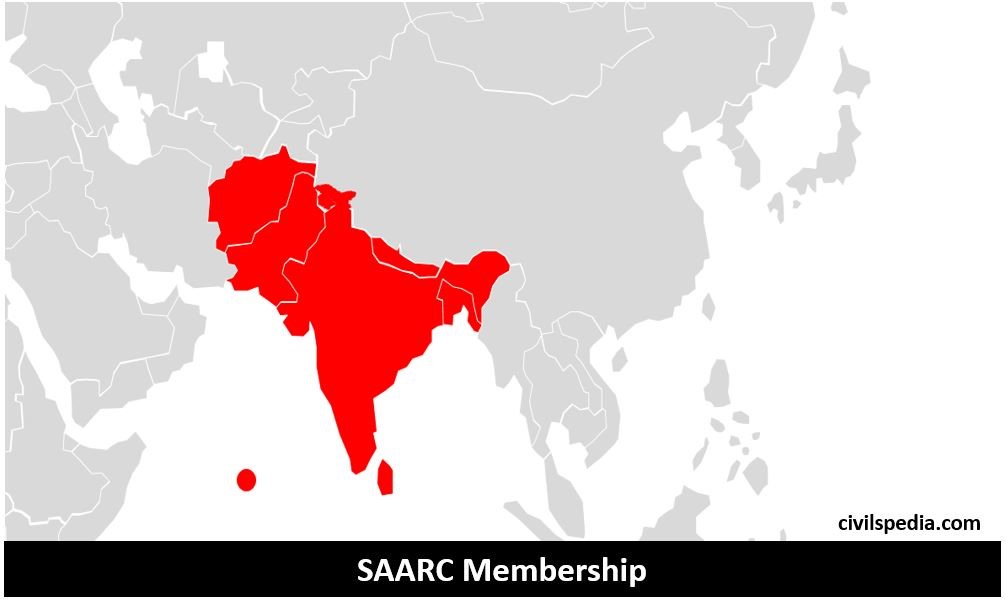
About South Asian Association for Regional Cooperation (SAARC)

Members

  1. Afghanistan
  2. Bangladesh
  3. Bhutan
  4. India
  5. Maldives
  6. Nepal
  7. Pakistan
  8. Sri Lanka
SAARC and India

Headquarter

  • Kathmandu, Nepal

Last Summit

  • Held in Kathmandu (Nepal)  in 2014

Secretary General

  • Arun Bahadur Thapa of Nepal

Objectives

  • Promote welfare economics.
  • Collective self-reliance among the countries of South Asia.
  • Accelerate socio-cultural development in the region.

Type of Organization

  • Decisions are taken by consensus
  • The organization reflects the South Asian identity of the countries based on shared history, language, religion, cuisines, etc.

Important Statistics

  • SAARC comprises 3% of the world’s area, 21% of the world’s population and 4% of the global economy.
  • 35% of the global youth resides in the SAARC region
  • South Asian nations also make an integrated “condominium” of common rivers, a mountain system, an ocean and a conjoint ecological system.

Timeline

1980 The idea of regional political and economic cooperation in South Asia was first raised in 1980
8 Dec 1985 The first summit was held in Dhaka
Last Summit Kathmandu (Nepal) – 18th Summit in 2014

Critical Evaluation

It was formed to promote regional development and improve ties among nations. But SAARC has not been able to generate the benefits of cooperation. The reasons for this are as follows:-

1. Political reasons

  • The boundary dispute between India and Pakistan has overshadowed the functioning of SAARC. 

2. Economic reasons

  • Low inter-regional trade: While organizations like ASEAN record trade of 20%, SAARC’s trade figures are at a dismal low at about 3%.
  • GDP of SAARC nations except India is small, hampering the effective economic relations among them. 
  • Other nations fear that competition would lead to injury to the industry of other members.

3. Historical reasons

  • Different nations have fought wars and past differences in the past, which hamper cooperation in present times.

4. Geographical reasons

  • This region has poor infrastructure. Hence, economic connectivity is low due to poor road transport. 

5. Fear about India’s Big Brother attitude

  • India constitutes 70% or more of SAARC’s area and population and has political conflicts with all her neighbours. 5 members have common borders with India but not each other. They perceive India as “Big Brother” and fear using the SAARC to pursue hegemony in the region.

6. Others

  • SAARC is an organization of countries not of equal stature-economically, geographically & politically.
  • There is an increase in Chinese influence on SAARC nations like Sri Lanka, Nepal, Pakistan and Maldives.

But even after that, SAARC provides a platform to meet and discuss important issues with hostile nations such as India and Pakistan, even during tense moments.


China  factor in SAARC

  • China holds an observer status in the group.
  • All SAARC nations except India and Bhutan are part of OBOR. 
  • Pakistan, China’s all-weather friend, also demands a more participatory role for China in the SAARC grouping. 
  • China is building large scale infrastructure in SAARC nations. E.g., China has started CPEC with Pakistan, the Hambantota project with Sri Lanka, FTA with the Maldives and the railroad pact with Nepal.
  • Pakistan is pursuing its regional connectivity goals exclusively with China through CPEC. 

But

  • China is constructing a dam on the Brahmaputra without taking Indian and Bangladeshi concerns onboard.
  • The behaviour of China in other engagements is not so pleasant. For instance, it almost shook ASEAN by bringing Cambodia, which did not even make a final statement nowadays. 

Indian Initiatives for SAARC

1. SAARC Satellite

  • South Asia Satellite is communication-cum-meteorology satellite by ISRO for the South Asia region. 
  • It was announced in June 2014 & launched in May 2017.
  • It has 12 Ku Transponders, with each nation getting at least One Transponder.
  • India bore the cost of the whole launch and satellite. 

2. Initiatives during Corona Period

India has taken the following measures to help SAARC countries in these challenging times

  1. COVID-19 Information Exchange Platform (COINEX), developed by India, facilitated various online learning modules. 
  2. SAARC Food Bank mechanism.
  3. Creation of SAARC COVID-19 Emergency Fund and contribution of $10 million in it.


3. Others

  • SAARC Disaster Management Centre in New Delhi 
  • Immediate medical visa for the entire region.  
  • E-connectivity– online courses and e-libraries.

South Asian Economic Union (SAEU)

All SAARC countries are committed to making South Asia an Economic Union in a phased manner

  1. Free Trade Area (Presently, we are in this stage – SAARC FTA)
  2. Customs Union
  3. Common Market
  4. Common Economic and Monetary Union. 


Bangladesh, Bhutan, India & Nepal Motor Vehicle Agreement (BBIN MVA )

Aim

  • Easing cross-border movement of people and goods

Timeline

November 2014

SAARC Motor Vehicle Agreement was proposed at the 2014 summit held at Kathmandu, suspended after objection from Pakistan. 
June 2015

BBIN MVA Agreement signed at Thimpu between Bangladesh, Bhutan, India and Nepal.
April 2017 Bhutan decides to withdraw from the agreement. 

Reasons
1. Environment Pollution: Diesel heavy vehicles traffic   
2. Noise Pollution: Heavy traffic will destroy the calm of the valley. 
3. Meagre Economic Benefits: Manufacturing Industry is not strong in Bhutan, so it will not benefit from this agreement 
4. Tourism may be affected. 
5. Opposition from rival parties. 
6. Fear of smuggling activities. 
April 2019

Bhutan Government announced that it would place a bill to ratify the BBIN initiative in Senate soon.

Provisions

  • The agreement removes all obstacles to the movement of vehicles within the member countries. A vehicle from one country can easily go to other without much hindrance. 
  • But vehicles will be allowed to ply only on the stipulated routes and attain specific permits. 
  • Also, drivers of these vehicles will have to carry a valid passport.

Benefits

  • For Nepal and Bhutan, two landlocked countries, this would improve their access to the open seas.
  • It will promote tourism. 
  • Economic interdependence had existed among these countries for centuries, as most of the region was one country before the partition of British India in 1947. later, partition disrupted the lines of communication.
  • South Asian region suffers from poverty, with a significant population living below $1 a day. Also, it is one of the least integrated regions globally. BBIN MVA can help change the scenario. 
  • It can help to counter China’s Belt and Road (BRI) Initiative in these countries. 
  • It will help in improving Logistics Performance Index (LPI) in the region. 

Future challenges

  • Cost  for implementation of the agreement will be borne by the respective countries. Since most of the countries are poor there is apprehension whether they will be ready to spend that amount.
  • Giving transit to India is a sensitive issue in Bangladesh.

Alternatives of SAARC

  • SAARC is not going anywhere. All decisions in SAARC are taken by consensus, and Pakistan blocks all the initiatives taken by India. Hence, Indian Policymakers have started to look for alternatives that exclude Pakistan. 
  • The suggested alternatives include BIMSTEC and Indian Ocean Rim Association (IORA).


Need to revive SAARC

  • SAARC serves an essential purpose as it reflects the South Asian identity of the member countries. 
  • India subcontinent, while geographically is one of the most integrated regions in the world in terms of terrain,  ecosystem,  river system etc.  But its polity, history,  economics, and below-par engagement make it one of the world’s least integrated regions of the world  –  This lack of integration can be overcome by  SAARC. 
  • South Asian countries are closely tied and face similar traditional and emerging issues like terrorism, energy shortage, hydro-politics, climate change.
  • Placing the bet on other platforms such as BIMSTEC is faulty as BIMSTEC can complement but can’t replace SAARC as SAARC is an old organization with a permanent secretariat and well-established conventions. 
  • SAARC is in line with India’s Neighbourhood First policy, of which SAARC could become the central pillar.
  • The European and ASEAN experience is testimony to the contribution of regional cooperation in economic growth.

BRICS and India

This article deals with ‘BRICS and India – UPSC.’ This is part of our series on ‘International Relations’ which is an important pillar of the GS-2 syllabus. For more articles, you can click here.


  • The term was coined by Jim O Neil, an economist at Goldman Sachs, in 2001 as BRIC (Without ‘S’)
  • BRIC was officially formed at the Yekaterinburg summit in 2009. Later, South Africa joined the bloc in 2010, and it became BRICS.
  • It is an ‘Economic grouping with political motives’.
  • The notion behind the coinage was that these nations’ economies would collectively dominate global growth by 2050. Along with that, if BRICS nations start to trade in their domestic currencies, it would break the dominance of the dollar.
BRICS and India

2001 Goldman Sachs economist Jim O’Neil coined the term ‘BRIC’.
2006 First Informal Meeting held.
2009 First formal meeting held in Yekaterinburg (Russia).
2010 South Africa joined the ‘BRIC’.
2014 New Development Bank or BRICS Bank was formed at Fortaleza (Brazil).
2016 8th BRICS Summit held in Goa.
2021 India hosted the 13th BRICS Summit through virtual mode.  
2023

BRICS announced that they are in the process of creating a new currency called BRICS currency that can be used for cross-border trade (instead of the US Dollar)
20244 New Members joined BRICS i.e. Egypt, Ethiopia, Iran and UAE turning it into BRICS 2.0
2025Indonesia joined BRICS as a full member.
2025The latest BRICS Summit was held in Brazil

  • Membership (10): Brazil, Russia, India, China, South Africa, Egypt, Ethiopia, Iran, UAE and Indonesia.
  • It is a non-western multilateral economic organization.
  • Purpose goals: economic and geopolitical.
  • Norms: BRICS follows the norms of non-interference in each other’s internal affairs and respects other international institutions.
  • BRICS is against uni-polarity and searches for multipolarity.


Factors that led to the creation of BRICS 

BRICS is a unique organization of countries that came together not because of geography, history or wealth, but because of their promise as key “emerging economies”.

  • Western economies faced the 2008 financial crisis while the BRICS nations kept on growing during that phase.
  • IMF and World Bank have become unrepresentative institutions dominated by western economies. BRICS countries shared a common objective of reforming the international financial and monetary system dominated by IMF and World Bank.
  • Search for multipolarity was another reason for the formation of BRICS.

The BRICS grouping has

  • 50% of the world population 
  • 25% of world GDP 
  • 30% of the world’s landmass 
  • 18% of the global trade
  • All have reiterated their support of the Paris Agreement. 

  • Economic Importance :
    • The combined GDP of BRICS nations account for roughly 25% of the total gross world GDP. 
    • BRICS nations are the fastest-growing economies of the world.  
    • BRICS nations are lucrative investment destinations in the world. 
    • Emerging multilateral financial institutions like AIIB and BRICS Bank are alternatives to Western-dominated World Bank and IMF. 
  • Political and military: China, Russia, and India are the most powerful countries by military strength after the US, with advanced naval forces.   
  • Demographic: BRICS nations account for nearly 42% of the world population, with a considerable number in working-age groups.
  • Dedollarisation: BRICS countries can become champions of Dedollarisation, which is used by the USA as a political weapon to further its interests.
  • BRICS aligns with India’s multilateral approach and gives a bigger voice to the Global South.
  • BRICS membership elevates India’s global profile. China may still not be interested in dehyphenating India and Pakistan, but India’s BRICS membership automatically de-hyphenates India and Pakistan while it casts India and China as equals.
  • BRICS countries have emerged as the voice of the developing countries or the economic south. Furthermore, all the BRICS nations are members of G-20 and WTO and safeguard the interests of developing countries against the aggressive club of developed countries. 
  • Safe Space to modulate rivalry: BRICS provides an alternative space to keep the dialogue open in case of conflicts between the member nations. For example, during the Doklam Crisis, India and China remained engaged through BRICS.


  • Competition: All BRICS countries want to become regional powers & frequently, their interests collide. 
  • The dominance of the Chinese economy makes it the union of unequal members. Jim O’ Neil observed that the Chinese forex is bigger than all other BRICS nations combined.
  • US Opposition: The newly elected Trump administration has adopted a strict posture towards BRICS, as it poses a danger to US and Dollar dominance in world trade.
  • Members are too similar in some key areas. Hence, they don’t complement each other. Each member has the same strengths and weaknesses. 
  • Too much Diversity in other areas, like starkly varying political systems, economies, and national goals.
  • Geographical Separation: Members are fragmented along 4 different continents. 
  • BRICS nations compete in third markets. In many areas, from clothing (China, India and Brazil), through economic influence in Africa (China, South Africa and India), etc. BRICS countries compete with one another.  
  • Contradictions on Trade: Brazil and Russia are commodity-exporting countries and want high commodity prices, while China and India are importing countries.
  • A large number of conflicting issues between members
    • India-China, China-Russia border disputes
    • Iran-UAE over Shia-Sunni rivalry
    • China artificially undervalues Renminbi 
    • China has ~30 trade disputes with BRICS nations. 
  • Diverging stands on multilateral forums
    • NSG: China is stopping the entry of India in NSG.
    • UNSC reforms: India & South Africa want reforms while China opposes them.

  • With BRICS going nowhere and China using it to promote its interests, there is a need to look toward the formation and re-activation of alternate forums (this doesn’t mean India should abandon BRICS altogether. India should remain in the group but betting all on BRICS will be futile). These forums can be
    • There is a need to revive the forgotten India, Brazil, South Africa (IBSA) group—perhaps enlarge it to include Turkey, Indonesia, South Korea and the like to develop alternatives to China-centric groupings.
    • India also needs to invest more in building groups that bridge the north-south divide. The G4 (Brazil, India, Germany and Japan) aspirants are one such group to the UN security council. 
  • The BRICS grouping has to go and demand multilateral reforms such as UNSC, World Bank, and IMF Reforms. 
  • All the BRICS nations should reach a common ground to resolve the issue of terrorism.

Shanghai Cooperation Organisation and India

This article deals with ‘Shanghai Cooperation Organisation and India- UPSC.’ This is part of our series on ‘International Relations’ which is an important pillar of the GS-2 syllabus. For more articles, you can click here


Members

  1. China
  2. Kazakhstan
  3. Kyrgyzstan
  4. Russia
  5. Tajikistan
  6. Uzbekistan
  7. India (joined in 2017)
  8. Pakistan (joined 2017)
  9. Iran (joined in 2022)
  10. Belarus (joined in 2024)

2 Observer States

  1. Afghanistan
  2. Mongolia

Headquarters

  • Beijing

Summits

  • First: Shanghai (China) in 2001
  • Latest: Astana (Kazakhstan) in 2024


Type of Organisation

  • It evolved from a border dispute solving mechanism to a regional security organisation in 2004 to a deliberation forum on all subjects. 
  • It works on the norms of consensus, voluntarism and non-interference. 
Shanghai Cooperation Organisation and India

Timeline

1996 Shanghai 5 was formed for security and border peace between Kazakhstan, Kyrgyzstan, Tajikistan, Russia and China.
2001 SCO was formed in Shanghai with 6 members (5 + Uzbekistan). India was also offered membership which it declined.
2017 India and Pakistan became members of SCO.
2022Iran became the member of SCO.
2024 Belarus became the member of SCO.
2024 Latest SCO Summit was held in Astana (Kazakhstan)
2025The next Summit will be held in Tianjin (China)

Significance of SCO

It is an important organisation with

  • 3 significant world powers, Russia, China and India, under its umbrella. 
  • 50% of the world’s population.
  • 25%  of the world’s GDP. 

  • Countering U.S. hegemony (the U.S. is trying to influence regimes through Colour revolutions).  
  • Economy: To enhance economic cooperation. 
  • Security: Issue of Islamic Fundamentalism, Terrorism, Secessionism/Separatism and Countering Drug Trafficking.


  • Rising China in Central Asia is a concern for Russia.
  • Russia has created CSTO (a mutual defence alliance) & EEU (the Economic Union of the Eurasian region).
  • China is more focused on the stability of Xinjiang rather than these Central Asian nations or containing NATO.
  • The Quad grouping of Australia, India, Japan, and the United States is viewed as a counter to the influence Russia and China seek to project through the SCO. India’s membership in both acts as an irreconcilable contradiction.


Importance of SCO for India

Energy Security

  • Some of the member countries of the grouping are rich in energy resources – both hydrocarbons and uranium. India, being energy deficient, need these resources. Russia has also mooted the idea of ‘Energy Club‘. 

Security

  • The Eurasian block can play a key role in stabilizing Afghanistan. 
  • SCO can help in forming a joint platform against terrorism & controlling the menace of drug trafficking in the following way
    • Members share a high volume of information on counter-terrorism through the SCO Regional Anti-Terrorist Structure (SCO RATS) based in Tashkent.  
    • SCO conducts annual Military exercises involving ground troops, aerospace & cyber threat.  

Economic Integration / Gateway to Eurasia

  • An important factor is promoting India’s economic integration with the Central Asian republics, which is in line with India’s Connect Central Asia Policy. India is also investing heavily in INSTC and Chabahar Port development.
  • Central Asian Republics provide a huge possibility for Indian Automobile, Banking, I.T. & related sectors. 

Alternative platform for dialogue with Pakistan and China

  • SCO provides an alternate platform for Indo-Pak & Sino-India dialogue to resolve their disputes. 

Other

  • With Russia and China taking the lead, the SCO could even prove a guarantor for projects like the TAPI (Turkmenistan-Afghanistan-Pakistan-India) and IPI (Iran-Pakistan-India) pipelines that India has held off due to security concerns. 


Issues

  • SCO is already dominated by two UNSC Permanent Members, i.e. China and Russia. Hence, it will not be easy for India to have a significant say in such an institution.
  • SCO will be the second regional grouping after SAARC to have India and Pakistan as members. It in itself can limit the effectiveness of SCO, as has been the case with SAARC.  
  • On the issue of terrorism, China and India have different attitudes vis a vis Pakistan based Terrorist Organizations. Also, the definition of terrorism is different for different states – Eg: the Chinese consider Tibetan Freedom Movement as terrorists while India doesn’t. 
  • In terms of connectivity, India has not joined China’s ambitious One Belt, One Road project and has concerns over China-Pakistan Economic Corridor (CPEC).  
  • SCO is seen as Anti-NATO by the USA and European countries, which doesn’t augur well for Indian ties with the USA and other western allies. 
  • SCO will help in strengthening China-Russia-Pakistan Axis, which is bad for Indian interests. 

India ASEAN Relations

This article deals with ‘India ASEAN Relations- UPSC.’ This is part of our series on ‘International Relations’ which is an important pillar of the GS-2 syllabus. For more articles, you can click here.


Part-1: About ASEAN

Origin of ASEAN

The South Asian region was colonized by the British, the French and the Americans. After World War II, most countries achieved independence, but various issues emerged in its aftermath

  • Issues regarding boundaries: Eg Indonesia vs Malaysia on Borneo Island
  • US involvement in Vietnam due to Cold War rivalries in the region

It raised fears of increased external involvement and that the region would become a theatre of war between capitalist and communist ideologies. 

Consequently, these countries decided to come on a common platform so as to 

  • Resolve the issues among the member nations.
  • Present a joint front to the rest of the world.

About ASEAN

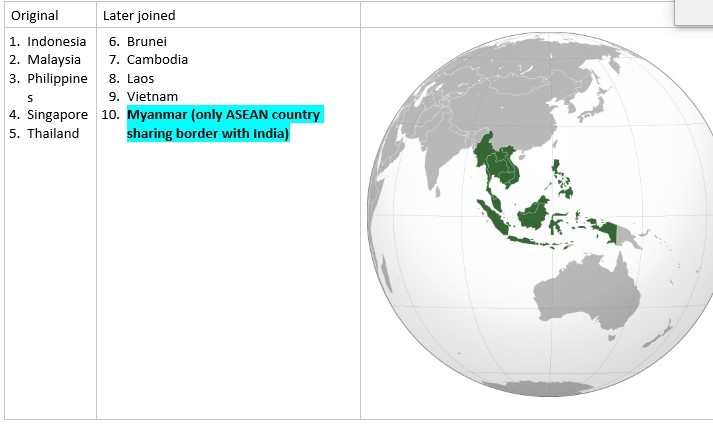
  • It was signed in 1967.
  • Headquartered in Jakarta
  • It consists of 10 countries
India ASEAN Relations

ASEAN region consists of

  • 25% of the world population.
  • The combined GDP is more than $5 trillion.

Evaluation of ASEAN

ASEAN has mixed track records with some major achievements but significant misses.

Good Performance

1 . Peace
  • ASEAN has maintained peace in the ASEAN region by settling various disputes peacefully. E.g., the conflict between Cambodia and Thailand over Preah Vihar Temple was solved peacefully in 2011. 
2. Economy

ASEAN has made various economic trade deals such as

  1. ASEAN Free Trade Area (AFTA)
  2. Chiang Mai Initiative (CMI)
  3. ASEAN Economic Union was set up in 2015, having a single market and production base

Not so Good

1. Economy
  • ASEAN failed to predict and prevent the South East Asian Financial Crisis of 1997.
2. Human rights
  • ASEAN has failed to pressurize authoritarian regimes to stop human rights abuses. E.g., the Rohingya crisis in Myanmar or Coupes in Thailand and Myanmar.
3. Against Chinese hegemony
  • ASEAN has shown a lack of resolve before China’s repeated provocation against ASEAN members, particularly the Philippines and Vietnam.
4. Environment
  • ASEAN has failed to stop the pollution and illegal trade in endangered species.

Bloc’s longevity, as well as its relative stability—is itself a testament that one of the world’s oldest regional organizations is in the right direction.


Chinese bullying in ASEAN

  • ASEAN has become the target of Chinese assertiveness and bullying.
  • There is a dispute between ASEAN members like Vietnam, the Philippines etc. and China in the South China Sea. International Court of Arbitration (ICA) has given the verdict against Chinese claims, but China has refused to accept the ICA verdict. 
  • Countries like Cambodia act as Proxy of China & don’t allow any text to pass if it has anything against China, such as Xinjiang, or human right violations is enumerated in it.

To counterbalance the Chinese assertion, ASEAN is looking at India. 


  • India’s 10% trade is with ASEAN 
  • ASEAN is the biggest FDI investor in India, with up to $80 billion.

Timeline of India-ASEAN relations

Till 1990 The Indian policymakers didn’t give ASEAN region much importance.
1990 Start of Look East Policy => India started to give importance to ASEAN. 
2002 India started annual Summits meetings with ASEAN (Start of Look East 2.0) 
2009 FTA in goods signed between India and ASEAN.
2015 FTA in Services and Investment signed between India and ASEAN minus Philippines.
2018 Leaders of the 10-members of ASEAN were the Chief Guests at India’s Republic Day.
2019 India refused to sign RCEP, which consist of ASEAN & 6 countries.
2025President of Indonesia (Prabowo Subianto) was Chief Guest at India’s Republic Day.

Fun Fact: Sukarno (erstwhile President of Indonesia) was the Chief Guest at India’s first Republic Day in celebrations in 1950.


Importance of ASEAN for India

  • ASEAN nations are strategically located at the intersections of major land and sea routes (including the Strait of Malacca).
  • Containing China: India can align with partners like Vietnam, Singapore etc., to counterpose China. 
  • Myanmar has rich oil reserves.
  • ONGC Videsh Limited has invested in the petroleum reserves of Vietnam.
  • Trade between India and ASEAN stood at $65 billion in 2015-16, constituting 10% of India’s total trade. 
  • ASEAN provides an opportunity for Indian businesses to integrate with global supply chains. 
  • We have signed the FTA in Goods , FTA in Services, and Investment.  
  • India eyes CMLV (part of ASEAN) for the “Make Outside India” initiative.
  • Singapore is one of the leading sources of FDI in India.
  • ASEAN is essential for the development of North East India. North-Eastern states can be integrated with ASEAN Supply Chains.
  • For this, the following projects are going on
    • IMT Highway
    • Kaladan Multimodal Transit Corridor
  • Security of Indian Ocean Region(IOR) like piracy, illegal migration, and trafficking 
  • Cultural Connections: Hinduism and Buddhism came to Southeast Asia from India. The Indian languages, Sanskrit and Pali, have influenced several of the region’s scripts.
  • Temples like Ankorwat
  • Tourism

Concerns between India-ASEAN

  • Trade Deficit: In 2022-23, India witnessed a trade deficit of $43.5 billion with ASEAN nations. It has also been observed that Chinese products are rerouted through ASEAN countries to claim the benefits of the India-ASEAN trade deal.
  • RCEP: India has declined to join the RCEP, in which ASEAN is a significant stakeholder.
  • Inadequate Infrastructure: Various projects such as IMT Highway aimed at integrating India with ASEAN have not been operational. 
  • Chinese Influence: It is difficult for India to match China in investments in ASEAN nations. 

Data Privacy Bill and BN Srikrishna Committee Report

Data Privacy Bill and BN Srikrishna Committee Report

This article deals with ‘Data Privacy Bill and BN Srikrishna Committee Report- UPSC.’ This is part of our series on ‘Science and Technology’ which is important pillar of GS-3 syllabus . For more articles , you can click here

Issues at hand

  • SC in K.S. Puttaswamy case has declared Right to Privacy as Fundamental right. 
  • Most of the data storage companies are based abroad.  They also export data to other jurisdiction making it difficult to apply Indian laws. 
  • India does not have any dedicated legal framework for data protection.
  • India does not have provisions   for data localization i.e. to store data within country .
  • Volume of data on internet is expanding exponentially 
  • Generally, the application using pre-ticked boxes on consent regarding the privacy policy and use of their personal data
  • RBI announced that the payment system providers (Visa, Mastercard, PayTM etc) need to store entire payments data in a system only in India

Data Protection Bill and Justice BN Srikrishna Committee report

Provisions of Data Protection Bill which is based upon the recommendations of Justice BN Srikrishna Report are as follows :-

  • Fiduciary relationship: Relationship between individual and service provider must be viewed as a fiduciary . Therefore, the service provider is under an obligation to use data fairly and for the authorised purposes only.
  • In case of violation, he can be punished.
  • Rights of the individual: Certain rights regarding data has been given to individual. These include:
    • right to be forgotten.
    • right to seek correction of inaccurate, incomplete, or out-of-date personal data, and
    • right to have personal data transferred to any other data fiduciary
  • Data localization: It mandates Data localization of at least one copy in India by data fiduciary
  • **Data Protection Authority: to protect interests of individuals, prevent misuse of personal data, and ensure compliance with the Bill
  • Define Sensitive personal data: It includes passwords, financial data, genetic data, caste, religious or political beliefs, or any other category of data specified by the Authority. 
  • explicit consent of the individual is required for Processing of sensitive personal data
  • Exemptions from compliance: It also gives exemptions for processing of personal data for certain purposes, such as journalistic activities, law enforcement, security of state
  • Recognises privacy as a fundamental right

Importance of Data Localisation

  • Data is the new oil fueling the 4th Industrial Revolution and Artificial Intelligence led economy
  • Increase revenue and create jobs as technology companies will be forced to open up offices in India and cant shift their profits to outside locations to avoid taxes.
  • Maintain data sovereignty and privacy of citizens
  • Important for national security as any data can be retrieved for investigation of crime

Issues with the Bill

  • Issues with data localization
    • There is no evidence that data localization leads to better privacy and security of data.
    • The industry will have to incur the additional costs given the bill proposes that companies ensure the storage, on a server or data centre located in India, of at least one copy of personal data.
    • Keeping a copy in India does not really guarantee against breach of security or privacy.
  • exemption on the ground of security of state may be too broad and may lead to surveillance and systematic access to citizens’ data by the state.
  • Protectionist measures in the law => US and European Union countries are planning to take India to WTO on these issues.

Data localisation in other countries

Russia and China Strict data localisation
EU General Data Protection Regulation 2018 (GDPR) which mandates that every EU citizen’s data be stored within the EU.

Reasons of fall of Mughal Empire

Reasons of fall of Mughal Empire

This article deals with ‘ Reasons of fall of Mughal Empire – UPSC.’ This is part of our series on ‘Modern History’ which is important pillar of GS-1 syllabus . For more articles , you can click here

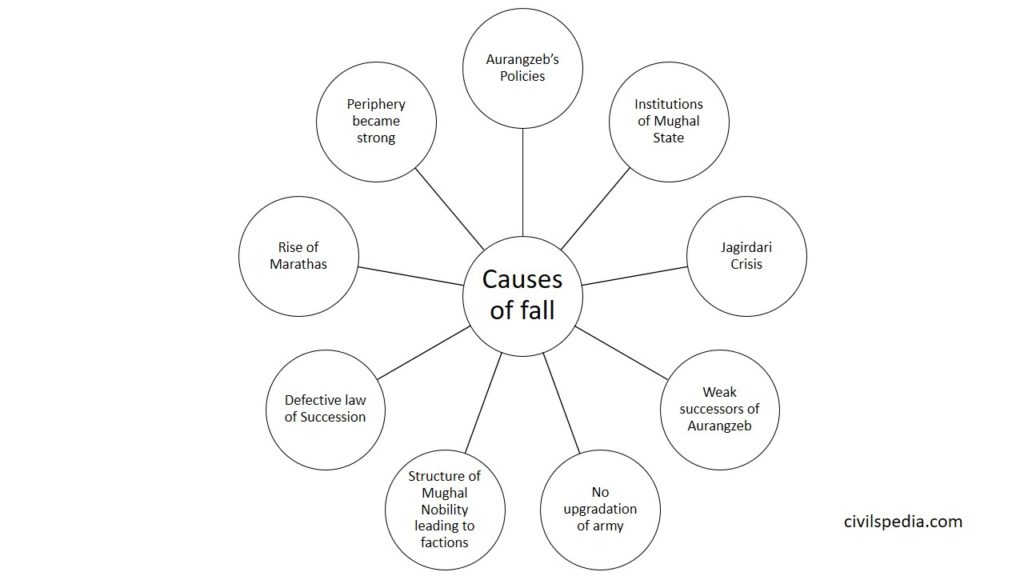
Reasons of fall of Mughal Empire

1.Aurangzeb’s  policies

  • Alienation of Hindus  who constituted majority of population of India with his policy of religious bigotism . The imperialist designs & narrow religious policies of Aurangzeb turned the Rajputs , reliable supporters of the imperial dynasty into foes .
  • Expansionist military campaigns in western India against  Bijapur, Golconda & Marathas which drained wealth of empire & expanded empire beyond the point of effective control (this expedition is called Deccan Ulcer like Spanish Ulcer which caused downfall of Napoleon) 
  • But some other historians believe that the roots of Mughal decline lay in institutions and systems intrinsic to Mughal administration, rather than in personalities or specific policies .

2. Institutions of Mughal Empire

  • Mughal state was a WAR STATE in core .  It developed a centralised administrative system whose vitality depended on its military power with emperor standing at apex & Mansabdars or military aristocracy beneath
  • Appointment , promotion or dismissal of Mansabdars and jagirs allotted to them was done by emperor alone leading to personal loyalty and there was no national, ethnic or religious loyalty .  Effectiveness and the permanence of this relationship depended on the personal qualities of the emperor and the constant expansion of resources, which explains the constant drive towards territorial conquests in Mughal India. But there were no more conquests since the late years of Aurangzeb

3. Jagirdari Crisis

  • This was created because too many Mansabdars were chasing too few jagirs & many of them have to remain jagirless for years 
  • In Words of Satish Chandra :“The available social surplus was insufficient to defray the cost of administration, pay for wars of one type or another and to give the ruling class a standard of life in keeping with its expectations” . This happened because of the
    1. Unusual increase in the number of mansabdars at a time when the area to be distributed as jagir (or paibaqi) remained stagnant or even declined.
    2. Revenue collection, particularly in the south, fell far short of the estimated income, diminishing in turn the real income of the jagirdars in disturbed areas.
    3. To make matters worse, there was a continuous price rise since the late seventeenth century, as the supply of luxury goods flowed towards the European markets, putting the Mughal aristocracy in further distress.
    4. As too many mansabdars were now chasing too few jagirs, many of them had to remain jagir- less for years; and even when a jagir was assigned, there was no guarantee that they would not be transferred within a short period. The entire aristocracy, therefore, suffered from a tremendous sense of personal insecurity.
  • This jagir crisis was not, however, a new phenomenon, as there had always been gaps between collection of revenue and the estimated revenue income of a particular jagir. The crisis increased during the last years of Aurangzeb, mainly because of the Deccan wars. There was now a rise in the number of mansabdars and the political turmoil made the collection of revenue a more difficult task. Also when two kingdoms of Golconda & Bijapur were added to Mughal empire , their noblemen were absorbed in Mughal aristocracy but what Aurangzeb did wrong was he converted large chunk of land to Khalisa ie royal land to finance his campaigns leading to artificial scarcity of jagirs . After his death & during Bahadur Shah’s time this reached to crisis situation
  • This crisis played important role in decreasing loyalty of aristocracy 

4. Weak successors of Aurangzeb

  • Had no hold over administration  & mere symbolic heads
  • Nadir Shah’s attack in 1738-39 gave final blow to Mughal prestige
  • Weren’t able to stop Maratha plunders which even reached upto suburbs of Delhi in 1734

5. No Upgradation of army & weak generals

  • Military reforms were not made with changing times + no new technology & weapons introduced in the army
  • The Mughal artillery was crude and ineffective against the guerrilla tactics of  Marathas . The Maratha fortresses which mughal  armies couldn’t capture despite repeated attempts easily succumbed to the British arms.
  • Dearth of capable commanders in Mughal army but this statement challenged by some historians saying that there were capable commanders like Sayyid Brothers, Abdus Samad Khan , Zakaria Khan,  Saadat Khan but all were occupied in self aggrandisement

6. Degeneration of Mughal Nobility

  • ‘When gold rusts what will iron do’ . Following the unworthy examples of the emperors, the nobles discarded hard life of military adventure & took to luxurious living. They became ‘knights of romance’ against ‘knights at arms’
  • At a time when the emperors ceased to be impartial judges for rewarding merit, the nobles had no incentive to fight & die for the empire

7. Structure of Nobility

  • Mughal nobility was divided into three warring factions
Irani Group Led by Asad Khan & his son Julfiqar Khan
Turani Group Led by Ghazi Uddin Khan & Feroz Jung & his son Chin Qulich Khan (Nizam ul Mulk)
Hindustani Sayyid Brothers , Khan-i-Dauran & some Afghani leaders 
  • Although no factional rivalries went beyond imperial court , nor lapsed into violent confrontations . No one questioned the divine rights of the Timurids to rule but every group tried to extend their influence over the emperors to  control the distribution of patronage
  • Proximity of one to centre of power alienated others & this gradually affected personal binds of loyalty between the emperor & nobleman . Each faction tried to win the emperor to its viewpoint & poison his ear against other faction.
  • Even in face of foreign danger these hostile groups couldn’t forge a united front & intrigued with invader. The personal interests of Nizam-ul-Mulk & Burhan-ul-Mulk led them to intrigue with Nadir Shah.

8. Defective Law of Succession

  • Absence of the Law of Primogeniture among the Mughals usually meant a war of succession among the sons of dying emperor in which military leaders of the time took side . Although this system was not commendable but has inherent advantage that it provided the country with the ablest son of the dying emperor as ruler .
  • But after Aurangzeb, the new principle that worked in Mughal dynasty was survival of the weakest . The Princes of Royal Dynasty receded to the background & struggle was fought by leaders of rival factions using royal prince as nominal leaders. Powerful nobles started to act as king makers to suit their personal interests  

9. Recurring peasant revolts

  • These revolts can be interpreted in various ways. They can be por­trayed as
    • Political assertion of regional and communitarian identities against an intruding centralising power or
    • As reactions against the bigoted religious policies of Aurangzeb. The latter interpretation seems to be more unlikely, as in the later span of his reign, Aurangzeb was showing more liberalism towards the non-believers and in fact wooing many of the Hindu local chieftains in a cool calculating move to win their loyalty and solve the political problems of the empire by isolating his enemies .
  • Mughal Empire was empire imposed from above . Its increasing economic pressures was never fully accepted by rural society but the fear of Mughal Army always acted as deterrent
  • But in late 17th century , weakness of Mughal army became apparent after it faced successive debacles & at same time oppression of Mughal ruling class increased . Resistance  to imperial authority also became widespread
  • In most cases rebellions were led by Local Zamindars (who were forced to pay more taxes by Mansabdars/ Zamindars and were often failing ) & fully backed by oppressed peasantry
  • Other major reason for the open defiance of the local landlords might have been the increasing oppression of the jagirdars. The earlier emperors tried to keep them in check through a system of rotation.

10. Rise of Marathas

  • Most powerful external factor that brought collapse of Mughal empire was the rising power of the Marathas .
  • Marathas inaugurated the policy of Greater Maharashtra & popularised the ideal of Hindu-pad padshahi . The ideal of Hindu Empire could only be realised at the cost of Mughal empire. Although they didn’t succeed in making Hindu Empire but they certainly played a great part in bringing about disintegration of the Mughal empire .

11. Perspective of Periphery

  • By Revisionist historians
  • Mughal decline was due to rise of new groups into economic & political power & inability of the distant & weakened centre to control them any longer
  • Even in 18th century there were some surplus regions like Awadh, Bengal, Benaras . This made more resources at disposal of Zamindars & peasants & powerful lineages who gained distinctively greater advantage & confidence vis a vis imperial centre
  • Taking advantage of weakening central control they found more convenient to repudiate their allegiance . Although they kept on sending share of revenue but Mughal control over these territories were not there

3D Printing

3D Printing

This article deals with ‘ 3D Printing – UPSC.’ This is part of our series on ‘Science and Technology’ which is an important pillar of the GS-3 syllabus. For the whole syllabus of Science and Technology, you can click here.


What is 3D Printing?

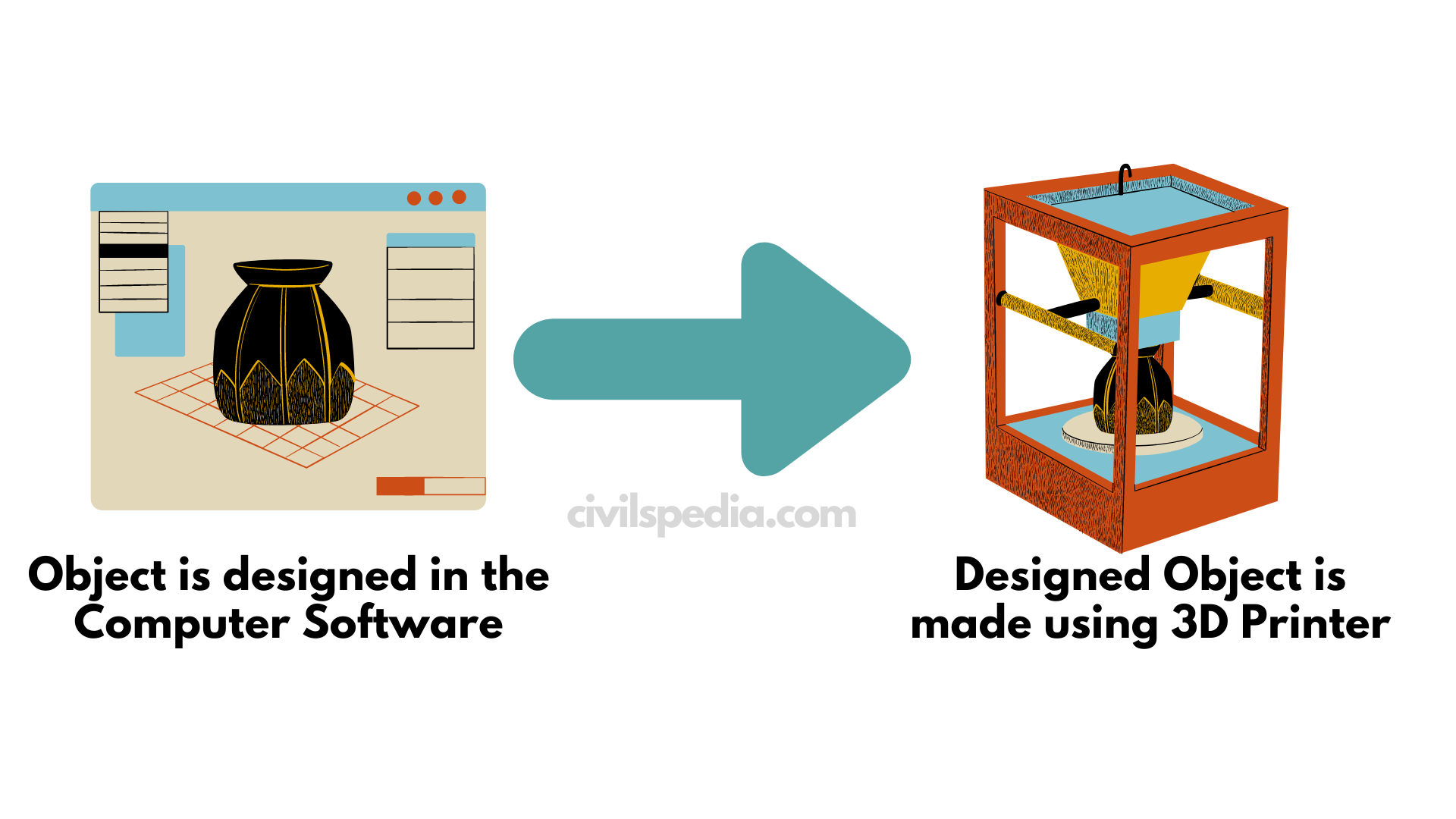
3D printing or additive manufacturing is a manufacturing technique. It involves

  1. making three-dimensional objects
  2. from a digital design
  3. by adding one layer at a time. 
3D Printing

Applications

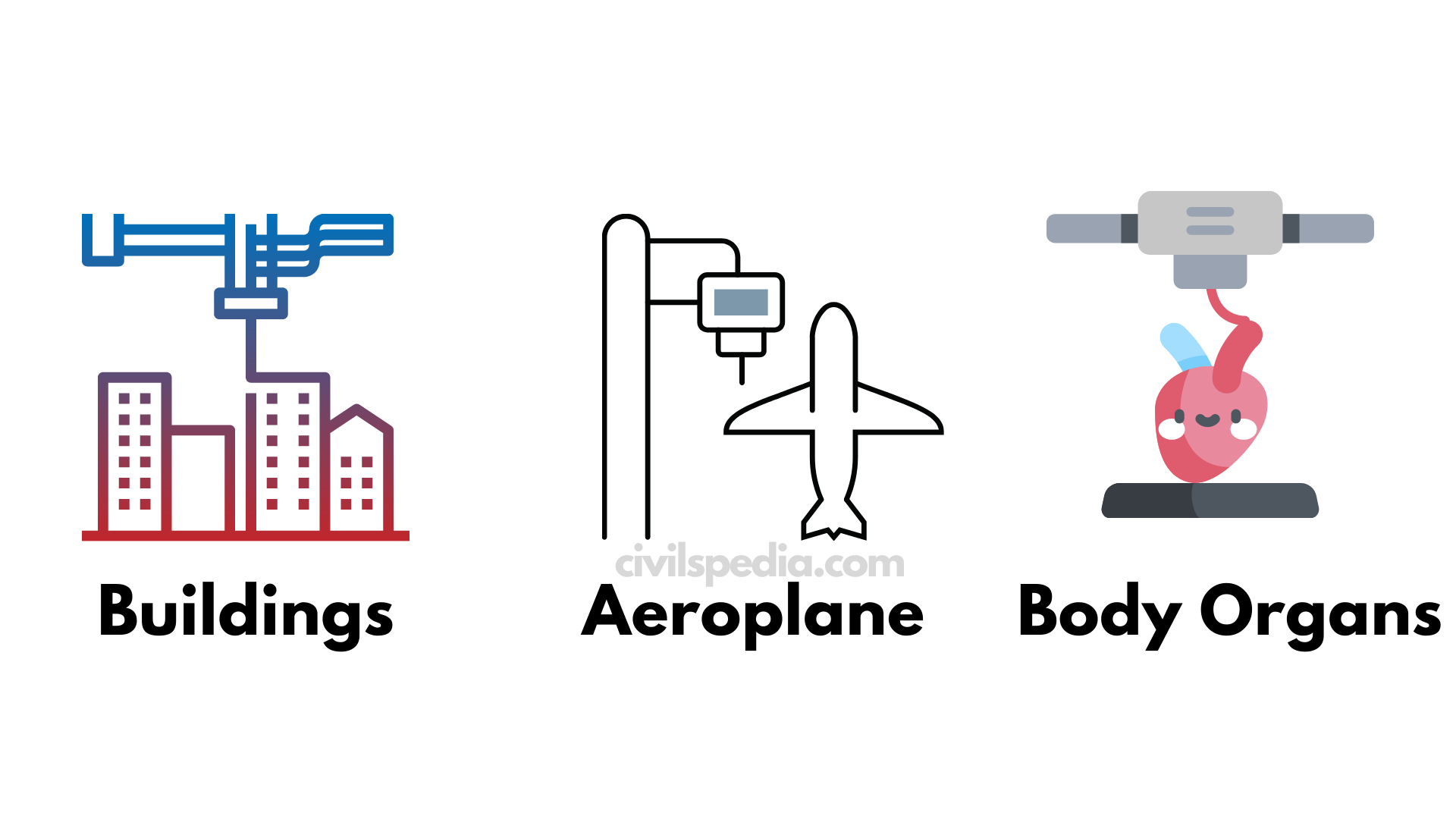
  1. Architecture and Construction: Countries around the world are using large 3D printers to construct multi-storied houses layer by layer. In 2021, IIT Madras has constructed India’s first house using 3D printing in just 5 days.
  2. Medicine: Bioprinting of artificial organs like the Liver, Pancreas etc.  
  3. Manufacturing: Parts of cars and aeroplanes are being built using 3D printing. 
  4. Repairing Damaged Cultural Sites: Aleppo in Syria was re-created using 3D Printing after it was completely destroyed by ISIS.
  5. Prototypes: Prototypes can be made very cheaply.

Any object can be made. Just make a digital design on PC, add material in the 3D Printer and it will make it.

Applications of 3D Printing

Side Topic: Bio Ink

Printing the Body Organs

Advantages

  • No Wastage: It is an additive process, in which an object is manufactured by adding layers in contrast to present manufacturing techniques which are reduction processes. Hence, there will be no wastage of material and the cost of production will reduce dramatically. 
  • Manufacturing Decentralisation: In contrast to centralisation i.e. making products in centralised manufacturing units, it will usher revolution of decentralised manufacturing, creating business opportunities.
  • Customised Products: Presently companies make standard products because the mould they use is the same. But using 3 D Printing, customised products according to the need of the person can be made without any increase in the cost of production. 
  • Breaking manufacturing Boundaries: Using this technique, we can manufacture things that were impossible to manufacture using ordinary manufacturing techniques. Eg: Body Organs.
  • Saves Time: This technique does the job accurately and in less time.


Challenges

  • Job Losses: Single 3 D printer can make products that were earlier made by hundreds of workers.
  • Security challenge: Even weapons can be made at home.


Steps taken by Government

Ministry of Electronics and Information Technology(MEITY) has released ‘National Strategy for Additive Manufacturing‘ to tap the potential of 3D printing in India.

Virtual Reality and Augmented Reality

Virtual Reality and Augmented Reality

This article deals with ‘ Virtual Reality and Augmented Reality – UPSC.’ This is part of our series on ‘Science and Technology’ which is an important pillar of the GS-3 syllabus. For the whole syllabus of Science and Technology, you can click here.


Virtual Reality

Virtual Reality and Augmented Reality
  • Virtual Reality (VR) is an artificial environment that is created with software and presented to the user in such a way that the user suspends belief and accepts it as a real environment. 
  • The simplest form of VR is a 3-D image that can be explored interactively at a personal computer.
  • Virtual reality can be divided into:
    • The simulation of a real environment for training and education.
    • The development of an imagined environment for a game or interactive story.

Applications

Virtual Reality

1. Education

  • Virtual Reality can be used to make study more interactive in the classroom. It will help in understanding concepts and recreational activities.

2. Training

  • The usage of Virtual Reality from a training perspective is to allow professionals to conduct training in a virtual environment where they can improve upon their skills without the consequence of failing the operation.

3. Video Games

  • The use of graphics, sound and input technology in video games can be incorporated into Virtual Reality. 

4. Culture & Heritage

  • Virtual reality enables heritage sites to be recreated extremely accurately. The original sites are often inaccessible to the public, or may even no longer exist.

5. Therapy

  • The primary use of Virtual Reality in a therapeutic role is its application to various forms of exposure therapy, including treating phobia patients. 

6. Business Opportunities

  • Magic Bricks in their Mumbai Office have come up with VR technology where people will be shown and made to experience homes that Company is selling without taking clients to location.

Augmented Reality

Augmented Reality is the integration of digital information with the user’s environment in real-time. In simple terms, it means adding a layer of digital information on top of the physical world around us. 


Application

Augmented Reality
Military A transparent display is positioned directly in the fighter pilots view, showing the information about altitude, speed etc.
Museum Audio Guide given in Museums is also a form of Augmented Reality as it adds a layer of sound.
Google Glasses A person can get information on all the objects in his line of the site apart from many other things.
Medical During surgery, a layer of information can be added which will help the medical practitioner in taking correct decisions.
Enhanced TV experience Sports scores on TV during a match is an example of Augmented Reality.

Recently, it has been announced that India’s first augmented reality (AR) education and training institute will be set in Varanasi.


Extended Reality (XR)

  • XR is the mix of augmented reality (AR) and virtual reality (VR) that combine the realms of the real and virtual.
  • The term came to the limelight during the Covid-19 pandemic as Extended Reality can fill the gaps in our work environment. XR can make employees feel that they are working by sitting next to their colleagues in the office, though they are spread to geographically distant places.