Pesticides (Agricultural Inputs)

This article deals with ‘Pesticides (Agricultural Inputs).’ This is part of our series on ‘Economics’ which is an important pillar of the GS-3 syllabus. For more articles, you can click here.


  • 15-25% of the crop in India is lost to weeds, pests, diseases and rodents. 

Statistics of Pesticide Use in India

  • Total pesticide consumption is the highest in Maharashtra, followed by Uttar Pradesh, Punjab and Haryana. 
  • On the other hand, per-hectare consumption of pesticides is the highest in Punjab.
  • Amongst the crops, paddy accounts for the maximum share of consumption (26-28%), followed by cotton (18-20%).

Pesticides (Agricultural Inputs)

Even though per hectare pesticide is much lower in India (0.5 kg per ha) than in other advanced economies, like 7.0 kg per ha in the USA and 12 kg per ha in Japan. But there are some issues:-

  1. The quality of the spray is substandard.
  2. Farmers use pesticides without following proper guidelines. 
  3. Use of broad-spectrum pesticides, which kill beneficial insects and pollinators as well.
  4. Residues of pesticides are found in fruits and veggies. It leads to a ban on their exports to first-world nations (especially the EU).
  5. When a pesticide is sprayed on crops, most of it bounces off the leaves and falls to the ground. It then mixes with soil and water, contaminating both, and enters the food chain, leading to biomagnification. 
  6. 93 chemicals banned in most of the developed world are sold in India. 
  7. Carcinogenic pesticides like Monsanto’s Glyphosate (brand-named ‘Roundup’) are still sold in India despite the proven fact that it can cause cancer.  
  8. Pesticides like Endosulfan (used on Cashew Plantations in Kerala) have been proven to be genotoxic.
  9. Rising Usage: A warmer climate and growing population are expected to increase the use of pesticides to combat the potential rise in pest invasions and feed a larger population. 
  10. Pesticide Poisoning: According to NCRB, in 2019, 6,962 deaths were reported out of 7,007 pesticide poisoning cases.
  11. Opaque and out-of-date regulatory framework: The Pesticide Management Bill (PMB) has been discussed since 2008. The cabinet approved the latest draft in February 2020.
  12. Private Sector Monopoly: There is a private sector monopoly in pesticide trade whose decision is guided by the profit motive alone. 

  1. Move towards Organic Farming.
  2. Use narrow-spectrum pesticides.
  3. Using biocontrol agents and biopesticides: This method involves controlling pests, such as insects, mites, weeds, and plant diseases, using other organisms. 
  4. Adopt an Integrated Pest Management approach, which encompasses a judicious mix of pest control methods like bio-pesticides, bio-control agents and pesticides. (Vietnam Case Study: In Vietnam, almost all the farmers of the Mekong Delta adopted a policy of “no-spray for the first 40 days”. They used predatory beetles that prey on rice pests.)
  5. The government should pass the Pesticide Management Bill, 2017, which aims to replace the Insecticide Act of 1968 with larger penalties and jail time for selling substandard or fake pesticides. 

Note: India is a signatory to United Nations Environment Programme (UNEP) led Stockholm Convention for persistent organic pollutants and Rotterdam convention for export-import of pesticides.  

Fertilizer (Agricultural Inputs)

This article deals with ‘Fertilizer (Agricultural Inputs).’ This is part of our series on ‘Economics’ which is an important pillar of the GS-3 syllabus. For more articles, you can click here.


Fertilizer (Agricultural Inputs)

Plants require Nitrogen, Phosphorus and Potassium (NPK) for their balanced growth. If soil is deficient in these nutrients or if the farmer is using High Yielding Variety seeds that require more nutrients than any natural soil can supply, different fertilizers are used to boost nutrients in the soil.

NutrientFertilizer used
Nitrogen (N)Urea
Urea is produced using Haber’s Process using LPG as raw material.
It is the most widely consumed fertilizer in India. The Ministry of Chemical and Fertilizer gives subsidies to the Indian companies to manufacture and sell it at a lower price to farmers. 
Phosphorus (P)Diammonium Phosphate (DAP)
80% of its demand is met via imports.   
Potassium (K)Muriate of Potash (MOP)
It is not manufactured in India. Hence, 100% of its demand is met via imports.

Fertilizers are provided to the farmers at subsidized rates. In 2020, Rs 71,000 crore was paid in fertilizer subsidies by the Union Government.

  • Nutrient Based Subsidy is used in the case of DAP & MOP
  • It was framed under Fertilizer (Control) Order, 1985 and issued under Essential. Commodities Act, 1955.
  • The government fixes per kilogram subsidy on DAP & MOP in this system. (Cost of Fertilizer for farmer = Market Price MINUS Fertilizer Subsidy)
  • But, imports of DAP & MOP aren’t controlled.

The case of urea is very different. The government intervenes in the sector in five ways: 

  1. It sets the Maximum Retail Price (MRP).
  2. It provides a subsidy to 30 domestic producers on a cost-plus basis, meaning more inefficient producers get larger subsidies. 
  3. It provides a subsidy to importers.
  4. Imports are canalized—only three agencies can import Urea into India.
  5. Half of the movement of fertilizer is directed—that is, government tells manufacturers where to sell their urea.

These distortions feed upon each other, leading to a series of adverse outcomes.


  • Urea is subsidized 75% of its price. 
  • Due to this, it is smuggled to
    1. Industry (Ammonia-based industry) 
    2. Across the border to Bangladesh and Nepal  
  • Additionally, larger—presumably richer— farmers consume subsidized urea. Ideally, subsidized urea should be given only to poor farmers
  • The regulation under canalization creates shortages. Under the provisions of canalization, the government orders specific companies to when to import, what quantities to import & where to sell. But estimating the demand is a difficult task & shortages can’t be addressed instantaneously (it takes 60 days at least).
  • Earlier, the main objective of the Indian government was self-sufficiency  & this led to Subsidy on Cost Plus Basis, where the subsidy a firm receives is based on its cost of production: greater the cost, the larger the subsidy. Consequently, inefficient firms with high production costs survive, and the incentive to lower costs is blunted.
  • Since Urea is cheaper than other Fertilizers, it creates a situation of urea overuse which is detrimental for the soil. Consequently, the soil’s N:P: K ratio is disturbed (Rajasthan – N:P: K = 25:12:1 instead of 4:2:1). 
  • The declining response ratio or marginal productivity of fertilizers since the 1970s is a pointer to their inefficient use in Indian agriculture.
  • Fertilizer use is leading to harmful effects on the human health such as respiratory diseases, cancer etc.

Steps to rectify Fertilizer Usage
  • Earlier, the government used to give subsidies to the fertilizer company when fertilizer left the company’s godowns. 
  • This system has been changed. Now, Fertilizer companies are paid subsidies only after the retailer has sold the fertilizer to the farmer through a Point of Sale (PoS) device.
  • This system prevents the diversion of subsidized urea towards non-agricultural purposes and smuggling to Nepal and Bangladesh.

  • The scheme aims at marketing fertilizers in the country under ‘Bharat’ brand name.
  • The uniform design of bags across the country will now mention them as ‘Bharat Urea’, ‘Bharat DAP’, ‘Bharat MOP’, ‘Bharat NPK’.
  • Under the scheme
    • The new “Bharat” brand name and PMBJP logo will cover two-thirds of the front of the fertilizer packet.
    • The manufacturing brands can only display their name, logo, and other information on the remaining one-third space.

  • The government started this scheme in 2015.
  • Under this scheme, urea is coated with neem, which has the following benefits
    1. It stops diversion to industrial consumers as neem coated urea cant be used in Ammonia-based industry due to adverse reactions that neem can cause.
    2. It helps in slowing down the Nitrification of urea & increasing the efficacy of urea.
    3. Due to the pesticidal properties of neem, the amount of pesticides required is reduced.   

  • Soil Health Card Scheme is a component of NMSA (National Mission on Sustainable Agriculture).
  • In this, farmer’s land is tested for 12 parameters and given Soil Health Card (updated every 3 years).
  • The card also advises the farmer about the type of crops that can be grown and fertilizer requirements to achieve maximum yield for various crops.  

Importance

  • Assist farmers in supplying proper fertilizer mix, which is currently dominated by urea. 
  • It will help the farmer to select the most appropriate crop pattern.
  • This will lead to a diverse crop pattern that currently revolves around wheat & rice.

  • In 2018, the size of the Urea Bag was reduced to 45 kg instead of earlier 50 kg.
  • Reason: Neem Coated Urea has increased the effectiveness of urea. Since farmers mainly assess the requirement of urea in terms of bags, the government has decided to reduce the size of the bag. 

  • Nano Urea is made by IFFCO.
  • It comes in liquid form and needs to be sprayed on the crop.
  • It is more efficient than normal urea. Nutrient Use Efficiency (NUE) of nano urea is over 80% against 30-50% of conventional granular urea. Hence, farmer can achieve the same efficiency by applying lower quantity, thus reducing the overall cost per hectare.
  • Nano Urea’s limitation is that, being a liquid fertiliser, it can only be sprayed after the crop has developed leaves.

  • Urea Gold is developed by Rashtriya Chemicals and Fertilizers Ltd.
  • Urea Gold combines urea with sulphur.
  • Benefits
    • Indian soils lack Sulphur and Urea Gold provides Nitrogen and Sulphur as single package.
    • Enhance plant nutrient uptake as coating Urea with Sulphur increases the Nitrogen Use Efficiency (NUE) due to gradual release of Nitrogen.

  • PM PRANAM: PM Program for Restoration, Awareness Generation, Nourishment and Amelioration of Mother-Earth
  • Aim: To reduce the use of fertilizers in the farming
  • The scheme aims to encourage the state governments to reduce the consumption of fertilizers in their state. If state government is successful in reducing the consumption of fertilizers in their state, the Union government will transfer some percentage of the savings in the subsidy bill arising due to decrease in fertilizer consumption as grant.

  • To reduce the cost of imported urea, the Indian government is setting up Joint Ventures with companies of oil rich countries like Oman, where gas prices are low, resulting in cheaper production of fertilizers. 

  • Bringing urea under the NBS program would encourage fertilizer manufacturers to be efficient.

  • Use BAPU (Biometrically Authenticated Physical Uptake) Model for selling urea.
  • Under this model, the government sets the maximum limit on subsidized Urea Bags one can buy. Small farmers will still get all urea at a subsidized rate, but big farmers will have to buy more than the set limit at full price.

  • Use Soil Health Card to make Tailor-made fertilizer for a particular field.

  • Teach farmers about the Integrated Nutrient Management  which uses practices such as organic manures, plantation of legume crops, crop residue management etc.

Organic Alternatives to Fertilizers
  • Manure is a natural substance made by the decomposition of organic waste.
  • Apart from nutrients, it also provides humus to the soil.
  • But manure is less rich in nutrients compared to fertilizers.
  • The government is promoting the use of manure via schemes like
    1. Gobar Dhan Yojana: For converting cattle dung and solid waste from farms and fields to manure, biogas and Bio-CNG (India has 300 million cows generating 3 million tons of dung).
    2. City Compost Scheme: Fertilizer companies and marketing entities will also co-market City Compost with chemical fertilizers.

  • Vermicompost is a mixture of earthworms and decomposed foodleading to the breakdown of organic matter.
  • Benefits of Vermicompost:
    1. Increase in soil aeration by earthworms.
    2. Enriches soil with microorganisms.
    3. Water retention of soil capacity increases.
    4. Easy to produce at an affordable cost.

Biofertilizer uses Micro-Organisms to produce impact similar to Fertilizers. Eg

  1. Rhizobium Bacteria for Nitrogen Fixation.
  2. Mycorrhiza Fungi for Phosphorus.

Water and Irrigation (Agricultural Inputs)

This article deals with ‘Water and Irrigation (Agricultural Inputs).’ This is part of our series on ‘Economics’ which is an important pillar of the GS-3 syllabus. For more articles, you can click here.


  • Water is a critical input for successful agriculture. This water can be provided naturally through rainfall or artificially through human efforts. 
  • Irrigation is the process of supplying water to the crops by artificial means such as canals, wells, tubewells, tanks, etc., from freshwater sources such as rivers, tanks, ponds, or underground reserves.


  • India has 18% of the world population but just 4% of freshwater resources. Hence, freshwater is a scarce resource in India. 
  • 55% of India’s total area under agriculture has irrigation facilities & the rest 45% is rainfed.
Water and Irrigation (Agricultural Inputs)
  • There are regional disparities in irrigation facilities. While Punjab, Tamil Nadu and UP have more than 50% of agricultural land under irrigation, other states like Maharashtra and Rajasthan have less than 50%.
  • Due to lower levels of irrigation,
    1. Indian agriculture is vulnerable to the vagaries of nature. E.g., due to El-Nino induced drought conditions in 2014, the agriculture growth rate dipped to -0.2%. 
    2. Farmers can’t grow multiple crops, reducing the overall productivity of farms and farmers. 

  • The Ministry of Agriculture launched it in 2015.
  • It is a core scheme in which the Union give some funds, and the rest of the funds are to be provided by the states. 
  • It aims to bring 2.85 million hectares of agricultural land under irrigation.

3 objectives to be achieved under PMKSY

Pradhan Mantri Krishi Sinchai Yojana
  • Increase Irrigated Area so that every farm gets an irrigation facility.
  • It is to be achieved through Accelerated Irrigation Benefit Program (AIBP). 
  • Improve the efficiency of water usage by promoting Micro-Irrigation.
  • E.g., Drip Irrigation, Sprinkler Irrigation etc.
  • Financial assistance is provided at 55% of the total project cost for small and marginal farmers, and 45% for other farmers for installation of micro irrigation

It includes

  • Setting up Water Harvesting Structures like check dams, tanks etc.
  • Conserve Soil Moisture
  • Ground Water Recharge
  • Municipal Water Treatment and re-use

  • River inter-linking project must be completed to transfer water from water surplus basins to water-deficit basins.
  • Electricity subsidies for tubewells should be eliminated as they encourage the wastage of water.
  • Pulse cultivation should be encouraged in drought-prone areas.
  • There should be cost-based water pricing, and canal water theft should be dealt with strictly.
  • Rainwater Harvesting should be encouraged to capture and store rainwater.
  • Watershed Management should be promoted for the recharge of surface and groundwater.

Seeds (Agricultural Inputs)

This article deals with ‘Land (Agricultural Inputs).’ This is part of our series on ‘Economics’ which is an important pillar of the GS-3 syllabus. For more articles, you can click here.


  • High-yielding varieties (HYV) of seeds are one of the most crucial factors for enhancing agricultural productivity. 20-25% of farm productivity relies on seed quality. 
  • But the issue with HYV seeds is that they need to be replaced every year for the best results. It is not possible in India because
    1. Farmers are poor, and they can’t afford to buy HYV seeds.
    2. Due to infrastructural issues, HYV seeds of the best quality aren’t available to meet the demand of all farmers.
  • As a result, India’s Seed Replacement Ratio (SRR) is low, and most farmers use farm-saved seeds.
Seeds (Agricultural Inputs)

  • SRR is the percentage of sown area covered by the certified seeds rather than the farm-saved seeds. 
  • In India, SRR is low, varying between 20-35% for various seeds.


Quality Seeds are of the following types

  • Breeder seeds are produced in laboratories either by ICAR, Agricultural Universities, or MNCs like Monsanto.
  • These seeds can be High Yielding Variety (HYV) or Genetically Modified (GM) Seed.

  • Breeder seeds can’t be produced on a large scale. Hence, the industry produces Foundation seeds from Breeder seeds at a large scale.
  • In the government sector, National Seeds Corporation produces the Foundation Seeds using Breeder Seeds made by ICAR or Agricultural Universities.

  • Foundation seeds are then distributed in villages to large farmers and Farmer Producer Organisations. They use foundation seeds to produce certified seeds.

Breeder, Foundation and Certified Seeds are collectively called Quality Seeds.

They are better than Farm Saved Seeds because, according to Mendel’s Laws, dominant genes will dominate in the next generation, and the efficacy of seeds reduces.


HYV seeds can either be Hybrid Seeds or Genetically Modified Seeds. The difference between them is as follows:-

Hybrid SeedsHybrid Seeds are developed by cross-breeding or cross-pollination with other plants.
GM SeedsGM Seeds are developed by transferring selected genes from one organism into another.
E.g., In BT Cotton, a gene from bacteria named Bacillus Thuringenesis (BT) is transferred to cotton so that it can produce natural pesticides to kill the insects and pests.
  • HYV seeds have a higher yield and productivity than ordinary seeds.
  • HYV has a shorter life cycle, allowing farmers to venture for multiple cropping.
  • Per quintal requirement of irrigation is lower in the case of HYVs.
  • It increases the income of farmers. Per hectare income of farmers increases significantly by using HYV seeds.


  • India has a low Seed Replacement Ratio and high use of farm-saved seeds, negatively impacting farm productivity. 
  • Low investment in R&D by Seed Companies: Investment in R&D is just 3-4% of profits against the international norm of 10-12%.
  • India has a weak IPR regime to protect the rights of seed companies. Hence, companies are not interested in investing in India.
  • The efficacy of certified seeds is also doubtful in many cases.  
  • Seed Monopoly IssuesMonsanto and other MNCs indulge in seed monopolization. It has become the cause of farmer suicides in Vidarbha.
  • Issue of Terminator Genes: Seed companies use Terminator genes in the GM seeds. Such seeds can be used only once and lose their vigour next season. In this way, farmers are forced to buy expensive seeds every season. 
  • Issue of Trait Fees: Under the Indian Patent Act, Seed companies can’t patent particular seed and plant varieties. But companies like Monsanto can charge Trait Fees if other companies use their technology to produce the seeds. BT Cotton is produced by Indian Seed Companies using Monsanto’s Bollgard technology, and in return, Indian seed companies pay a type of royalty to Monsanto, called Trait Fees. The government of India decides the ceiling on Trait fees. But the government has no fixed policy in this regard, causing many legal issues.
  • Loss of genetic diversity of seeds as local varieties have not been preserved. 

Land (Agricultural Inputs)

This article deals with ‘Land (Agricultural Inputs).’ This is part of our series on ‘Economics’ which is an important pillar of the GS-3 syllabus. For more articles, you can click here.


  • India has 18% of the world’s population but 2.5% of the world’s land. Hence, land is a scarce resource in India. 
  • Net sown area in India is 141 million hectares out of India’s total geographical area of 368 million hectares.
  • Due to the tradition of equal division of land among heirs each passing generation, the issue of small-sized farms and land fragmentation has come to the forefront.
    • The average size of farm holdings has declined from 2.3 hectares in 1970-71 to 1.08 hectares in 2015-16 to 0.512 hectares in 2019 (SAS,2021)
Average Household Land Ownership Trends in India
  • The distribution of land is not a consolidated one, but its nature is fragmented. Different tracts have different levels of fertility, and it is distributed accordingly. If there are four tracts to be distributed between two sons, both sons will get smaller plots from all four tracts. Hence, landholdings have become fragmented.
  • According to Situation Assessment Survey, 2021 (SAS, 2021), 86% of agricultural household ownerships are small and marginal while just 0.1% are large.
Land (Agricultural Inputs)

Agricultural holdings are classified into three categories:

Economic HoldingHolding which ensures a minimum satisfactory standard of living in a family.
Family HoldingHolding which gives work to an average size family having one plough.
Optimum HoldingMaximum size of the holding which must be possessed and owned by a family


  • Land Consolidation: Reallocation of holdings to create farms comprising only one or a few parcels instead of many patches. However, all states have passed such legislations, but it has been implemented only in Punjab, Haryana and some parts of UP. 
  • Land Leasing: Union has circulated the Model Land Leasing Act providing security to the owner of land against illegal occupation by a tenant farmer. Provisions of the Model Land Leasing Act will encourage owners of land who have moved to some other sector for employment to lease their land to tenant farmers for cultivation. 

Pre-History, Proto-History and Historical Age

This article deals with ‘Pre-History, Proto-History and Historical Age’ . This is part of our series on ‘Ancient History’ which is important pillar of GS-1 syllabus . For more articles , you can click here.


First, we will look into the meaning of Pre-History, Proto-History and Historical age to clarify these words.


  • Pre-History deals with the pre-historic cultures, which are identified as illiterate cultures of the past without the development of the art of writing. For this reason, we don’t find written records or literary resources for their historical reconstruction, which is solely based on archaeological resources like tools, pottery, cave paintings, bones, and other material remains.
Pre-History, Proto-History and Historical Age

Pre-Historic Cultures of India

In the Indian subcontinent, all Stone Age cultures, such as 

  1. Palaeolithic (like Bhimbetka (MP), Hunsgi (Karnataka) etc.)
  2. Mesolithic (like Bagor (Rajasthan))
  3. Neolithic (like Burzahom (Kashmir) and Mehrgarh (Baluchistan))
  4. Some metal age cultures, such as Chalcolithic (Jorwe (Maharashtra)) and Megalithic (Brahmagiri (Karnataka) and Adichanallur (Tamil Nadu))

are considered as Pre-Historic cultures.


  • Proto-History deals with proto-historic cultures or proto-historic times. 
  • Proto-historic cultures are supposed to be literate, but their scripts remain undeciphered. In the absence of the decipherment of the script, the reconstruction of the protohistoric cultures is based on archaeological resources. 
  • At times, even some illiterate cultures are considered proto-historic, provided that they are mentioned in the literary sources of some contemporary literate societies.
Proto-History
  • Indus Valley Civilization or Harappan Civilization mainly represents the Proto-Historic Age in the Indian subcontinent. 

  • The historical phase starts when we find both literary and archaeological resources for the historical reconstruction.
  • In north India, it began with the Vedic literature or Vedic civilization, whereas, in South India, it started with the Sangam literature. 
Historical Age

Space Junk

This article deals with ‘Space Junk‘. This is part of our series on ‘Science and Technology, which is an important pillar of the GS-3 syllabus. For more articles, you can click here.


  • Space Junk is the collection of defunct objects in orbit around Earth
  • Two primary debris fields exist, i.e. (1) the ring of objects in the Geostationary Orbit and (2) the cloud of objects in the Low Earth Orbit (LEO).
Space Junk

  • Matter in the orbit travels at ridiculously high speeds. If this matter were to travel in the same plane and direction indefinitely, it would be impossible for any matter to collide. However, in space, uncontrolled objects do not follow a straight path. Instead, each piece of debris is subject to drift and decay and can collide with each other at any time. 
  • The chance of collision is influenced by the number of objects in space. Beyond a certain point, a runaway chain reaction may occur that would rapidly increase the number of debris objects in orbit and significantly increase the risk to operational satellites. This is known as Kessler’s Syndrome.


  • Kessler Syndrome (explained above)
  • Increased cost of space launches due to extra protective and mitigation measures.
  • Interference with astronomical observations.
  • Risk to space assets and astronauts
  • Large space debris re-entering the atmosphere in an uncontrolled way can create a risk to the population on the ground.


  1. Project NETRA (Network for Space Object Tracking and Analysis): It is a joint project of ISRO and the Indian Institute of Astrophysics (IIA). Under the project, optical telescope facilities, connected radars, data processing units, and a control centre will be established to track space objects as small as 10 cm up to an orbit of 2,000 km. 
  2. Debris-Free Space Missions (DFSM) 2030: It aims to achieve debris-free space missions by all Indian space actors by 2030. 
  3. Space Situational Awareness Control Centre (SSACC): It assimilates tracking data of inactive satellites 

  1. Inter-Agency Debris Coordination Committee (IADC): It is an international governmental forum for worldwide coordination related to man-made and natural debris in space. 
  2. Zero Debris Charter: Signed by 12 countries, it contains high-level guiding principles and jointly defined targets to become debris-neutral by 2030.  
  3. Other country specific projects
Steps to Combat Space Junk

Dr. Hargobind Khorana

This article deals with ‘Dr. Hargobind Khorana – UPSC.’ This is part of our series on ‘Science and Technology’ which is an important pillar of the GS-3 syllabus. For more articles, you can click here.


  • Dr Hargobind Khorana was born in Raipur village of Multan district (Punjab) in 1922. He later became a naturalized citizen of the US.
  • His early training was in chemistry, but later, he started applying chemistry to solve problems in biology, beginning the field of Chemical Biology.

Dr. Hargobind Khorana
  • He received the 1968 Nobel Prize for Physiology or Medicine (shared with Nirenberg and Holley) for interpreting genetic code and its function in protein synthesis.

  • Dr Khorana constructed the world’s first synthetic gene, paving the way for further advancements in the field of genetic engineering and biotechnology.

  • DNA Polymerase are enzymes that help in replicating DNA. He contributed to the science of Polymerase Chain Reaction (PCR) tests, used to detect genetic material from a specific organism, like a virus.

  • Dr. Khorana discovered the structure of transfer-RNA, or tRNA (small RNA molecule that participates in protein synthesis).

  • He had an interest in investigating the molecular process behind vision.
  • He investigated rhodopsin mutations associated with retinitis pigmentosa, which causes night blindness.  Rhodopsin is a light-sensitive protein found in the retina of the vertebrate eye.

Union Public Service Commission (UPSC)

Union Public Service Commission (UPSC)

This article deals with ‘Union Public Service Commission (UPSC) – Indian Polity.’ This is part of our series on ‘Polity’ which is important pillar of GS-2 syllabus . For more articles , you can click here.


Introduction

  • The Union Public Service Commission (UPSC) serves as the central recruiting agency in India and is responsible for conducting examinations and selecting candidates for various government posts.
  • The Constitution of India directly created this body, highlighting its significance and constitutional mandate.
  • The provisions related to the UPSC are outlined in Articles 315 to 323, which fall under Part XIV of the Indian Constitution.
    • Article 315 establishes the UPSC and outlines its composition, functions, and powers.
    • Articles 316 to 319 detail the appointment, removal, suspension, prohibition to hold office after ceasing to be member and term of office of members of the UPSC, ensuring their independence and impartiality.
    • Article 320 empowers the UPSC to conduct examinations for appointments to civil services and other positions, ensuring a merit-based selection process.
    • Article 321 provides for the power to extend the functions of Public Service Commission.
    • Articles 322 and 323 deal with the expenses and annual reports of the UPSC


Composition

  • UPSC consists of a Chairman and other Members appointed by the President of India. 
Union Public Service Commission (UPSC)
  • The Constitution hasn’t specified the strength of the Commission & left the matter to the discretion of the President.
  • No qualifications are prescribed except that one-half of the members of the Commission should be persons who have held office for at least ten years, either under the Government of India or the Government of a state.
  • The Constitution also authorizes the President to determine the conditions of service of the Chairman and other members.  

Term of Chairman and Members

The Chairman and members of the Commission hold office for

  • Term of 6 years or 
  • Until they attain the age of 65 years

Whichever is earlier. 

However, members of the UPSC have the option to relinquish their positions at any time by submitting their resignation to the President of India.


Removal of Chairman and Members

  • The President can remove the Chairman or Members of UPSC.  
    • If he is adjudged insolvent (that is, has gone bankrupt)
    • If he engages in any paid employment outside of his office
    • Infirmity of mind or body
  • The President can also remove them due to misbehaviour. However, in this case, the President has to refer the matter to the Supreme Court for an enquiry and act according to the advice. 


Independence

  • The manner of removal of members of the UPSC ensures their independence, as they can only be removed on the grounds mentioned above, safeguarding their security of tenure.
  • Conditions of service for UPSC members cannot be altered to their disadvantage after their appointment, ensuring stability and protection against arbitrary changes.
  • The entire expenses of the UPSC are charged on the Consolidated Fund of India, ensuring financial autonomy.  
  • The Chairman of UPSC (on ceasing to hold office) is not eligible for further employment in the Government of India or a state.
  • Member of UPSC (on ceasing to hold office) is eligible for appointment as the Chairman of UPSC or a State Public Service Commission (SPSC), but not for any other employment in the Government of India or a state.
  • Neither the Chairman nor a member of the UPSC is eligible for reappointment to that office.


Functions

  • The UPSC conducts examinations for appointments to the All-India Services, Central Services, and Public Services of centrally administered territories, ensuring merit-based selection.
  • It assists the States in Joint Recruitment for any services for which candidates possessing special qualifications are required.
  • It serves the needs of a state at the request of the State Governor and with the approval of the President of India.
  • It is consulted on matters related to personnel management (like suitability of candidates, promotions, transfers, extension of service etc. of civil servants).
  • The jurisdiction of UPSC can be extended by an act made by the Parliament.

The UPSC annually presents a report on its performance to the President. The President places this report before both Houses of Parliament, along with a memorandum explaining the cases where the advice of the Commission was not accepted and the reasons for such non-acceptance. 


Limitations

The following matters are kept outside the functional jurisdiction of UPSC. In other words, the UPSC is not consulted 

  1. While making reservations of appointments or posts in favour of any backward class of citizens.
  2. While taking into consideration the claims of SCs & STs in making appointments  
  3. Posts of the highest diplomatic nature and a bulk of group C and D services.
  4. With regard to the selection for temporary  post (less than a year.)

The President holds the authority to exempt certain posts, services, and issues from the jurisdiction of the UPSC. However, any regulations established by the President for this purpose must be presented before both Houses of Parliament for a minimum of 14 days. Parliament retains the power to modify or revoke these regulations as deemed necessary.


Role of UPSC

  • The Constitution visualises the UPSC to be the ‘watchdog of the merit system‘ in India, ensuring that recruitment to various civil services is based on merit and fairness.
  • UPSC’s responsibilities are specifically focused on the selection process. It does not involve itself in matters such as service conditions, cadre management, training, and other administrative aspects. These areas fall under the jurisdiction of the Department of Personnel and Training (DoPT).
  • The recommendations made by UPSC are advisory in nature and are not binding on the government. However, the government is answerable to Parliament if it chooses to deviate from UPSC’s recommendations. 
  • The emergence of the Central Vigilance Commission (CVC) in 1964 affected the role of UPSC in disciplinary matters. This is because both are consulted by the government while taking disciplinary action against a civil servant. However, the UPSC, being an independent constitutional body, has an edge over the CVC, which is a statutory body.

Comptroller and Auditor General (CAG)

Comptroller and Auditor General (CAG)

This article deals with ‘Comptroller and Auditor General (CAG) – Indian Polity.’ This is part of our series on ‘Polity’ which is important pillar of GS-2 syllabus . For more articles , you can click here.


Introduction

Comptroller and Auditor General (CAG)
  • The Constitution of India (Article 149) provides for an independent office of CAG 
  • CAG is the head of the Indian Audit and Accounts Department
  • CAG is the guardian of the public purse at both levels—Centre and State. 


Appointment and Term

  • CAG is appointed by the President of India by a warrant under his hand and seal. 
  • CAG holds office for a period of six years or up to the age of 65 years, whichever is earlier.  
  • He can also be removed by the President on the same grounds and in the same manner as a judge of the Supreme Court.


To ensure the Independence of Office

  • CAG is provided with the security of tenure. He can be removed by the President only in the same manner as the Judge of the Supreme Court. Thus, the CAG doesn’t hold his office till the pleasure of the President, although the President appoints CAG.
  • CAG is not eligible for further office under the Government of India or any state after he ceases to hold his office (controversy erupted when former CAG Vinod Rai was appointed as Head of Bank Board Bureau )
  • Neither his salary nor his rights regarding leave of absence, pension, or age of retirement can be altered to his disadvantage after his appointment.
  • Administrative expenses of the office of the CAG are charged upon the Consolidated Fund of India.  


System of Auditing in India

  • Articles 148 to 151 of the Indian Constitution institutionalized the Auditing Mechanism and office of CAG. But this system is a continuance of British rule. The same Auditing System is continuing in India.
  • The Comptroller and Auditor General (CAG) of India is a constitutional authority responsible for auditing. CAG operates independently of the Government and reports directly to the Parliament or State Legislatures, thereby ensuring impartiality and objectivity in its auditing processes.
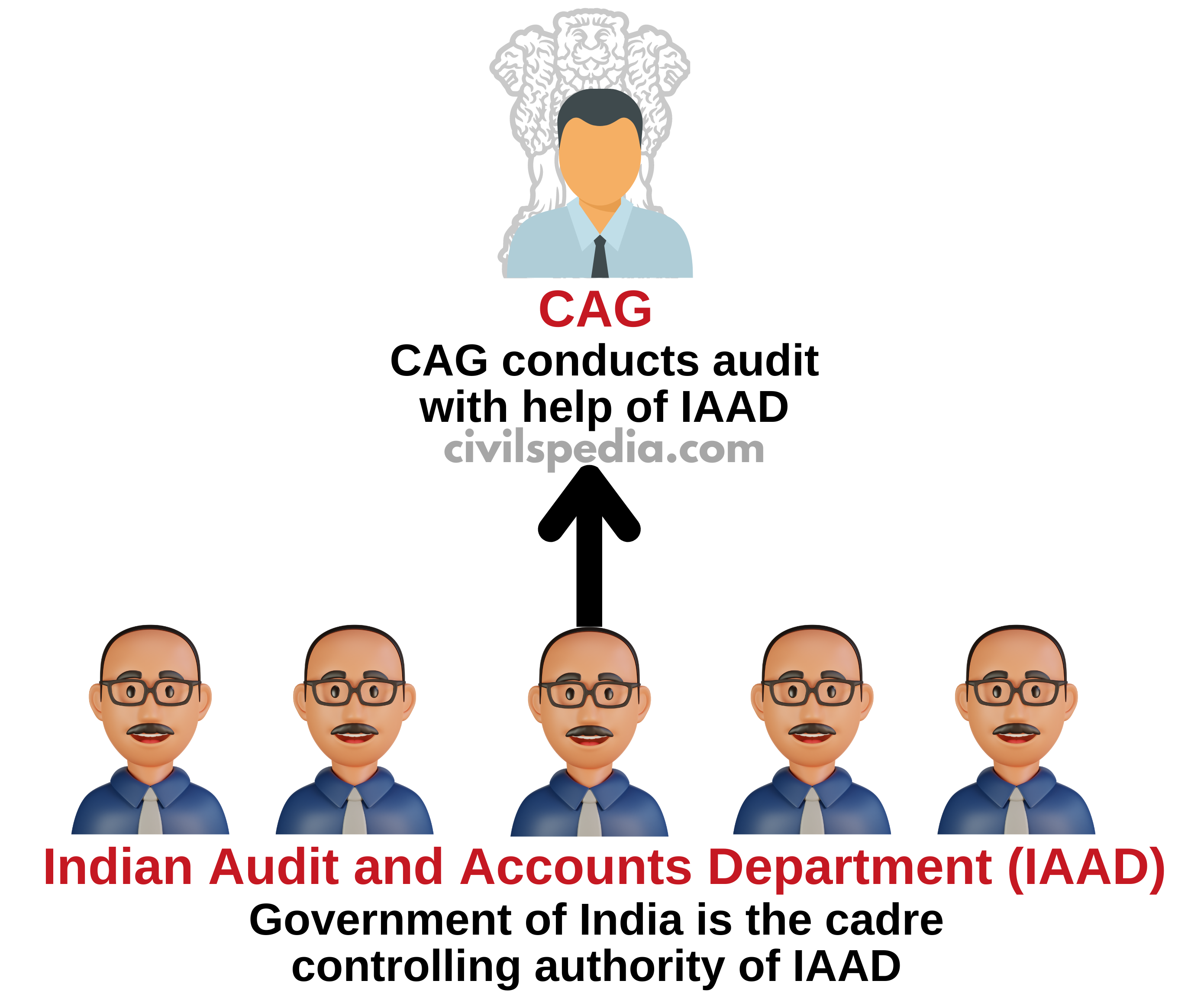
  • The Indian Audit and Accounts Department (IA&AD) is the primary body through which CAG conducts audits. 
CAG and Auditing System in India

Issue with the System

  • CAG (IAAD) conducts Audit on behalf of Parliament. Principally, it should be entirely out of the influence of the Executive. However, the Government of India is the Cadre controlling Authority of the Indian Audit and Accounts Department (IAAD), which is headed by CAG and with whose help CAG conducts audits. This is a continuance of the British Era Model (1937 rules) in which the Executive indirectly controlled CAG.  

Duties and Powers of  the CAG

Article 149

Constitution (Article 149) authorises the Parliament to prescribe the duties and powers of the CAG.  Accordingly, Parliament enacted CAG’s (Duties, Powers and Conditions of Service) Act, 1971. The Act was amended in 1976 to separate accounts from audits in the Central government.

The duties and functions of the CAG  

  • CAG audits the accounts related to all expenditures from 
    • Consolidated Fund of the Union of India and each state 
    • Contingency Fund of the Union of India and each state
    • Public Account of the Union of India and each state  
  • CAG audits the balance sheets of the departments of the Central Government and state governments.
  • CAG can audit the accounts of any other authority when requested by the President or Governor. For example, audit of local bodies

Earlier, CAG used to compile and maintain accounts of the Central Government as well. In 1976, he was relieved of his responsibility to compile and maintain accounts of the Central Government due to the separation of accounts from Audit.


Article 150

  • CAG advises the President with regard to the prescription of the form in which the accounts of the Centre and states shall be kept.

Article 151

  • CAG submits the audit reports related to the accounts of the Centre to the President, who shall, in turn, place them before both Houses of Parliament  

He acts as a guide, friend and philosopher of the Public Accounts Committee of the Parliament.


Role of CAG

  • The role of the CAG is to uphold the Constitution of India and the laws of Parliament in the field of financial administration. The audit reports of the CAG secure accountability in the sphere of financial administration of the executive.  
  • CAG is an agent of the Parliament and conducts an Audit of expenditure on behalf of the Parliament. In addition to legal and regulatory AuditCAG can also conduct the propriety audit; that is, he can look into the ‘wisdom, faithfulness and economy’ of expenditure and comment on the wastefulness and extravagance of such expenditure. However, legal and regulatory Audits are obligatory, but propriety audit is discretionary (but CAG can’t audit Secret service expenditure).
  • The Constitution of India visualises the CAG as the Comptroller as well as the Auditor General. However, in practice, the CAG is fulfilling the role of an Auditor-General only and not that of a Comptroller, as the CAG has no control over the issue of money from the Consolidated Fund and is concerned only at the audit stage when the expenditure has already taken place (unlike Britain)


Problems with CAG

  • Paralysing Unwillingness to Act: The Comptroller and Auditor General’s (CAG) presence in India is often cited as a primary cause of bureaucratic inertia. Officials fear making decisions due to the scrutiny they may face from the CAG, leading to indecision and stagnation in governance processes.
  • Post-Mortem Examination: CAG audits often serve as post-mortem examinations of government expenditures. CAG is concerned only at the audit stage when the expenditure has already taken place
  • Appointment of Generalists: The practice of appointing generalist bureaucrats, such as those from the Indian Administrative Service (IAS), as the CAG is criticized. Many argue that specialists from services like the Indian Audit and Account Service, Indian Economic Service, Indian Statistical Service, or Indian Revenue Service would be better suited for the role due to their expertise in auditing and financial matters. 
  • CAG & Defence:   CAG reports have sometimes been accused of jeopardizing national security, as seen in instances where revelations about defence preparedness were made public. For example, a CAG report in 2017 warned that the Indian Army’s ammunition stock would be depleted within 10 days of the war, potentially compromising the country’s defence capabilities.
  • Issue of Notional Loss: The CAG’s estimation of notional losses, such as in the 2G spectrum case, has been a subject of controversy. These estimates, which are based on assumptions and methodologies that may not always align with legal standards, can lead to inflated figures and subsequent legal challenges. 
  • CAG Activism: Some critics perceive the CAG’s involvement in high-profile cases like the 2G spectrum and Coalgate as examples of activism beyond its mandate. While the CAG’s role is primarily to audit government expenditures and ensure accountability, its involvement in such cases has been seen as overstepping boundaries and encroaching into policy and regulatory domains.
  • Much of the government expenditure is kept out of CAG Audit by Governments. 
    • CAG’s Authority doesn’t extend to Government Corporations created with special laws. Parliament or State Legislature can make provisions regarding Audit within the Act itself. Additionally, new organizational structures in the form of public-private partnerships are also out of the scope of CAG’s Audit. E.g., GMR Airport 
    • NGOs and Private Agencies take up many Government works at delivery points. These private agencies and NGOs are also out of the ambit of CAG.
  • Issue of Redactment: CAG, in the Audit Report of Acquisition of Rafale, redacted, i.e. removed sensitive information from the document citing security concerns expressed by the Government.
  • Politicization of CAG’s office: The politicization of the Comptroller and Auditor General (CAG) post in India has become a subject of concern in recent years. The Constitution of India explicitly states that the CAG should not be given a post-retirement posting, emphasizing the need for the CAG to maintain impartiality and independence from political influence. However, there have been instances where former CAGs have been appointed to positions that raise questions about their independence and neutrality. For example 
    • Former CAG Vinod Rai (who unearthed the Coal Scam) was appointed as Chairman of the Bank Board Bureau.
    • TN Chaturvedi (CAG from 1984 to 89) joined the BJP after retirement and contested the election using BJP’s ticket. He was later made Governor of Kerala too. 
  • Appleby’s Criticism
    • Paul H. Appleby was highly critical of the role of the Comptroller and Auditor General (CAG) in India, going as far as recommending its abolition. 
    • He argued that the institution of the CAG was inherited from colonial rule, implying it may not be suitable for modern governance needs.
    • Appleby criticized the CAG for fostering a paralysing unwillingness to act within government circles, suggesting that its oversight role may stifle decision-making and action.
    • He questioned the competence of auditors to understand the nuances of good administration, asserting that their expertise lies in auditing rather than administration.


Side Topic: Presumptive Loss / 2G Spectrum Case

The theory of presumptive and notional loss involves calculations by the CAG to estimate the potential revenue lost by the Government due to irregularities or lack of adherence to proper procedures in resource allocations, such as natural resources like spectrum and coal.

Using the Theory of Presumptive and Notional Loss 

  • In the case of the 2G Spectrum Allocation, the CAG calculated a notional loss of Rs 1.76 lakh crore due to the use of a “first come, first served” policy instead of an auction, which could have potentially generated higher revenue.
  • In the Coal Scam, the CAG initially estimated a notional loss of ₹10 lakh crore, later revised to Rs 1.86 lakh crore, highlighting discrepancies in the allocation process.

However, in December 2017, a Special CBI Court acquitted A Raja and Kanimozhi and rejected the presumptive loss theory proposed by the CAG. 

It’s also important to recognize that the Government’s objectives extend beyond profit maximization; considerations such as socio-economic factors and job creation also play a significant role in decision-making. 

Hence, CAG has failed to accommodate the changing dynamics of doing business in the LPG Era