Extremist Phase

Extremist Phase

This article deals with ‘ Extremist Phase – UPSC.’ This is part of our series on ‘Modern History’ which is important pillar of GS-1 syllabus . For more articles , you can click here

Rise of Extremists

  • Failure of Moderate politics became quite apparent by end of 19th century & new trend that rose was that of extremists
  • Extremism developed in 3 main regions under three leaders
Bepin Chandra Pal Bengal
Bal Gangadhar Tilak Maharashtra
Lala Lajpat Rai Punjab

Reasons for rise of Extremism

1 . Recognition of true nature of British Rule

  • Early nationalist leaders exposed the true nature of British rule in India. They conclusively proved by elaborate data that British rule & its policies were responsible for the economic ruin of India & deepening her poverty
    • MG Ranade : Essays in Indian Economics(1898)
    • Dadabhai Naoroji : Indian Poverty & un-British Rule in India(1901)
    • RC Dutt : Economic History of India
  • With their economic critique & Drain Theory , they exposed real nature of British rule.
  • Thus extremist ideology was next & logical step to these developments in political thinking.

2. Dissatisfaction with Congress’s achievements

  • Younger elements within the Congress were dissatisfied with the achievements of Congress during first 15-20 years & also with cold & reactionary attitude of the government . They lost their faith in British sense of justice & were strongly critical of the peaceful & constitutional means
  • On his return from England in 1905, Lala Lajpat Rai said that British democracy was too busy with their own affairs & British press is unlikely to champion their cause. They have to make a blow for freedom themselves.

3. Curzonian Administration

  • Curzonian administration  magnified this nationalist anger further .
  • Initiated number of unpopular legislations & administration  measures which hurt educated Indians
    • Indian Universities Act : placed Calcutta University under complete government control
    • Indian Official Secrets Act, 1904 : placed restrictions on press
    • Reform of Calcutta Corporation(1898) : Reduce the elected members by increasing official members because large number of nationalist leaders were getting birth from this institute
    • Partition of Bengal

4. Deteriorating economic condition

  • Large number of famines in 1890s
  • Total toll of 90 lakh
  • Government did nothing & people not satisfied with government efforts

5. International Influence

  • 1896 : Ethiopia defeated Italy
  • Russia defeated by Japan
  • Irish, Turkish movements

All this gave  impression to nationalists that United India can take on British &  that Europeans are not invincible

6. Partition of Bengal

  • Worst & most hated work of Curzon’s policy.
  • From 1903-1905 , Moderates were in commanding position . It was made public in 1903 that partition would be done & finally took place in 1905 & in meantime , Moderates were not able to do anything
  • Utter disregard of Curzon showed to public that Moderate’s policy of ‘petition, prayers & protests’ wasn’t going to work

Fighting Factions in different regions : Moderates vs Extremists

At start of 20th century , there was great deal of faction fighting at almost all levels

Bengal Bitter journalistic rivalry between Bengalee edited by Moderate SN Banerjea & Amrita Bazaar Patrika by Radical leader Motilal Ghosh
Maharashtra Competition between Gokhale & Tilak for controlling Poona Sarvajanik Sabha .
Split in the Congress at Surat was the product of a fierce struggle between ‘the Tilakites of Poona’ and Moderates of Bombay, led by Pherozeshah Mehta.
Madras Three factions fighting with each other
Punjab Arya Samaj divided after death of Dayanand between Moderate College group & Radical Revivalist group

These factions in all parts fighting for supremacy was ultimately  won by  Extremists

Side Note – Historians of the ‘Cambridge school‘ have been trying in recent years to present the emergence of Extremist dissent as basically a set of factional quarrels for the control of the Congress. Certainly there was no lack of factionalism in Congress circles during the 1890s. Yet Cambridge scholars surely press it much too far. It is difficult to understand why dissidents should have been so eager to capture the Congress—not yet a real political party with power and patronage opportunities & not more than an annual platform with very inadequate funds—unless it was because they had certain alternative strategies and ideals to put forward. Above all, such scholarship ignores entirely the fairly systematic critique of Moderate politics which was emerging in the 1890s, most notably in the three principal bases of later Extremism—Bengal, Punjab and Maharashtra.

Goal of the Extremists

Their goal was SWARAJ but different people interpreted it differently

Tilak Indian control over the administration  but not a total severance of relations with British 
Bipin Pal Believed no self government was possible under British paramountcy & for him swaraj meant complete autonomy free from British control
Aurobindo Ghosh Absolute political freedom
Most others Self rule within Parameters of British imperial structure

Methods of Agitation

  • Passive resistance :  opposition of colonial rule through violation of its unjust laws , boycott of British goods & institutions
  • Development of indigenous alternatives ie Swadeshi & national education

Revivalism & Extremists

  • They gave Revivalist discourse . They sought to invoke an imagined golden past & used symbols from a retrospectively constructed history to arouse nationalist passions. Historical figures who had demonstrated valour & prowess were now projected as national heroes .  Tilak started Shivaji festivals in Maharashtra .  Marathas , Rajputs & Sikhs stereotyped as martial races by Britishers were now placed in Aryan tradition & appropriated as national heroes
  • Some of the leaders like Tilak & Aurobindo Ghosh also believed that  use of Hindu mythology & history was best mean to reach the masses & mobilise them in support
  • Vivekananda’s teaching effects – physical culture movement started with great enthusiasm with gymnasiums coming up in Bengal to reclaim physical prowess
  • Indian Political leaders also looked back to ancient Indo -Aryan traditions as an alternate to Anglo -Saxon political systems . Extremists tried to define Indian nation in terms of distinctly Indian cultural Idioms which led to religious revivalism invoking glorious past

More on Revivalism in next article. Click here to jump over to article.

Main Leaders During Extremist Phase

1 . Bal Gangadhar Tilak

  • 1856-1920
  • Known as Lokmanya and father of Indian unrest
  • He began his political career as moderate but turned extremist by beginning of the 20th century

Pioneer in many ways:

  • Use of religious orthodoxy as a method of mass contact through organisation of Ganpati festival in 1893
  • First to develop patriotic cum historical cult through organisation of the Shivaji festival in 1897
  • Experimented with kind of non revenue campaign among the famine stricken peasants of Maharashtra in 1896-97

Vision on social reforms :

  • Although a radical in politics , he was conservative in social reforms
  • He said both were distinct & political freedom must come before social freedom
  • He opposed any initiative by British government as it was an alien government as well as by congress as it would estrange masses from it

Education & Press

  • He was prominent member of DECCAN EDUCATION SOCIETY
  • He helped to found new English school later known as  Ferguson school
  • Editor of 2 newspapers :
Maharatta In English
Kesari In Marathi

Freedom struggle

  • Also founded Home Rule League in 1916 April
  • Gave slogan : Swaraj is my birthright and I shall have it
  • He was imprisoned twice for his nationalist activities :
1897  For 18 months
1908 For 6 years to Mandalay
  • Prominent role in anti partition movement (1905-08).  Made it an all India movement

2. Lala Lajpat Rai

  • 1865-1928
  • Known as Punjab Kesari
  • Leader of the ‘college faction’ of Arya Samaj
  • Played role in anti partition movement 1905
  • Deported to Burma in 1907
  • Went to USA after his release & in  1914 founded  INDIAN HOME RULE LEAGUE there
  • Editor of newspaper PUNJABEE, KOHINOOR & VANDE MATARAM
  • Wrote biographies of Mazzini, Garibaldi, Shivaji and Shrikrishna; stayed in America for some time; and was also elected to the Central Assembly.
  • Wrote Book named UNHAPPY INDIA, YOUNG INDIA
  • Died of lathi charge injuries in protests to Simon commission

3. Bipin Chandra Pal

  • 1858-1932
  • Father of revolutionary thought in India
  • Began his journalist career with PARIDARSAK
  • Started NEW INDIA to propagate nationalism
  • He started his political career as a moderate but after partition of Bengal switched to radical methods
  • He and Aurobindo Ghosh were exponents of new nationalism – swaraj + boycott+ swadeshi + national education
  • After the end of anti partition movement he retired from active politics

4. Aurobindo Ghosh

  • 1872-1950
  • Wrote New lamps for the old
  • Advocated the Doctrine of PASSIVE RESISTANCE in series of articles in 1907 in VANDE MATRAM of which he was editor
  • Part of swadeshi boycott movement
  • Principal of Bengal National College started in Calcutta as a part of scheme of national education
  • Arrested in 1908 for Kennedy murders and immediately after being judged innocent gave up politics and escaped to Pondicherry to take up religion.

Moderates versus Extremists

Moderates Extremists /Militant Nationalists 
Social base : Anglicised Upper Class of Urban Areas Social base :Educated middle class and lower  middle classes in towns
Ideological inspiration: Western liberal thought and European history Ideological inspiration : Indian history ,cultural heritage and Hindu traditional symbols
They claimed social equality & share in British Government of India on grounds that they were British subjects They demanded social & political equality as their birthright .
Believed in England’s providential mission in India Rejected providential mission theory as illusion
Believed that political connections with Britain were in India’s social,political and cultural interests Believed that political connections with Britain would perpetuate British exploitation of India
Professed loyalty to British crown British crown was unworthy of claiming Indian loyalty
Movement should be limited to middle class intelligentsia ,masses not yet ready for participation in the political work Immense faith in the capacity of masses to participate and to make sacrifices
Demanded constitutional reforms,  limited self-government within the imperial framework and share for Indians in the services Demanded Swaraj
Insisted on use of only constitutional methods Did not hesitate to use non constitutional methods like boycott and the passive resistance
They were patriots but did not play the role of comprador class They were patriots who made sacrifices for the sake of the country

Unlike  the  Moderates  who  drew  upon  the  ideas  of Gladstone,  Disraeli  and  Burke  to  refine  their  political  strategy,  the  Extremists  found  Bankim’s Anandamath,  a  historical  novel  that  narrated  the  story  of  the  rise  of  the  Hindu  Sannyasis visavis the  vanquished  Muslim  rulers  and  Vivekananda’s  interpretation  of Vedanta  philosophy. The  poem  “Bande  Mataram”  in  Anandamath  clearly  set  the  tone  of  the  Extremist  philosophy in  which  the  notion  of  ‘Mother’  seemed  to  be  prominent.    But by  overlooking  the  non-Hindu  tradition  completely  and  accepting  the  Hindu  tradition as  Indian  tradition,  they  however,  nurtured  a  narrow  view  of  history  which  is  misleading given  the  cross-fertilisation  of  multiple  traditions  in  Indian  civilisation.

Assessment of Extremism

  • Extremist as a political philosophy wasn’t consistent philosophy . Advocates of extremism ranged from
    • Active revolutionaries who werent even objected to non violent acts to those who opposed all violent methods
    • Their definition of Swaraj wasn’t consistent either

However, all extremist leaders were one in realising the evils of foreign rule & in demanding some degree of independence from colonial stranglehold.

  • They broadened the social base of nationalist movement . Most of them represented the urban lower middle class & aimed at spreading the message of Congress to the people. They spoke , wrote & edited newspapers in vernacular languages & thus succeeded in conveying their message to larger audience
  • Socially speaking  , their ideology proved to be a reactionary development. In contrast to Moderates , the Extremists became revivalist & obscurantists in matters of social reforms. Tilak’s opposition to Age of Consent Act & his association with Anti-Cow killing societies & his organisation of Ganesh & Shivaji festivals projected them as leader of Hindu orthodoxy. Although the revivalist dimension of Extremist politics was mainly directed against the foreign rulers , it developed an unhealthy inter-relationship between religion & politics  & encouraged Muslim separatism

Side Note – Age of Consent issue , revealed how much the climate of educated opinion had changed since 1860, when sexual intercourse with a girl below the age of ten had been declared to be rape without much protest from anyone. The relatively minor reform raising this age from ten to twelve,  in 1891 provoked massive opposition, particularly in Bengal and Maharashtra. Frankly conservative and obscurantist sentiments mingled here with the nationalist argument, put forward most notably by Tilak, that foreign rulers had no right to interfere with religious and social customs. The latter argument, it must be added, was slightly specious, since Hindu orthodox groups in the same period seldom hesitated to plead for legislation against cow-slaughter. Such legislation would surely also have been an interference with the religious and social customs of a big part of Indian society—the Muslims.
Use of Press by Nationalists

Use of Press by Nationalists

This article deals with ‘ Use of Press by Nationalists – UPSC.’ This is part of our series on ‘Modern History’ which is important pillar of GS-1 syllabus . For more articles , you can click here

Rise of Press in India

  • Portuguese brought press to India & first book published was Jesuits of Goa in 1557.
  • 1684 – East India Company setup printing press in Bombay
  • For a century no newspapers were published in Company’s territory because servants didn’t wish to make news of malpractices & abuses of private trading public & reach London.
  • First attempt to publish newspaper in India came from disgruntled employee who wanted to expose malpractice of Private trade (William Bolts in 1776) but he was stopped from publishing.
  • First newspaper in India was started by James Augustus Hickey named The Bengal Gazette /Calcutta General Advertiser in 1780 (Governor General at time was Warren Hastings) but he was too outspoken & criticized Governor General & Chief Justice & his press was seized in 1783.
  • Later other newspapers came up
    • Calcutta Gazette (1784)
    • The Oriental Magazine of Calcutta (1785)
    • The Calcutta Chronicle (1786)
    • The Madras Courier (1788)
    • The Bombay Herald(1789)

Rise of the Nationalist Press

  • Introduction of printing press in India was an event of revolutionary significance in the life of Indian People because it led to  awakening & growth of national consciousness among them &  gave rise to nationalist press
  • Raja Rammohan Roy was the founder of nationalist press . Although few newspapers before him were started by others but his Sambad Kaumudi (1821-Bengali) & Mirat ul Akhbar(Persian – 1822) were first indian newspaper with distinct nationalism in it .
  • Vernacular newspapers  published even from small towns discussed nationalist issues. Eg Bengali newspapers discussed on large extent issue of  increase in excise duties on cotton in western India.
  • Congress solely relied on press in the early days to propagate resolutions and proceedings . These newspapers were started not as a profit making venture but as a national service  & acted as source of the political education & participation
  • More Vernacular & English newspapers were started later
  Language By Year
Bombay Samachar Gujarati Faroonji Murzban 1822
Bang Dutt Bengali Dwarkanath Tagore , Prassana kumar Tagore 1830
Jam e Jamshid Gujarati PM Motiwala 1831
Raztgaftar Gujarati Dadabhai Naoroji 1854
Shome Prakash Bengali IC Vidyasagar 1858
  • Sir Surendra Nath Banerjea  started Bengalee in 1879 , an English daily to propagate his moderate nationalist views . He was even imprisoned for 2 months for Contempt of Court
  • Sir Dayal Singh Majeethia , on advice of Surendra nath started The Tribune of Lahore in 1877 .  It propagated views of  liberal nationalist hue

Fight to secure Press Freedom

Raja Rammohan Roy(1824)  had protested against a regulation restricting the freedom of the Press. In a memorandum to the Supreme Court, he had said that every good ruler ‘will be anxious to afford every individual the readiest means of bringing to his notice whatever may require his interference. To secure this important object, the unrestricted liberty of publication is the only effectual means that can be employed.’

Use of Press for Indian National Movement

  • Role of newspapers in making  nations in times when nations didn’t exist has been recognised by various scholars (eg Anderson in his book Imagined Communities)
  • During Revolt of 1857 : Many papers were in operation in the country.  In 1857 itself , Paygam-e-Azadi started publication in Hindi and Urdu, calling upon the people to fight against the British.
  • During peasant unrests , Newspapers came forward to take up their cause . Eg : During Indigo Rebellion , Hindoo Patriot and Somprakash came on side of Peasants .
  • Press was a weapon in the hands of nationalist groups to popularise the idea of representative government , liberty, democratic institutions , home rule, dominion status & independence . These newspapers had wide  reach till remote villages & acted as  local libraries .  People would gather around a single newspaper and discussed  each & every part of news .
  • Newspapers like Amrita Bazar Patrika of Sisir Kumar Ghosh ruthlessly examined each and every policy of Britishers and shook the moral foundations of Raj
  • Most of the work of Congress  atleast in Moderate Phase was also carried out through press & interestingly nearly 1/3rd of founding fathers of congress were journalists. Eg : Surendranath Banerjee’s Bengalee etc
  • Without press, all india conferences of nationalist organisations could not have been held and movements like Swadeshi Movement, Home Rule League, NCM etc couldn’t have been organised  . Eg
    • All national workers would look to Young India of Gandhi for directions
    • Home Rule League : Commonweal etc used by Annie Besant
    • Swadeshi & Boycott : Sanjibani, Hitabadi etc
  • During his stay in South Africa, Gandhiji had brought out Indian Opinion and after settling in India, he started the publication of Young India. Tilak also used Kesari and Mahratta to propagate  message of freedom movement and was also jailed for spreading Sedition .
  • Revolutionaries : They also used it to popularise idea of overthrowing the Raj by Armed rebellions . Eg : Ghadar Movement’s ‘Ghadar’ , Yugantar by Barindra Nath Ghosh etc
  • Indian Nationalists settled abroad also used newspapers to popularise their cause . Eg : Shyamji Krishna Verma started ‘Indian Socialist‘ and Madam Bikaji Kama’s ‘Bande Mataram’
  • Press was effective weapon in the hands of social reform groups to expose the evils such as caste fetters , child marriage, ban on widow remarriage etc and helped to organise their propaganda at large scale  (Eg : ICV Shomeparkash, RRRR Sambad Kaumudi)
  • Press also brought to the Indian people knowledge of happenings in the international world . Press also became weapon to construct solidarity ties between the progressive forces of different nations

Newspapers and person’s associated with them (important for Prelims)

Hindu & Swadesamitran G Subramaniyam Ayer
Bengalee SN Banerjee
Amrit Bazaar Patrika Sisir Kumar Ghosh & Motilal Ghosh
Kesari (in Marathi) Mahratta (in English) Tilak
Sudharak GK Gokhale
Leader MM Malviya
Hindustani Advocate GP Verma
Tribune & Akhbar e Aam Dyal Singh Majithia
Punjabee
Kohinoor
Vande Mataram (Urdu)
Lala Lajpat Rai  
Hind Prakash
Dhyan Prakash
Gujarati Sandhya
Brahmabandak Upadahya
Yugantar Barinder kumar ghosh
Indian Socialist Shyaamji Krishanji Varma (in London)
Gadar Lala Hardyal
Reformer Prasann Kumar Tagore
Bahishkrit Ambedkar
National Herald JN Nehru
Bande Mataram Bikaji Kama
Vande Mataram Aurobindo Ghosh
New India Commonweal Annie Besant
Al Hilal & Al Balagah  Maulana Abul Azad
Pakhtun  Khan Abdul Ghaffar Khan
Kudi Arasu Naicker
Young India Indian Opinion (South Africa) Gandhi
Young India Home Rule league of Tilak 

Government policy of oppression & Methods deployed by nationalists to escape

1 . Section 124 A of IPC (Sedition)

  • Since 1870 – whoever attempts to excite feelings of disaffection to the Government  was to be punished with transportation for life or for any term or with imprisonment upto three years.

Methods adopted by  Indian Journalists to evade this

  • Since Article 124A excluded persons whose loyalty to Government was undoubted , they prefaced their vitriolic writing with effusive sentiments of loyalty to Government of India & Queen
  • They used to publish anti-imperialistic extracts from London based Socialist & Irish newspapers eg sympathatic treatment of Russian terrorist activists against Tsar would draw parallel between Government of India & Indian revolutionaries

2. Vernacular Press Act 1878

  • An unfortunate legacy of Revolt of 1857 was  spirit of racial bitterness grew among rulers & ruled
European press Always sided government in all political controversies
Vernacular press Became more vocal & increasingly critical of government policies
  • Passed because Indian Newspapers became too critical of the policies of Lord Lytton & especially his inhuman approach towards victims of famine in 1876
  • Act empowered Magistrate
    • Require printer & publisher of newspaper  to enter into a bond binding them not to print or publish anything likely to incite the people against government
    • To warn as well as to confiscate deposit in case of violation
    • Magistrate’s action was final with no appeal could be made to a court of law
    • Only applicable to vernacular newspapers.
  •  Was later repealed by Lord Ripon in 1882

Was bitterly criticised by Indians because

  • Discriminatory Act – restrictions were imposed only on vernacular papers and english papers were out of its ambit
  • Moderate respectable Indians would retire from the field of journalism
  • Sound & healthy political growth would be retarded
  • Even the government would be deprived of all trustworthy sources of keeping itself well informed of the real inner feelings & thoughts of the people towards it

How Indian Newspapers escaped this

  • Was mainly aimed at Amrita Bazaar Patrika which was published in both Bengali & English but the day Act passed , overnight it converted to English Newspaper stopping Bengali edition. Hence, it was out of the  ambit of law

Main personalities who fought for freedom of press

1 . Surendranath Banerjea

  • First person to go to jail for performance of his duty as journalist
  • He wrote editorial in his newspaper Bengalee, condemning Judge of Calcutta High Court (Norris) by declaring him unworthy of his post who deeply hurt feelings of Bengali Hindus with objectionable remarks against some idol
  • Jailed for two months for Contempt of Court

2. BG Tilak

  • Militant Nationalist & started two newspapers with GG Agarkar – Kesari (Marathi) & Mahratta(English)  &  used them to spread discontent against British Rule & preach national resistance
  • Other vehicles used by Tilak
Ganapati Festivals The political recruitment of God Ganapati Started in 1893 to propagate nationalist ideas thru patriotic songs & speeches
Shivaji Festival Started in 1896 to stimulate nationalism among Maharashtrians
  • 1897 : published poem in Kesari titled Shivaji’s Utterance in which he justified Shivaji’s killing of Afzal Khan . Parallel was drawn by  justifying killing Britishers by Indians
  • 1897: Plague broke out in Poona & Government took severe measures of segregation & house searches. Tilak stayed in city to help people but at same time criticized harsh & heartless measures of government .  Popular discontent was already there & Chapekar Brothers killed Lt Ayerst ( although attack was against Rand , Head of Plague Committee) .  Government decided to use this opportunity against Tilak &  arrested him under 124A on charge of sedition . He was sentenced 18 months of rigorous punishment leading to  discontent in whole nation .  Protests even by moderates & Tilak became national hero overnight
  • Swadeshi movement : Press played major role & Tilak was front-runner in that .  Published articles like Arrival of the Bomb & condemned use of violence & individual killings.  Arrested in 1908 & 2 years imprisonment – massive public reaction – Bombay remained close for week in protest.

Legislations to control Press

Liberation of Indian Press , 1835 Lord Bentinck adopted liberal policy towards the press & considerable discussion was done about giving freedom to the press.
It was Metcalfe as Governor General who liberated Indian press & Lord Macaulay (true Whig) supported and encouraged him to do so.
New Act required publisher to make declaration giving true & precise account of premises of the publication to open it & inform while closing  

Note : Metcalfe = Liberator of Indian Press
 
Licensing Act, 1857 – After mutiny, it was found necessary to put restrictions on press
– Compulsory for each newspaper to obtain license & government reserved the discretionary right to grant licence or revoke it at any time .
– It was a temporary measure . Soon all restrictions were withdrawn & consequently many newspapers like  Indian Mirror, Amrit Bazar Patrika came up  
Registration act of 1867 Every book & newspaper was required to have printed legibly on it the name of printer & publisher and place of printing
Within 1 month of publication of book , a copy of the book had to be supplied to local government free of cost  

Vernacular press act of 1878 Dealt above
   
Repeal of Vernacular Press act Vernacular press act was resented as an attempt of government to curtail free expression of opinion
When Liberal Party’s government came to power – Lord Ripon became Governor General – he repealed this act Even Article 124A & its sedition principle was not used very frequently
Indians praised Lord Ripon for this gesture of  goodwill but English condemned this act saying that a free Indian press was bound to criticize the acts of omission & commission of the government & thereby bring it into disrepute
 
Newspaper (incitement to offences) Act , 1908 Press was criticizing Lord Curzon’s policy of repression . With this Act, Government did following
Empowered district magistrate to confiscate press & property connected with newspaper which published objectionable material which served as incitement to murder or acts of violence
Editors of newspapers were given option to appeal High Court within 15 days of order of forfeiture

Rigorous nature of act was resented  by Indian press & several important newspaper like Yugantar, Sandhya & Vandemataram stopped  their publication  
Indian Press Act, 1910 Act of 1908 wasn’t able to stop Anti-British campaign . Hence more stringent act was made 
Empowered Local Government to demand deposit not less than ₹500 & not more than ₹2,000 from the keepers of newsprinter presses & forfeit security & annul registration of offending newspapers. Fresh registration could be made by security of not less than ₹1,000 & not more than ₹10,000 & forfeit security, confiscate press if persisted to publish objectionable material
Definition of objectionable matter whose publication was to be curtailed – all attempts direct or indirect  to reduce persons as employed in His majesty’s defence forces or to intimidate people to give money for revolutionary work or to prevent them from giving help in discovering or punishing revolutionary crime
Aggrieved party can move to Special Tribunal of High Court against forfeiture within 2 months.  

In 5 years, action against 991 presses was taken & confiscated securities amounted to ₹5 Lakh.  
Defence of India Rules (WWI) Repression of the free public criticism during World War I
 
 
Press committee 1921 Chaired by Tej Bahadur Sapru as part of Government of India Act, 1919 
– Recommended repeal of the Press Acts of 1908 and 1910 => accepted in 1922  
Indian Press(Emergency Powers) Act, 1931 Civil Disobedience movement (CDM) was in full flow &  government reacted by imposing harsh control
Owners  of presses asked to deposit security &  amount to be decided by government
Penalty for printing objectionable material – 6 month imprisonment
Also restrained publication of pictures of the leaders of CDM & their news  
Foreign relations Act, 1932 – Any book, newspaper or other document containing such specified defamatory matter which tend to prejudice the maintenance of friendly relations between his majesty’s government & Government of such state would be retained in same manner as seditious literature  
 
Defence of India rules  (WW2) Press censorship
Amendments to act of 1931

At one time, publication of all news related to congress activity was declared illegal  

Economic Critique

Economic Critique

This article deals with ‘ Economic Critique – UPSC.’ This is part of our series on ‘Modern History’ which is important pillar of GS-1 syllabus . For more articles , you can click here

Economic Critique of Colonialism  by Moderates

  • Of national movement of all countries , Indian national movement was most deeply & firmly rooted in understanding of nature & character of  economic exploitation & domination.
  • Moderates were the first in the 19th century to develop an economic critique of colonialism. This critique was, also, perhaps their most important contribution to the development of the national movement in India .
  • They raised basic questions regarding the nature and purpose of British rule & clearly understood the fact that the essence of British imperialism lay in the subordination of the Indian economy to the British economy .
  • They were able to see that colonialism no longer functioned through the crude tools of plunder and tribute and mercantilisin but operated through the more disguised and complex mechanism of free trade & foreign capital investment.
  • They did economic critique using following arguments
    • Drain Theory
    • Critique of Railways
    • Deindustrialization of India

Main persons who carried out the process of Economic analysis of British Rule

1 . Dadabhai Naoroji

  • Dadabhai Naoroji, the Grand Old Man of India.
  • Born in 1825, he became a successful businessman but devoted his entire life and wealth to the creation of a national movement in India.
  • Founded Dnyan Prasarak Mandali (Society for Promotion of Knowledge)  in India during early age and then East India Association in London
  • Made poverty his special subject and spent his entire life awakening the Indian and British public to the ‘continuous impoverishment and exhaustion of the country’
  • Main proponent of Drain Theory
  • Wrote book titled – Poverty & un-British Rule in India
  • First Indian to become member of House of Commons on Liberal Party’s Ticket from Finsbury.
  • Participated in International Socialist Council in 1904
  • Put forward demand of self government & treatment of India like other British colonies
  • Respected equally by both Moderates & Extremists 
  • Gokhale called him  Gladstone of India

2. Justice MG Ranade

  • Taught an entire generation of Indians the value of modern  industrial development & said that if India is poor today it is through operation of economic causes

3. Romesh Chandra Dutt

  • Retired ICS officer, published The Economic History of India at the beginning of the 20th century in which he examined in minute detail the entire economic record of colonial rule since 1757.
  • Also explained Drain Theory in his book(written below)

Position of Indian Economy at time of European Arrival

  • India was self sufficient
  • India was self governing
  • Village economy  was self sufficient – whole economy was union of agriculture & handicraft
  • Relationship with land was based on custom

Overall, economic system was very stable

In Mughal India, unlike medieval Europe, there was no sharp division between urban centres where industries were concentrated & the countryside which supplied primary produce. Industrial production in India continued to be a largely rural based activity.

But negative aspect of Indian economy

  • Closed economy
  • No mobility of labor

How pattern of trade changed after East India Company (EIC) became political power?

1 . Before EIC became political power

  • East India Company (EIC) came as trading company
  • Was using metals & their own goods in return of Indian Textile (not cotton) & spices .  These items had huge demand In  England .  Huge profit was made after selling them.
  • This trade was based upon the price differential between Asia and the rest of the world. That is European merchants bought goods at a low price in India and sold them for a much higher price in the European markets.  The profits were based on the difference between the purchase price and selling price.
  • As export increased , local ruler were earning too  & they welcomed Britishers
  • By 1664, the English EIC imported more than 7,50,000 pieces of cotton goods from India, which accounted for 73 % of total trade. In the following two decades the figure further increased to 1.5 million pieces with cotton textiles now contributing to 83 % of the total import value. This unprecedented growth of Indian textile imports into Europe was accompanied by a steady inflow of bullion into India from the buyer nations 
  • But Britishers in Britain were unhappy because of Indian cloth all around  & put pressure on British government to do something . Law was passed forbidding  Indian textile but Indian market was so huge that despite laws & huge import duty , Indian manufacturers held their foreign markets

2. After EIC  became Political power

  • Two important things changed all wrt  India
    1. Industrial Revolution in Britain
    2. Battle of Plassey – East India Company controlled Bengal & Diwani Rights  . They used this revenue to finance its Indian goods & no bullion from Britain was required. Even Indian revenue was used to finance their imports from country like China
  • East India Company progressively abandoned free competition to secure its goods in the local markets. The producers of these goods were forced to supply their produce to the Company at low prices arbitrarily fixed by  Company
  • Up to 1753, the English Company depended on the Indian merchants to procure cloth: these merchants were called dadni merchants since they were the agency through which dadan or advance was given by the Company to the artisans or weavers. After the battle of Plassey the increasing political power in the hands of the English enabled them to make these merchants just commissioned agents . Finally, in 1789 the system of ‘direct agency’ was introduced, dispensing with Indian middlemen altogether.

Phases of Economic Exploitation of India

Did by ‘RP Dutt’ in ‘India Today’ (MFFC)

First Phase – 1757 to 1813 (monopoly of East India Company ended by Charter Act)
– Period of Mercantilism
Direct plunder
Main principle was that British bullion wouldn’t be used  to buy goods from other nations. Indian revenue was used for this .
Favorable balance of trade in favor of Britain  
East India Company  used its monopoly in trade along with coercive power of state to buy cheap and sell dear.  
     
Second phase – 1813 – 1858 (Company’s rule ended)
– Classical age of free traders .
– Industrial Revolution started in England &  Industrial Capitalists needed a market to sell finished goods and get cheap raw material to produce finished goods at great pace .
Tools : Free trade policy and commercialization of agriculture
There was no import duty on finished goods in India and British markets were protected with high export duties charged on Indian goods (specially textile) .
India was becoming market of British textile & also became source of Raw material .  
Third Phase – 1858 – 1947
– Age of Financial Capitalism.
– Investment in Britain was not much attractive and there was surplus capital in Britain .  Hence, huge investment was coming through capitalists to make profits in India.
– British capitalists were investing in India with guaranteed system (profit assured ) . Eg in Railways , investors were assured  returns using  Indian tax payers  money

Each stage developed out of conditions developed during earlier stage and different mode of colonial exploitation overlapped, old form of colonial exploitation never ceased but got integrated in to new pattern.

Deindustrialisation of India

  • Refers to the process of a continued and marked industrial decline.
  • Proportion  of national income generated by industry & the % of population dependent on it are commonly used as quantitative measures of industrial growth or decline. Increase means industrialization & decrease means deindustrialization
  • Indian nationalists used the destruction of Indian craft industries under early British rule to substantiate their point that India was being exploited under British rule. The nascent free trader group in Britain attacked the East India Company’s monopolistic control over India by criticizing the destruction of the country’s traditional crafts under the Company rule.
  • Early nationalist economists such as R.C. Dutt and subsequently Madan Mohan Malaviya (in his dissent note at the Indian Industrial Commission) argued that India underwent de-industrialization; their evidence was statistics of import of manufactures, particularly import figures of Manchester made cotton cloth.
  • In 1968, Essay by Morris David Morris challenged this arguing that increase in imports  of cloth cant justify the De-Industrialisation Theory because  there was not much direct evidence of the decline of India’s traditional industries and the nationalists had ignored the possibility of increase in demand curve for cloth in India. If we assume that there was an expansion in the domestic market for textiles in India because of the increase in the population of the country and the increase in the purchasing power of the people there would be little or no decline in traditional artisanal production. But Bipin Chandra and Tapan Raychaudhury strongly responded against this arguing that
    1. First of all these authors argued Morris had ignored a large body of evidence about the decline in traditional handicrafts and the economic position of the weavers which was easily available and scattered in a wide variety of sources ranging from government and famine reports to eye-witness accounts.
    2. Secondly domestic market could well have grown a little because of an increase in the population, but there was very little evidence to suggest that there was an increase in the per capita income of the country during the 19th century. In fact all the evidence pointed towards either a decline in the per capita income or stagnation

Causes of De-Industrialisation

  • Forcible reduction of purchase prices in India was resorted to by the Company to increase the difference between its buying and selling price and consequently increase its trading profits.
  • Import restrictions on Indian textiles in England with their market protected by heavy excise Duties.
  • Flooding of Indian markets with cheap industry made cloth without payment of Custom duties .
  • Fowler Commission artificially fixed exchange of ₹  high at  1 Shilling 4 Pence to make Indian exports uncompetitive
  • Decline of Indian rulers and princes
  • New Middle Class had taste for British goods and clothes.
  • Expansion of Railways : Cheap factory made products could reach to hinterland easily.
  • The income of weavers and spinners were drastically reduced, thereby restricting any possibility of capital accumulation and technological innovations in this traditional industrial sector.

Attitude of Nationalists towards foreign Capital

In 1899, Lord Curzon said that  foreign capital was ‘a sine qua non’ to the national advancement’ of India.

But Nationalists were firmly against the investment of foreign capital in India

  • They wanted that industrialisation of India should occur but not through foreign capital but Indian Capital . They saw foreign capital as an unmitigated evil which did not develop a country but exploited and impoverished it .
  • The key to India’s development  could only be industrialisation with Indian capital, while investment of  foreign capital meant drainage of wealth through expatriation of profit.
  • What mattered in the case of foreign trade, was not its volume but its pattern or the nature of goods internationally exchanged and their impact on national industry and agriculture. And this pattern had undergone drastic changes during the 19th Century, bias being overwhelmingly towards export of raw materials and the import of manufactured goods.

Foreign capital has economic as well as political implications

Economic Instead of encouraging and augmenting Indian capital, foreign capital replaced and suppressed it, led to the drain of capital from India and further strengthened the British hold over the Indian economy.
To try to develop a country through foreign capital, was to barter the entire future for the petty gains of today.
Political Penetration of a country by foreign capital inevitably led to its political subjugation.
Foreign capital investment creates vested interests which demands security for investors and, therefore, perpetuate foreign rule.

To quote Dadabhai Naoroji , “materially” British rule caused only “impoverishment”; it was like “the knife of sugar. That is to say there is no oppression, it is all smooth and sweet, but it is the knife, notwithstanding. “

Critique of Railways

  • Railway represented not economic development but colonisation & underdevelopment . Railways had not been coordinated with India’s industrial needs. 
  • Objective of setting up railway was quite clear
    1. Enable imported English manufactured good  to reach interior of the country
    2. Facilitate the collection and export of raw materials and agricultural  goods from the interior
    3. Allow an opportunity  for the investment of English capital in railway companies operating  in India
    4. Mechanism of administrative control through rapid movements of troops and faster communication network.
  • To serve the first two objectives, it would also be convenient to have a rate of freight charges which would allow cheap transport of manufactured goods from port cities to the interior &  of agricultural products from the interior to port cities. Opposite operation charges were high .
  • The railway companies were set up in England as joint stock companies. In order to encourage investors and bring confidence in them ,assured 5% interest was offered to them . This was ‘Guaranteed interest contract‘ with right to pull money any time
  • The companies were given free land with ninety-nine years lease, after the expiry of which the line would become government property. But any time before that – even a few months before the expiry of the lease-the companies could return the lines to the government and claim full compensation for all capital expended. In other words, they could enjoy 5 per cent guaranteed profit for ninety-eight years and then get back all their capital. This made the railway projects, as Sabyasachi Bhattacharya describes them, “an instance of private enterprise at public risk“.
  • State started to feel the heat after 1869 as the fiscal burden of bearing the cost of guaranteed profits of private companies increased due to depreciation in the value of rupee and rise in interest rates on govemment borrowings abroad.  State started direct construction by engaging engineers in some places & shifted from ‘broad-gauge’ system to ‘metre-gauge’ to cut down the expenditure of govemment on railway construction.  In case of private investors, Guaranteed Interest was reduced to 4%.
  • The outcome was not good for India in a number of ways
    1. A government guarantee of interest means that irrespective of profit or loss the interest had to be paid out of Indian tax payers’ money to the English investors. This encouraged over-expenditure 
    2. The English railway companies imported into India  engines, rail and the machinery and even the coal for the engines (coal was imported for a decade or so). In most other countries railway construction had encouraged auxiliary industries like the engineering industry, iron and steel production, mining etc (backward linkage’ effects). India was denied the benefit of such auxiliary industrial development too
    3. As late as 1921, only 10% of the superior posts in the railways were manned by Indians, so the diffusion of new skills also remained limited
    4. In certain cases the construction work disturbed ecology, subverted the natural sewage system, and in Bengal for example, created malaria epidemic in the nineteenth century
  • Nationalists main objection was against the selection of Railway as priority area for such public investments, as many of them believed that irrigation would have been a more suitable area for such investment promising higher social benefits. For a colonial government looking for profits, there was obviously less incentive for investment in irrigation. Thus the railways, as it seems, did not encourage Indian economic development as it did in industrializing Europe.

Drain theory

  • Main & first proponent of Drain theory – Dadabhai Naoroji ( The Poverty & Unbritish Rule in India )
  • Large part of India’s capital and wealth was being transferred or ‘drained’ to Britain in the form of
    1. Salaries and pensions of British civil and military officials working in India,
    2. Interest on loans taken by the Indian Government,
    3. Profits of British capitalists in India,
    4. Home Charges or expenses of the Indian Government in Britain (Secretary of State & India office in London created in  1858)

& from these India got no economic or commercial return

  • According to the nationalist calculations, this drain amount to one-half of government revenues and over one-third of India’s total savings. The drain was the basic cause of India’s poverty and the fundamental evil of British rule in India.
  • In Naoroji’s calculation this huge drainage amounted to about £12 million per year.
  • R.C. Dutt made the drain the major theme of his Economic History of India. He protested that “taxation raised by a king, says the Indian poet, is like the moisture sucked up by the sun, to be returned to the earth as fertilising rain; but the moisture raised from the Indian soil now descends as fertilising rain largely on other lands, not on India. So great an Economic Drain out of the resources of a land would impoverish the most prosperous countries on earth “
  • Moreover, the drain theory had the great political merit of being easily grasped by a nation of peasants. Money being transferred from one country to another was the most easily understood of the theories of economic exploitation, for the peasant daily underwent this experience vis-a-vis the state, landlords, moneylenders, lawyers and priests.
  • This theory was supported by Gandhi later on

Note – Many Indians, too, were subordinate beneficiaries and agents of colonial exploitation, and the nationalists generally ignored this. Nationalist opinion also usually refused to concern itself with the plight of Indians working in Indian-owned factories, in sharp contrast to that of those employed by foreigners, for whom (as for the Assam coolies) humanitarian sentiments were often expressed.

Result of Economic Critique

  • The nationalist economic agitation gradually undermined  moral foundations  challenging the whole concept of paternalistic imperialism of British rule in India. It corroded popular confidence in the benevolent character of British rule 
  • The economic development of India was offered as the chief justification for British rule by the imperialist rulers and spokesmen. The Indian nationalists controverted it forcefully and asserted that India was economically backward precisely because the British were ruling it in the interests of British trade, industry and capital, and that poverty and backwardness were the inevitable results
  • They cut at the political roots of the empire and sowed in the land the seeds of disaffection and disloyalty . This was one of the major reasons why the period 1875 to 1905 became a period of intellectual unrest

The  failure of moderate poli­tics was quite palpable by the end of the nineteenth century and their future was doomed as the less sympathetic Torries returned to power in Britain at the turn of the century. Nevertheless, the moder­ates created a political context within which such an agitation was to develop later on.

Moderates in Legislature

Moderates in Legislature

This article deals with ‘ Moderates in Legislature – UPSC.’ This is part of our series on ‘Modern History’ which is important pillar of GS-1 syllabus . For more articles , you can click here

Introduction

Legislative councils in India had no real power till 1920 , yet work done in them by nationalist leaders played important part in growth of national movement

Role of Legislative  Councils

1861 to 1892 After Mutiny of 1857 , government thought main reason for Revolt was Indian vies were not known to rulers &  decided to include them in councils . But didn’t serve the purpose because persons those were selected were Princes, big zamindars & merchants who didn’t represent common people
Although nationalists from beginning believed that India should eventually become self governing but till 1892 their demand was only limited to expansion & reform of Legislative councils because they were afraid of government declaring their activities as seditious
1892 Nationalists were totally dissatisfied with the Act of 1892
Saw it as mockery of their demands. Councils still impotent & despotism still ruled
Demanded Right to vote on Demand & raised slogan “No Taxation without Representation

Use of Legislatures by Nationalists

  • Lord Dufferin designed Act of 1892 in such a way that it enjoyed no real power & its members can make only worldly speeches & indulge in empty rhetorics.
  • But Indian leaders soon reformed impotent councils into forums for ventilating popular grievances, exposing the defects & shortcoming of bureaucracy & submitted the acts & policies of government to ruthless examination regarding their intention, methods & consequences
  • Changed SAFETY VALVE TO MAJOR CHANNEL FOR NATIONALISTIC PROPAGANDA

Most important Members who used Legislative Councils for National Awakening

1 . Pherozshah Mehta

  • Born in 1845 & was influenced by Dadabhai Naoroji when he was studying in London
  • Dominant figure of INC from 1890 to 1915 & exercised autocratic authority
  • Powerful debater + speeches marked by boldness & lucidity
  • Mehta was accused of changing the role and character of the colonial legislatures . Although press was used to condemn policies of  government but Mehta took that voice in Legislative Assembly
  • First Major intervention in Imperial Legislative Assembly came in 1895 on a bill for amendment of Police Act of 1861 which enhanced the power of the local authorities to raise a punitive police force in an area and to recover its cost from selected sections of the inhabitants of the area. Mehta pointed out that , “the measure was an attempt to convict and punish individuals without a judicial trial under the garb of preserving law and order.”  We may not find these remarks very strong today but they were like bomb thrown on civil services which considered itself beyond criticism in those times
  • Other intervention on Cutting government spending on Higher education because it was producing ‘discontended and seditious babus’ . Pointing to real motives  Mehta said most of the bureaucrats looked upon ‘every Indian college (as) a nursery for hatching broods of vipers; the less, therefore, the better.’
  • Also criticised the Bill in 1901 on taking away of  peasants‘ right of ownership of land to prevent them from bartering it away . Government passed it away using its official majority  but he performed first walkout in Indian History
  • Retired from  legislative council in 1901 due to bad health & his place was taken by Gopal Krishna Gokhale who was to prove more than worthy successor
  • Presided Congress session of 1890 .

2. Gopal Krishna Gokhale

  • Outstanding intellectual & trained in economics by Justice Ranade & GV Joshi
  • Not a great orator like Dadabhai, Tilak, Mehta or RC Dutt but relied upon his detailed knowledge & careful ,logical analysing power
  • Gokhale gained great fame for his budget speeches & he transformed legislative assembly into open university for imparting political education
  • Criticised government for presenting surplus budget & said that surplus budget is coming at time of depression & suffering when people are dying out of drought & famines .  Analysed that even during famines land & salt revenue was continuously increasing
  • Condemned large expenditure on army & territorial expansion beyond Indian frontiers & demanded greater expenditure on education & industry instead
  • Such was fear of his budget speeches that in 1910 , Lord Minto appointed RW Carlyle one of the greatest economist of times as Revenue member so that they can defend Gokhale in assembly
  • Gandhi declared him as his political guru

Moderate Phase

Moderate Phase

This article deals with ‘ Moderate Phase – UPSC.’ This is part of our series on ‘Modern History’ which is important pillar of GS-1 syllabus . For more articles , you can click here

Introduction

  • For first 20 years,  politics of Congress is referred  to as moderate politics because  Congress was hardly a full fledged political party by then . It was more in nature an annual conference which deliberated & adopted resolutions during 3 day tamasha (name given to them by extremists (rival group within Congress))
  • Moderates were basically influenced by Utilitarian theories of Edmund Burke, John Stuart Mill& John Morley
  • Moderates represented what can be said as Indian Liberalism . They wanted gradual or piece-meal reforms .  Their complaint was only against “un-British rule” in India perpetrated by the Viceroy, his Executive Council and the Anglo-Indian bureaucracy-an imperfection that could be reformed or rectified through gentle persuasion
  • They had intrinsic faith in the providential nature of British rule in India, they hoped that one day they would be recognized as partners and not subordinates in the affairs of the empire and be given the rights of full British citizenship.
  • Expectation of the Moderates was that full political freedom would come gradually and India would be ultimately given self governing right like those enjoyed by other colonies. But before achieving self government , Indians should be enlightened via education so that they can become responsible citizens (many Congress leaders were associated with educational institutions like Gokhale , SN Bannerjee) 

Methods of work in Initial Years

  • Early Congressmen had an implicit faith in the efficacy of peaceful and constitutional agitation.
  • Press and the platform at the annual sessions were their agencies. However, the press was the only agency through which the Congress propaganda was carried out throughout the year. Many leaders, in fact, were editors of either English or Indian language newspapers and wielded their pen powerfully.
  • Congressmen had great belief in British sense of Justice. They  worked under the illusion that all would be well if  British could be acquainted with true state of affairs in India . They thought that it was bureaucracy that stood in the way of their rights & intended to inform the Britishers about their problems & remind them their duty towards India . They send delegations to Britain to present Indian viewpoint . Dadabhai Naoroji spend his life in England
  • They took recourse to making earnest appeals , sending applications & petitions , holding meetings, organizing public opinion , propaganda through press (Key word : Petitions , Prayers and Press (PPP) )

Demands of the Moderates

All they wanted was Limited Self Government within the imperial framework

  • Indianization of Civil Services and Simultaneous examination for the I.C.S. in India and England (Indianized civil service would be more responsive to the Indian needs. It would stop the drainage of money, which was annually expatriated through the payment of salary and pension of the European officers. )
  • Abolition or reconstitution of the India Council,
  • Separation of the Judiciary from the Executive,
  • Repeal of the Arms Act,
  • Appointment of Indians to the commissioned ranks in the Army,
  • Reduction of military expenditure
  • Introduction of Permanent Settlement to other parts of India.
  • Expand & reform the Legislative Councils for elected representatives of people
  • Budget to be referred to legislature which should have right to discuss & vote
  • Military expenditure which used  Indian exchequer to fight imperial wars should be evenly shared by India & Britain

These demands were repeated year after year but there was hardly any response by the Britishers

They worked for the political unity of the country , for welding diverse people into a nation . For this, they kept all issues & demands which would bring one class in conflict with other out of their political agenda

Social demands too weren’t part of their agenda. Congress to them was a political body to represent political aspiration of Indian people as a whole & not a platform to discuss social reform. Separate organisation called Indian  Social Conference (1887)  was formed for this.

Moderate leaders

D Naoroji B Tyabji Pherozshah Mehta
MG Ranade G K Gokhale D E Wacha
S N Banerjee Anand Mohan Bose Rash Behari Ghosh

How many of their demands were met ?

Lord Cross’s Act or Indian Councils Act , 1892

  • Provided for marginal expansion of Legislative Councils (LCs) both at centre & provinces but members were to be selected & not elected
  • Budget can be discussed in Legislatures but not to be voted on
  • Government was given power to legislate without referring to Legislatures . Role of LC was recommendatory & not mandatory

Reformation of Administration : Charles Wood who was president of Board of Control opposed their demand of simultaneous holding of ICS exam in India & Britain on ground that there was no institution in India that can train boys but Public Service Commission was appointed later under Aitchison which recommended simultaneous exam . 

None of other demand was even considered by British authorities like

  • Income tax, abolished in the 1870s, was reimposed in 1886
  • Salt tax was raised from Rs. 2 to Rs. 2.5
  • Customs duty was imposed, but it was matched by a countervailing excise duty on Indian cotton yarn in 1894
  • Fowler Commission artificially fixed the exchange rate of rupee at a high rate of 1 shilling and 4 pence.

British attitude towards Moderates

  • From the beginning, Government was hostile towards development of nationalist forces. Dufferin was critical of its formation.  He even suggested to Hume that Congress should devote itself to social rather than political affairs but congress leaders refused to make the change . But they couldn’t be openly hostile to Congress . They hoped that Congress would keep itself busy with academic discussions confined to handful of people
  • Soon, it became clear (by 1887) that Congress & other nationalist associations & newspapers would not confine themselves to such a limited role. Newspapers reached out to people & Congress began to publish pamphlets in Indian languages . British couldn’t tolerate political awareness spreading among common people . This was nothing but sedition for administration because they exposed real, exploitative face of imperialism
  • Officials now publicly began to criticize & condemn Congress & other nationalist spokesperson.  They were branded as disloyal babus, seditious Brahmins & violent villains
  • In 1887 , Dufferin  attacked Congress by ridiculing it to be representing only a microscopic minority of people
  • British authorities pushed further their policy of Divide & Rule to counter nationalist movement
    • Encouraged Sayyid Ahmed Khan, Raja Shiva Prasad & Pro-Britishers to start anti congress movements. This started to drive a wedge between Hindu-Muslims
    • Cleverly exploited a controversy around Hindi & Urdu & give it a communal touch
    • Cow protection movement started by Hindu nationalist was used for same purpose

Achievements & contributions of Moderates

  • Creation of national awakening among the people and trained people in the art of the political work
  • Popularise the idea of democracy & nationalism among the people
  • Exposition of the exploitative character of the British imperialism eg drain of wealth theory & Economic Critique of  moderates was their greatest achievement
  • Creation of the common political & economic programme around which Indians gathered and waged political struggles
  • Providing sound base for foundation on which Indian national movement build up the momentum
  • They adopted the values of women empowerment , equality in the society and secularism and democracy
  • Shook the very belief that British Rule was for benefit of Indians – turned legislatures into forums

Limitations of Moderates

  • Don’t have much of political success to their credit but however meagre their success is it has to be seen in the context of prevailing political circumstances & colonial conditions they worked in
  • The movement under them failed to acquire roots in the masses and mobilise them  & their programme remained confined to educated elite called Bhadraloks
  • Landed interests dominated : For initial few years British Indian Association of landlords was major source of their finance + among lawyers most of them had landed interest . They demanded extension of Permanent Settlement only in interest of zamindars + in 1898 pro zamindari amendments were added to Bengal Tenancy Act,1885 on their demand  . 
  • Didn’t take pro worker stand – They opposed factory reforms to improve living condition of the workers & were pro industrial class always .They were opposed to factory reforms like the Mining Bill, which proposed to improve the living condition of women and children and restrict their employment under certain age. They also opposed similar labor reforms in Bombay on the plea that they were prompted by Lancashire interests. However, they supported labour reforms for Assam tea gardens, as capitalist interest involved there was of foreign origin
  • Early moderates were  all mainly Hindus barring notable Bombay politician Badruddin Tyabji . From 1892 to 1902- 90%. Hindus & 6.5 % Muslim delegates & among Hindus 40% were Brahmins & rest upper class Hindus . When congress demanded elected councils it was not liked by Sir Syed KHAN who feared that it would mean Hindu Majority rule . On cow protection issue although it has no sympathy with Hindu nationalists didn’t speak against them fearing losing Hindu votes &  all this further alienated Muslims from them

Revolt of 1857

Table of Contents

Revolt of 1857

This article deals with ‘ Revolt of 1857 – UPSC.’ This is part of our series on ‘Modern History’ which is important pillar of GS-1 syllabus . For more articles , you can click here

General Survey

  • Series of local risings & civil disturbances was not a rare occurrence in British India . Novelty of this mutiny lay in the wide extent of area covered & its military potentiality . Revolts of 1857 in parts of central & northern India resulted in the nearly collapse of British rule in these regions until the spring of 1858
  • Revolt witnessed extraordinary amount of violence unleashed on both sides
British Counter insurgency measures Public Execution of rebels – blowing them off from cannons & indiscriminately burning of their villages
Rebels Rebels massacred white civilians – women & children included . Bibighar Massacre in Kanpur was the most notorious among all
  • Revolt ended the rule of the EIC  in 1858 by an act of the Parliament . India was taken over by British crown
  • Revolt for long was mistaken to be mere mutiny of the Indian Sepoys in Bengal army , was indeed joined by an aggrieved rural society of the North India

Causes of Revolt

1 . Military Causes

1.1 Composition of the Army

  • Company while raising a standing army since mid 18th century respected traditions and customs of the indigenous communities . High caste identity of the army was deliberately encouraged . All sepoys were from Brahmin, Rajput & Bhumihar caste &  their caste rule, dietary & travel restrictions were respected under instructions from Warren Hastings
  • But from 1820s , things began to change . Army reforms were initiated to make it more universalized & from 1830s army begun to  curtail some of the caste privileges & pecuniary benefits

1.2 Bengal Regiment & Revolt

  • Mutiny mainly affected Bengal army : Madras & Bombay regiments remained quiet while Punjabi & Gurkhas soldier actually helped to suppress the rebellion (but half of the total army was in Bengal regiment ) . If we want to know why revolt happened, we have to concentrate here.
  • Composition of the Bengal Army was to be blamed for
    • High caste background of the sepoys mainly recruited from Awadh gave it a homogeneous character
    • They were nurturing for a long time number of grievances : their religious beliefs had lately come in conflict with new service conditions .
      • They were refused to wear their caste marks
      • Forced to cross seas which was forbidden in their religion &
      • In distant campaigns forced to eat whatever necessary for survival which led to their boycott from society
    • Their salary levels dropped & they suffered discrimination in matters of promotion & pension
    • In 1856 , new service rules  abolished their extra allowance for service outside their own regions  

1.3 White soldiers vs Sepoys

  • By the 1850s, there were other reasons for their discontent. The relationship of the sepoys with their superior white officers underwent a significant change in the years preceding the uprising of 1857.
  • In the 1820s, white officers made it a point to maintain friendly relations with the sepoys. They would take part in their leisure activities – they wrestled with them, fenced with them and went out hawking with them. Many of them were fluent in Hindustani and were familiar with the customs and culture of the country. These officers were disciplinarian and father figure rolled into one.
  • In the 1840s, this began to change. The officers developed a sense of superiority and started treating the Sepoys as their racial inferiors, riding roughshod over their sensibilities. Abuse and physical violence became common and thus the distance between sepoys and officers grew. Trust was replaced by suspicion. The episode of the greased cartridges was a classic example of this.

1.4 Christian missionaries in Army

  • There was constant fear among the Indian sepoys that British are determined to convert them into Christianity
  • Presence of missionaries , rumors about mixing cow & pig bone dust in flour & finally controversy about the cartridge of enfield rifles , all fitted well in this conspiracy theory

1.5 Other Religious beliefs shattered

  • In 1856, Act was passed under which  new recruits had to give an undertaking to serve overseas, if required. Conservative beliefs of the sepoys were thus shaken & they sometimes reacted strongly.
  • This issue of crossing sea was sensitive & earlier in 1824, the 47th Regiment of sepoys at Barrackpore refused to go to Burma by sea-route because their religion forbade

1.6 Annexation of Awadh

  • Annexation of Awadh in 1856 had special adverse effect on the morale of Bengal army as 75% was recruited from this region
  • Governor General was earlier warned that  every agricultural family in Awadh perhaps without exception sends one of its member into British army . Annexation of Awadh shook the loyalty of Sepoys & for them it was the proof of untrustworthiness of  British

1.7 Sepoys = Peasants in uniform

  • Sepoys were peasants in uniform & they were anxious about the declining conditions of the peasants due to summary settlements in Awadh
  • Revolt was preceded by about 14,000 petitions from sepoys about hardships relating to revenue system

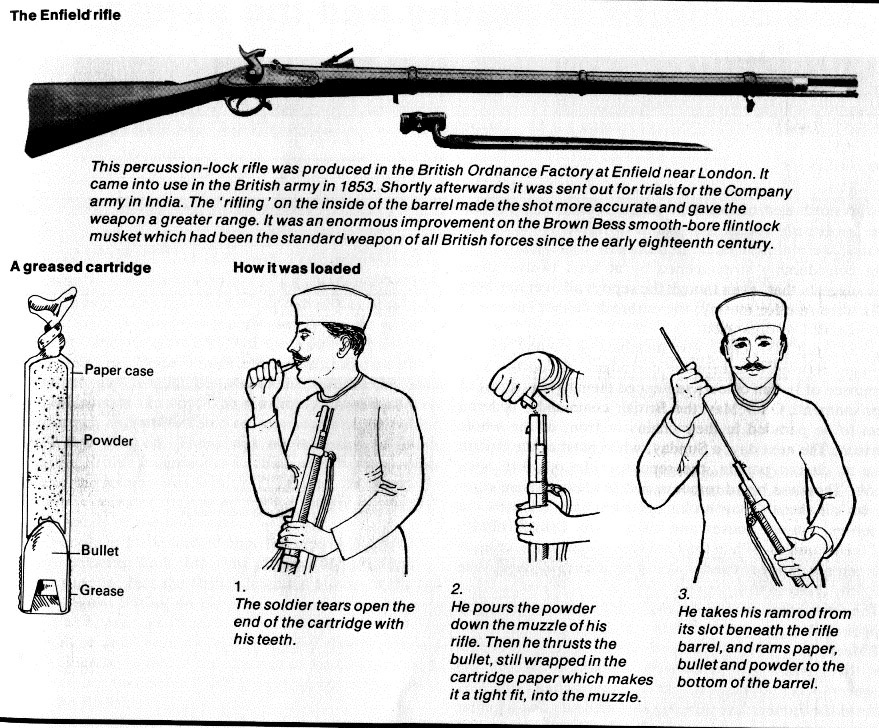
1.8 Introduction of greased Cartridge 

  • Late Jan 1857: rumors started to circulate among sepoys in Dum Dum near Calcutta that the cartridges of new Enfield Rifle introduced to replace old Brown Bess musket has been greased with cow & pig fat
  • This confirmed the sepoys old suspicion about the conspiracy to destroy their religion & caste and convert them to Christianity . Although the production of these cartridges stopped immediately but trust that was breached was never restored
Enfield Rifle and Revolt of 1857
How to use Enfield Rifle and controversy surrounding this

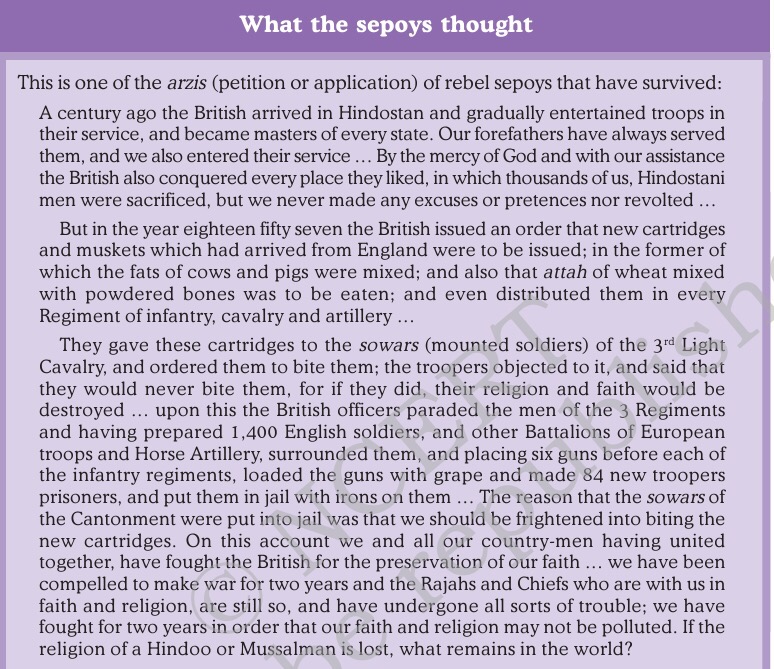
What the sepoys thought 
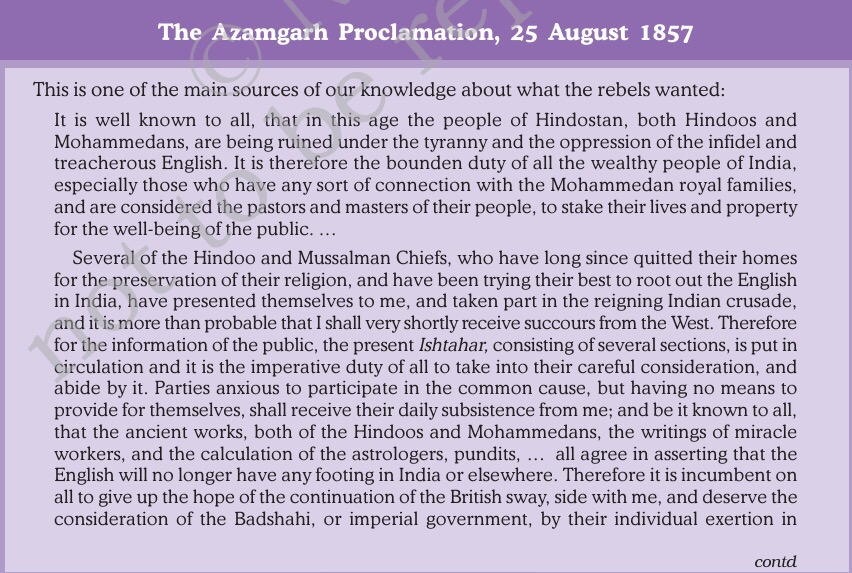
This is one of the arzis (petition or application) of rebel sepoys that have survived: 
A century ago the British arrived in Hindostan and gradually entertained troops in 
their service, and became masters of every state. Our forefathers have always served 
them, and we also entered their service . By the mercy of God and with our assistance 
the British also conquered every place they liked, in which thousands of us, Hindostani 
men were sacrificed, but we never made any excuses or pretences nor revolted 
But in the year eighteen fifty seven the British issued an order that new cartridges 
and muskets which had arrived from England were to be issued; in the former of 
which the fats of cows and pigs were mixed; and also that attah of wheat mixed 
with powdered bones was to be eaten; and even distributed them in every 
Regiment of infantry, cavalry and artillery 
They gave these cartridges to the sowars (mounted soldiers) of the 3rd Light 
Cavalry, and ordered them to bite them; the troopers objected to it, and said that 
they would never bite them, for if they did, their religion and faith would be 
destroyed upon this the British officers paraded the men of the 3 Regiments 
and having prepared 1,400 English soldiers, and other Battalions of European 
troops and Horse Artillery, surrounded them, and placing six guns before each of 
the infantry regiments, loaded the guns with grape and made 84 new troopers 
prisoners, and put them in jail with irons on them The reason that the sowars of 
the Cantonment were put into jail was that we should be frightened into biting the 
new cartridges. On this account we and all our country-men having united 
together, have fought the British for the preservation of our faith we have been 
compelled to make war for two years and the Rajahs and Chiefs who are with us in 
faith and religion, are still so, and have undergone all sorts of trouble; we have 
fought for two years in order that our faith and religion may not be polluted. If the 
religion of a Hindoo or Mussalman is lost, what remains in the world?

It is much more difficult to explain the civilian revolt that accompanied the mutiny.

  • Regions and people who were beneficiaries of colonial rule did not revolt.
  • Bengal and Punjab remained peaceful; the entire south India remained unaffected too.
  • On the other hand, those who revolted had two elements among them-the feudal elements and the big landlords on the one end and the peasantry on the other.

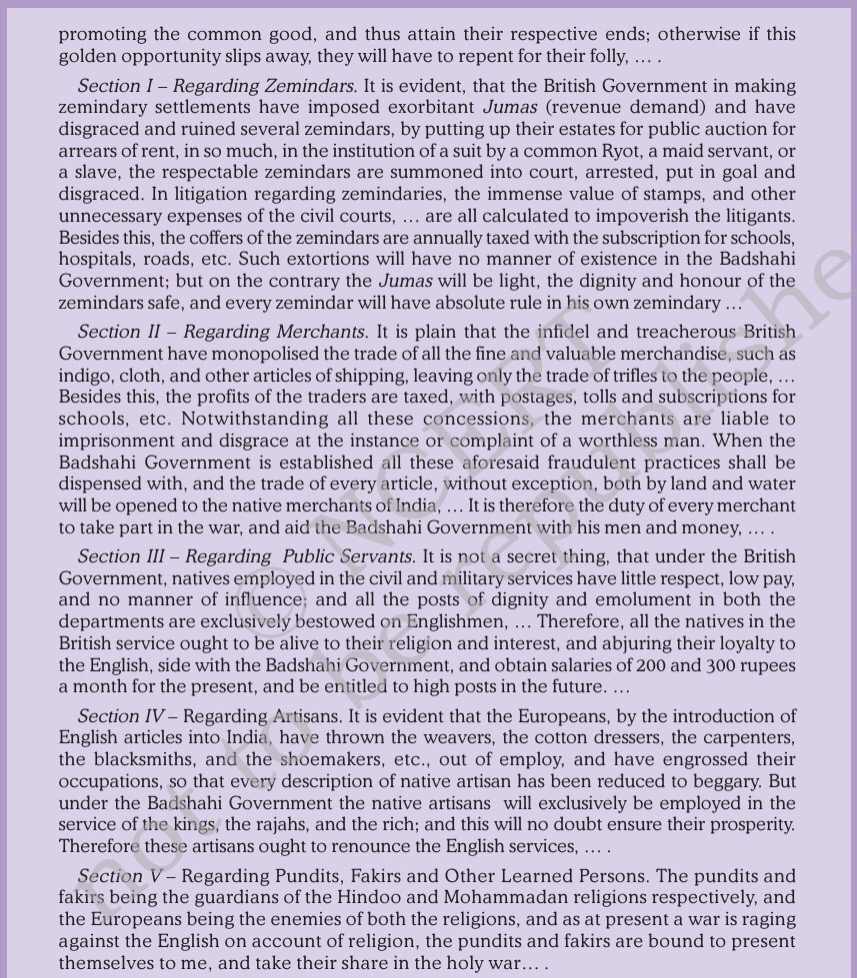
2. Exploitation of the peasants

  • To extract as much money as possible Company’s Administration devised new systems of land settlements – Permanent, Ryotwari and Mahalwari -each more oppressive than the other. Proprietary rights of the peasants were taken from them . This affected their social position to great extent . They were now mere tenants & owners of the land were zamindars
  • Peasants had to pay beyond their means & any adverse natural shifts like droughts or flood compelled them to go for loans to the money lenders who charged exorbitant interest. This made them heavily indebted to moneylenders  & forced them to sell their lands
  • Peasantry was also oppressed by petty officials in administration who extracted money on the slightest pretexts. If the peasants went to the law court to seek redress of their grievances, they were bound to be totally ruined.
  • This nexus between the lower officials, law courts and money lenders created a vicious circle which made the peasantry desperate and ready to welcome any opportunity for change of regime.

3. Alienation of the Middle & Upper strata of Indians

  • During Mughals or even in administration of local princes & chieftains , Indians served at all the positions – both upper & lower but British administration deprived the Indians of higher posts which were taken mainly by British &  Indians served only at subordinate positions.
  • In Military services, the highest post attainable by an Indian was that of a Subedar on a salary of ₹ 70 & in Civil Services that of Sadr Amin on a salary of ₹500 per month.
  • The cultural personnel like poets, dramatists, writers , musicians etc who were earlier employed by native states were now thrown out
  • Religious Pandits & Maulvis also lost their former power & prestige

4. Annexation of Princely States

Major grievances were

  • Annexations under Doctrine of Lapse : Satara, Nagpur, Sambhalpur , Bhagat, Jhansi & Udaipur(sns buj) were taken like this in quick succession . This amounted to British interference in traditional system of inheritance & created a group of disgruntled feudal lords . Their right to succession wasn’t recognised .
  • Annexation of Awadh in 1856 : Awadh was annexed on excuse of mismanagement & king was deported to Calcutta.  This annexation didn’t affected nawab &’his family but entire aristocracy
  • The Muslim feelings were hurt.  Bahadur Shah II , the Mughal Emperor was an old man who might die any moment. Britishers recognised the succession of Prince Faqir ud Din but imposed many restrictions on him. Fakir died in 1856 & Lord Canning announced that the Prince next in succession would have to renounce the regal title & ancestral Mughal palaces in additions to renunciations agreed upon by Fakir. These acts greatly unnerved the Indian muslims who thought English wanted to humble the House of Timur
  • Absentee Sovereignty-Ship of British Rule in India was also important reason. Earlier rulers like Mughals or Afghans after conquering India had settled here & became Indians. The revenue  collected from the people were spent in India only but in case of Britishers they were ruling from England & draining India of her wealth.
  • Hence, various rulers took arms against Britishers
Nana Sahib Leader at Kanpur
– Adopted son of Peshwa Baji Rao II , who wasn’t recognised as next Peshwa 
Begum Hazrat Mahal Took control over Lucknow
Khan Bahadur Khan Rohilkhand
Rani Jhansi Took control at Jhansi
– Although she was earlier prepared to accept British paramountcy if her adopted son was recognised as legitimate heir to the throne

Case of Awadh

(This topic is explained at great length in NCERTs . Hence, we are covering this in detail)

  • Area which was the breeding ground of Revolt / Mutiny was Awadh. Here various events happened which made Prince , Taluqdars, Peasants and Soldiers to join hands with each other to oust their common enemy that is East India Company.
  • Important to study because majority of army that rebelled was from this region

Case of deposing the King

  • The Subsidiary Alliance had been imposed on Awadh in 1801. By the terms of this alliance the Nawab had to disband his military force, allow the British to position their troops within the kingdom, and act in accordance with the advice of the British Resident who was now to be attached to the court. Deprived of his armed forces, the Nawab became increasingly dependent on British to maintain law and order within the kingdom. He could no longer assert control over the rebellious chiefs and taluqdars.
  • In the meantime the British became increasingly interested in acquiring the territory of Awadh. They felt that the soil there was good for producing indigo and cotton.
  • By the early 1850s, moreover, all the major areas of India had been conquered: the Maratha lands, the Doab, the Carnatic, the Punjab and Bengal. The takeover of Awadh in 1856 was expected to complete a process of territorial annexation that had begun with the conquest of Bengal almost a century earlier.
  • Lord Dalhousie’s annexations created disaffection in all the areas and principalities that were annexed but nowhere more so than in the kingdom of Awadh in the heart of North India. Here, Nawab Wajid Ali Shah was dethroned and exiled to Calcutta on the plea that the region was being misgoverned. The British government also wrongly assumed that Wajid Ali Shah was an unpopular ruler. On the contrary, he was widely loved, and when he left his beloved Lucknow, there were many who followed him all the way to Kanpur singing songs of lament.

Case of Taluqdars – Summary Settlement

  • Countryside of Awadh was dotted with the estates and forts of Taluqdars who for many generations had controlled land and power in the countryside. Before the coming of the British, Taluqdars maintained armed retainers, built forts, and enjoyed a degree of autonomy, as long as they accepted the suzerainty of the Nawab and paid the revenue of their taluqs.
  • Some of the bigger Taluqdars had as many as 12,000 footsoldiers and even the smaller ones had about 200. The British were unwilling to tolerate the power of the taluqdars. Immediately after the annexation, the taluqdars were disarmed and their forts destroyed.
  • The British land revenue policy further undermined the position and authority of the taluqdars. After annexation, the first British revenue settlement, known as the Summary Settlement of 1856, was based on the assumption that the taluqdars were interlopers with no permanent stakes in land: they had established their hold over land through force and fraud.  The Summary Settlement proceeded to remove the taluqdars wherever possible. Figures show that in pre-British times, taluqdars had held 67% of the total number of villages in Awadh; by the Summary Settlement this number had come down to 38%.

Case of Peasants

  • British land revenue officers believed that by removing taluqdars they would be able to settle the land with the actual owners of the soil and thus reduce the level of exploitation of peasants while increasing revenue returns for the state. But this did not happen in practice: revenue flows for the state increased but the burden of demand on the peasants did not decline. Officials soon found that large areas of Awadh were actually heavily overassessed
  • The dispossession of taluqdars meant the breakdown of an entire social order. The ties of loyalty and patronage that had bound the peasant to the taluqdar were disrupted. In pre-British times, the taluqdars were oppressors but many of them also appeared to be generous father figures: they exacted a variety of dues from the peasant but were often considerate in times of need. Now, under the British, the peasant was directly exposed to overassessment of revenue and inflexible methods of collection. There was no longer any guarantee that in times of hardship or crop failure the revenue demand of the state would be reduced or collection postponed; or that in times of festivities the peasant would get the loan and support that the taluqdar had earlier provided.

Case of Sepoys

  • The grievances of the peasants were carried over into the sepoy lines since a vast majority of the sepoys were recruited from the villages of Awadh.
  • Sepoys were peasants in uniform & they were anxious about the declining conditions of the peasants due to summary settlements in Awadh . Revolt was preceded by about 14,000 petitions from sepoys about hardships relating to revenue system

5. Eroding feeling of British Invincibility

British rule’s invincibility was eroding  now . British suffered reverses in wars

  1. First Afghan war 1838-41
  2. Punjab wars 1846-49
  3. Crimean / Ukraine wars – 1854-56
  4. Santhal  Rebellion defeated British .

6. Administrative  Causes

  • The administrative machinery of East India Company was insufficient & inefficient . The land revenue policy was very unpopular. Many districts of newly acquired states were in state of permanent revolt & military had to be sent to collect the land revenue . In the district of Panipat there were 136 horsemen for collection of land revenue but only 22 for performance of police duties.
  • They eliminated the middlemen by directly establishing contact with peasants . But the tax charged was exorbitant . They alienated Taluqdars as well as peasants .
  • Confiscation of estates on large scale was done. The Inam Commission appointed in 1852 in Bombay confiscated as many as 20,000 estates . Hence, aristocracy was driven into poverty making them their staunch opponents .

7. Social & Religious  Causes

  • Like all conquering people the English rulers of India were rude & arrogant towards the subjects . However, the English were infected with a spirit of racialism. The European officers in India were very exacting & over bearing in social behaviour. The Indian was spoken as nigger & addressed as a suar or pig . It may be easy to withstand physical & political injustices but religious persecution touches tender conscience & forms complexes that are not easy to eradicate .
  • That one of the aims of English was to convert Indians into Christianity was made clear by Directors of East India Company in House of Commons . Sepoys were promised promotions if they accepted the True Faith. The missionaries were given ample facilities & American Missionary Society at Agra had setup an extensive printing press .
  • Religious Disabilities Act ,1850 (Lex Loci Act) modified Hindu customs, a change in religion didn’t debar son from inheriting the property . Strange rumors were current in India that Lord Canning had been specially selected with the duty of converting the Indians to Christianity . In this surcharged atmosphere even the railways & telegraph & steamships began to be looked upon as indirect instruments for changing their faith.

8. Role of Rumors and Prophecies

According to Britishers Rumours and Prophecies had most important role in this

  • That bullets of Enfield Rifle were greased with cow and pig fat which will defile the religion of Hindus and Muslims
  • Cow & Pig bone dust in atta (wheat flour)
  • British conspiracy to convert Military into Christianity
  • Battle of Plassey happened on  23 June 1757. They said there is prophecy that British rule will come to end after century ie 23 June 1857. Response to the call for action was reinforced by the prophecy

Discussion is not whether those rumours were representing truth or not. But why people believed those rumours

  • Rumors circulate only when they resonate with the deeper fears and suspicions of people. The rum ours in 1857 begin to make sense when seen in the context of the policies the British pursued  (as mentioned above)

Events in military  mutiny

29 March In Barrackpore near Calcutta , Sepoy by name of Mangal Pandey (of 34th Native Infantry) fired at European officer & his comrades refused to arrest him when ordered by European superiors
They were soon apprehended, court martialed & hanged in early April
Incidents of disobedience & arson were reported from army cantonments in Ambala , Lucknow & Meerut  
24 April – Meerut: 90 men of 3rd Native Cavalry refused to use greased cartridges
85 dismissed & 5 given imprisonment of 10 years
9 May In Meerut sepoys rescued  their arrested comrades who previously refused to accept new cartridge , killed their European officers & proceeded to Delhi
12 May Killed all the Company’s officers in Red fort of Delhi (Simon Fraser was first to be killed)
Proclaimed Bahadur Shah as Emperor of Hindustan
From Delhi uprising soon spread to other army centers in North West provinces & Awadh & soon took shape of civil rebellion

Leaders of the revolt

Who were the leaders

  • To fight the British, leadership and organisation were required. For these the rebels sometimes turned to those who had been leaders before the British conquest ie Kings, Zamindars, Rajas etc
  • Along with that, at some places religious leaders especially Maulvis also emerged as leaders. Maulvi Ahmadullah was the most famous such leader
  • Elsewhere, local leaders emerged, urging peasants  and tribals to revolt. Shah Mal mobilized the villagers of pargana Barout in Uttar Pradesh; Gonoo, a tribal cultivator of Singhbhum , became a rebel leader of the Kol tribals .

Whether leaders especially Kings were joining the revolt on their own ?

  • One of the first acts of the sepoys of Meerut was to rush to Delhi and appeal to the old Mughal emperor to accept the leadership of the revolt. This acceptance of leadership took its time in coming. Bahadur Shah’s first reaction was one of horror and rejection. It was only when some sepoys had moved into the Mughal court within the Red Fort, in defiance of normal court etiquette, that the old emperor, realising he had very few options, agreed to be  nominal leader of  rebellion.
  • Elsewhere, similar scenes were enacted although on a minor scale. In Kanpur, the sepoys and the people of the town gave Nana Sahib, the successor to Peshwa Baji Rao II, no choice save to join the revolt as their leader. So was Kunwar Singh, a local zamindar in Arrah in Bihar.
  • In Awadh, where the displacement of the popular Nawab Wajid Ali Shah and the annexation of the state were still very fresh in the memory of the people, the populace in Lucknow celebrated the fall of British rule by hailing Birjis Qadr, the young son of the Nawab, as their leader.

Delhi Soldiers proclaimed Bahadur Shah as leader but real authority lied with soldiers
3rd July : General Bakht Khan reached Delhi to lead the soldiers
Formed a Court of soldiers consisting of both Hindus & Muslims who took all decisions in the name of emperor
Fall to British on 20 Sept 1858 => Emperor taken as prisoner & his sons were butchered
Dealt by : John Nicholson ( from Punjab)
 
Bareilly General Bakht Khan led the troops to Delhi after defeating local British army 
In Delhi ,  troops proclaimed Bahadur Shah Zafar as leader of the movement
After Bakht khan ,movement was led by Khan Bahadur
– Dealt by JOHN NICHOLSON
 
Lucknow – Begum Hazrat Mahal led the revolt after her adopted son Bijris Qadir was refused to continue to rule
– Dealt by Colin Campbell
 
Kanpur Nana Sahib / Dhondu Pant – adopted son of last Peshwa Baji Rao II
Tantia Tope (Full name – Ram Chandra Pandu Ram Tope ) who was Guerrilla warfare expert was appointed as commander in chief and General of Nana Saheb but was betrayed by Man Singh
Siege of Kanpur – BIBIGHAR MASSACRE or Sati Chaura Ghar Massacre in which British entered into a promise with Nana Saheb & declared the area to be safe for British. But later he declared that he was with rebels  . 200 Europeans including women & children were killed in Kanpur
Dealt by : Colin Campbell
 
Allahabad Led by Liyakat Ali
Dealt by Colonel Neil
 
Bihar – Kunwar Singh who was zamindar of Jagdishpur (Bihar Arrah district) in his 70s led the revolt after British acquired his land
Most formidable challenge was posed by him to British Authority
– Dealt by VINCENT EYRE
 
Faizabad Maulvi Ahamadullah, native of Madras led the revolt
 
Jhansi Led by Rani Lakshmi Bai
– Damodar Rao , her adopted son  was refused as successor after demise of his husband  Gangadhar Rao
Met Tantiya Tope at Kalpi, place between Jhansi and Kanpur
– General Hugh Rose said about her => here lay the woman who was only man among the rebels (Indian National Army’s    first female unit was named after her)
Dealt by : Hugh Rose  

Demands of Rebels

  • As victors, the British recorded their own trials and tribulations as well as their heroism. They dismissed the rebels as a bunch of ungrateful and barbaric people. Apart from few proclamations and ishtehars (notifications) , we have nothing to reconstruct the history of Revolt from their prespective. Sepoys were common people mostly illiterate and hence didn’t wrote any of their experience. Attempts to reconstruct the events of Revolt of 1857 is thus heavily relied on what British thought.

Azamgarh Proclamation (25 August 1857) by Bahadur Shah

The Azamgarh Proclamation, 25 August 1857 
This is one of the main sources of our knowledge about what the rebels wanted: 
It is well known to all, that in this age the people of Hindostan, both Hindoos and 
Mohammedans, are being ruined under the tyranny and the oppression of the infidel and 
treacherous English. It is therefore the bounden duty of all the wealthy people of India, 
especially those who have any sort of connection with the Mohammedan royal families, 
and are considered the pastors and masters of their people, to stake their lives and property 
for the well-being of the public.. 
Several of the Hindoo and Mussalman Chiefs, who have long since quitted their homes 
for the preservation of their religion, and have been trying their best to root out the English 
in India, have presented themselves to me, and taken part in the reigning Indian crusade, 
and it is more than probable that I shall very shortly receive succours from the West. Therefore 
for the information of the public, the present Ishtahar, consisting of several sections, is put in 
circulation and it is the imperative duty of all to take into their careful consideration, and 
abide by it. Parties anxious to participate in the common cause, but having no means to 
provide for themselves, shall receive their daily subsistence from me; and be it known to all, 
that the ancient works, both of the Hindoos and Mohammedans, the writings of miracle 
workers, and the calculation of the astrologers, pundits, . 
. all agree in asserting that the 
English will no longer have any footing in India or elsewhere. Therefore it is incumbent on 
all to give up the hope of the continuation of the British sway, side with me, and deserve the 
consideration of the Badshahi, or imperial government, by their individual exertion in 
contd
promoting the common good, and thus attain their respective ends; otherwise if this 
golden opportunity slips away, they will have to repent for their folly, . 
Section I — Regarding Zemindars. It is evident, that the British Government in making 
zemindary settlements have imposed exorbitant Jumas (revenue demand) and have 
disgraced and ruined several zemindars, by putting up their estates for public auction for 
arrears of rent, in so much, in the institution of a suit by a common Ryot, a maid servant, or 
a slave, the respectable zemindars are summoned into court, arrested, put in goal and 
disgraced. In litigation regarding zemindaries, the immense value of stamps, and other 
unnecessary expenses of the civil courts, are all calculated to impoverish the litigants. 
Besides this, the coffers of the zemindars are annually taxed with the subscription for schools, 
hospitals, roads, etc. Such extortions will have no manner of existence in the Badshahi 
Government; but on the contrary the Jumas will be light, the dignity and honour of the 
zemindars safe, and every zemindar will have absolute rule in his own zemindary 
Section Il - Regarding Merchants. It is plain that the infidel and treacherous British 
Government have monopolised the trade of all the fine and valuable merchandise, such as 
indigo, cloth, and other articles of shipping, leaving only the trade of trifles to the people, . 
Besides this, the profits of the traders are taxed, with postages, tolls and subscriptions for 
schools, etc. Notwithstanding all these concessions, the merchants are liable to 
imprisonment and disgrace at the instance or complaint of a worthless man. When the 
Badshahi Government is established all these aforesaid fraudulent practices shall be 
dispensed with, and the trade of every article, without exception, both by land and water 
will be opened to the native merchants of India, It is therefore the duty of every merchant 
to take part in the war, and aid the Badshahi Government with his men and money, 
Section Ill - Regarding Public Servants. It is not a secret thing, that under the British 
Government, natives employed in the civil and military services have little respect, low pay, 
and no manner of influence; and all the posts of dignity and emolument in both the 
departments are exclusively bestowed on Englishmen, Therefore, all the natives in the 
British service ought to be alive to their religion and interest, and abjuring their loyalty to 
the English, side with the Badshahi Government, and obtain salaries of 200 and 300 rupees 
a month for the present, and be entitled to high posts in the future. 
Section IV— Regarding Artisans. It is evident that the Europeans, by the introduction of 
English articles into India, have thrown the weavers, the cotton dressers, the carpenters, 
the blacksmiths, and the shoemakers, etc., out of employ, and have engrossed their 
occupations, so that every description of native artisan has been reduced to beggary. But 
under the Badshahi Government the native artisans will exclusively be employed in the 
service of the kings, the rajahs, and the rich; and this will no doubt ensure their prosperity. 
Therefore these artisans ought to renounce the English services, . 
Section V— Regarding Pundits, Fakirs and Other Learned Persons. The pundits and 
fakirs being the guardians of the Hindoo and Mohammadan religions respectively, and 
the Europeans being the enemies of both the religions, and as at present a war is raging 
against the English on account of religion, the pundits and fakirs are bound to present 
themselves to me, and take their share in the holy war....

Repression by Britishers

  • It wasn’t easy for the Britishers to put down revolt.
  • Before sending out troops, large number of laws were passed and whole of North India was placed under Martial Law. Even military officers were given power to try and rebels only had one punishment – death
  • They, like the rebels, recognized the symbolic value of Delhi. The British thus mounted a two-pronged attack. One force moved from Calcutta into North India and the other from the Punjab – which was largely peaceful – to reconquer Delhi. British attempts to recover Delhi began in earnest in early June 1857 but it was only in late September that the city was finally captured. The fighting and losses on both sides were heavy. One reason for this was the fact that rebels from all over North India had come to Delhi to defend the capital.
  • In the Gangetic plain too the progress of British reconquest was slow.  As soon as they began their counter-insurgency operations, the British realized that they were not dealing with a mere mutiny but an uprising that had huge popular support.
  • Military wasn’t the only thing they used. They tried to break away leaders from the rebels because they knew that rebels without leaders can be easily suppressed. In Awadh, many Taluqdars were promised their old estates to be given back to them. Rights of the rulers were promised to be recognized. Hence , they were able to break unity with diplomacy

Nature of Revolt

Various historians have given various interpretations at different point of times. Some of them are discarded now .

1 . Primarily a Mutiny of the sepoys , civilian participation being secondary phenomenon

  • The movement began as military mutiny which led to collapse of administration & law , other elements which had their own grievances also jumped into it
  • What began as a military mutiny ended in certain areas as outbreak of civil population 

2. SEPOY MUTINY confined to army only

  • British historians like Kaye, Trevelyan , Lawrence, Holmes have painted it as mutiny confined to the army which didn’t command the support of the people at large
  • Similar view was held by many contemporary Indians like Munshi Jiwan Lal, Moinuddin (both eye witnesses at Delhi) , Durgadas Bandyopadhyaya (eye witness at Bareilly) & Sir Syed Ahmed Khan (Sadr Amin at Bijnor in 1857) 

3. Revolution jointly organised & carried on by both the Hindus & Muslims

  • Some writers view it as Hindu-Muslim conspiracy to replace British Government by national one
  • The great rebellion was outcome of Mohammedan conspiracy making out capital of the Hindu grievances
  • Bahadur Shah’s indifference in the beginning was a political trick which he wanted to play upon the English through which he wanted to trap them

Not accepted by historians now.

4. Religious war against Christians

  • Not accepted by Historians
  • One of the cause of the revolt was certainly religious
  • But they revolted not to uproot the Christianity but to defend their religion & afterwards rebels forgot their religious motive

5. A Revolt started by Discontented rulers

  • Some historians opine that it was revolt against the British only by those discontented  native rulers whose territory, jagirs , pensions & allowances had been taken away
  • But those scholars who don’t subscribe to this view say that neither all discontented feudal elements nor all rulers had taken part in this revolt eg Jagirdars in Punjab who has lost their land didn’t participate in it 

6. Racial struggle for supremacy

  • According to some of the English historians it was racial struggle for supremacy between the Black & White
  • But this view is not accepted . Certainly all whites were on one side but all blacks were not on other side  

7. War of Indian Independence

  • Vir Savarkar , Ashok Mehta & JL Nehru hold this view 
  • First given by VD Savarkar in 1909 in his book Indian war of Independence . Although his claim was vigorously denied by many & said it was not war of independence but it can be certainly said to be first combined attempt by many classes of people to challenge a foreign power.

Later Historiography, though accepting the popular character of the Revolt, laid emphasis on its backward -looking character. Bipin Chandra has stressed this point:  “The entire movement lacked a unified and forward looking programme to be implemented after the capture of power”

Conclusion : It was something more than a Sepoy mutiny but something less than a national revolt

  • It was not national because the popular character of the revolt was limited to North India alone while regions & groups who were benefitted from colonial rule remained loyal & infact helped in crushing the revolt
  • There was no consensus or national cause for which they were fighting for . Everybody was fighting for his/her petty gains & even if Britishers accepted their terms, they were ready to join them 
  • RC Majumdar – It was neither first nor national not war of independence

Its importance was indirect and posterior . As it is said that Julius Caesar dead was more powerful than when he was alive. The same thing can be said about the Mutiny of 1857. Whatever might have been its original character, it soon became a symbol of challenge to the mighty British power in India . It remained a shining example before the nascent nationalism in India in its struggle for independence from British yoke.

Was it organised , planned revolt or spontaneous ?

  • No reliable account left hence it is difficult  to ascertain
  • Our study of history is based on British record of revolt of 1857 . Rebels did not leave any record . British suppressed any favorable mention of the revolt
  • If one look at the Chronology of events , it looks like the start of Revolt was spontaneous without any planning of mass uprising at same time . After it started , there was some communication between Sepoys of different regiments, Leaders of different places & some elements of organisation and planning was also present . But element of planning and organisation can’t be overemphasized.

Arguments for Spontaneous Start

  • Bahadur Shah vacillated at the thought of becoming the Shahenshah-e-Hindustan to lead the revolt. If it was fully planned , then this wouldn’t have happened.
  • All the rebellious troops didn’t rise simultaneously
  • If one observes the dates of mutiny it would appear that as the news of the mutiny in one town traveled to the next , the sepoys took up arms. 

Elements of Organised Revolt later on

  • Bahadur Shah, after initial vacillation, wrote letters to all the chiefs and rulers of India urging them to organize a confederacy of Indian states to fight and replace the British regime (as shown in Azamgarh Proclamation)
  • Tantya Tope , commander of Nana Sahib later faught with Lakshmi Bai suggesting correspondance between different leaders and mobilisation of resources in each other’s help
  • It is clear that there was communication between the sepoy lines of various cantonments. 
  • Sepoys or their emissaries moved from one station to another to join revolt . People were thus planning and speaking about the rebellion 
  • Charles Ball noted that nightly Panchayat of Sepoy leaders gathered in the Kanpur sepoy lines to decide on further actions. What this suggests is that some of the decisions were taken collectively.

Earlier there were theories that Message was  conveyed to common public by circulation of chapattis,  lotus flowers , propaganda by sanyasis , faqirs and mandarins. But this is uncertain and highly unlikely.  

Causes of failure of Revolt of 1857

  • Revolt lacked universal support – various sections remained alienated – princes, merchants, intelligentsia
  • Lack of unity among Indians
    • Soldiers of Punjab & South India didn’t revolt & even helped to suppress mutiny
    • Possibility of revival of Mughals created fear among Sikhs who had faced much of oppression from Mughals earlier
    • Rajput Chieftains & Nizam of Hyderabad was suspicious of Maratha power
    • Zamindars in Bengal were creation of British & they supported them
  • Revolt lacked central & effective leadership. Strength & energy of insurgents couldn’t be channelized in absence of effective leaders . Although Indians had Rani Lakshmi Bai, Tantya Tope etc but they were no match to professionals like Havelock etc
  • Revolt was poorly organised & no unity of action & coordination . Many a time resurgent acted like unruly mob
  • Revolt was retrogressive in character . Leaders were devoid of modern outlook . They wanted to go to old order & hence intelligentsia not only remained aloof but helped in suppressing the revolt
  • Leaders were suspicious & jealous of each other . Begum of Awadh quarreled with Maulwi  Ahmadullah . Similar was the case between Ahmadullah and Mughal Nawab
  • British had superior arms & backed by industrialized nation who can keep the war machinery running for long time & on other side rebels were short of ammunition .
  • Luckily for the Britishers, Crimean & Chinese wars were concluded in 1856 & as a result soldiers numbering 1,10,000 poured into India from all parts of the world to suppress revolt.
  • Railways, post & telegraph helped in fast movement of troops + facilitated exchange of info to coordinate their operations

British attitude after Revolt

1 . Transfer of Power

  • Power to govern passed from East India Company to British Crown through Act of 1858
  • Reason was political opinion in England which held that Company’s economic & administrative policies were responsible for widespread discontent among different segments of Indian society  erupting in form of Revolt of 1857.
  • Now Secretary of State for India aided by a Council was to be responsible for governance of India . Earlier this power was with Directors of Company

2. Change in Military Organisation

  • Number of European soldiers was increased and fixed at one European to two Indian soldiers in Bengal Army and two to five in Bombay and Madras armies
  • European troops were kept in key geographical and military positions. The crucial branches of the army like artillery were put exclusively in European hands.
  • Organisation of the Indian section of the army was now based on the policy of “divide and rule”. Regiments were created on the basis of caste , community and region to prevent the development of any nationalistic feeling among the soldiers .

3. Divide & Rule

  • British thought that revolt was a conspiracy hatched by the Muslims & they  were severely punished and discrimination made against them in public appointments
  • Later, Policy of preferential treatment of the Muslims was adopted towards the end of the 19th century. This   contributed to the growth of communalism.

4. New Policy Towards the Princes

  • Earlier policy of annexation was now abandoned and the rulers of these states were now authorized to adopt heirs.
  • Authority of the Indian rulers over particular territories was completely subordinated to the authority of the British. They were converted into a Board of Privileged Dependents.

5. Search for new friends

  • Found in Zamindars whose existence depended on them
  • Later used Muslims & other communal forces  

Graphene

Last Updated: May 2023 (Graphene)

Graphene

This article deals with ‘Graphene.’ This is part of our series on ‘Science and Technology’ which is an important pillar of the GS-3 syllabus. For more articles, you can click here.


Introduction

Graphene is a form of carbon consisting of planar sheets (2D structure), which are one atom thick, with the atoms arranged in a honeycomb-shaped lattice. 

Graphene

Properties

  • Heat conductivity is 10 times better than Copper
  • 200 times stronger than steel 
  • 1000 times electrical conductivity than Copper wire 
  • Highly flexible and can flex 20% without damage. 
  • Transparency is 97% (hence, it can be used to make flexible & unbreakable screens).
  • It has a high absorption capacity for Electromagnetic Waves
  • It has anti-bacterial properties.
  • It is biocompatible, i.e., it can hook up with biological cells.
Properties of Graphene

Applications

  • Making Flexible Screens
  • Thermal management applications.
  • Solar cells of high efficiency
  • To recreate bones as they mimic the environment of the bone.  
  • Desalination: It can be used as a sheet in the process of reverse osmosis. With Graphene, the energy used in reverse osmosis is 45% less than ordinary process & the process is twice as fast (Note that cost of energy is the most expensive component in the whole process).


But the issue with graphene is it is challenging to make. Presently, large scale studies and experiments are going on to devise a method to make it at a large scale cheaply and out of laboratory conditions.

Nanotechnology

Nanotechnology

This article deals with ‘Nanotechnology.’ This is part of our series on ‘Science and Technology’ which is an important pillar of the GS-3 syllabus. For more articles, you can click here.


Introduction

  • Nanometre literally means 10^-9 (one billionth of matter). At this level, the material starts to display unique physical & biological properties.
  • Nanoscale operates at the scale of 1 to 100 nanometres.  
  • Nanotechnology is the manipulation of materials at the Nanoscale (1-100 nm) to exploit properties that differ significantly from those on a larger scale.
Nanotechnology

What happens at Nano-scale?

  • Very High Surface Area to Volume Ratio.
  • Particles start to follow Quantum Physics (instead of Newtonian Physics).

History

  • The concept was given by Nobel laureate physicist Richard P Feynman in 1959. He said two things 
    • Encyclopedia of the whole world can be shown on the tip of a needle.
    • There is a lot of space at the bottom.
  • The human body inspired his whole research. He observed that whole information about the human body is stored in DNA, RBCs that transport oxygen is of nano size, etc. Hence, he held that nanoproducts, if made, will be more efficient.
  • Norio Taniguchi presented large information about Nanotechnology in 1974. He made the first nano-objects and told the world about the real uses of nanotechnology.

How it is better than traditional techniques?

  • The problem of Size: Objects made with the Traditional Approach are large and hence wasteful.
  • Impact on the environment: Traditional Approach impacts the environment and body negatively. E.g., Global Warming after Industrialization & adverse effects of medicines on body. 
  • Problem of Efficiency: Energy that can be utilised from traditional objects has an efficiency of just 10%. In Nanotechnology, efficiency can go up to 100%.
  • Expensive: Due to the large size of traditional objects, they are expensive. 

Nanotechnology addresses all the above problems.


Stages of Nano-Technology

Till 2005 
Inactive 
Nanotech 
Stage 
Till 2010 
Active 
Nanotech 
Stage 
civilspedia.com 
Till 2015 
3D 
Nanotech 
Stage 
Present 
Molecular 
Nanotech 
Stage

Four Stages of

First Stage

  • The first phase is also known as the Inactive Nanotechnology Stage 
  • Nano Products made during this stage don’t play an active role.
  • E.g., Nanogel, Nano polymer, Nano metals etc., were produced in this stage. 
  • This stage was operational till 2005.

Nano metals show properties that are entirely different from traditional metallic objects of the same metal. E.g., Nano-Aluminium (aluminium particles broken to Nanoscale) can be used as fuel, which is not possible with ordinary Aluminium.


Second Stage

  • The second phase is also known as the Active Nanotechnology Stage.
  • Nanoproducts made in this stage play an active role.
  • E.g., Targeted Nano-medicines, transistors etc.
  • This stage was operational till 2010.

Third Stage

  • Nanoproducts made in this stage were 3 Dimensional 
  • E.g., Nanomachines, Nanobots etc.
  • This stage was operational till 2015.

Fourth Stage

  • The fourth stage is also known as Molecular Nanotechnology Stage.
  • Nanoproducts made during this stage are molecules important for human use. 
  • E.g., DNA, RNA, Proteins, Enzymes etc.
    • Artificial Gene was made in this stage. 
    • The enzyme was made, which can transform nitrogen into nitrate. If commercially developed, it will end the use of Urea as this enzyme can convert nitrogen in air and field to nitrate.

We are living in the fourth stage of nanotechnology


Two Approaches of Nanotechnology

Nanoproducts can be made in two ways

1. Top to Down Approach

  • In this technique, large particles are converted to nanoparticles by dividing them again and again till we reach Nano-Levels. 
  • First and Second Stage nanoproducts can be made with this approach. 

2. Bottom Up Approach

  • Particles at the Quantum level are manipulated to convert them to Nanoproducts like Nanorobot, Nanomedicines etc. 
  • Nanoproducts of 3rd and 4th generations are made in this.

Applications of Nanotechnology

1. Graphene

  • Graphene is the nanoproduct of Carbon.
  • Dealt in detail in other article (CLICK HERE).


2. Fullerene

  • Fullerene is considered the third form of Carbon. Most popular Fullerene is C-60 or Buckminster Fullerene.
  • They have a football shape.
  • Main use 
    • Lubricant to reduce friction in machines. 
    • Act as an antioxidant in the human body by neutralising free radicals.
    • They help in neutralising the pollutants that damage the Ozone layer.

3. Medicine

3.1 Quantum Dots

  • he quantum dots are nanoparticles that tightly confine electrons (or holes) in all three spatial dimensions, which can be activated by radiation. 
  • Special features of Quantum dots based therapy are 
    • Targeted tissue damage: They can be used to target specified locations by attaching proteins or other polymers.  
    • Activated by Light: When they reach their location, they can be activated by light activating tightly confined electrons.

Applications of Quantum Dots

  • Target-based therapy: It doesn’t damage nearby healthy tissues & cells.
  • Quantum Dots can even kill superbugs that have become resistant to antibiotics.   
  • It can be used in the treatment of cancer by destroying tumour cells. 
Quantum Dots

But extensive clinical trials are required to begin using quantum dots in routine treatment procedures.


3.2 Other Applications

  • Therapy techniques where nanosponges freely flow in the bloodstream and attract toxins to themselves. 
  • Nanobots can be used the target-based therapy.
  • Dabur has made Nanogel which can destroy cancerous cells.
  • Gene Sequencing: Nanodevices such as gold nanoparticles can be used to sequence DNA.

But most of the technology is still in the testing phase. As a result, we need more understanding before actually deploying nanomedicine on a commercial scale.


4. Military

  • Military Nanobots: Military Nanobots can perform works such as nano-drones, NextGen uniforms etc., for the military.
  • Smart dust may be employed for stealth monitoring of hostile environments. E.g., verification of the enemy’s whereabouts from their movements. 

5. Water Treatment

  • Nanomembranes for water purification, desalination, and detoxification. 
  • Nano-sensors for the detection of contaminants and pathogens.

6. Environment

  • Combating Carbon Emission: The researchers have developed a nanoCO2 harvester that can suck CO2 from the atmosphere and convert it into methanol.
  • Swarms of nanorobots shall sweep oceans disassembling pollutants to protect the marine environment. 
  • Cleaning Water & Combating water pollution: Magnetically charged nanoparticles can adsorb heavy metals and dyes from the water bodies. 

7. Textiles

  • Clothes that clean themselves: Being developed by a group of researchers at Monash University, Australia.  
  • Fluorescent nanoparticles used to provide a range of visible colours in a single dye.

8. Computer

  • Nanotechnology will enable the creation of a new generation of computer components capable of storing trillions of bytes of information in the size of a sugar cube.
  • Help develop compact robots which can perform delicate human functions. 

9. Automobiles

  • Toyota has been using nanocomposites in bumpers that are less heavy & twice the resistant to scratching. 
  • Due to high surface area, they have been used in automotive catalytic converters.

10. Nanorobotics

  • Nanotechnology is the technology of creating robots or nanomachines at a microscopic scale or at least very close to that.  

11. Agriculture

  • Nano pesticides: Nano pesticides are pheromones that lure insects to either trap or destroy them. Even a small amount is very effective.
  • Nanosensors: Nanosensors are used to detect pathogens & take proper remedial measures. 

Side Topic: Nano-Fertiliser

  • India’s first Nano-Fertiliser has been made by Central Research Institute for Dryland Agriculture (CRIDA), Jodhpur.
  • Dr Tarafdar has developed the technology.
  • It is an enzyme that can convert atmospheric nitrogen to nitrate. 
  • If it is commercialised, it can reduce Indian dependence on the import of fertilisers from outside and reduce the cost of production of farmers. It can also help in ending eutrophication and water pollution done by fertilisers. 

Nanotoxicology

Nanotoxicology is the study of the toxicity of nanomaterials.

Toxicological Issues with Nano Materials

  • Because of quantum size effects & large surface area to volume ratio, nanomaterials are highly active even when made of inert elements like gold.
  • It may be hazardous because of its size as it can float in the air & might easily penetrate animal & plant cells.
  • Most human-made nanoparticles don’t appear in nature & living organisms may not have appropriate means to deal with them.

Nanotoxicological studies are intended to determine whether & to what extent these properties may pose a threat to the environment & human beings.

Guidelines for Safe Handling of Nano Materials has been issued by the Government giving standard operating procedure (SOP) for handling nanomaterials 


Issues with Nanotechnology

1. Toxicity

  • Dealt Above

2. Ethical Issues

The ethical question is where to mark the boundary to the use of Nanotechnology because  

  • Nanotechnology may be used in warfare
  • Nanotechnology may invade people’s privacy

3. Governance Issue

  • Nanotechnology is an interdisciplinary field. Hence, regulating such a sector is a problem. 

4. Nano-Divide

  • Nanotechnology will bring a ‘technological tsunami‘ that would exacerbate the division between rich and poor known as Nano-Divide. 

5. Relationship between developed & underdeveloped Countries

  • Properties at the Nanoscale may be used to imitate the properties of rare minerals, thus affecting the export rates of their main producers. 

6. Human Resource Issues

  • A developing country such as India may struggle to find quality human resources, especially in an emerging field that requires cutting-edge research.

Nanotechnology & India

CNR Rao is known as the Father of Nanotech in India.


11th FYB & Nano Mission

  • In the 11th Five Year Plan (FYP), under the leadership of CNR RAO, Nano Mission was started in India, and ₹1000 crore were allocated for this mission. 
  • Nano Mission of India has the following targets
    • Promotion of basic research in Nanotechnology 
    • Developing laboratories for Nanotechnology
    • Training and Developing human resources in Nanotechnology
    • International Collaboration in Nanotechnology 
  • As a result of this Mission, India in 2013-14 became the country from where 3rd largest number of research papers were published. Research papers were published in diverse fields like Nanomedicine, Nanogold, Nano filter papers, Nanosilver sheet etc.

12th FYP

  • 12th FYP considered Nanotechnology to be an expensive technique and reduced the funding in this
  • Rs. 650 crores were earmarked for Nano Technology.  
  • The government has specifically asked for application-oriented R&D in nanotechnology (instead of merely going for research papers).

Nano Mission is still active as part of the IMPRINT II program. 


Other Steps

1. Laboratories

  • 7 Centres for Nano Technology in IITs and other institutes have been opened.

2. International Collaborations

India has signed MoUs with various countries to develop nanotechology. These include

  • US: On projects in Carbon Nanotubes
  • Germany: On Nano-composites used in Automobiles

Role of Family Society and Educational Institutions in Inculcating Values

Last Updated: June 2023 (Role of Family Society and Educational Institutions in Inculcating Values)

Role of Family Society and Educational Institutions in Inculcating Values

This article deals with the topic titled ‘Role of Family Society and Educational Institutions in Inculcating Values .’ This is part of our series on ‘Ethics’. For more articles, you can click here.


Concept of Socialization

To set the context for the article, we will first deal with the concept of socialization.

Socialization

What is Socialization?

  • Socialization is the process by which a person develops values to live in society as a productive and participative member. 
  • It is a lifelong process (from coming out of the womb to going to the tomb) of shaping an individual’s social tendencies so that he becomes and remains a useful and productive member of his society. 
  • It is a process by which a nascent biological infant becomes a sharing and participating member of his society. 
  • It is a process by which culture is transmitted from one generation to the next.
  • But why are we reading this? The answer is – If a question comes about how you will develop this value/attitude, this is the way out.

Agencies of Socialization

Values are developed by the following agencies 

Agencies of Socialization

Mechanisms of Socialization

Mechanisms of Socialization
  • Observational Learning: The process of learning by watching others is known as Observational Learning. It occurs through social role models like parents, teachers, friends, siblings etc.
  • Conditioning: It is a deliberate effort to socialize individuals by attaching rewards and punishment to encourage and discourage the behaviour.
  • Role Playing: It is the process of imagining and visualizing oneself as someone else and acting like him. While playing such roles, the individual is able to get a feel of others and suitably modifies his response. 
  • Trial and Error: It is based on self-learning and experiences. 

Important Points

  • Socialization is the story of involving these agencies and mechanisms to develop certain individuals’ values. (by extension: if a person is showing those values/attitudes which are making him a liability to society, we can use this process to mould his values/attitudes accordingly) 
  • Implicit in the idea of socialization is individual will have some discretion about which values he wants to imbibe and which he doesn’t want to imbibe. 
  • Also, when an individual imbibes values, it is upon his discretion in which way he will behave to show that value. E.g. individual has imbibed the value of patriotism but now how he will show that value in his behaviour is upon his discretion.  

Role of Family in the Socialization of Children

  • It is the informal agency of socialization. 
  • Family is a network of relationships marked by cooperationcontinuity and emotionality not duplicated in any other system.

How Parents help in the formation of values?

There is close contact between the parents and children. Parents are more accessible to the child than other members of the family. The minds of children develop in a major way through the process of non-formal education at home. Home is often said to be the first school, and parents are the first teachers.

How Parents help in the formation of values? 

As far as Value development is concerned, the family is one of the agencies in forming values. The same mechanisms are at play here, i.e. Observational Learning, Conditioning, Role Modelling and other family-specific things.

  • Observations: The child develops values by observing people who are significant to him. Since a child spends maximum time around their parents, it is natural that they observe them keenly and start to inculcate values shown by their parents.  
  • Conditioning: Those values which are rewarded by the parents become strong, and which are punished become weak. Hence, parents, via this, help in the formation of values in children. 
  • Role of Customs and Traditions: Customs and traditions taught by the family help the children to be disciplined and organized. But at the same time, if the female members of the family do not have freedom or if they are not allowed to work outside, children would develop the same patriarchal mindset.
  • Ensures smooth integration into society: Family inculcates the values which conform to societal norms and thus ensures value consensus to integrate the child into society. 
  • Emotional Experience: If children grow among secure individuals, they start to trust people around them & their thinking becomes positive.
  • Democratic decision-making: The family should allow the child to participate in decision-making and let children put their views and thereafter take decisions. It helps in inculcating democratic values. 
  • Helping children with good reading: Parents must encourage children to read good books and learn from them. Additionally, telling stories about the life of great persons can also help in this regard. 

Further, we will discuss the ‘role of the family in socialization’ under 3 headings.

Role of Family in the Socialization of Children

1. Styles of Parenting

  • It is the behaviour displayed by parents to discipline their children and inculcate values in them.
  • Parents translate their love and affection for their children into different styles of parenting. 

Depending upon the style of parenting, it can be classified into three types.

1.1. Authoritarian

  • They believe in restricting the autonomy of their children. 
  • They impose their value system on their children. Hence children of Authoritarian parents are generally. 
    • Either over-compliant or hostile  
    • Less cooperative 
    • More Self Centric 
    • Less Compassionate 
    • Less Empathetic 
    • Biased or partial 
  • In India, most children receive Authoritarian Parenting. The reason for this is the huge power difference between different family members. There is a clear hierarchy of power enjoyed by parents and children.

1.2. Democratic

  • They deal with their children in a rational & issue-oriented manner.
  • Unlike authoritarian parents who rely on physical punishment to discipline their children, democratic parents use the threat of withdrawal of love as a principle mechanism to discipline their children. 
  • Democratic parenting requires two outstanding qualities, i.e. (1) Patience and (2) Tolerance. People are very low on these qualities even if educated. It is the reason why democratic parenting is rare, even in the case of educated parents.
  • If they make use of physical punishment, they explain to their children why they were given physical punishment. 
  • They also provide positive re-enforcement on the display of desired behaviour. 
  • Democratic parenting will develop the following values
    • Objectiveness 
    • Impartiality
    • Cooperativeness
    • Tolerance
    • Patience
    • Empathy 
    • Compassion

1.3. Permissive

  • Permissive parents provide their children with as much freedom as is consistent with the child’s physical survival.
  • Their parenting will be characterized by neglect, apathy and non-involvement.
  • Parents have indifferent behaviour towards their children, and as a result, children will develop the following values. 
    • Avoidance
    • Non Involvement
    • Indifference 
  • There is a tendency among children that they will identify themselves with negative role models and develop negative values. The reason for this is that parents have the least watch over their children due to complete indifference towards their children.

2. The role played by Mother

  • There is an emotional bond between the child and his caretakers. This bond is significant because it provides security to the child to explore his environment & becomes the basis for a future inter-personal relationship. 
  • By the time they are one year old, all babies get attached to the mother. But the nature and quality of attachment differ. Based on the demandingness and rewardingness of the mother, attachment can either be secure or insecure. 
    • Secure attachment is characterised by
      • A warm relationship between the mother and child 
      • When mothering is consistent, and the mother presents herself as a rational role model to the child, then the mother-child relationship is characterised by trust and mutuality. 
    • Insecure Attachment: When a mother is
      • Impervious to the needs of a child 
      • Places unreasonable demands from the child 
      • The mother-child relationship is characterised by neglect or indulgence, or excessive indulgence. 
  • Secure attachment is important because 
    • It will produce a value of empathy, tolerance, patience, impartiality, cooperation etc., in the children.  
  • The insecure attachment will result in the following things in children.
    • Absence of bold and confident behaviour
    • Lack of trust, self-belief and cooperation
    • Poor achievement orientation & high dependency orientation
    • Avoidance of responsibility assumption

Hence, Insecure attachment provides none of the values demanded from civil servants like trust, transparency etc.

In most cases in India, the relationship is of an insecure type. The reason for this is that due to the patriarchal setup of society and the dependence of the mother on the males for resources, the mother herself is very insecure.


3. Role of Fathers

  • Like the mother, the father also influences the child’s value development through Observational Learning & Conditioning (reward and punishment).
  • Boys, through their identification with their fathers, acquire gender-appropriate values and behaviour. 
  • Likewise, girls, through the identification with their fathers, learn to make heterosexual adjustments. 


UPSC (2017): “If a country is to be corruption free and become a nation of beautiful minds, I strongly feel there are three key societal members who can make a difference- the father, the mother and the teacher.” – A. P. J. Abdul Kalam. Analyse.


Role of School

  • School is the formal agency of socialization.
  • It steps into the life of a child when a child is 4-5 years old. 
  • It helps children in the development of 
    • Cognitive Skills: Through Curricular Activities
    • Social Skills: Through Extracurricular Activities 
    • Interpersonal Skills: Through Extracurricular Activities
    • Psychomotor Skills: Through Curricular Activities 
  • The school acts as a bridge between family and society and prepares the child for adult life.
  • The school helps the child to interact with those who are neither your friends nor your kin.

Agents that are at play in value development at School

1. Teachers

  • Teachers are great role models, and their action greatly impacts children at their impressionable age. 
  • The main mechanisms used by them include
    • Observational Learning 
    • Operant Conditioning (reward & punishment) 
  • Through their unbiased treatment of the class, they help generate Impartiality.  
  • Through their commitment, diligence and timeliness, they generate values of hard work, keeping commitments and observing punctuality. 
  • They help to inculcate the value of rational and objective thinking and scientific temperament.
  • A teacher can help develop learners’ self-attributional patterns through judicious use of reward and punishment. 

2. Curriculum

  • The curriculum should provide culture-specific inputs that facilitate the child’s adjustment to his socio-cultural milieu. 
  • The curriculum should use anecdotes (storytelling) which can inculcate certain values in children. E.g. Stories of Panchatantra or stories of patriotism of freedom fighters etc. 

3. Extracurricular Activities

These are important to inculcate values of

  1. Teambuilding 
  2. Cooperative behaviour 
  3. Responsibility assumption
  4. Commitment  
  5. Tolerance
  6. Patience 

Side Topic: Schools as agents of socialization is failing because 

  • There is a huge divide between text & context. The content is not in sync with the socio-cultural milieu. What is taught at school is challenged at home and vice versa. Hence, when the curriculum is designed, policymakers should be aware of the socio-cultural milieu of the child. Along with that, parents’ reorientation should occur parallel to children.
  • The scheme of evaluation is rotten, with more focus on fact memorization and reproducibility, and not on practical knowledge.
  • There is a lack of scientific temper in the content, which is driven by ideological colourization.

Role of Social Influence and Peer Pressure 

  • Social Influence can be defined as a change in behaviour caused by real and imagined pressure from others (in society). 
  • Peer Pressure involves interaction between coequals (in the above cases, the interaction wasn’t between equals).
  • The importance of peer group is at its peek during adolescence. It is the phase where an individual goes through emotional, physical and cognitive changes. Hence, adequate intervention by family and school is required to prevent any negative socialization.  Peer group influences our life goals, occupational goals, behaviour etc.
  • The most effective social influence attempts to succeed in changing a person’s attitude and behaviour. But changing someone’s attitude is not necessary for social influence to occur; all that is required is behaviour change. 
  • But the thing is, although social influence doesn’t require a person to change his Values and Attitude, he does change that gradually because if he is working against his values, that process will make him pass through Mental turmoil and conflict each time he does that. Gradually, to avoid this, he alters his values and attitude. 

Categories of Social Influence

1. Conformity/Peer Pressure

  • It involves changing one’s behaviour to match the responses of others and to fit in with those around us. 
  • Why person do this 
    • To make a person socially acceptable 
    • Avoid social rejection
    • Fear of being different from the group 

2. Compliance

  • Act of changing one’s behaviour in response to a direct request from friends, neighbours, relatives etc.

3. Obedience

  • A special type of compliance that involves changing one’s behaviour in response to a directive from an authority figure
  • Obedience is a good & easy way of behaviour change because People usually accept their directives without giving much thought to what they are saying. 

Other things related to when a person works in a group

  • Social Loafing: When a person works in a group, he tends to put less effort than he puts when working individually.
  • When a person is part of a mob or group, he loses his individuality), and he is at the mercy of the group, whether good or bad. These things result in mob violence because he dares not speak against what others are saying. 
  • Group Think: The mode of thinking that occurs when the desire for harmony in decision-making in a group overrides a realistic appraisal of alternatives. 

Role of Media

  • Media is the mode of communication. When this media appeals to the masses, it becomes a case of mass media. Hence, mass media is the entire family of technological devices that makes communication with the masses possible. 
  • It is known as the ‘fourth pillar of democracy’ as it helps in ensuring the transparency and accountability of the government. Moreover, it acts as the linking pin between the government and the people. 

How Media helps in Socialization

  • It helps in shaping the perception by educating the masses.
  • It is also the source of observational learning to inculcate values. 
  • It provides us with topics for discussion. 
  • Media influence our aspirations. The media has increased the aspirations of people for quality of life. 

Problems with using media as a Source of Socialization

It has increased

  1. Commodification
  2. Consumerization
  3. Increased feeling of relative deprivation
  4. Disinhibition of various anti-social behaviours 
  5. Blurred the distinction between illusion and reality 
  6. Aspiration explosion
  7. Paid News: Mass behaviour is not shaped by something neutral but by somebody who is controlling media with money power 
  8. Sensationalising of news may promote communal hatred.
  9. Desensitization to violence 
  10. Advertisements shown on TV sometimes promotes Stereotyping (E.g., Fair and Lovely Ad) & objectification of woman.

Role of Religious Institutions

  • Religion can be defined as the collection of belief systems and world views intending to give meaning to life through various symbols, narratives and sacred histories.  

Significance of Religion

  • Children’s level and type of religious socialization depend upon parental religious participation. It is observed that children raised in religious homes have more religiosity in their life. 
  • It is an integrative social force. Religious rituals like weddings, funeral ceremonies etc., promote group solidarity and cohesion. 
  • Provides us identity: Identity increases the sense of security in a person due to belonging to a collective.
  • Causality: We need religion to explain the causality of things where it is hard to find a scientific explanation of those things. But in cultures where the domain of Supernatural to explain cause is more, there is a low level of education and scientific temper. 
  • Religion also plays a prophetic function. It provides authentic and time-honoured standards upon which institutional norms can be evaluated. 
  • Religion provides society with a positive framework to manage frustration and miseries.  
  • Entertainment: Religion is one of the most important sources of entertainment for people. 
  • Religion helps man to know his creator, thus satisfying man’s intellectual nature. 

Overall, religion plays an important role in social cohesion, keeping the crime under check and upholding the moral fabric of the society.


Role of Workplace

  • Work is important for a person because it provides a person with an identity. Most researchers have concluded that occupational identity is the most critical identity for an individual. 
  • The workplace provides job satisfaction which has an impact on interpersonal & social relationships. 
  • The workplace provides individuals with work culture, i.e. ethos & values, wrt work. If the work culture is compatible with the individual’s socialization, job satisfaction will be higher. E.g., a Boss or Group leader has to provide Paternalistic touch to his team because Indians are socialized to live in such a society. 

Values a person develops from Workplace are

  • Commitment
  • Diligence (persistent work)
  • Excellence
  • Team Spirit
  • Appreciation of  Diversity

How Workplace can develop certain Value in the Employees?

  • Reward: It is a good method to change attitude and behaviour but with three conditions attached 
    • Saliency: Reward must be visible
    • Valiance: Reward must be something which person wants (don’t give chocolate to diabetic person)
    • Contingency: Person must know what he should do to get the reward

Poor work culture in organizations is because of the absence of saliency, valiance & contingency in the reward system.

Human Values

Human Values

This article deals with the topic titled ‘ Human Values .’ This is part of our series on ‘Ethics’. For more articles, you can click here.


Introduction

  • Although value systems depend upon society, religion, geography etc., certain values are common to all humans. These values are found in all value systems and cherished by all humans. These are known as Human Values.  
  • Freedom, Creativity, Love & Wisdom form the core of human values, and all other values revolve around them.  
  • These are universal; i.e., even if we go to the earliest recorded human societies, we will find their existence. Hence, human values have played an important role in the evolution of human societies. 
  • In simple words, ‘They remain static and never change with time or region.’
Human Values

1. Freedom

  • Freedom is something fundamental in every living being. Every living being who has come on Earth wants to remain free. They always dislike bondage and restrictions. 
  • Our history is full of the quest for freedom of individual & this has been a guiding principle of human civilization. Entire human civilization is based on this constant endeavour for freedom

There are different perspectives on freedom

1.1 Individual Freedom

  • By individual freedom, we mean 5 types of freedoms. 
    1. Personal Freedom of the Individual: Every person wants to live his life in his way.
    2. Societal Freedom: Freedom to do the type of work one wants to do, marriage partner one wants to have, a lifestyle one wants to have etc 
    3. Political Freedom: Every individual has the freedom to think about the political system one wants to live in. One can have his political ideology, political likes and dislikes, and nobody should be compelled to think on a particular line. 
    4. Economic Freedom: Freedom to do the type of business, choose the type of livelihood and job.
    5. Religious Freedom: Freedom to have religious beliefs of his own, including the freedom not to believe in god. 
  • The liberating concept behind individual freedom is the uniqueness of the individual, i.e. every individual is unique.  

1.2 Intellectual Freedom

  • It is the freedom of mind and knowledge, the freedom to question the old ideas and create new ones, the freedom to think unthinkable, the freedom to explore the unexplored, and the freedom to reach unreachable. 
  • Tagore has also written about Intellectual Freedom, i.e., “Where the mind is without fear, where streams of human reason are not lost in the sand of dead habits, in that light my country awakes.”
  • Intellectual Freedom helps the person to question the status quo, thus the road to development. Hence these intellectuals are always thought to be a threat to the rulers. Because of this reason, when the Pakistani army stormed East Pakistan, they targeted first Dhaka University. 
  • Good rulers like Akbar, Chandragupta etc., patronized the scholars and intellectuals. Any society grows with the ideas and philosophies of these intellectuals. 

1.3 Freedom of Will

  • Freedom of will denotes the freedom to choose between alternatives, achieve self-defined goals & bring changes for the betterment of the world. 

1.4 Freedom from & Freedom to

  • Freedom from includes
    • Freedom from Gender discrimination 
    • Freedom from Economic exploitation
    • Freedom from Mechanization of life  
    • Freedom from Environmental pollution etc 
  • Gains of ‘Freedom from’ are immense. Entire human civilization and progress rest upon ‘Freedom from’. It gives a real sense of comfort to human life in various ways, but it is very important to have a second type of freedom as well, i.e.’ Freedom to’. 
  • ‘Freedom to’ gives positive content. It includes the freedom to think, freedom to decide, freedom to be creative, freedom to actualize own potential, and freedom to live a good life. 

Hence, the process which started with ‘Freedom from’ and is accepted now in all countries must be taken to the level of Freedom if we want to achieve real human progress. 


Side Topic: Freedom vs Discipline

  • We always want freedom. In the name of freedom, we want that we should be free to do anything without any condition. 
  • But freedom comes with certain restrictions. Even our constitution agrees with this concept. 
  • Freedom is not absolute and always comes with the cost of discipline. Hindi word for Freedom is Swadheenta which is the combination of two words, i.e. Swa, meaning Self and Adeenta, meaning control. Hence, Freedom is a thing in which a person is under self-control (not in control of others but not absolutely free).
  • Hence, freedom and discipline can be said to be two sides of the same coin. Freedom and discipline are correlated; one can’t exist without the other.

2. Creativity

  • It is important because, through creativity, civilization can grow, and it is the unique endowment of human beings. 
  • Freedom & creativity are interlinked because no creativity can take place without freedom. 

Creativity is of three categories

2.1 Intellectual Creativity

  • It involves the creativity of mind.
  • It is at play when scientists give new theories and axioms.

2.2 Artistic Creativity

  • Artistic creativity is more of creativity of the heart.
  • It is expressed through poetry, drama & other forms of literature and different art forms like painting, sculpture, music and decorative art. 

2.3 Practical Creativity

  • Man has always been in search of creating something useful for humanity that should bring prosperity and comfort to the life of people. 
  • It is expressed when engineers and scientists invent new creations with practical use (like cars, tractors, computers etc.)

The civil servant needs to be creative because the civil servant is expected not only to solve the problem but to anticipate the problem as well. 


3. Love

Human Love is the binding force that unites one individual with another individual or with a group of people.


Categories of Human Love

3.1 Parental Love

  • Usually comes in the form of the mother’s love and the father’s love for the child.
  • A mother’s love for the child is totally unselfish; hence, it is the noblest kind of human love.  

3.2 Love between man & woman

  • In Indian society, love between man and woman can only be legitimized through the union of marriage. 

3.3 Love of God

  • Bhakti saints such as Mira, Surdas, Chaitanya etc., were so filled with the love for God that they left everything to attain their beloved. 
  • This love is based on total devotion & complete surrender 

3.4 Love among Equals

  • It is the basis of friendship and helps establish perfect harmony in society.

3.5 Spiritual Love

  • A spiritual person sees everybody in himself and himself in everybody. 

4. Wisdom

  • It is related to the mind (as love is related to the heart).
  • The full flowering of both wisdom & love is necessary for becoming great. The good life is that which is inspired by love and guided by wisdom. 
  • Wisdom doesn’t come automatically with the accumulation of knowledge. What is required is that there has to be an element of the experience.  
  • The government doesn’t post newly recruited to IAS as head of the department, although he is more energetic. The reason is that a senior person is more experienced and hence wiser than newly recruit. 
  • Wisdom helps us make the right choice when we are faced with two options that can’t be termed wrong, i.e., wisdom helps us make decisions when facing ethical dilemmas.
  • Wise persons have emotional maturity, aren’t overwhelmed by success and are depressed at failure. This is important in civil services because if a civil servant succeeds, he mustn’t be overjoyed. If he fails, he analyses the causes of failure and tries not to repeat the same mistake.