Cloud Computing

Cloud Computing

This article deals with ‘ Cloud Computing.’ This is part of our series on ‘Science and Technology’ which is an important pillar of the GS-3 syllabus. For more articles, you can click here.


What is Cloud Computing?

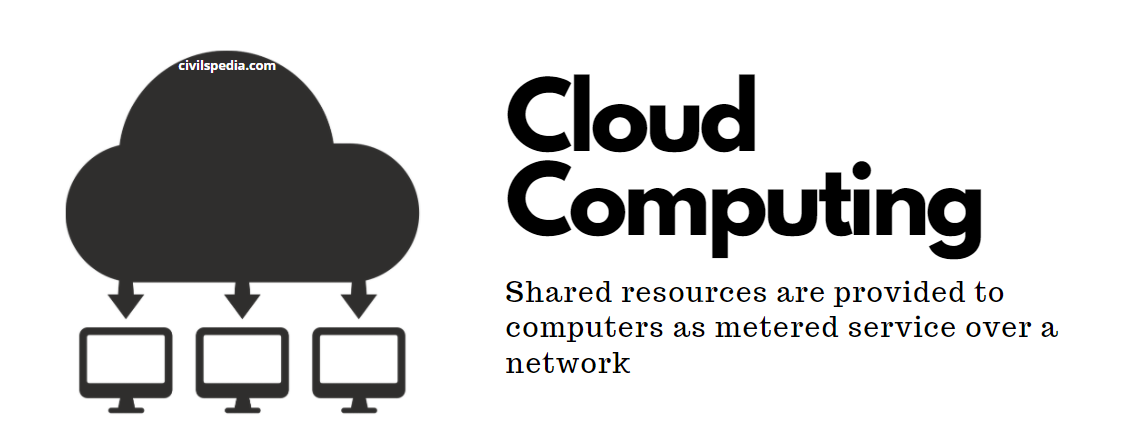
Cloud Computing is a service whereby shared resources are provided to computers as metered service over a network (typically the internet). This allows consumers & businessmen to use the application without installation & access their personal files at any computer with internet access.
Cloud  Computing

Benefits of Cloud Computing

Agility Improves user’s ability to re-provision technological infrastructure. 
Cost Cost is claimed to be reduced since the infrastructure is typically provided by a third party & doesn’t need to be purchased for one time or infrequent intensive computing tasks.
Device & location independence It enables users to access systems using a web browser regardless of their location or what they are using like PC or mobile.
Multi-tenancy It enables sharing of resources & costs across a large pool of users thus allowing for infrastructure at lower cost & also proper utilisation of system that are often only 10-20% utilised.
Security Security is often as good or even better than other traditional systems, in part because providers are able to devote resources to solving issues that many customers cant afford.

Service Models of Cloud Computing

Types of Cloud COmputing

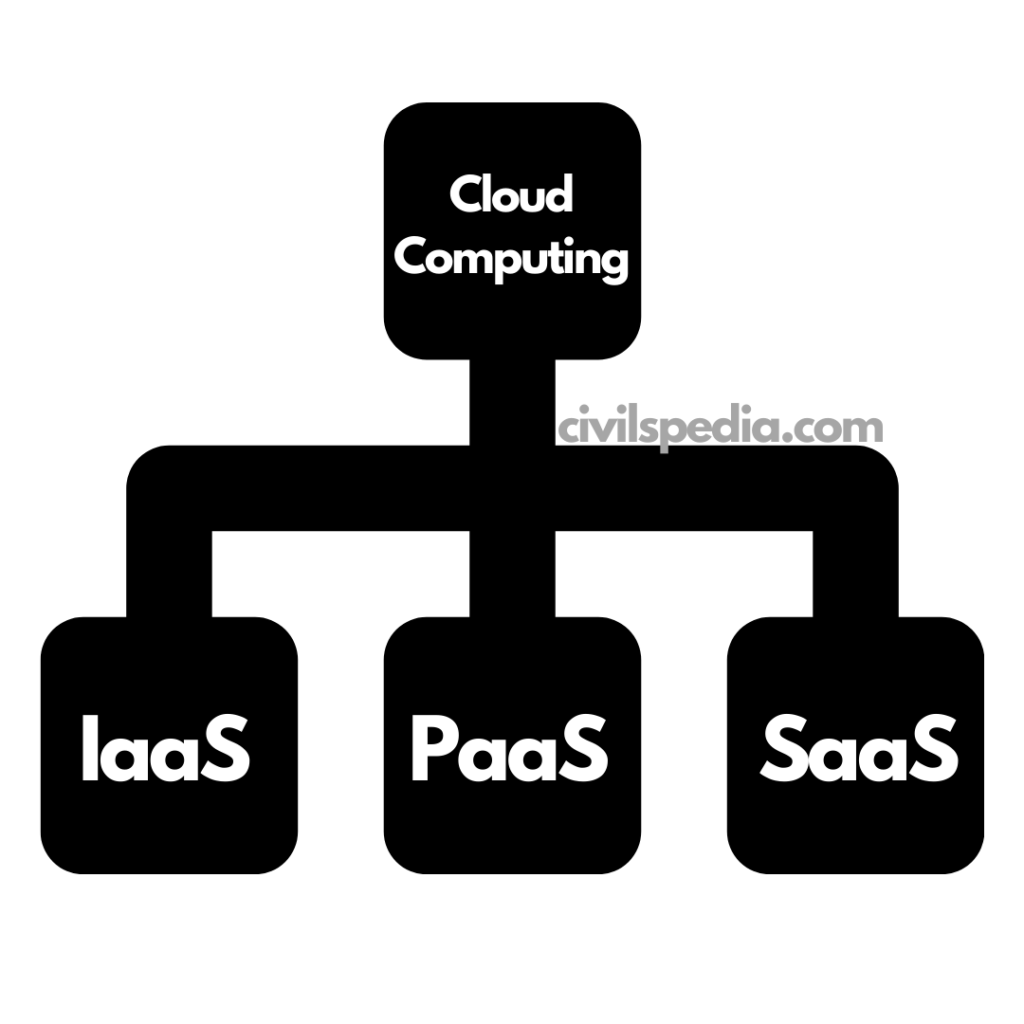
Cloud Computing providers offer three fundamental services:-

Infrastructure as a Service (IaaS)

  • It is the most basic cloud service model.
  • In this model, cloud providers offer equipment supporting the operations like raw storage, firewalls, balancers & networks.
  • The equipment is owned by the service provider, which is also responsible for housing, running and maintaining it. The client is typically charged on a per-user basis.
  • Example: Amazon Web Services which provides virtual server and storage.

Platform as a Service (PaaS)

  • In this model, the cloud provider delivers a computing platform or solution stacks like operating system, programming language execution environment and the web server.
  • Application developers can develop & run their software solutions on a cloud platform without the cost & complexity of buying & managing the underlying hardware & software layers.

Software as a Service (SaaS)

  • In this model, the cloud provider installs and operate application software in the cloud & cloud users access the software from cloud clients. This eliminates the need to install & run the application on the cloud user’s own computer simplifying maintenance & support.

Government of India’s Initiatives in Cloud Computing

1 . Meghraj (Government of India’s Cloud)

  • To harness the benefits of cloud technology, the Ministry of Electronics and Information Technology (MeitY) has initiated a project named ‘MeghRaj’ for creating a Government of India cloud (GoI Cloud) computing environment at the national level.
  • The GI Cloud is envisaged to provide the following outcomes:
    1. Optional utilisation of ICT infrastructure. A software availed by any department in the government of India can be made available to other departments with no additional costs;
    2. Speedy development and deployment of e-Gov applications;
    3. Quick replication of successful applications;
    4. e-Governance
    5. App Store hosting certified applications.

2. DigiLocker

  • It is part of the government’s Digital India Initiative, to enable Indian citizens to store certain official documents like PAN, driving licence, passport, mark sheets etc. on the cloud.
  • It is linked to a person’s Aadhar number.
  • It is based on the IaaS model as storage (infrastructure) is provided as a service.
  • Driving License and Registration Certificates have also been linked with the Digilocker. People will no longer need to carry around physical copies of their RCs and Driving Licences. They can instead access digital copies of the same on their mobile phones via the DigiLocker mobile app.
  • Digital locker minimizes the usage of physical documents.
Internet of Things

Internet of Things

This article deals with ‘Internet of Things- UPSC.’ This is part of our series on ‘Science and Technology which is an important pillar of the GS-3 syllabus. For more articles on S, you can click here.


What is Internet of Things?

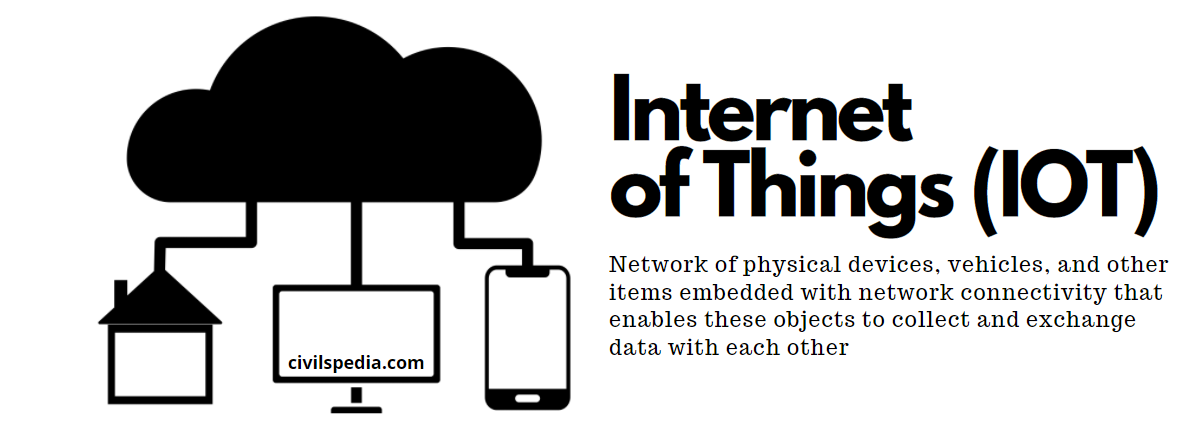
The internet of things (IoT) is the network of physical devices, vehicles and other items embedded with network connectivity that enables these objects to collect and exchange data with each other. 

Earlier Internet of People i.e. (only) people used the internet to communicate with each other.
Present  Internet of Things i.e. things will (also) use the internet to communicate with each other.

Economic Survey (2019) mentioned that the Government is considering the rollout of a 13-digit Machine to Machine (M2M) Numbering Plan for M2M communication.

Internet of Things

Example of IoT in our  life

Internet of Things - UPSC

How is IoT achieved ?

This is achieved by

  • Finely fabricated micro-controllers which are small computers themselves. They are used internally by various single-board computers.
  • Sensors to collect information. 

Applications of Internet of Things

  • Healthcare Sector: IoT based devices can be used in combination with the cardiac monitor to raise an alarm to the doctor in case of abnormality. 
  • Agriculture Sector: IoT can be used to gather live pedological data that can be used by scientists to improve the yield of the land. It can also help in implementing precision agriculture.
  • Transportation Sector: IoT can help in the early detection of wear and tear to prevent accidents. Apart from that, Self Driving Cars will use it for taking real-time decision. 
  • Energy Management: IoT will help in managing temperatures in Nuclear Power Plants using sensors.
  • IoT will help in providing virtual personal assistant to every person on the earth.


Issues related to Internet of Things

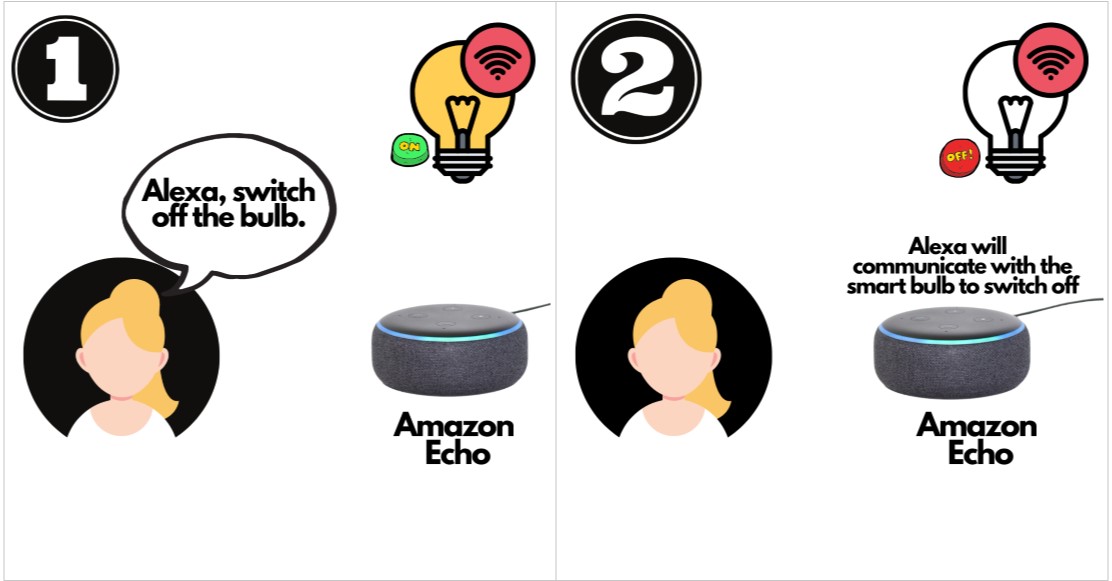
  • Privacy Intrusion: There is a danger that these smart devices can be used to intrude into the privacy of common people. An example of this came in Amazon Echo / Victor Collin case (2017 in the US) . Hence, IoT devices can be used by State Agencies opening up avenues for Orwellian levels of surveillance. 
  • The high initial cost of setup and technology will not be equitable thus increasing the gap between the haves and have nots.


India and IoT

  • Smart City Project and Digital India Program are going to lead to a rapid growth of IoT industry in India.
  • Ministry of Electronics and Information Technology (MEITY) has also drafted India’s Internet of Things Policy with provisions like (1) funding of various IoT projects, (2) promote Venture Funds that support IoT related projects, (3) 100% duty waiver on import of raw material for manufacturing of IoT devices, (4) develop workforce with required skillset to work in IoT industry etc.
  • Indian IoT company Smartron has developed ‘tronX‘ – an artificially intelligent IoT platform.

Big Data

Big Data

This article deals with ‘ Big Data .’ This is part of our series on ‘Science and Technology which is an important pillar of the GS-3 syllabus. For more articles, you can click here


Big Data

What is Big Data?

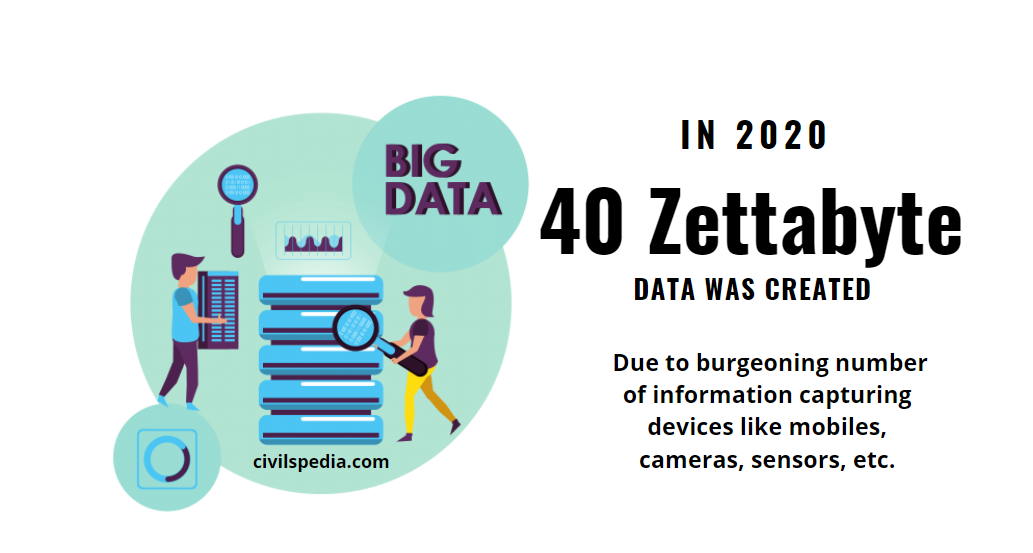
  • Big data is a catchphrase used to denote a set of data, both structured and unstructured, so large that it is not possible to analyse and process it by using conventional database management systems. Such a huge surge in data has occurred due to a burgeoning number of information capturing devices like mobiles, cameras, sensors, etc. and a less increase in our storage capacity despite the latter being digital now.
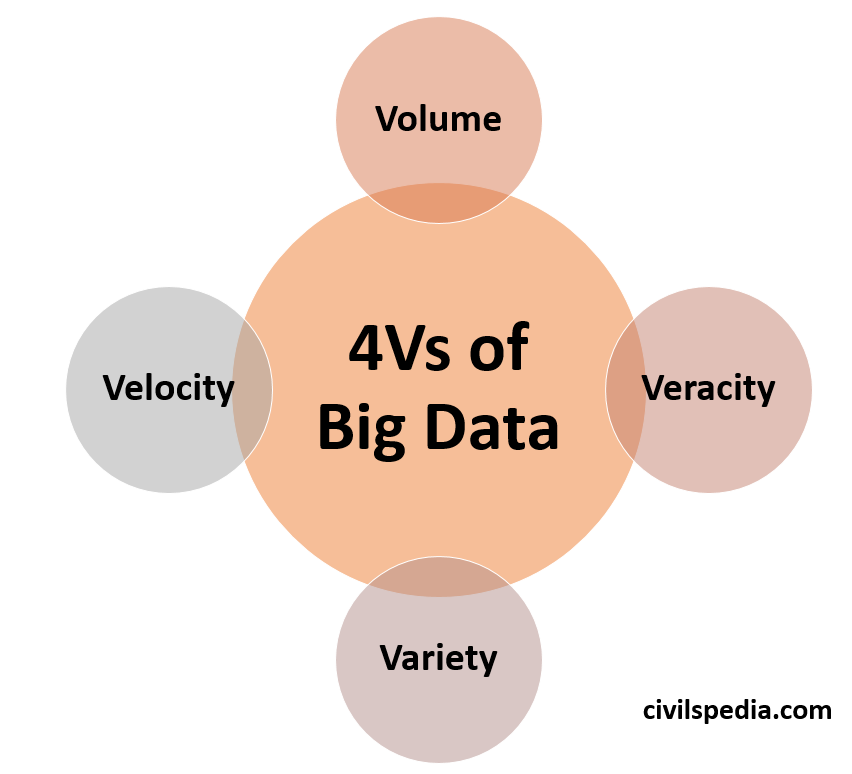
  • It is characterised by 4Vs
    • Volume – Volume is huge
    • Velocity – It is being created at a huge speed.
    • Variety – It is of a large variety. 
    • Veracity – There is uncertainty about their truth.
4Vs of Big Data
  • Big Data in itself is not of use unless it is structured and analysed.

Use of Big Data Analytics

Business

  • Customisation of services: Companies use Big Data to analyse their customers’ preferences like likes and dislikes and tailor their products accordingly. This brings more satisfaction to the customer.
  • Big Data helps business in cost reductions, time reductions, new product development and optimised offerings.  Instead of focusing only on profit and loss, it integrates a wide range of insights, taking into account each and every factor that could possibly influence the business.

Science and Technology

  • Using Big Data, research data can be captured in more depth & analysed in a better way. Eg:  data at the Large Hadron Collider for atomic research.

Security

  • Big Data can be used to analyse fund transfer, emails, web accounts etc. to enhance our preparedness to tackle terrorism (by creating cyber trials).
  • Intelligence Bureau of India is also using Big Data analyses in its Operation Chakravyuh.

Governance

  • Big data can be analysed for targeted delivery of schemes, maintain a record of beneficiaries, analyse the response of the electorate to policies, predict future trends and demands of population etc.

Health

  • Big Data can be used in developing the treatment of various complicated diseases. Eg: canSAR Project (the canSAR project is the biggest database of cancer response to various drugs).  

Charitable sector

  • Some social organisations are using open government data to improve advocacy and fundraising. 

Sports

  • Big Data is used to analyse and improve the performance of individuals (at sports, at home or work) where data from sensors in equipment and wearable devices can be combined with video analytics to get insights that traditionally were impossible to observe.

Big Data in India

  • With a population of 1.2 billion, the relevance of Big Data Analysis becomes all the more pronounced for India.
  • It is not only being used by private players but also by government agencies for policymaking.

Big Data & Government

  • Big Data Management Policy, 2016: It was launched by CAG and led to the foundation of Data Analytics. Along with that National Informatics Centre (NIC) launched a website to share the data of various ministries with citizens.
  • NITI Aayog has also echoed the idea of evidence-based policymaking guided by Big Data.
  • Internal Security: NATGRID is an example of Big Data Analytics. Apart from that, the Intelligence Bureau of India is also using Big Data analyses in its Operation Chakravyuh.
  • The government is using large data from the Goods And Services Tax Network (GSTN) to understand the patterns of trade. 
  • Project Insight used Big Data to identify tax evaders.
  • The government of India is also working towards an Open Data Policy, to encourage sharing of information between departments and across ministries.
  • Aarogyashri Healthcare Trust by the Telangana government uses data analytics to identify disease trends.
  • Justice BN Srikrishna Committee recommended that personal data can be processed for purposes that are lawful. An individual has the right to withdraw consent to process his data. 

Issues (wrt India)

  • Absence of good quality of datasets as the dataset is found to be
    1. Outdated and incomplete.
    2. Lacking in semantic interoperability.
  • Lack of competent professionals/ data scientists: According to NASSCOM, there is a deficit of 1.4 lakh data scientists.
  • Privacy Concern: There are concerns about the misuse of Big Data by intruding into the personal sphere of individuals.
  • Data Sovereignty Issue: Indian data collected for Data processing is taken abroad and stored in servers situated outside India.
  • Lack of coordination and cooperation between different ministries as well as between public and private sector.
  • Ethics of big data: It comes into role as a huge amount of private data is available and how and where it should be put to use raises the question.

Generations of Wireless Communication

Generations of Wireless Communication

This article deals with ‘Generations of Wireless Communication .’ This is part of our series on ‘Science and Technology’ which is an important pillar of the GS-3 syllabus. For more articles, you can click here


Introduction

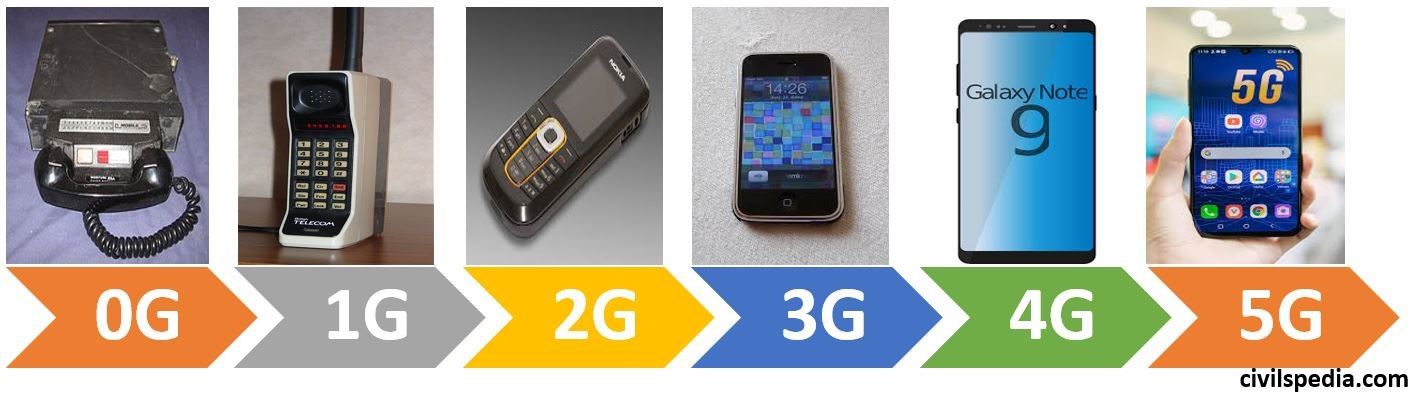
Mobile Generations is a system used by cellular telephone manufacturers and service providers to classify wireless communication into several generations; each generation is characterized by new frequency bands, higher data rates and non–backwards-compatible transmission technology. In the recent past, mobile wireless technologies have undergone technology evolution from 0G TO 5G.

Generations of Wireless Communication

0G

  • It is also known as Mobile Radio Telephone or Pre-Cellular.  
  • It was usually mounted in cars & trucks although briefcase models were also available. 
  • Motorola in conjugation with Mobile Telephone System (MTS) introduced it in the US in 1946. 


1G

  • 1G technology was Analog Telecommunication standard.
  • It was introduced in the 1980s.
  • Main Use: Voice Calls.
  • Limitations: Limited capacity, not secure and background interference.
  • Speed: 2 Kbps


2G

  • It was commercially launched as GSM standard in Finland in 1991.
  • It uses Digital Technology (Main difference between 1G & 2G is 1G was analog  and 2G was digital).
  • 2G has two technologies i.e. TDMA (GSM) & CDMA.
  • Main Uses: Voice calls, short messages and browsing .
  • Limitations: Low network range and slow data rates due to which it can’t handle complex data such as videos .
  • Speed: 64 Kbps

2.5G

  • 2G cellular technology with GPRS (General Packet Data Service) is called 2.5G.
  • It provides the usage of e-mails, MMS, web browsing and camera facilities.
  • Speed: 144 Kbps

EDGE or 2.75G

  • EDGE = Enhanced Data Rule for GSM Evolution
  • It has the same network design, but the data speed was increased noticeably (3 times that of GPRS) .
  • It had the added advantage that there was no need to install additional hardware by the telecom companies.

3G

  • 3G was introduced in 2000.
  • Improvements over 2G: Clarity in Voice calls, digital broadband and increment in speed.
  • Main Uses: Text and high speed internet.
  • Limitations: High power consumption, Low network coverage and High cost of spectrum licence.
  • Speed: 2 Mbps
  • Introduction of 3G technology gave rise to applications not previously available like
    1. Mobile TV
    2. Telemedicine
    3. Video on Demand
    1. Videoconferencing
    1. Location based services


4G

  • Benefits over 3G : Very high speeds at lower price than 3G.
  • Main Uses: High speed applications, IP Telephony , Video Calling , gaming services, HD Tv, 3D TV and Wearable devices.
  • Limitations: LTE supported mobiles and complicated hardware required to use 4G mobile technologies.
  • Speed: 1 Gbps

LTE (Long Term Evolution)

  • 4th Generation Network is called LTE (Long Term Evolution).
  • LTE was designed only as data network.
  • LTE has brought very high bandwidth to mobile devices and  data transfer has become very fast.

VoLTE (Voice Over LTE)

  • VoLTE is a voice technology that works over the LTE data connection.
  • It has extremely high voice quality. It also includes the ability to make video calls.

5G

5G Technology
  • 5G technology has ultra High Speeds and presents a big leap forward from the present 4G technology.
  • Main Use :
    1. Internet of Things (5G System will be intelligent enough to allocate resources. Eg: Driverless car which needs to take a decision in a fraction of seconds will be given greater bandwidth than ordinary user).
    2. Hologram TV
    3. Augmented reality
  • Limitations: It is not Net Neutral and involves high costs.
  • It will use drones and balloons to provide internet everywhere. 
  • Speed: more than 20 Gbps.

Advantages of 5G Technology

Advantages of 5G Technology
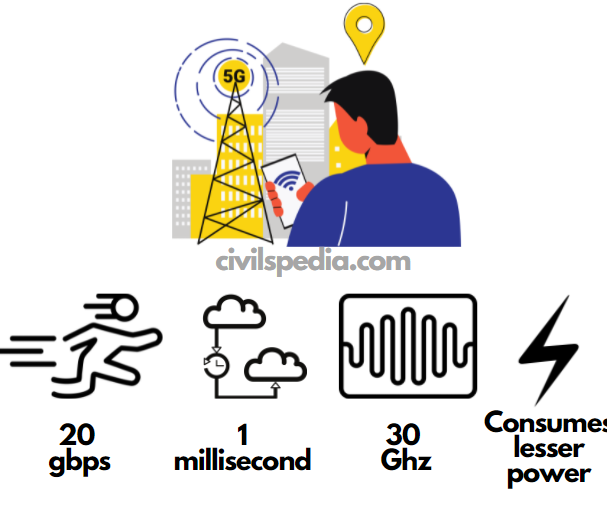
  • Faster data speed of more than 20 Gbps.
  • Ultra-low latency: Latency refers to the time it takes for one device to send a packet of data to another device. In 4G the latency rate is around 50 milliseconds but 5G will reduce that to about 1 millisecond.  Hence, it can be used in driverless cars where such things are required.
  • 5G has 30  GHz of available spectrum in comparison to lesser 3 GHz for 4G.
  • 5G antennae consume very little power compared to existing technology. Hence, it will make 5G handsets energy efficient.
  • With higher speed, 5G will improve the quality of remote learning by allowing real-time interactivity and transporting students to virtual classrooms.
  • As per the OECD Committee on Digital Economic Policy, 5G technologies rollout will help in increasing GDP, creating employment and digitizing the economy.
  • It will help to incorporate technologies such as the Internet of Things (IoT) & Artificial Intelligence in our lives. It is said that 5G is the foundation for realising the full potential of IoT.
  • Agriculture: 5G can enable improvement in the entire value chain, from precision farming, smart irrigation, improved soil and crop monitoring, to livestock management.

Challenges in rolling out 5G

  • 5G will not be net neutral.
  • Integration of various standards of 5G: There are already multiple groups working to come up with standards around interoperability, backward compatibility with older technologies etc. Thus standardisation becomes a major challenge
  • Building Infrastructure: It is a huge task, with issues around spectrum and installing new antennas. 
  • Expensive Spectrum in India than other countries.
  • Lack of skilled professionals who can advance  5G technology.
  • The reluctance of people to adopt and support the technology due to unaddressed rumours related to possible health hazards posed by 5G radiations. 
  • Obstacles like buildings, trees and even bad weather can cause interruptions which would require more base stations to be built to ensure better connections.

Other information

  • South Korea has become the world’s first country to launch 5th-Generation (5G) networks.
  • Shanghai has become the World’s First City With 5G Network Coverage.

Indian readiness to adopt 5G

  • In India, Steering Committee, headed by AJ Paulraj has submitted a report titled ‘Making India 5G Ready’.
  • Jan 2021: Bharti Airtel successfully demonstrated its live 5G service in Hyderabad, the first in India showcasing its readiness for the 5G technology.
  • Department of Telecommunication (DoT) has given permission to 4 Telecom Service Providers (TSPs) i.e. Jio, Airtel, Vi and MTNL for conducting trials for the use of and applications of 5G technology (May 2021).
  • D10 Club: “D10″ club is the group of  10 Democratic countries– UK, US, Italy, Germany, France, Japan and Canada plus Australia, South Korea and India with aim of creating alternative suppliers of 5G equipment and other technologies to avoid relying on China.

2019 Huawei Issue

Chinese company Huawei is the frontrunner in 5 G Technology. But the US is against the operations of Huawei because of the following reasons:-

  • Huawei’s founder is an ex-PLA Officer & Huawei indulge in cyber espionage & leaking data to the Chinese government.
  • Other Reason – The US doesn’t want that monopoly of its tech giants like IBM, Google etc is threatened. Until now, rules of the game were written by US firms but Huawei is challenging it (whoever writes the rules will have inherent benefit in future).

Super Computers

This article deals with ‘Super Computers .’ This is part of our series on ‘Science and Technology which is an important pillar of the GS-3 syllabus. For more articles on Science and Technology, you can click here


Super Computers

  • Super-Computers are computers with gigaflop capabilities.
  • Currently, American “Summit” is the fastest Computer. But China has the most number of Supercomputers in the Top 500.
  • Uses: Super Computers are used where large processing power is required. Their uses include
    • Weather forecasting (eg: timely warning of cyclones)
    • Codebreaking
    • Genetic analysis
    • Scientific research (like at CERN)
    • Data Mining & Big Data Analysis
Super Computers

National Supercomputing Mission

  • It was launched in 2015.
  • It is the joint mission of the Ministry of Electronics and IT (MEITY) and the Department of Science and Technology (DST) and implemented by C-DAC & IISc (Bangalore).
  • The mission envisages empowering academic and R&D institutions by installing a supercomputing grid comprising more than 70 high-performance computing (HPC) facilities. 
  • PARAM Shivay is the first supercomputer built under this project and installed at IIT-BHU.  Later, Param Shakti was installed in IIT-Kharagpur and Param Brahma was installed in IISER-Pune.
  • Under the mission, India has also signed an agreement with French company Atos to design and instal a supercomputer named BullsSequana.


Supercomputers of India

  1. Pratyush
  2. Mihir
  3. Sahastra T
  4. TIFR Colour Boson
  5. Param
  6. Saga 220

Pratyush and Mihir

  • Ministry of Earth Sciences (MoES) has set up a high-performance computing (HPC) system consisting of two supercomputers Mihir and Pratyush (which can be connected with each other to solve high-level computations).
    • Pratyush installed at the Indian Institute of Tropical Meteorology, Pune having a capacity of 4 petaflops.
    • Mihir installed at  National Centre for Medium-Range Weather Forecasting, Noida having a capacity of 2.8 petaflops
    • (=> giving a total capacity of 6.8 petaflops.)
  • It is India’s first multi-petaflop supercomputer and is the fourth fastest supercomputer in the world which is dedicated to weather and climate research after Japan, U.S.A.  and United Kingdom.
  • It has also taken India up from the earlier 365th position to top 30 in the infrastructural ranking of Top 500 HPC facilities in the world.

Saga 220

  • SAGA = Supercomputer for Aerospace with GPU Architecture
  • SAGA 220 is a supercomputer built by ISRO in 2011 with 220 Teraflops peak performance. It can be scaled up to Petaflop (i.e. 1000 Teraflop) capability.
  • Use: Space scientists use it to solve complex aerospace problems.
  • The project is worth (just) 14 crore and it consumes a power of only 150 kilowatts (=> It is presented as a Model of cheap and environmentally green Super-computer).

Quantum Computer

  • Quantum Computer is the computer design that uses the principle of quantum physics to increase computational power beyond what is attainable by a traditional computer.
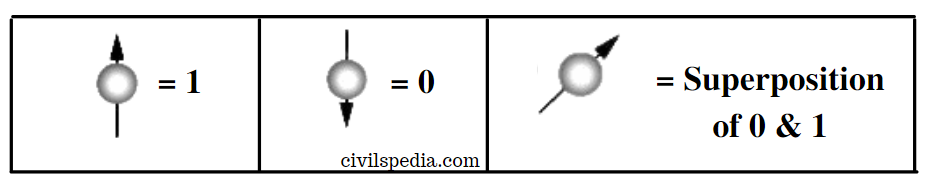
  • Normal computer functions by using 1s and 0s retained in electronic components such as transistors. But Quantum Computer would store information as either 1,0 or a quantum superposition of two states enhancing computational capabilities.
  • The basic unit of quantum computing the qubit (quantum + bit). While the bit in conventional computers is either a digital “1″ or “0”, the qubit can contain “1″, “0” or ‘or a quantum superposition of two states”.
Qubit

Applications of Quantum Computers

  • High-level R&D with the help of simulations.
  • Quantum communications are very secure and fast.
  • Quantum Cryptography
  • Big Data Analysis
  • Deep Learning
  • Quantum computing can bring down the space needed to store data.

Steps taken by India to promote Quantum Computing

  • Budget 2020 announced that the Government of India will start the National Mission on Quantum Technologies for a period of 5 years.
  • Department of Science and Technology started Mission Mode Project called QuST (Quantum Science and Technology) aimed at making Quantum Computer.
  • Quantum Communication based Satellite named QuEST (Quantum Experiments Using Satellite Technology) is being built by ISRO. 
  • Niti Aayog has pitched for using Quantum Computing for Big Data Analysis.

Challenges of Quantum Computers

  • Quantum Computers have the potential to decode and crack the world’s encrypted data by breaching security measures easily, thus posing threat to data as well as internal security.
  • Hardware difficulties in developing a system such as qubits which are made from silicon atoms and work at a very low temperature, near-zero degree kelvin.
  • Funding issues as huge funds are required to set up labs.
  • Issues in building Public-Private and Academia-Industry Partnership.

Grid Computing

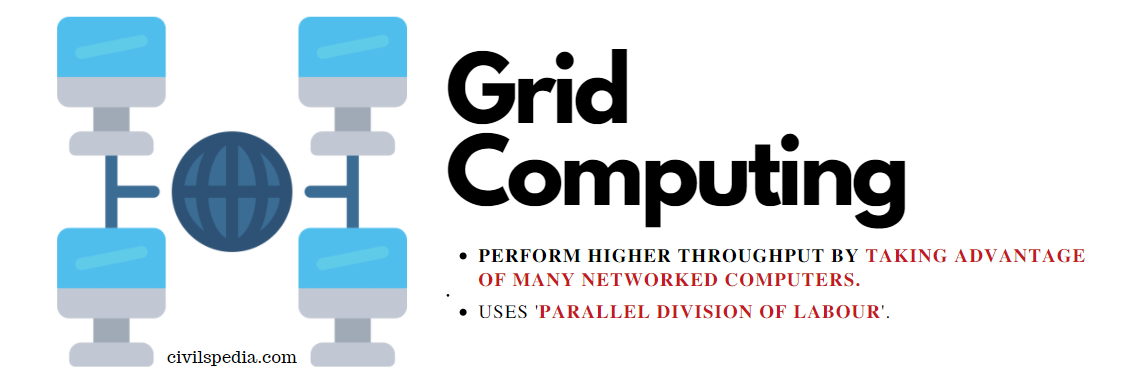
  • Grid Computing is the cheapest model to make supercomputer using unused power of computers that are on the same network.
  • It is the emerging computing model which provides the ability to perform higher throughput by taking advantage of many networked computers.
  • It is the parallel division of labour between processes. It uses the resources of many separate computers connected by a network usually the internet to solve large scale computational problems.
  • A large problem is solved by breaking it into smaller parts.
Grid Computing

Common features of Grid Computing

  • It is the model for solving the massive computational problem by making use of unused resources of a large number of computers.
  • It has the design goal of solving problems too big for any single supercomputer.

Applications of Grid Computing

Climate Modelling It can solve the massive computational problem by means of combining unutilised power in thousands of personal computers worldwide.
Educational institutions It provides a cheaper option for educational institutions using a cluster of standard computers that can achieve teraflop performance. Usually, such educational institutions can’t afford the cost of the supercomputer.
Government agencies Grid Computing can be used to combine geographically spread high-performance computing resources to tackle national tasks like electoral rolls or tax databases.

Other Developments in Grid Computing

Garuda It is an Indian Grid Computing initiative connecting 17 cities across India & 45 participating institutions.
World Community Grid  (WCG) Supported by IBM which has donated hardware, software & technical services.
One can join WCG by downloading software application from the internet.
When the computer is idling, this software programme will use its power to work on the grid’s project & when it is in normal use, the software will stop working for the grid.

Memcomputer

  • Memcomputer is a new type of computer that works by mimicking the human brain.
  • In conventional computers, processing & memory occur at separate places. Hence, it consumes time & energy putting limitations on computations. But in Memcomputers, processing & storage occur at the same place (just like our brain) leading to fast processing.
  • The processing capability of the order of Quantum Computers which operate at extremely low temperature can be achieved in memcomputers operating at normal temperature.

India Central Asia Relations

India Central Asia Relations

This article deals with ‘India Central Asia Relations.’ This is part of our series on ‘International Relations’, which is an important pillar of the GS-2 syllabus. For more articles, you can click here.


What is Central Asia?

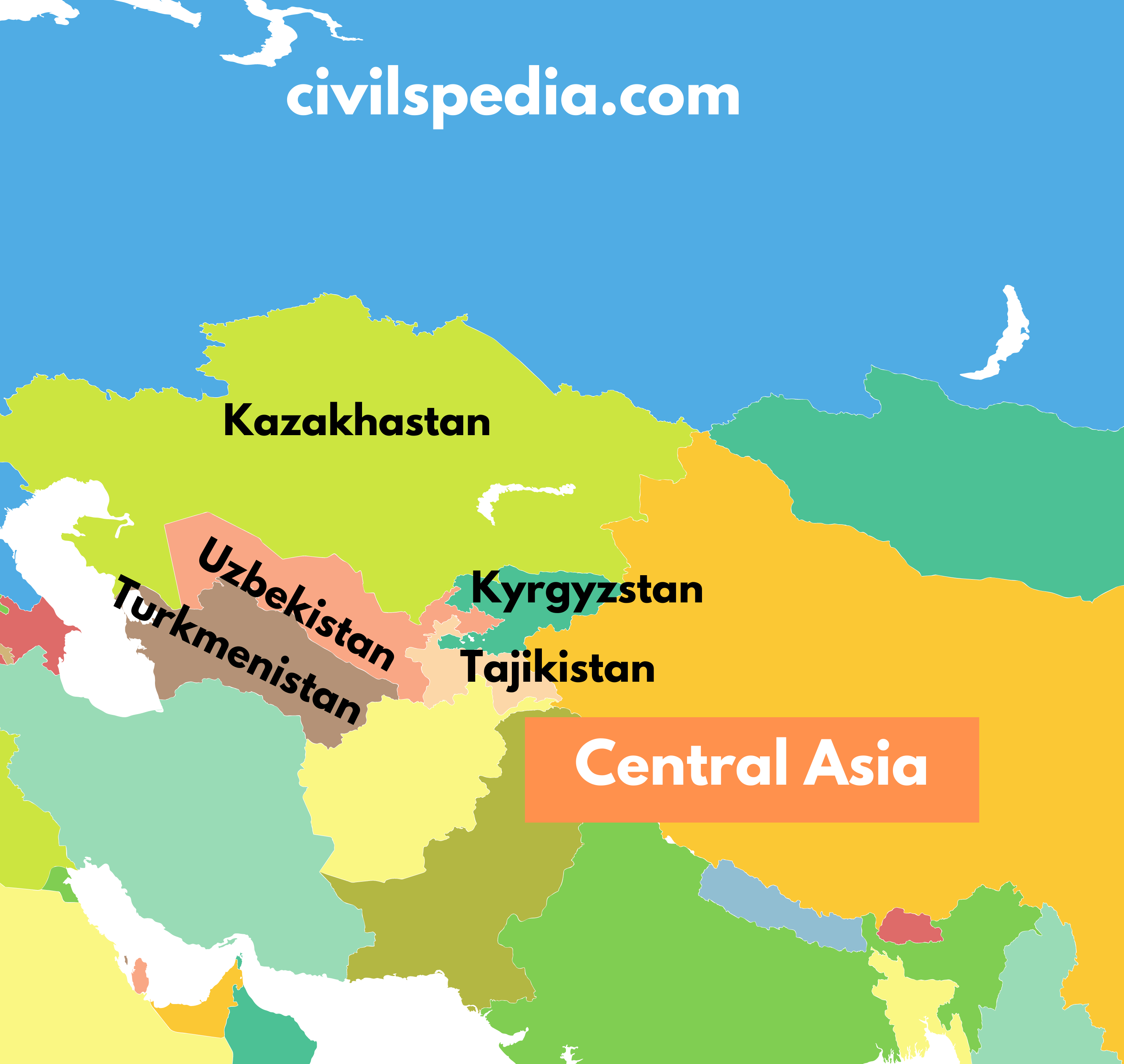
India Central Asia Relations
  • Central Asia is a region made up of five nations forming the underbelly of Russia. These include
Country  Capital
Kazakhstan Astana
Kyrgyzstan Bishkek
Tajikistan Dushanbe
Turkmenistan Ashgabat
Uzbekistan Tashkent
  • These countries gained independence in 1991 after the disintegration of the Soviet Union.
  • These countries are landlocked but are ultra-rich in resources and have sparse populations.
  • India considers the Central Asian countries part of its ‘extended and strategic neighbourhood’.  

Historical Connection with India

  • Al -Beruni came to India in the 11th century from Central Asia. He authored a famous book named Tahkik ul Hind.
  • Babur, who founded Mughal Empire in India, was a native of Uzbekistan (Ferghana province).

Politics of the region

  • Although these countries achieved their independence in 1991, authoritarian regimes have remained in power (except Kyrgyzstan.)  
  • They have not opened up their economies and always feared that western countries, especially the US supported by NATO, might try to change the regime like what happened in Tulip Revolution in Kyrgyzstan in 2005.  

Economy of these States

  • States which have a strong economies are
    • Kazakhstan with high per capita income
    • Turkmenistan, which is a major supplier of gas  
  • But this is not the case with other states. E.g. Kyrgyzstan & Tajikistan are economically weak because they don’t have hydrocarbon resources. These states are still dependent on Russia (For example, Tajikistan’s primary source of revenue is remittances from Russia).


Importance for India

1. Natural resources

The Central Asian region is endowed with rich natural resources

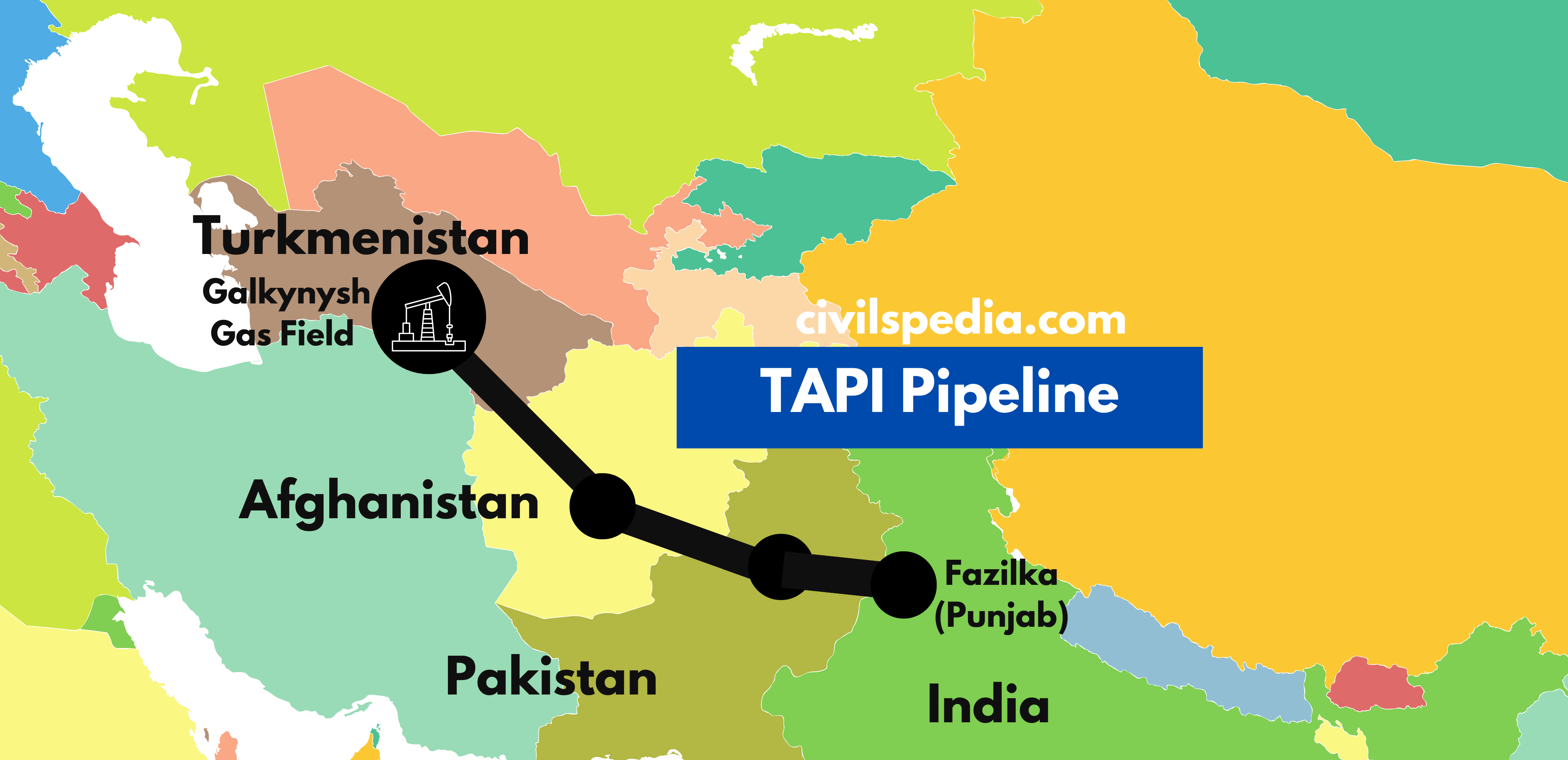
  1. Turkmenistan: It has the 4th largest gas reserves. India is part of the TAPI Pipeline starting in Turkmenistan
  2. Uzbekistan: Uzbekistan is rich in gas resources.
  3. Kazakhstan: Kazakhstan is rich in oil and Uranium (KazAtomPro)
  4. Tajikistan: Tajikistan has vast hydropower potential 

Since India is an energy-hungry nation, these nations are natural allies in this respect.


2. Strategic Location

  • It is located at the bridge between  Europe and Asia. 
  • The central lynchpin in this is the International North-South Corridor.

3. Security

  • Tajikistan, Uzbekistan and Turkmenistan border Afghanistan. After the US withdrawal from Afghanistan, Central Asian nations and India can cooperate to control terrorism and extremism in Afghanistan. 
  • Central Asia is known for its moderate practice of Islam. It can act as a counter to the radical Wahabist ideology of Islam.
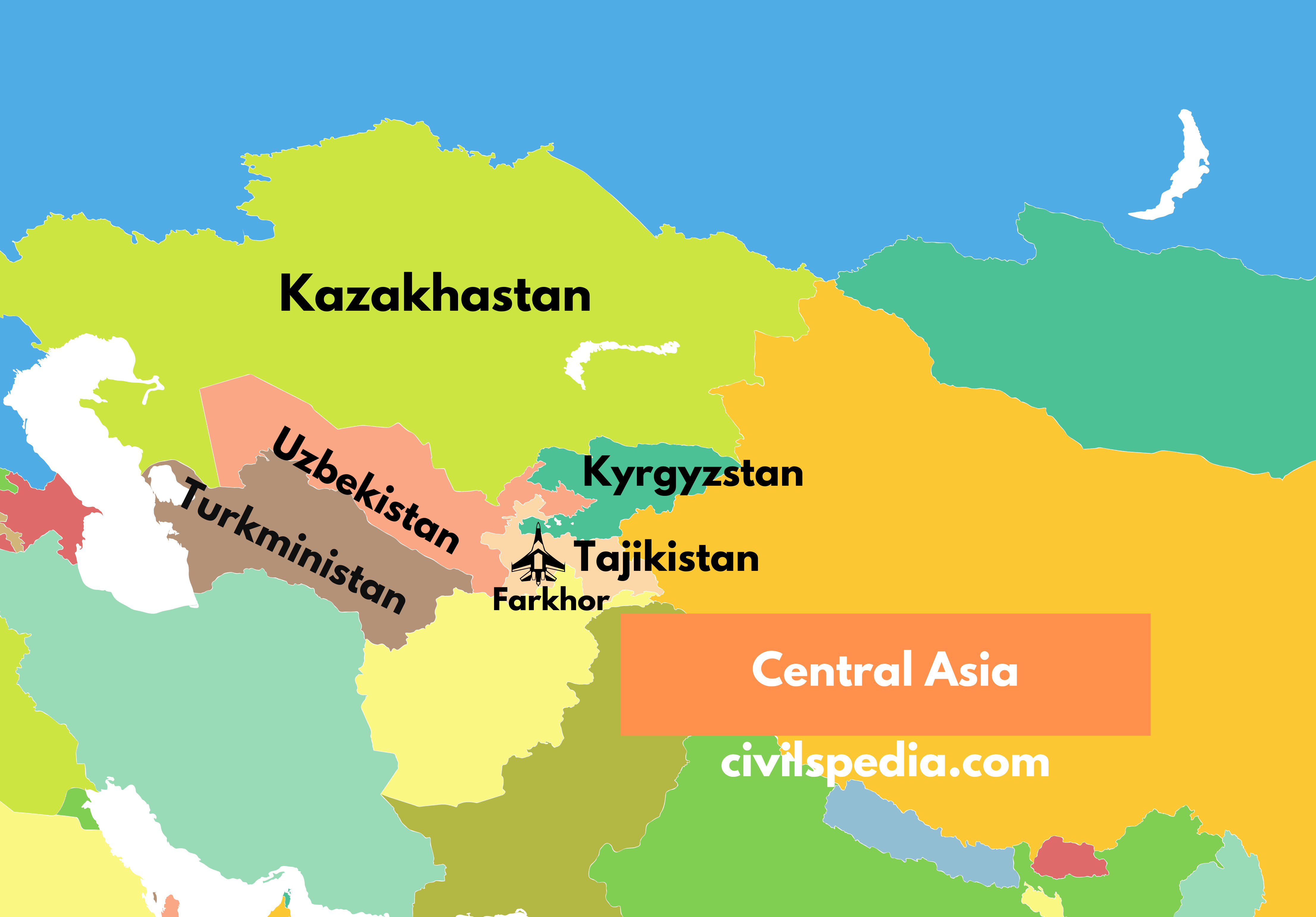
  • India’s only foreign military airbase, i.e. Air Base in Farkhor (Tajikistan), operated by IAF.  
Farkhor Airbase in Tajikistan
Farkhor Airbase (of India) in Tajikistan

4. Trade

  • Trade between India & Central Asia is roughly $2 billion compared to their $50 billion trade with China. Hence, there is enormous untapped potential.   
  • Indian pharma and drugs, tea and coffee, are in huge demand in Central Asia.  
  • Various Indian Companies are involved in Energy Projects in Central Asia. These include
    • NPCIL (Nuclear Power Corporation of India) has signed a Memorandum of Understanding (MoU) with Kazakhstan (KazAtomPro) 
    • ONGC, Mittal Energy & KazMe2unaiGaz (KMG) have signed a deal regarding the offshore Satpayev Oil Block in the Caspian Sea.
    • BHEL & NHPC are working on hydro projects in Tajikistan 

5. The demand for Indian Products

  • Indian Pharma and Drugs, Tea and Coffee have a huge demand in Central Asian countries.
  • Bollywood is popular in Central Asian countries. 

6. Drug Trafficking

  • Tajikistan is a gateway for Afghan Drugs to Central Asia. This money is used for funding terror activities against India too.

Steps taken by India

  • Connect Central Asia Policy: Dealt below.
  • India has stepped up its multilateral engagements with Central Asian Countries through forums such as Shanghai Cooperation Organisation (SCO), Eurasian Community etc.
  • India has renewed its efforts toward the completion of the International North-South Transport Corridor (INSTC).
  • India has signed the Ashgabat Agreement.
  • Indian government invited the leaders of the Central Asian nations as the Chief Guest for 2022 Republic Day


TAPI Pipeline

TAPI Pipeline
  • TAPI pipeline aims to bring gas from Turkmenistan to India while passing through Afghanistan and Pakistan.

It has the following advantages

  • It will help bring energy to India and its neighbours at a competitive price.
  • It will help India diversify its fuel basket
  • It can help to normalize the relations between India, Pakistan and Afghanistan.
  • It will help stabilize Afghanistan as it can earn revenue through transit fees. 

But there are challenges as well

  • Finance: Nearly 85 % of the project cost is expected to be incurred by Turkmenistan, which is currently facing economic hardship
  •  Security: The region through which the TAPI pipeline passes is turbulent. 
  • Geopolitics: Diplomatic relations between India and Pakistan are not conducive for a venture such as the TAPI pipeline.

Connect Central Asia (2012)

  • India’s initiative for political, economic & cultural proximity with Central Asia 
  • It was propounded in 2012. 
  • The main Aspects of the initiative include 
    • Cooperation in science and technology 
    • Educational Exchange 
    • Helping Infrastructural Development in Central Asia 
    • Regular Summit Meetings and other exchanges  
  • It focuses on socio-economic-political cooperation.


Ashgabat Agreement

  • The agreement was signed between the governments of Iran, Oman, Turkmenistan, and Uzbekistan, which Kazakhstan and Pakistan later joined in 2016. India joined the grouping in 2018.
  • The agreement aims to establish international transport and transit corridor linking Central Asia with the Persian Gulf. It will be achieved via easy customs clearances, fast transport etc.
First Joining Uzbekistan, Turkmenistan and Iran via Rail line
Second Making shipping corridors at Bandar Abbas and Chabahar

Constraints in relation

1. Landlocked and Inaccessible

  • Central Asian region is landlocked and has poor connectivity with India.
  • To address this, the following connectivity initiatives have been started 
    1. International North-South Transport Corridor (INSTC)
    2. Building Chabahar Port in Iran
    3. India has joined Shanghai Cooperation Organization 
    4. The process of signing the free trade agreement (FTA) with the Eurasian Economic Union has been fast-tracked
    5. India has signed Ashgabat Agreement 
    6. Connect Central Asia Policy 
    7. TAPI Pipeline 

2. Takeover of Afghanistan by Taliban

  • It has made access to Central Asian countries even more difficult.

3. Chinese presence and interest

  • China is making considerable inroads in Central Asia through the One Belt One Road initiative.

4. Radicalisation and Terrorism

  • Central Asia is vulnerable to radical Islamist influences like Al Qaeda, Islamic State, Taliban, IUM, Hizb-ut-Tahrir and others.

5. Other Issues

  • “Youth bulge” with huge unemployment and limited economic opportunities
  • Serious and worsening corruption
  • Potentially restive minority populations (such as the ethnic Uzbeks in Kyrgyzstan )
  • Drug trafficking

Chinese Challenge

  • China has invested a massive $35 Billion in Central Asian states. 
  • Central Asian states are an important part of the Silk Road Economic Belt (SREB). 
  • Most of the Chinese investments are in the field of energy. Notable projects include
    1. Pipeline from Turkmenistan To China 
    2. Pipeline from Kazakhstan to China

Investment Comparison: India vs. China

  China India
Investment $35 billion $1.6 billion
Trade $50 billion $2 billion

Way Forward

  • India should consider setting up an India-Central Asia Forum (on the lines of the India-Africa Forum)   
  • India should develop the Chabahar port on a priority basis.  
  • India should focus on Telemedicine, Tele-education etc., i.e. areas where India is strong & where geography doesn’t matter much.
  • India should utilize the potential of the Shanghai Cooperation Organization.

India European-Union Relations

India European-Union Relations

India European-Union Relations

This article deals with ‘India European-Union Relations.’ This is part of our series on ‘International Relations’, which is an important pillar of the GS-2 syllabus. For more articles, you can click here.


Why is Europe important to India? 

  • Europe is linked to India’s colonial legacy, as India was a colony of Britain. 
  • Ties are also coloured by the outlook of educated western leaders like JL Nehru, Gandhi etc. 
  • Britain has a special place in Indian foreign policy due to the large Indian Diaspora in Britain.
  • India can learn the art of multilateralism from European Union. EU can act as a model for creating the SAARC Custom Union. 
  • India and the European Union are ‘natural partners’ because of their shared values & beliefs in democracy, pluralism, independent media & the rule of law.


Various aspects of India-EU Relations

1. Trade Relations

India-EU Relations
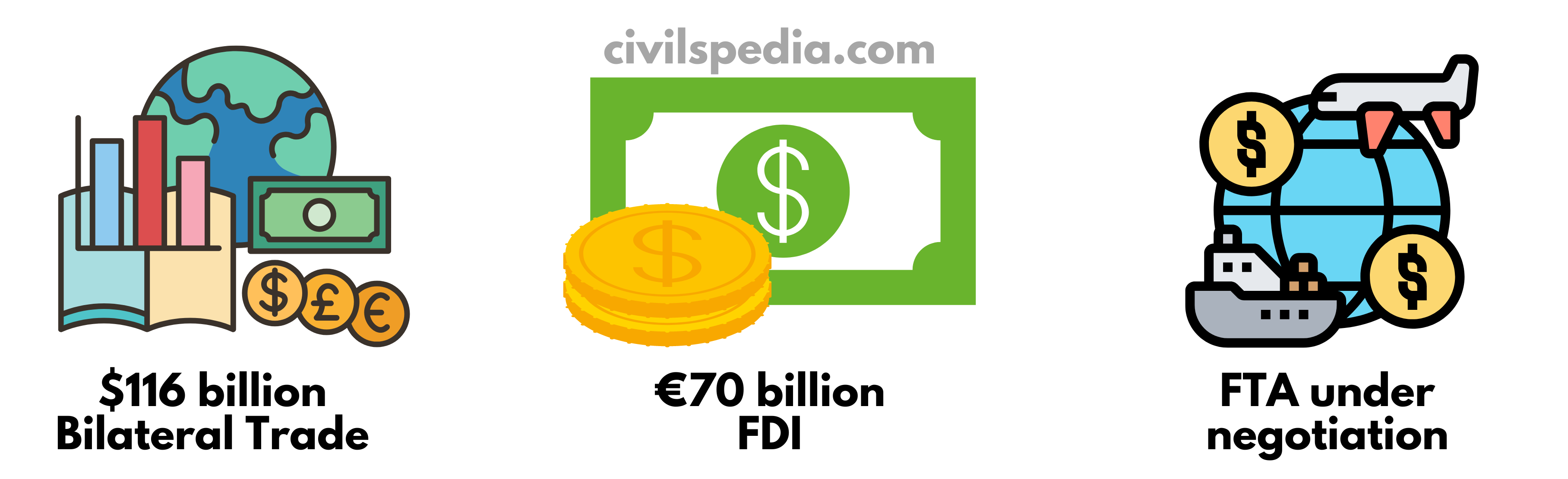
  • The European Union is one of India’s largest trading partners. The bilateral trade accounts for $137.41 billion in 2023-24..  
  • The European Union is the second largest investor in India, with a cumulative FDI of €70 billion since 2000. 
  • The Free Trade Agreement (FTA) between India and the European Union is currently under negotiation. When signed, it would be the world’s largest, encompassing 1.8 billion people (as of 2025, the India-EU FTA is in finalization stage, and both parties are engaged in intense talks following Trump tariffs on both parties).
  • But problems are present because European markets are going towards protectionism.  

2. Security Relations

  • India and Europe share a common interest on
    • Defending global terrorism & extremism 
    • Securing trade lines from attacks by pirates 
    • Preventing attacks on IT infrastructure 
  • The relation will be helpful in securing Indian Ocean Region because its members, like France, Italy etc., have important bases.
    • France: Reunion Island and UAE 
    • Italy: Djibouti

3. Maintain the World Order

  • India and European Union have a commitment to a “rules-based” international order and a “multipolar” world.
  • For UNSC Reforms, the EU is most important because of the Veto Power of France. 

4. Climate Change & Environment

  • Both shares a common view toward Climate Change 
  • After the withdrawal of the UK from the European Union, India-EU Cooperation has become even more important. 

5. City to City Cooperation

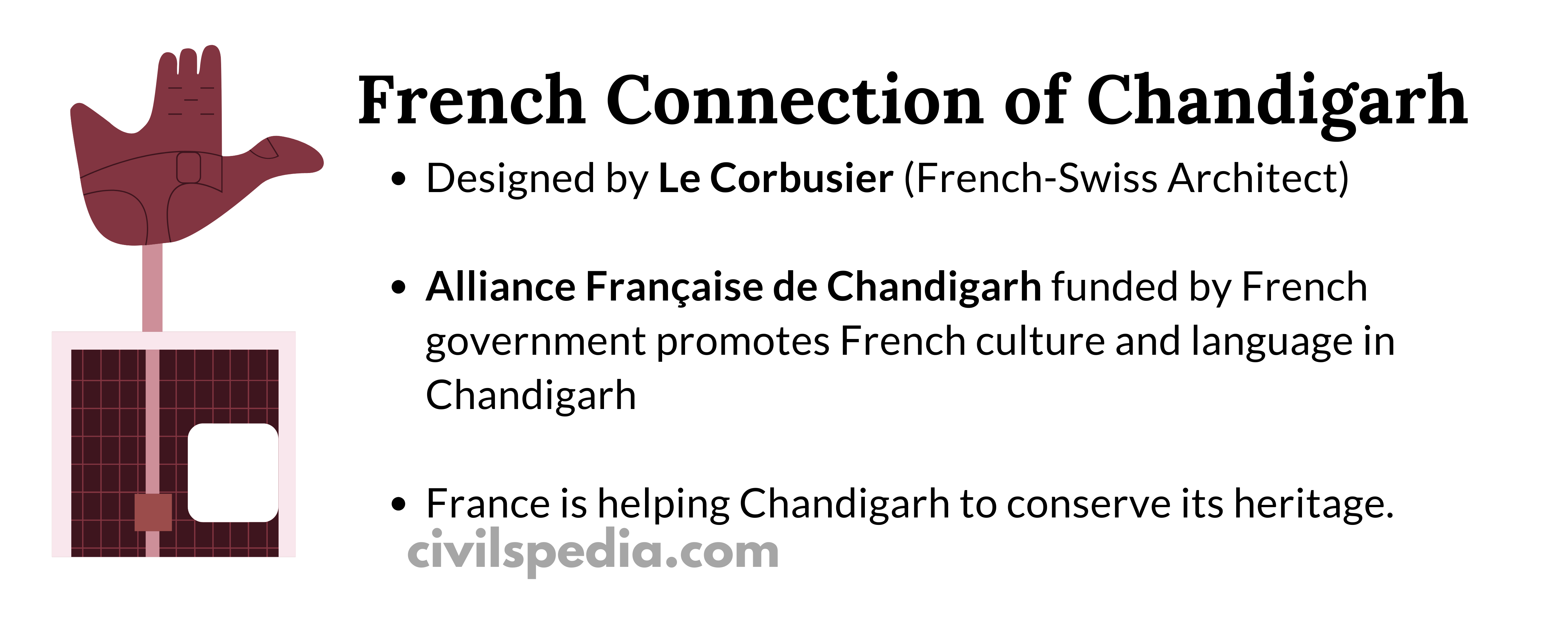
  • There is a city-to-city cooperation between European and Indian cities such as Mumbai, Pune and Chandigarh
Chandigarh- France Connection

6. New opportunities

  • Assertive China and its challenge to the existing balance of power is forcing the European Union & India to work jointly.
  • Post-Brexit, India has deepened its relationship with the European Union. Earlier, all the EU trade with India was routed through London.

Challenges

  • The increasing wave of Protectionism in the European Union countries.
  • In the WTO, both are leaders of Opposite Blocs wrt the Doha Development Agenda. 
  • Issues wrt Bilateral Investment Treaty (BIT) (discussed below)
  • Carbon Border Adjustment Mechanism (CBAM): CLICK HERE
  • Indian agro-products are banned from entering the EU on frivolous pretexts under SPS measures of the WTO.
  • Labour Issues: There are problems with the Labour Laws in India. E.g., Indian Carpets are denied entry on the pretext that the carpet industry of Mirzapur employs child labour.
  • Human Rights issue: EU members have expressed concerns regarding the deteriorating human rights situation in India. 


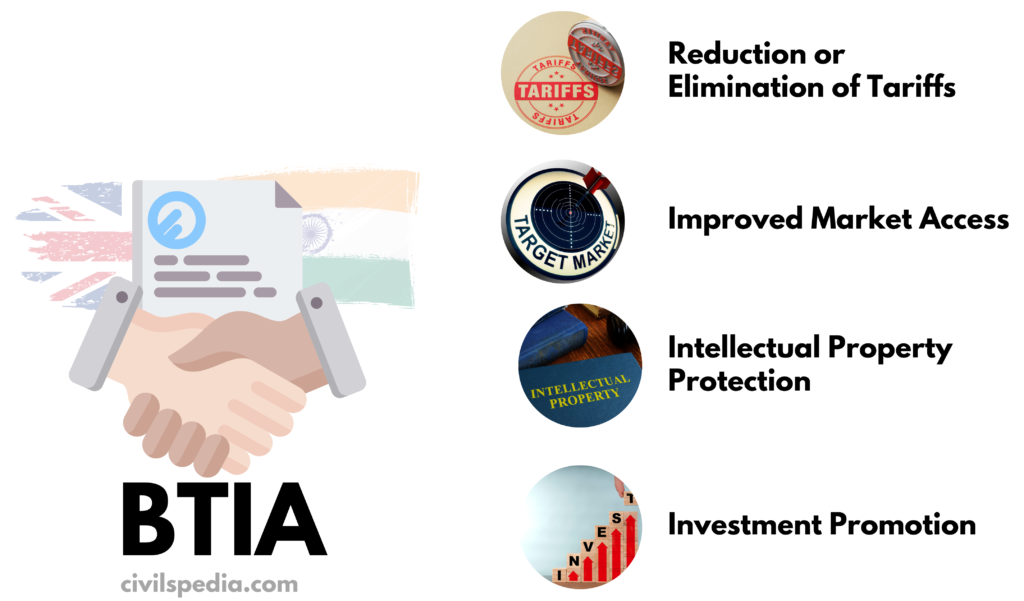
India-EU FTA or Broad-based Trade & Investment Agreement (BTIA)

Both parties initiated negotiations on a Free Trade Agreement (FTA) called the Broad-based Trade and Investment Agreement (BTIA) in 2007 but have not reached a conclusion till now.

India-EU FTA or Broad-based Trade & Investment Agreement (BTIA)

Concerns raised by EU

  • India’s model BIT (Bilateral Investment Treaty): The Model Treaty allows companies to seek international arbitration only when all domestic options have been exhausted.  
  • Data Secure Status of India: EU has refused to grant the status of Data Secure Nation to India. Hence, it will increase operating costs and affect competitiveness. 
  •  India’s IPR Regime  with the provision of compulsory licensing  
  • Issues such as Vodafone Case and Retrospective taxation  
  • EU wants India to reduce taxes on liquor (which would benefit France) and automobiles (which would benefit Germany)
  • Duty and tariff protection provided by the Indian government to domestic producers of spirit, wine and dairy products

Concerns raised by India

1. Concerns in Agriculture Sector: 

  • The EU subsidises its dairy products. Hence, there is a concern about dumping Indian markets with European Dairy products.
  • Europe uses the SPS Measures clause of WTO to block access to Indian Agri products in Europe.

2. Concerns in the service sector: 

  • India demands relaxation in the movement of skilled professionals into the EU. 
  • Indian government wants recognition of India’s professional qualifications in the EU.   

3. Procurement Policy

  • EU wants the government procurement chapter to be added to the FTA so that it can capture the lucrative government procurements.

Post-Brexit Opportunities

After Brexit, it could be easier for India to negotiate the terms of the FTA with the EU. Till now, the UK was playing the role of the most prominent spoiler.

Radio Isotopes and their Uses

Last Update: May 2023 (Radio Isotopes and their Uses)

Radio Isotopes and their Uses

This article deals with ‘Radio Isotopes and their Uses .’ This is part of our series on ‘Science and Technology’ which is an important pillar of the GS-3 syllabus. For more articles, you can click here.


Introduction

Isotopes of some elements are unstable and hence radioactive. E.g.: Iodine-131, Indium-92, Molybdenum-99, Chromium-51, Phosphorous-32 etc.


Applications of Radio Isotopes

1. Energy

  • Energy can be produced by using nuclear fission and fusion in a controlled way using nuclear reactors.
Radio Isotopes and their Uses

2. Agriculture

  • To develop mutant crops: Radioisotopes is used to develop high yield, disease-resistant varieties 
  • BARC has produced green manure crop Sesbania Rostrata using this
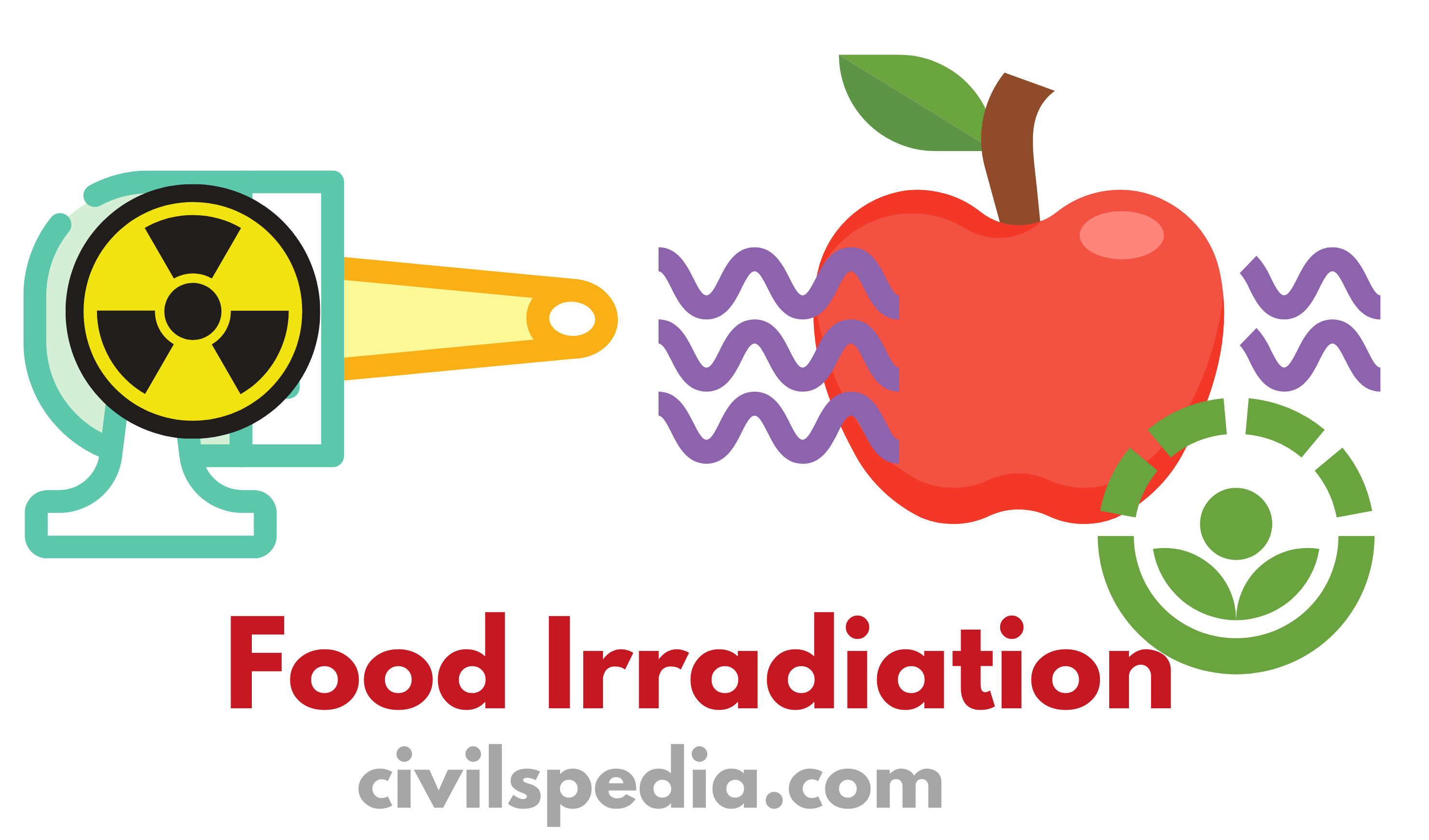
  • Food irradiation: Food irradiation is used for food preservation, in which radiation is used to break chemical bonds of enzymes needed for chemical reactions. It increases the shelf life of perishable food. CODEX & HACCP accept food irradiation. Prevention of Food Adulteration Act has provisions regarding food irradiation.
Food irradiation

3. Medicine and Healthcare

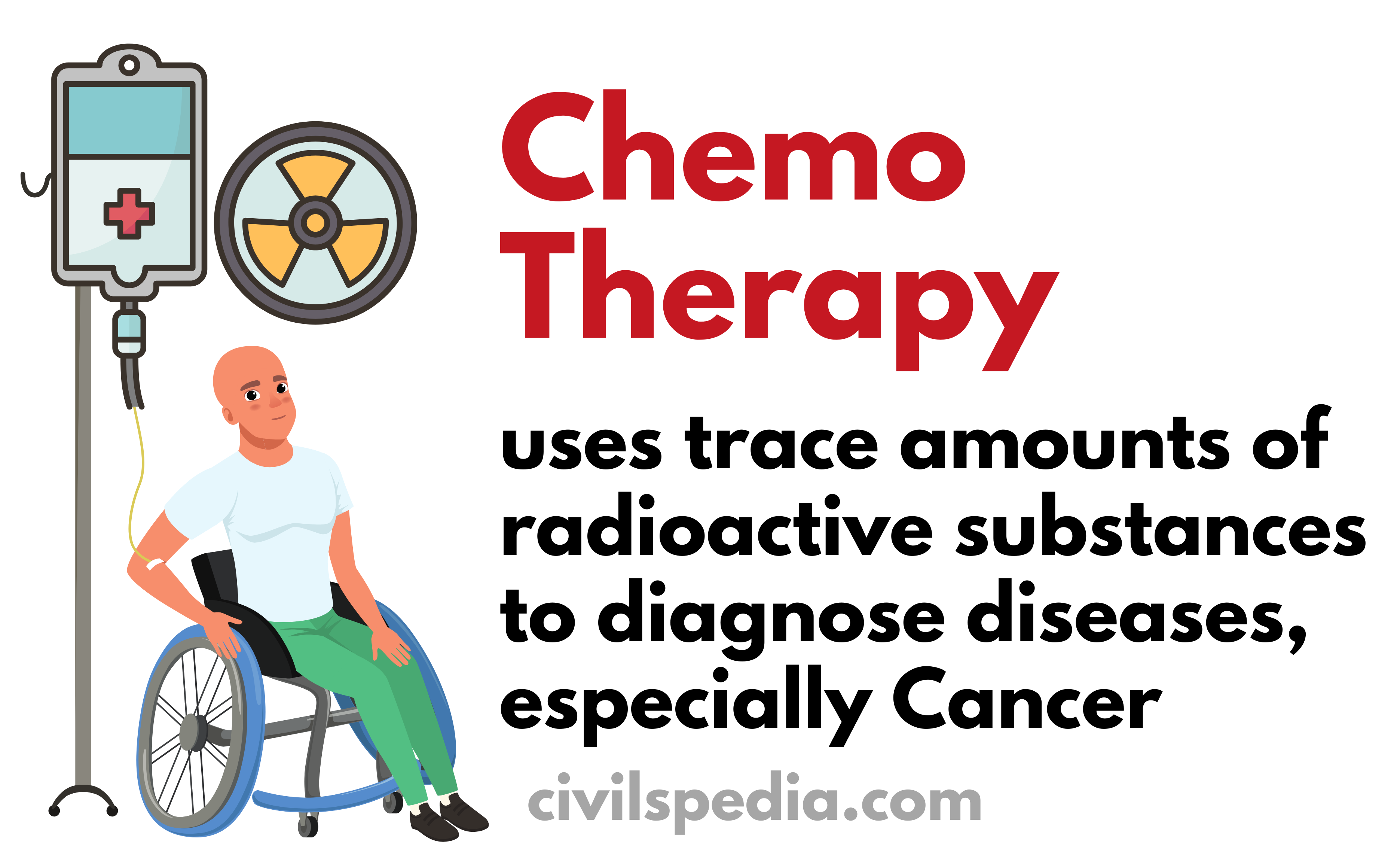
  • Nuclear medicine is a medical speciality that uses trace amounts of radioactive substances (called radio-pharmaceuticals) to diagnose and treat a wide range of diseases and conditions safely and painlessly.
    1. Thyroid cancer is treated using I-131 (iodine)
    2. Bhabhatron, designed by BARC, is used to treat  Breast Cancer, Bowel Cancer, Head and Neck Cancer and Lung Cancer using radioactive Co-60 (Cobalt).
    3. Brachytherapy is done by placing sealed radioactive sources at or near the target area. It is used for treating Prostate Cancer using Iridium-192
  • Radio Immunoassay to measure Hormones, Enzymes and Serum Proteins.
  • Radiation Sterilization is used to sterilize medical products such as syringes, cotton wool etc.
Nuclear Medicine

4. Dating / Archaeology

  • C-14 Dating: Radioactivity of a particular isotope of Carbon, i.e. C-14, is used by archaeologists to ascertain the age of dead organisms. 
  • Uranium Dating: Uranium dating is used to date the rocks formed 1 million to 4.5 billion years ago.


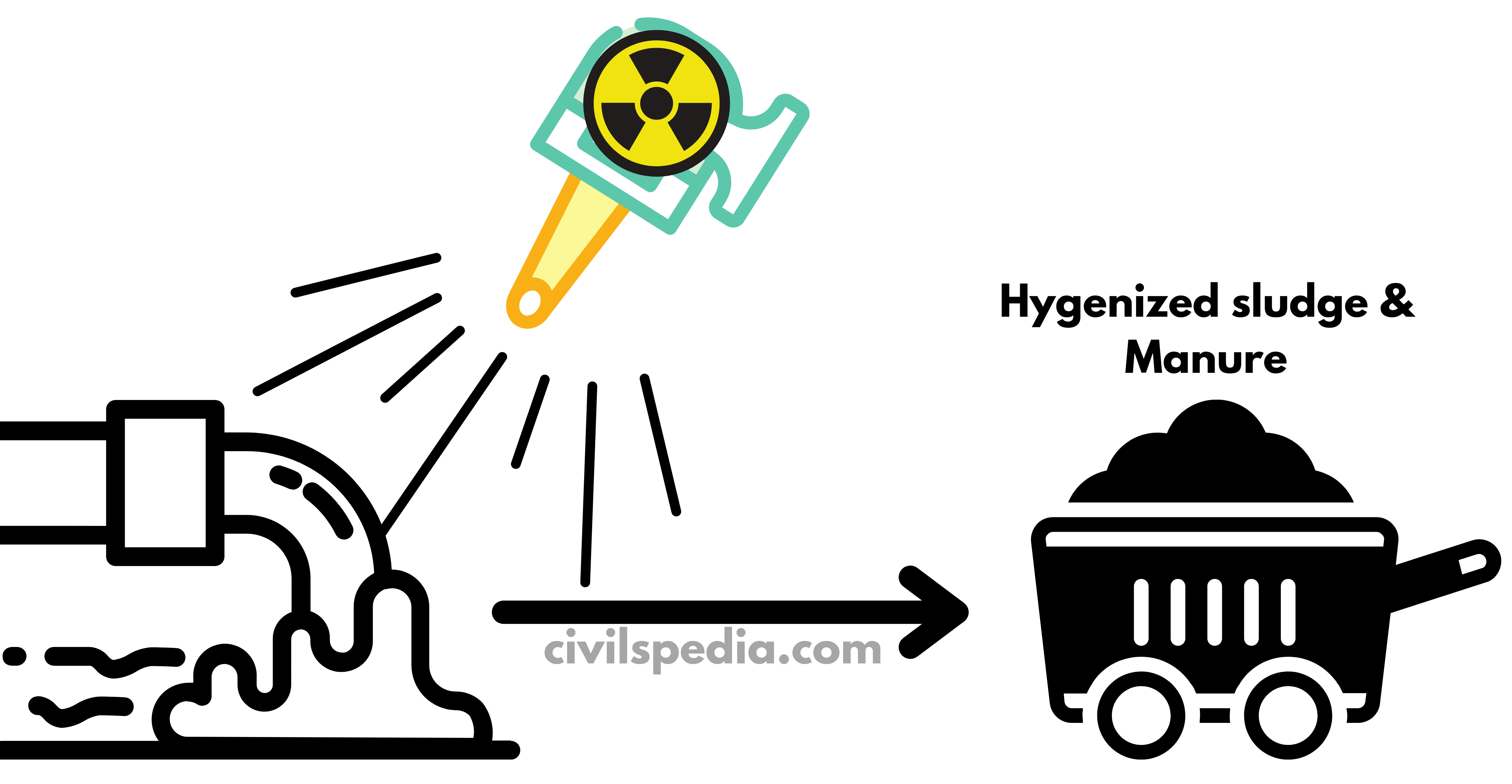
5. Sludge Hygenization

  • Radiation Technology is used to hygienize the sludge and manufacture manure from it. Ahmedabad Municipal Corporation (AMC) is using this technique.
Radioactivity Applications

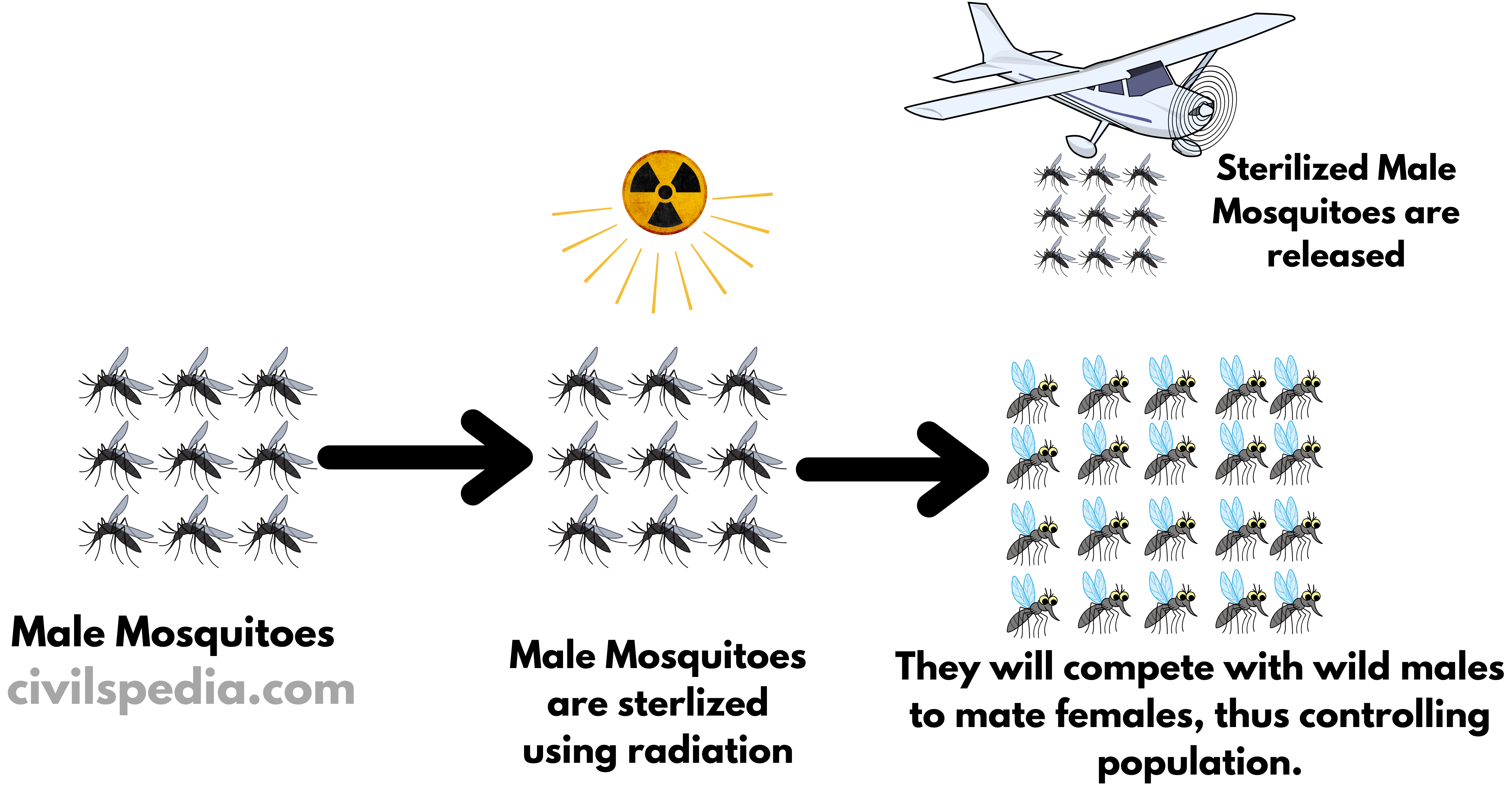
6. Insect and Pest Control

Insect and Pest Control

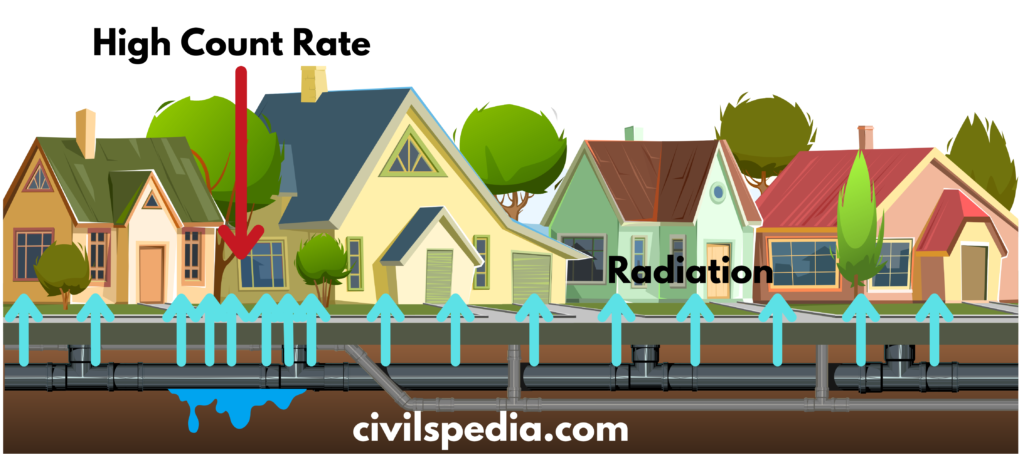
7. Detecting Leakage

  • Radioactivity can be used to detect the point of leakage in underground pipelines. The point of leakage has high levels of radiation. 
High Count Rate 
civilspedia.com

8. Other uses

  • Water Management: BARC has developed desalination technologies for providing potable water in rural areas & on ships using radioactive materials.  
  • Industry: Radioisotopes are used in the quality control of industrial products.

Nuclear Energy as Power Source in India – Advantages and Disadvantages

Nuclear Energy as Power Source in India – Advantages and Disadvantages

This article deals with ‘Nuclear Energy as Power Source in India – Advantages and Disadvantages .’ This is part of our series on ‘Science and Technology’ which is important pillar of GS-3 syllabus . For more articles , you can click here

Installed capacity of India

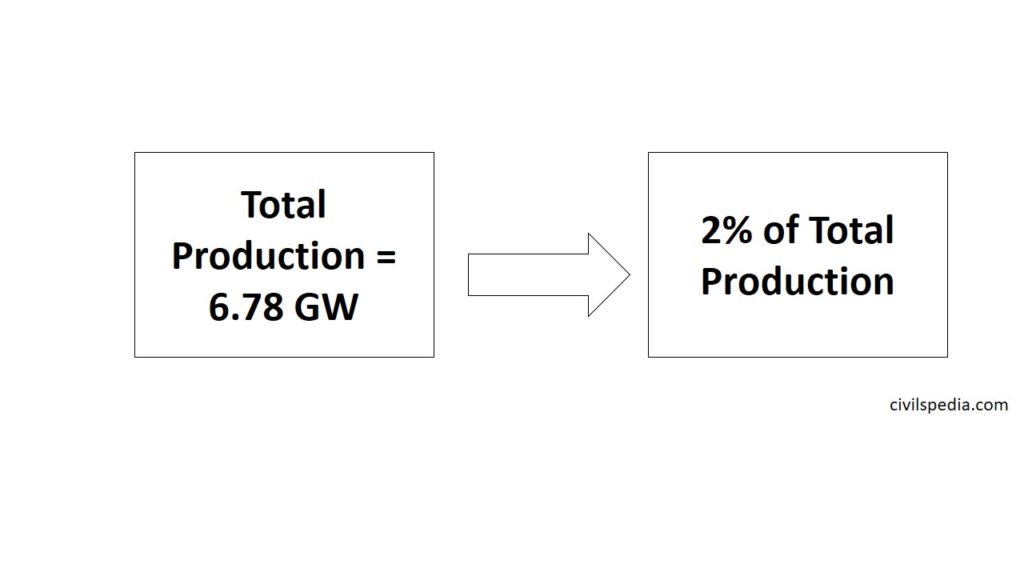
As of April 2017 => 6,780 MW (6.78 GW) which constitutes ~2% of installed capacity of India

Nuclear  Energy as Power Source in India - Advantages and Disadvantages

Problems with Nuclear Power generation in India

1.India’s domestic Uranium Reserve can support only 100 GW of energy.

  • Our future depends upon  development of third stage of Nuclear Program without which will remain dependant on imported Uranium as it is case with Oil currently.

2. Current Nuclear reactors consume significant amount of water.

  • Hence most of upcoming plants will be set up near sea coasts. It will put pressure on the coastline & Western  Ghats.

3. There are long gestation periods which increase costs of the plant significantly.

4. New safeguard requirements post Fukushima disaster has pushed per MW costs of Nuclear Reactors significantly higher in comparison to Thermal, Solar and Wind Plants.

  • Jaitapur plant in Maharashtra (AREVA) is expected to cost 20 crore/ MW in comparison other sources cost 4 crore/ MW.

5. Some argue that Total costs of a Nuclear Lifecycle which involves Mining of Uranium, transportation , handling of waste generated etc is significantly more than economic value generated during lifetime of the functioning of the plant

6. Nuclear installations will be favorite targets of terrorists  which can cause irreversible damage to people 

So, Should Nuclear Energy be used ?

Strong arguments which justify use of nuclear energy are

  • No Green House Gases (GHGs) are emitted in Nuclear Power generation  => Helps to fight Global Warming
  • It generates very limited waste in quantity (although far more hazardous in quality). 
  • Helpful to achieve Paris Pledges => 40% of energy from Non-fossil sources till 2020
  • Increases image of country as technologically advanced nation .
  • Non fluctuating source of renewable energy. Solar, Wind etc energy depend on sunshine, wind speed etc and hence fluctuate

But

  • Cost of power from new nuclear reactors is increasing significantly post Fukushima Disaster . Power from new reactors costs between Rs. 6.2-6.5/Unit 
  • In case of any nuclear leakage & accident in nuclear power plants, damage is immense & incurable
  • Land acquisition issues ,  need for large water reservoirs for the reactors, & concerns about a possible tsunami scenario 
  • Major Nuclear Companies like Toshiba-owned Westinghouse, Areva etc are on verge of Bankruptcy pointing towards fact that Nuclear Energy has become unviable
  • Investing in Solar and Wind Energy is better option  . Cost of Solar Energy has decreased to around ₹4.5 / kWh compared to ₹6.5 kWh of Nuclear Energy
  • Uranium contamination of ground water due to Mining. Eg : in Rajasthan

Conclusion : India is producing miniscule 2% of its energy from Nuclear Energy. Although we should increase this share but at the same time safety protocol should be updated

Indian Nuclear Sector

Indian Nuclear Sector

This article deals with ‘Indian Nuclear Sector.’ This is part of our series on ‘Science and Technology’ which is important pillar of GS-3 syllabus . For more articles , you can click here

Aim of the nuclear research in India

  • Peaceful use of the nuclear energy
  • Power generation
  • Applications in the agriculture
  • Medical sciences, industrial application etc

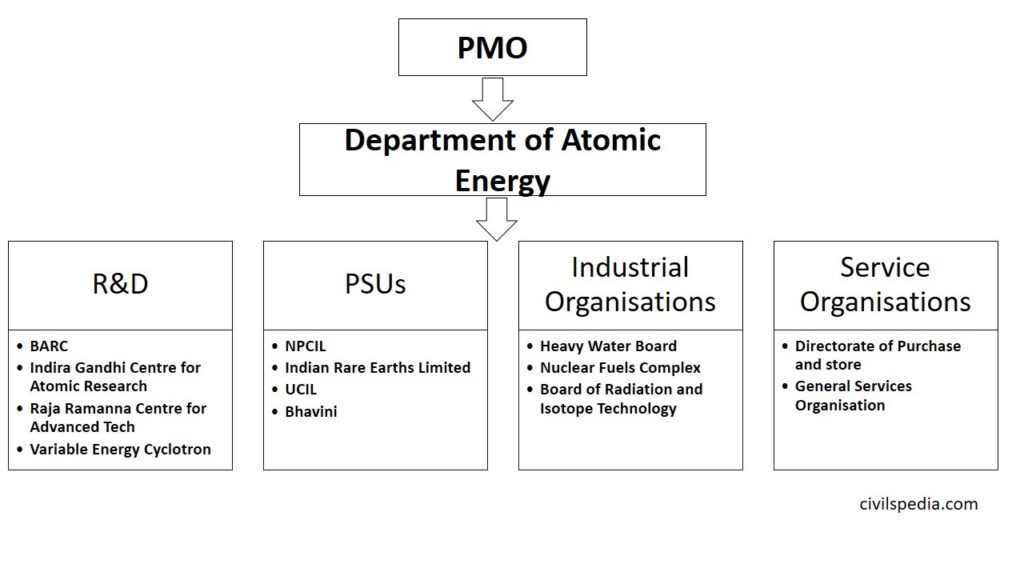
Organisational set up

Indian Nuclear Sector

Department of Atomic Energy( DAE)

  • Formed  in 1954
  • Headquarters – Mumbai
  • Directly under PMO
  • Responsible  for the Nuclear energy including nuclear power and research

Atomic Energy Regulatory Board( AERB)

  • Setup in 1983
  • Under Atomic Energy Act ,1962
  • For regulating nuclear sector

Some institutions running under DAE

1.R&D sector

BARC

  • Bhaba Atomic Research Centre
  • Headquartered in Bombay
  • Formed in 1954 in Trombay (Mumbai)
  • Involved in research and development (R&D) in the field of Nuclear Energy.
  • Made  research reactors like Apsara (1956), Zerlina (1961) etc

IGCAR(Indira Gandhi Centre for Advanced Research)

  • Headquartered in Kalpakkam
  • Formed in 1981
  • Made various reactors for producing energy   . Eg Tarapur (1969), Rawatbhata (1981) etc
  • Currently working on PFBR (2nd Stage Reactor)

Raja Ramanna Centre for Advanced Technology

  • Situated in Indore
  • Doing work in advanced technology like Atomic Energy , Nano Tech, robotics etc

Variable Energy Cyclotron Centre

  • Situated in Kolkata

Atomic Minerals Division (AMD)

  • Situated in Hyderabad
  • Looks after availability of Nuclear Fuels in India 

2. Public Sector Undertakings

NPCIL (Nuclear Power Corporation of India Ltd)

  • Situated in Mumbai
  • Incharge of First stage of Nuclear Plants
  • All 24 Nuclear Energy  Plants in India are working under it

BHAVINI 

  • Bhavini = Bhartiya Nuclear Vidyut Nigam Limited
  • Situated in Kalpakkam
  • incharge of second stage -> PFBR operated by it

Uranium Corporation of India ltd (UCIL)

  • Situated in Jaduguda
  • Extract Uranium and process it to yellow cake

Indian Rare Earth ltd

  • Situated in Mumbai

3. Industrial sector

Heavy Water Board Mumbai
Nuclear Recycling Board Mumbai
Nuclear Fuel Complex Hyderabad
Board of Radiation and Isotope Technology Mumbai

4. Aided institutions

TIFR (Tata Institute of Fundamental research) Bombay
Tara Memorial Centre Bombay
Saha Institute of Nuclear Physics Kolkata
Institute of Physics Bhubaneswar
Institute of the Mathematical sciences Madras

India and Atomic Bomb

  • Indian Government formed Department of Atomic Energy (DAE) post independence which has conducted 2 successful Nuclear tests till date
1st May 1974 Smiling Budha Based on Nuclear Fission
2nd May 1998 Shakti Both Nuclear Fission and Fusion (Hydrogen bomb)
  • Indian Nuclear Program is considered better than rest of nuclear powers of the world because
    • India has adopted ‘No First Use Policy’ .
    • Indian Atomic Bombs are under Civilian Government.
    • Indian Nuclear Bombs are of minimal capacity of destruction .