Basics of Radioactivity

Basics of Radioactivity

This article deals with ‘Basics of Radioactivity .’ This is part of our series on ‘Science and Technology’ which is an important pillar of the GS-3 syllabus. For more articles, you can click here.


Constituents of Atom

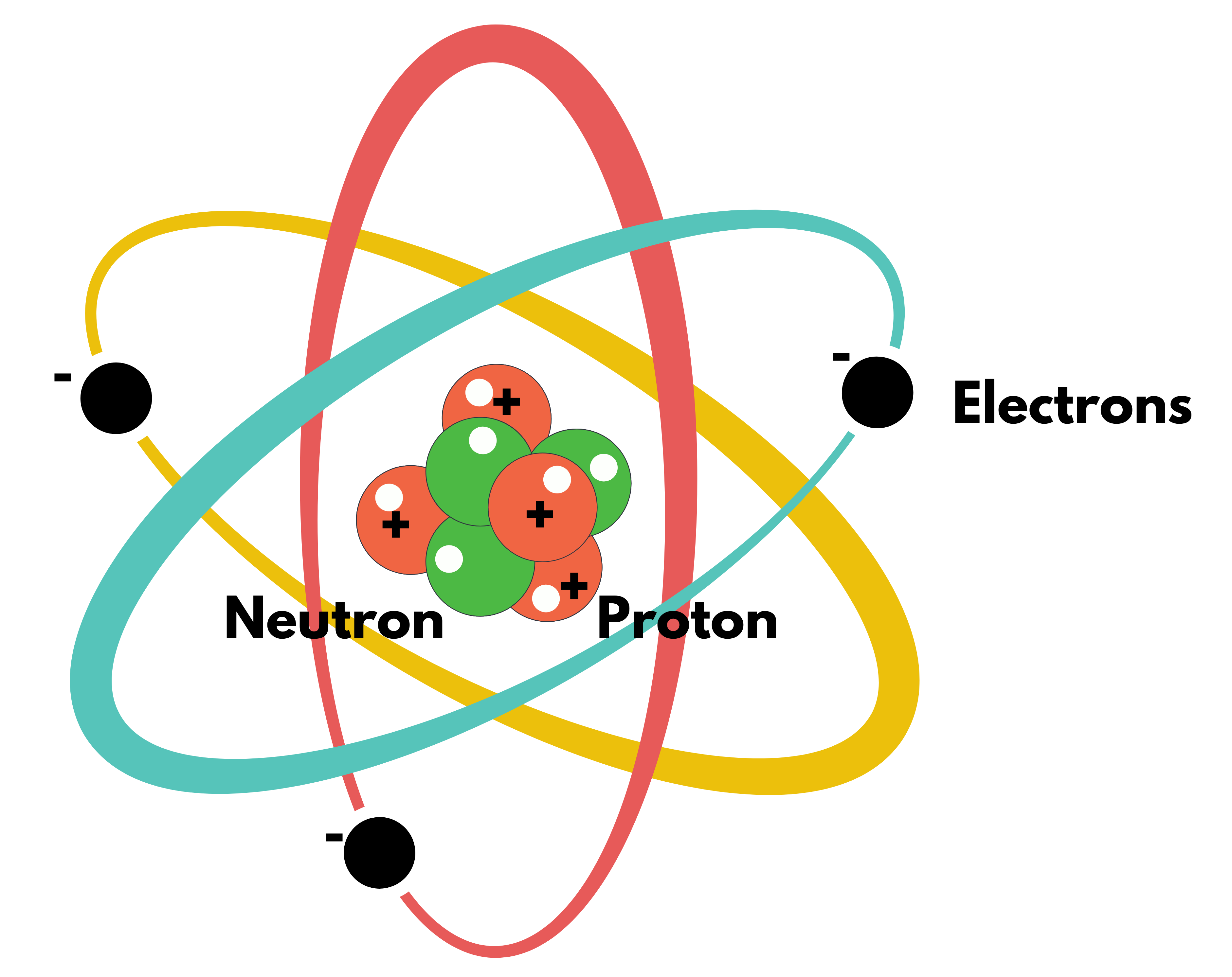
Atom has the following three constituents

Particle Mass (Kg) Charge (Coulomb)
Proton 1.672 X 10^-27 + 1.6 X 10^ -19
Neutron 1.675 X 10^-27 Neutral
Electron 9.108 X 10^-31 1.6 X 10^-19

Mass of Proton almost = Mass of Neutron = 1830 X Mass of Electron.


Atomic Structure

  • In an atom, Central Nucleus is surrounded by electrons at various energy levels. 
  • The most successful model is Wave Mechanical Model, but that is a mathematical rather than a visual model.
  • For our purpose, Bohr Atomic Model is enough. 

Bohr Atomic Model

  • Atom consists of 
    • Central Nucleus: Containing all Protons & Neutrons with almost the whole mass concentrated here. 
    • Electrons: Revolves around the nucleus in a circular pattern (like planets around the sun) 
  • Electrons can revolve only in certain specified orbits, with the electron in the innermost orbit having the smallest energy and the electron in the outermost orbit having the largest energy. 
  • When an atom is provided energy either by strong heating or by bombardment with some fast-moving particle, Electrons in a natural state can jump to higher energy levels. But the atom doesn’t remain in that state for more than 10^-8 s & comes back to a normal lower energy level, emitting surplus energy in the form of Photons.
  • Emitted energy can be Visible, UV or X-Ray, depending on the energy difference. 
Basics of Radioactivity

Radioactivity

  • The property under which a heavy nucleus of an element disintegrates itself into smaller nuclei along with alpha, beta & gamma rays without being forced by any external agent to do so is termed radioactivity. 
  • The phenomenon of radioactivity is natural and can’t be stopped. 
  • It is found that all atoms with more than 83 protons; and a neutron-to-proton ratio of more than 1 as they are unstable. To achieve stability, unstable nuclei disintegrate spontaneously with the Alpha, Beta & Gamma Rays emission. 
  • Henry Becquerel discovered the phenomenon of radioactivity.

Reason of Radioactivity

  • Inside the nucleus, positively charged Protons & Neutral are present. Hence, if only Electrostatic Force is there, all nuclei must have split apart due to repulsive forces. But this is not the case & the nucleus is stable.
  • But another force called Nuclear Force is working here. IT IS ATTRACTIVE FORCE EXISTING BETWEEN PROTON & PROTON and PROTON & NEUTRON. BUT THIS FORCE ACTS AT A VERY SMALL DISTANCE. Generally, Nuclear Forces overpower Electrostatic Forces inside the nucleus.
  • But in the case of larger nuclei, nuclear forces cannot overpower electrostatic forces, and they exhibit radioactivity.

Alpha, Beta & Gamma Radiations

 The most common types are

  Alpha  Beta Gamma
  Similar to Helium Nuclei (He (2,4)) and generally emitted by a large nucleus These are fast energy electrons   Gamma Radiations are electromagnetic radiations of high frequency
Generally emitted by unstable atoms to become stable by releasing energy
Penetration  It can penetrate  5 cm of air only. It can penetrate air and paper. It can penetrate most things except a thick sheet of lead or a very thick concrete wall.  
Mass Heaviest (4 amu) Lighter (9.1 X 10^-31 kg) Massless    
Speed Around 1/100 of the speed of light 33% to 99% of the speed of light Equal to the speed of light
Ionising power Maximum due to maximum charge (+2) and maximum mass Intermediate between beta & gamma Minimum due to zero charge
Effect on Photographic plate Produce smaller effect More effect Maximum effect
Effect of Electric and magnetic field Show deflection Show deflection Don’t show any deflection
Effect on the human body It causes a burning effect It can cause a shock on longer exposure It can cause cancer

Transmutation

  • Transmutation is the process of altering one element to another. 
  • Reason = Natural Radioactivity, Artificial Transmutation etc.
  • Artificial Transmutation is used to obtain elements with Atomic numbers greater than 92.


Half Age

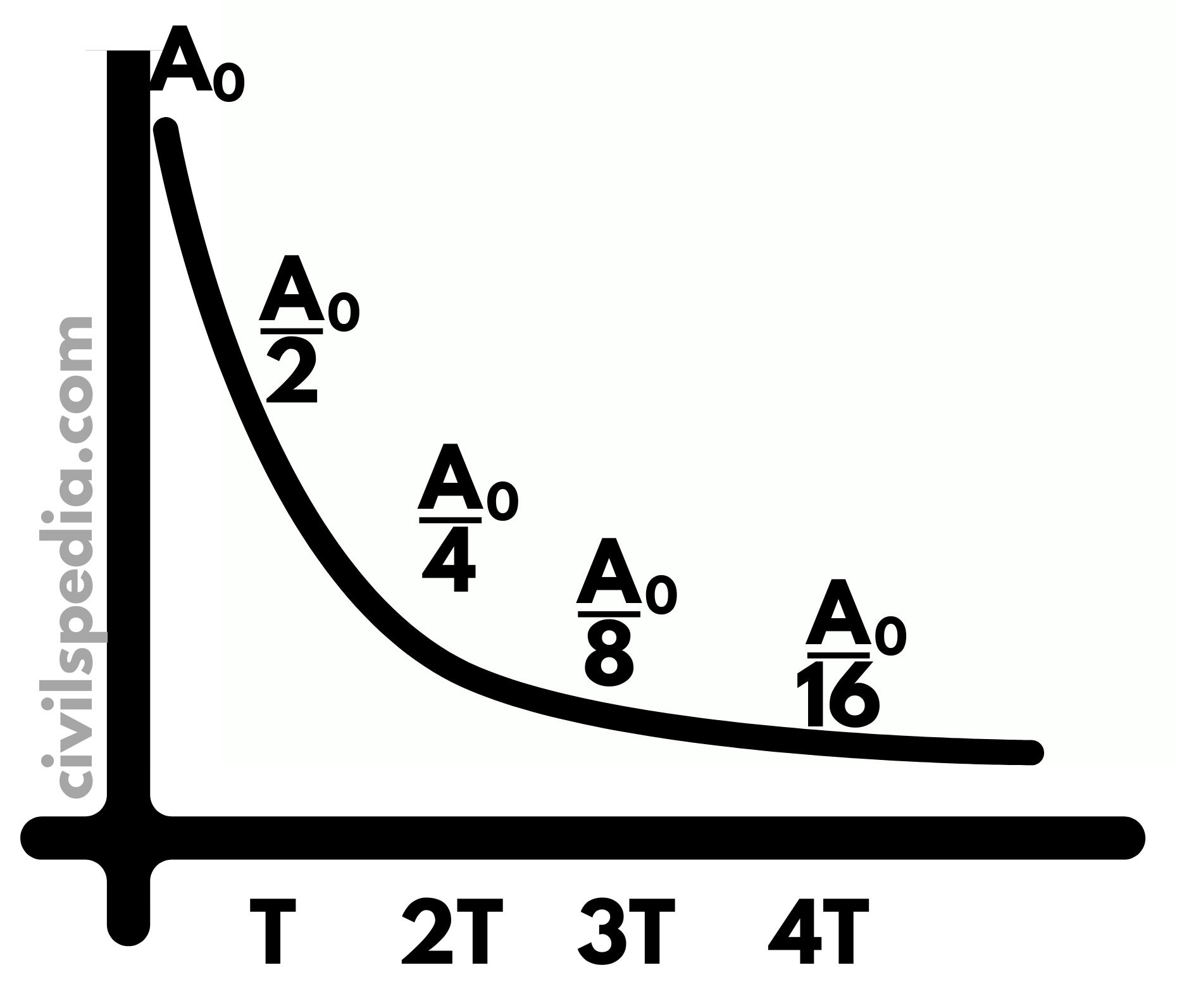
It measures the time it takes for a given amount of the radioactive substance to become reduced to half due to decay and, therefore, the emission of radiation.
Half Age of Radioactivity

Carbon Dating

  • The technique of estimating the age of the remains of a once-living organism, such as a plant or animal
  • It involves measuring the radioactivity of its C-14 Content (the half-life of C-14 is 5570 years).
  • The ratio of C-14 / C-12 in nature is 1/106. 

Uranium Dating

  • Uranium Dating is used for dating older but non-living things like rocks. 
  • The age of rocks from the moon has been estimated to be 4.6 X 10^9 years, nearly the time of Earth’s origin.

Isotope, Isobars & Isoneutrons

  • Atomic Number (Z) = Number of Protons
  • Mass Number (A) = Number of Neutrons & Protons

Isotope

  • Isotopes are nuclides with same Atomic Numbers but different Mass Numbers.
  • E.g., U (92,235) & U (92,238 ) + C-12 & C-14
  • Generally, isotopes don’t have different names except for isotopes of Hydrogen named Protium (H(1,1), Deuterium (H (1,2)) & Tritium (H(1,3)).

Isobars

  • Isobars are nuclides having same Mass Number but different Atomic Numbers.
  • E.g., K (19,40) & Ca (20,40) + C (6,14) & N (7,14) 
  • They have different names. 

Isoneutrons

  • Isoneutrons are nuclides having the same number of neutrons.
  • Examples include 
    1. C (6,14) & O(8,16): Both have 8 neutrons
    2. H (1,3) & He (2,4): Both have 2 neutrons 
Nuclear Fission Reactors

Nuclear Fission Reactors

This article deals with ‘Nuclear Fission Reactors .’ This is part of our series on ‘Science and Technology’ which is important pillar of GS-3 syllabus . For more articles , you can click here.


Nuclear Fission

  • In 1939, Otto Hahn and Strassman discovered Nuclear Fission when they found that a slow-moving neutron collides with a uranium nucleus; it breaks into two smaller nuclei of comparable masses with the release of energy. 
  • In simple words, Nuclear Fission means breaking up the heavier nucleus into two smaller nuclei and releasing an enormous amount of energy.
Nuclear Fission Reaction
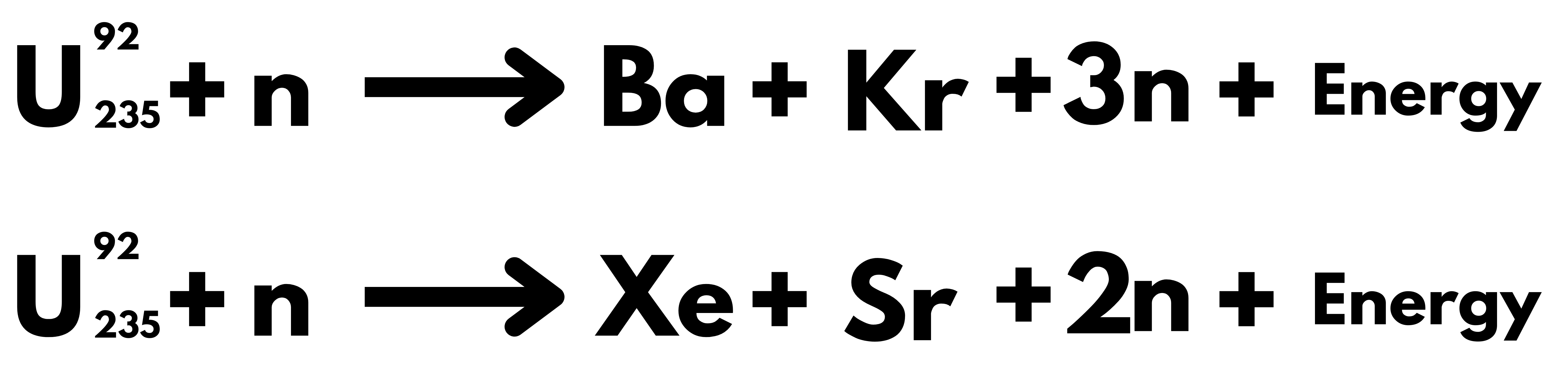
  • Reactant total mass is more than product total mass & EXCESS mass is converted to energy (using Einstein’s Mass – Energy Relation (E = mc^2)). The energy released from 1 nucleus of Uranium (235) is nearly 93 Mega Electron Volt. When one Uranium nucleus undergoes fission, the energy released might be small. But from each fission reaction, three neutrons are released. These three neutrons can cause further fission in three other Uranium nuclei. This process is called a chain reaction.
  • The energy produced in the nuclear reaction can be used to convert water into steam, which can be converted into electricity using Steam Turbine and Generator.

Types of Reactors

A simple Nuclear Reactor from which electricity can be generated is of following type

Types of Reactors
Fuel U-235, U-233, Pu – 239 or Th -232 is used as fuel in the Nuclear Reactor  
Moderator It reduces the speed of neutrons so that nuclear reactions can take place. 
– Graphite or Heavy Water (D2O) is used as Moderator.  
Coolant The coolant absorbs the energy/heat released from the reaction and transfers it into turbines.
Heavy Water or Water can be used as coolant (depending on the type of Reactor)  
Control Rods To control the speed of the Nuclear Reactor.
Boron or Cadmium is used as Control Rod.  
Concrete Shield Concrete wall with 2-5 m thickness to stop radiation from spreading.

Reactors used in India

1. Pressurized Heavy Water Reactor (PHWR)

Most of the Nuclear Reactors found in India are PHWRs.


Information at Glance

Fuel Natural Uranium (without enrichment) (It is easier to make and less expensive to use, as Uranium enrichment is a complex process)
Coolant Heavy Water/Deuterium Oxide
By Products Plutonium  (more amount )
Moderator Heavy Water/Deuterium Oxide (Moderator and coolant are same) => Neutrons collide with Heavy Water molecules and slow them.  
Why Pressurized If water is heated, it expands & becomes less dense. As a result probability of collision between neutrons and water molecules to reduce the speed of neutrons decreases. It is crucial to decrease the speed of neutrons to ensure fission.
Cost Less Expensive
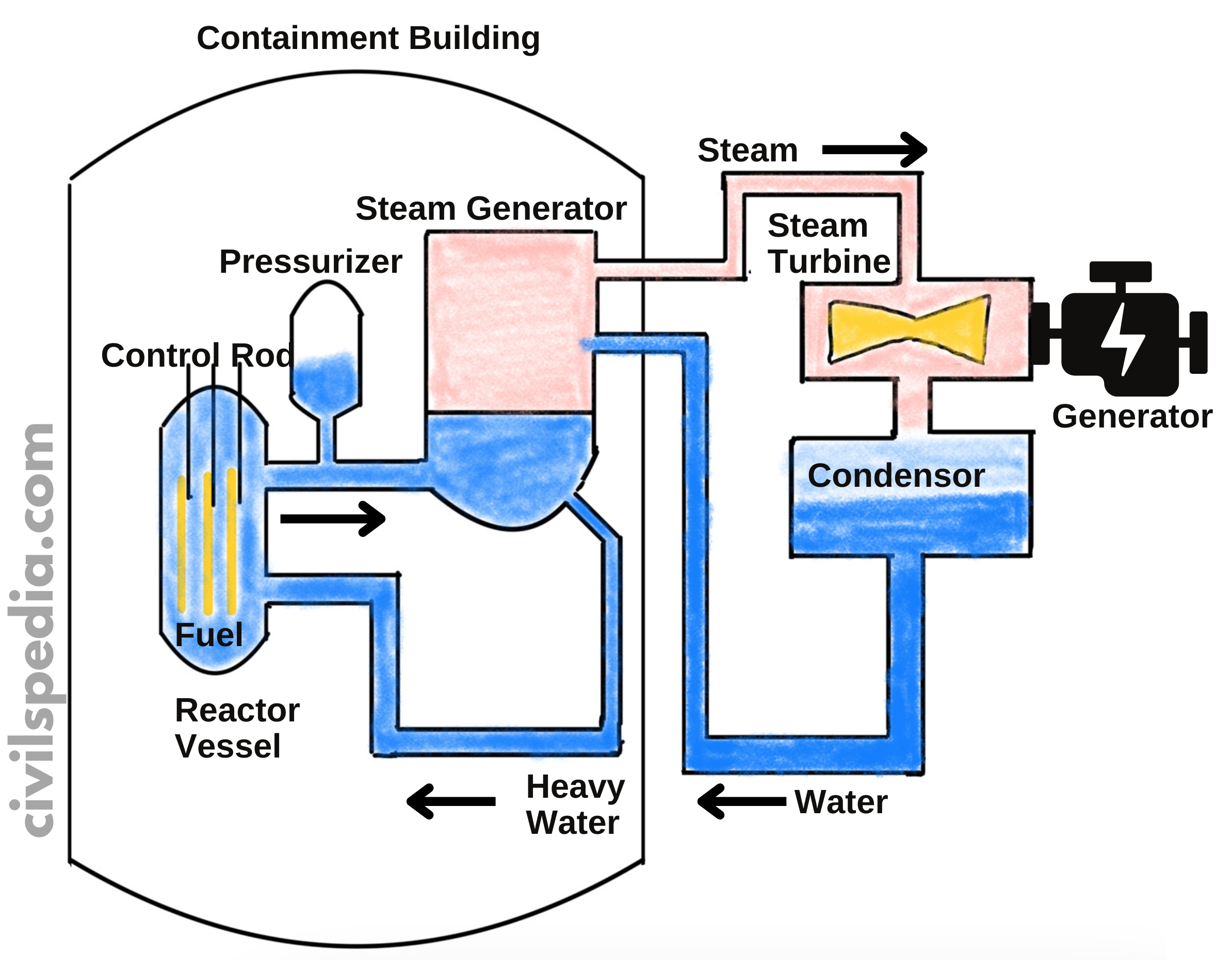
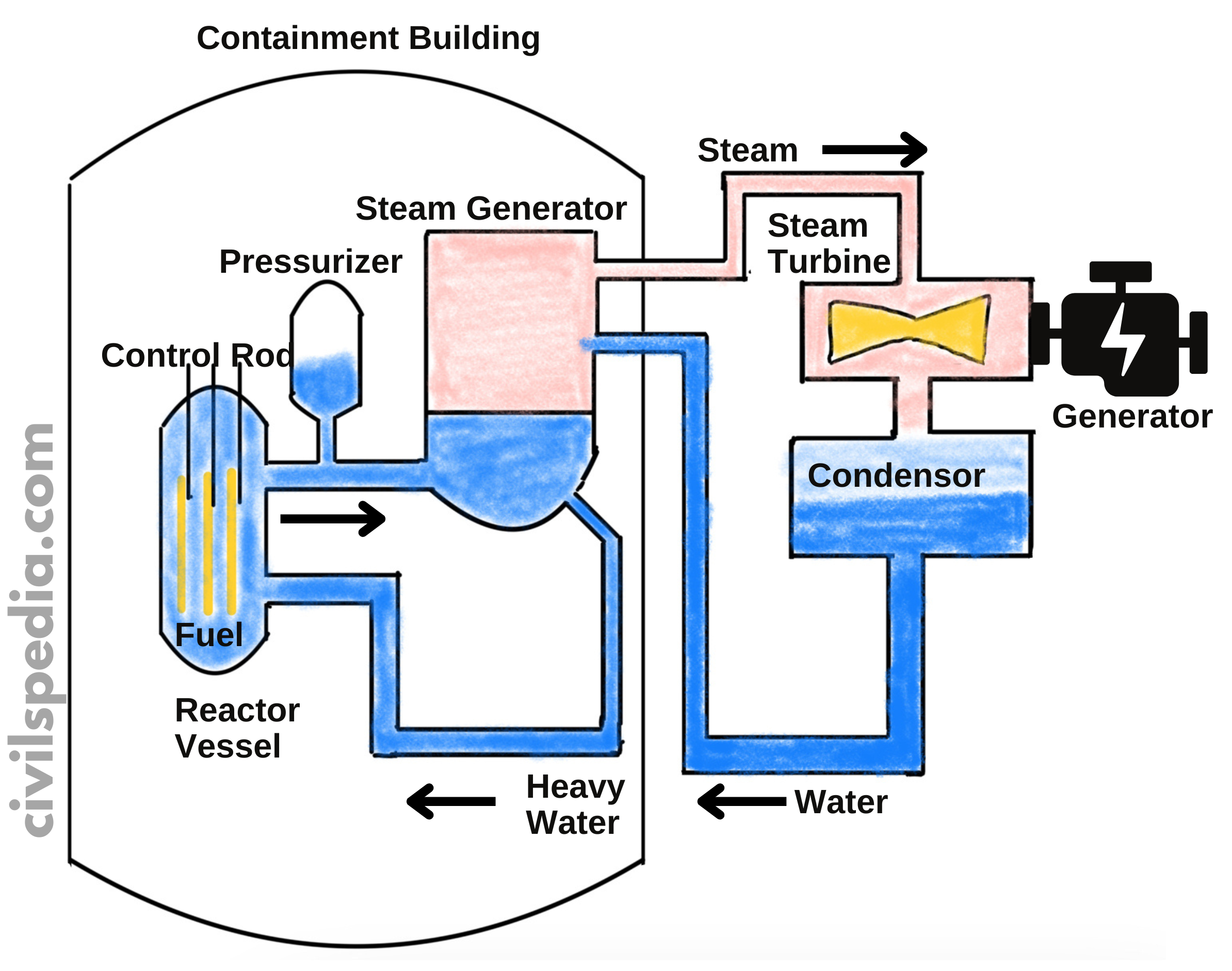
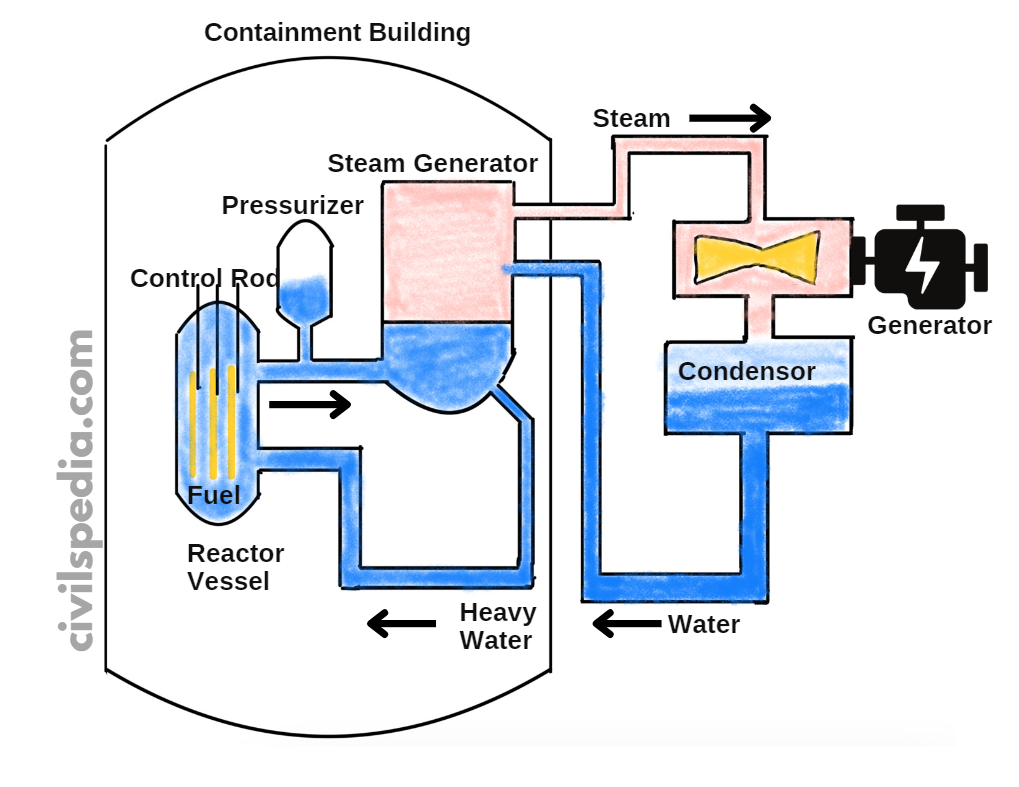
Pressurized Heavy Water Reactor (PHWR)

Details of PHWRs

The primary reaction which leads to the generation of energy while using Uranium as fuel is

Nuclear Fission Reaction
  • The most crucial point in Uranium Fission Reaction is the release of an extra 2.5 (average) Neutrons, which leads to the possibility of a chain reaction. If controlled, it can be used to produce energy called Nuclear Energy. At the same time, if it remains uncontrolled, it can result in an Atomic Bomb.
  • But the biggest hurdle, in this case, is the fact that neutrons liberated in the nuclear reaction are fast-moving & will not cause fission (instead, they will escape without causing any collision). To ensure a Fission reaction, these neutrons must be slowed. For this purpose, Moderators are used, which in this case are D2O (Heavy Water) & Graphite.
  • The reaction rate can be controlled by Control Rods, which are made up of neutron-absorbing material like Cadmium
  • The energy released in fission is continuously removed by a suitable Coolant which transfers heat to a working fluid which in turn may produce steam to drive the turbine & generate electricity. 
  • Pressuriser is used because when heavy water is heated, it expands & becomes less dense. As a result probability of collision between neutrons and heavy water molecules to reduce the speed of neutrons decreases. It is crucial to decrease the speed of neutrons to ensure fission. The Pressuriser ensures the suitable density of the heavy water.

2. Boiling Water Reactor (BWR)

  • It is the oldest type of Nuclear Reactor.
  • Fuel Used: Enriched Uranium
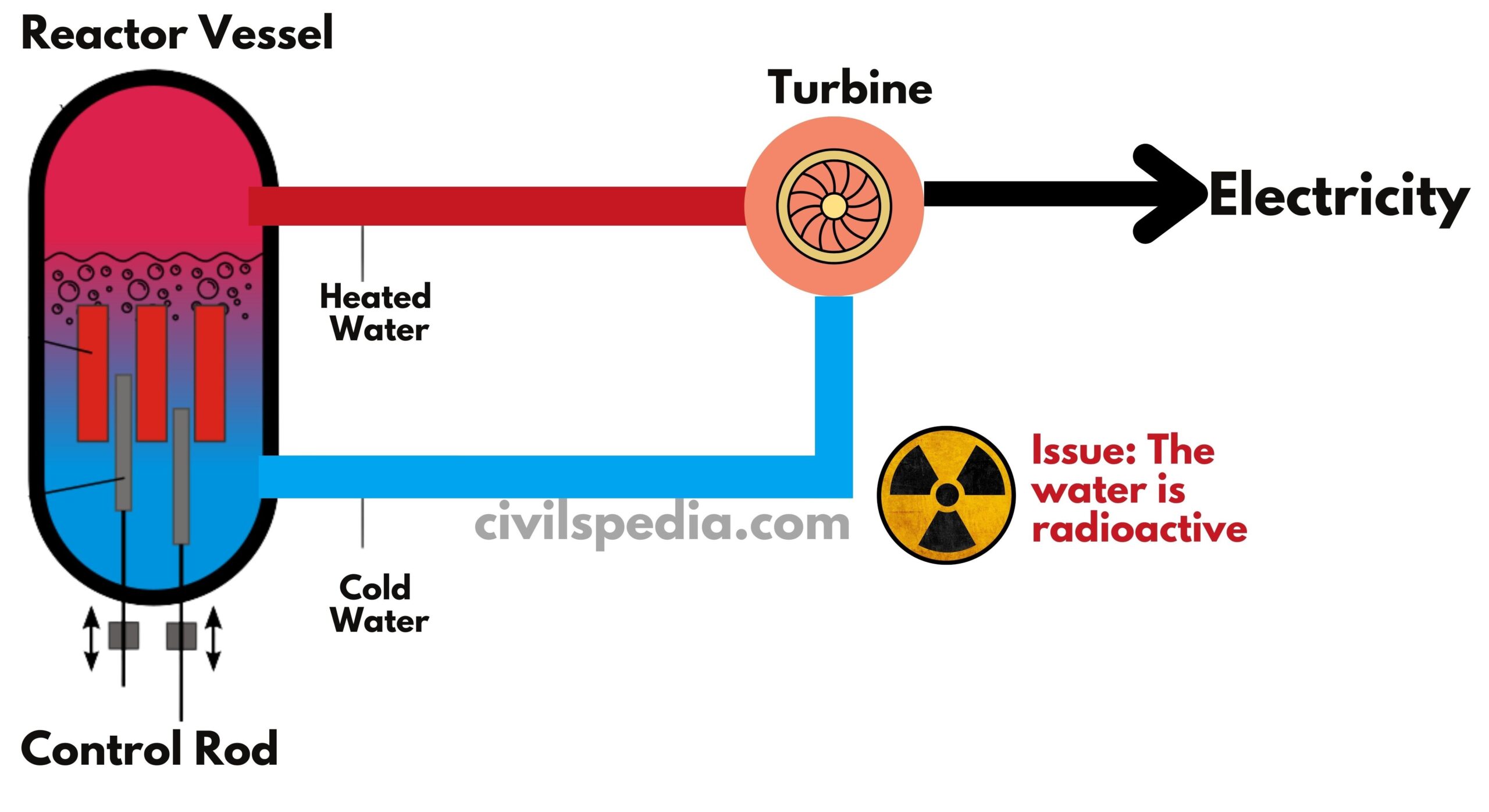
  • Working: Energy released during the fission reaction directly heats the (light) water. The same water is used to turn the turbine and then recycled back, to be used again in the cycle.
  • Moderator: No Moderator is used. The probability of neutron colliding with U-235 is achieved by using Enriched Uranium.
Boiling Water Reactor (BWR)
  • BWRs are the second most widely used reactors in the world. But in India, we don’t use them on a large scale. Tarapur Atomic Power Station was constructed initially with two boiling water reactors (BWR) under the 1963 Agreement between India, USA & International Atomic Energy Agency (IAEA).

Issue with BWR

  • The use of enriched Uranium increases cost and complexities.
  • Light water is directly heated by radioactive material. Hence, nuclear radiation fallout in case of an accident is maximum in such reactors. For example, Japan’s Fukushima Nuclear reactor, which caused great damage after a nuclear accident, was BWR. 

3. Fast Breeder Reactor

  • Fast Breeder Reactor produces the same kind of fissile material as it burns.
  • While using Pu239 as fuel, it can produce more Pu239 than it consumes by converting non-fissionable U-238 present in the natural Uranium.
  • With fast neutrons, the chances of absorption by U-238 increase. Additionally, Pu-239 produces extra neutrons in the case of a collision with fast-moving neutrons only. Hence, these reactors don’t use moderators to slow down the neutrons.
  • Liquid sodium or steam coolants are used in FBRs. 
  • India’s BHAVINI nuclear reactor is Prototype Fast Breeder Reactor.
Fast Breeder Reactor

  • SMRs are small reactors with a capacity of 30 to 300 MWe per Unit.
  • Utility: SMRs are a green option to balance the load of renewable power output (compared to thermal generators).
  • India has an edge in producing these reactors, and the government is pushing SMRs.
  • Budget 2025: The Government has allocated Rs. 20,000 cr for R&D in SMRs and the development of at least 5 operational SMRs by 2033.
  • India’s Rail Vikas Nigam Ltd. Is in talks with Russia’s Rosatom to build Small Modular Reactors (SMRs) for its Mega-projects.

Prelims Related: List of BARC Atomic Reactors

Apsara First Atomic Reactor in 1957  
Cirus Indo-Canadian Reactor
Operational Period: 1960-2010
Zerlina Operationalized in 1961
To study Uranium Heavy Water Reactors
Dhruva Operationalized in 1984
Completely indigenous reactor
Purnima -1  
Kamini – India’s first Fast Breeder Reactor.
Installed in Kalpakkam
India is 7th country in world to have FBR

Indian Three Stage Nuclear Program

Indian Three Stage Nuclear Program

This article deals with ‘Indian Three Stage Nuclear Program.’ This is part of our series on ‘Science and Technology’ which is an important pillar of the GS-3 syllabus. For more articles, you can click here


Introduction

Indian Three Stage Nuclear Program
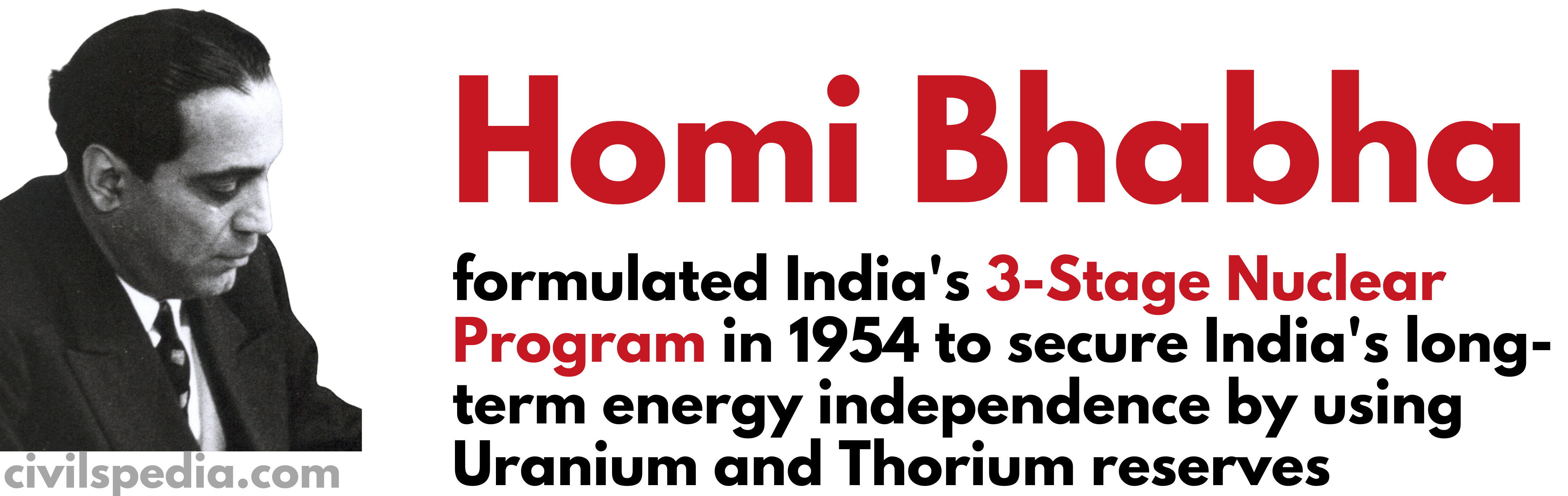
  • Homi Bhabha formulated India’s 3-Stage Nuclear Program. 
  • The reason for the formulation of this program was that India has the largest source of Thorium and modest deposits of Uranium. Considering this fact, Dr Homi Bhabha envisioned 3-Stage Nuclear Program in 1954. It aimed to secure India’s long-term energy independence by using Uranium and Thorium reserves found in the Monazite sands of coastal India. 
  • Note: India has only 1-2% of the global Uranium but about 30% of the world’s Thorium.

Stage 1

The first stage involves the utilization of Pressurized Heavy Water Reactors (PHWR) fuelled by natural Uranium. In this stage, natural Uranium is used as a fuel, and heavy water (deuterium oxide) is used as a moderator and coolant. India has built several PHWRs, which generate electricity and produce plutonium-239 as a by-product (to be used as fuel for the next stage.)


Overview

Reactor

  • Pressurized Heavy Water Reactor (PHWR)

Fuel used

  • Natural Uranium (Note: It is not enriched. Just Natural Uranium is used.)

Moderator and coolant

  • Heavy Water (D2O/Deuterium Oxide)

Reaction

Main Reaction (Energy)

Stage 1 of Nuclear Energy: Reaction 1

Other  (to get Pu -239)

Stage 1 of Nuclear Energy: Reaction 2

Process explained

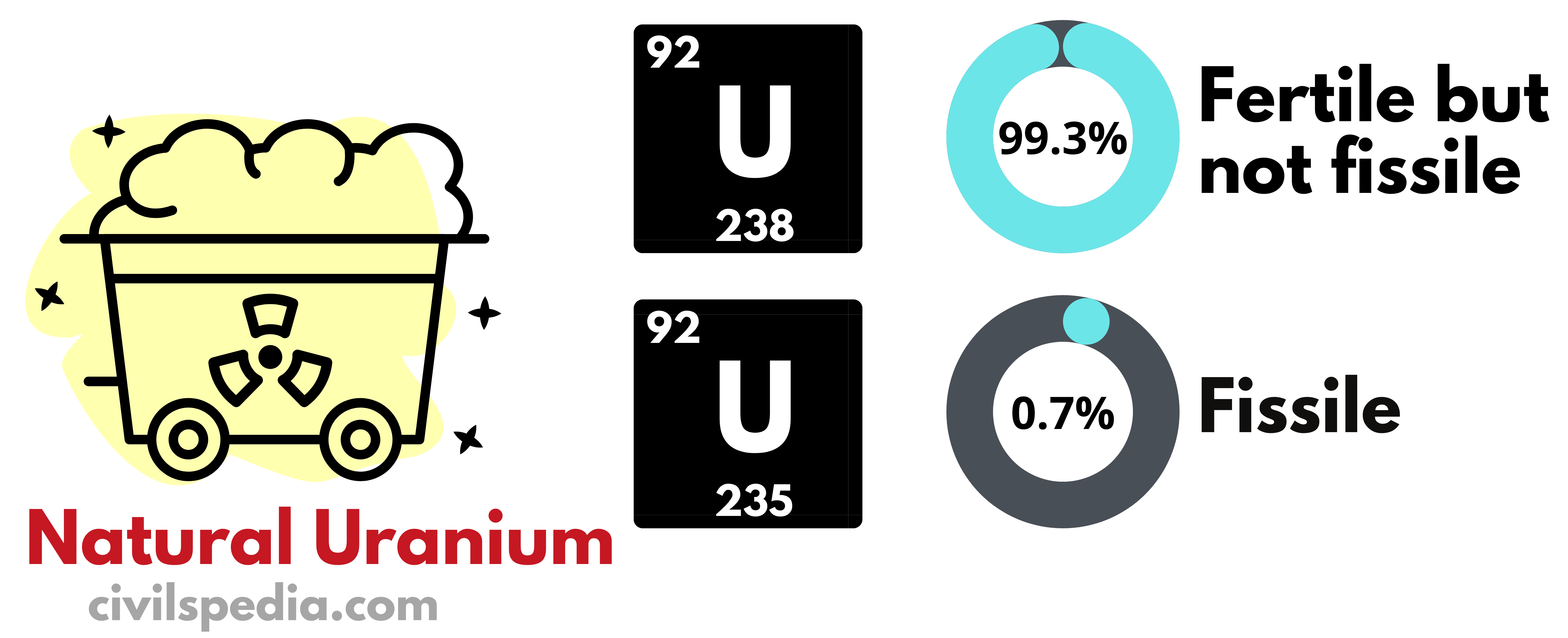
  • Natural Uranium contains both U-238 and U-235 in the following proportions.
Natural Uranium - composition
  • In Nuclear Reactor, when a slow-moving Neutron is bombarded on the Uranium fuel, it collides with and splits U-235 nuclei, thus releasing a large amount of energy and 3 neutrons. The production of 3 neutrons helps in making it a chain reaction. 
  • Some of the neutrons will get absorbed into U-238, thus converting it into Pu-238 (Plutonium-238, which is fissile). Pu-238, thus generated, acts as fuel in the second stage.

Pressurized Heavy Water Reactor

Pressurized Heavy Water Reactor

Why is Heavy Water is used as Moderator?

  • A moderator in the form of Heavy Water is used to decrease the speed of neutrons produced in the nuclear reaction because it increases the probability of fission with Uranium-235, even though its proportion is just 0.7% in natural Uranium. 
  • Heavy water slows down neutrons by their repeated collisions with neutrons.

Control Rods

  • To reduce the power level or to shut down the reactor, the reaction rate is lowered by decreasing the number of available neutrons. It is achieved with the help of control rods like Boron or Cadmium Rods, which can absorb the neutrons.

The operator of PHWR or First Stage of the Indian Nuclear Program 

  • PHWR is operated by NPCIL or Nuclear Power Corporation of India Limited. 
  • Almost the entire base of Indian nuclear power is composed of stage 1 PHWRS except for the two Boiling Water Reactors (BWRs) at Tarapore.

Stage 2

Fast Breeder Reactor

Stage 2 of Indian Three Stage Nuclear Program

Overview

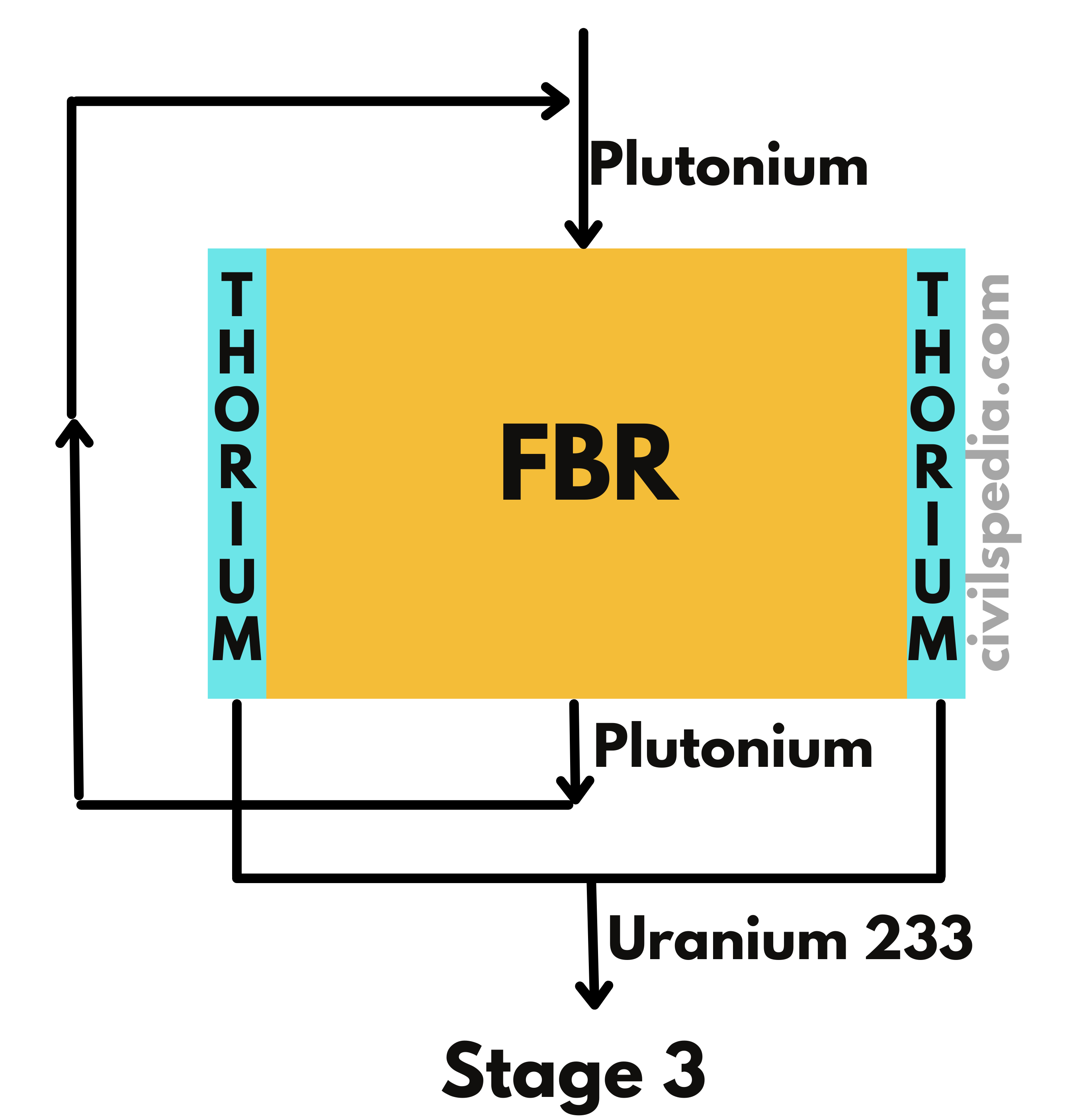
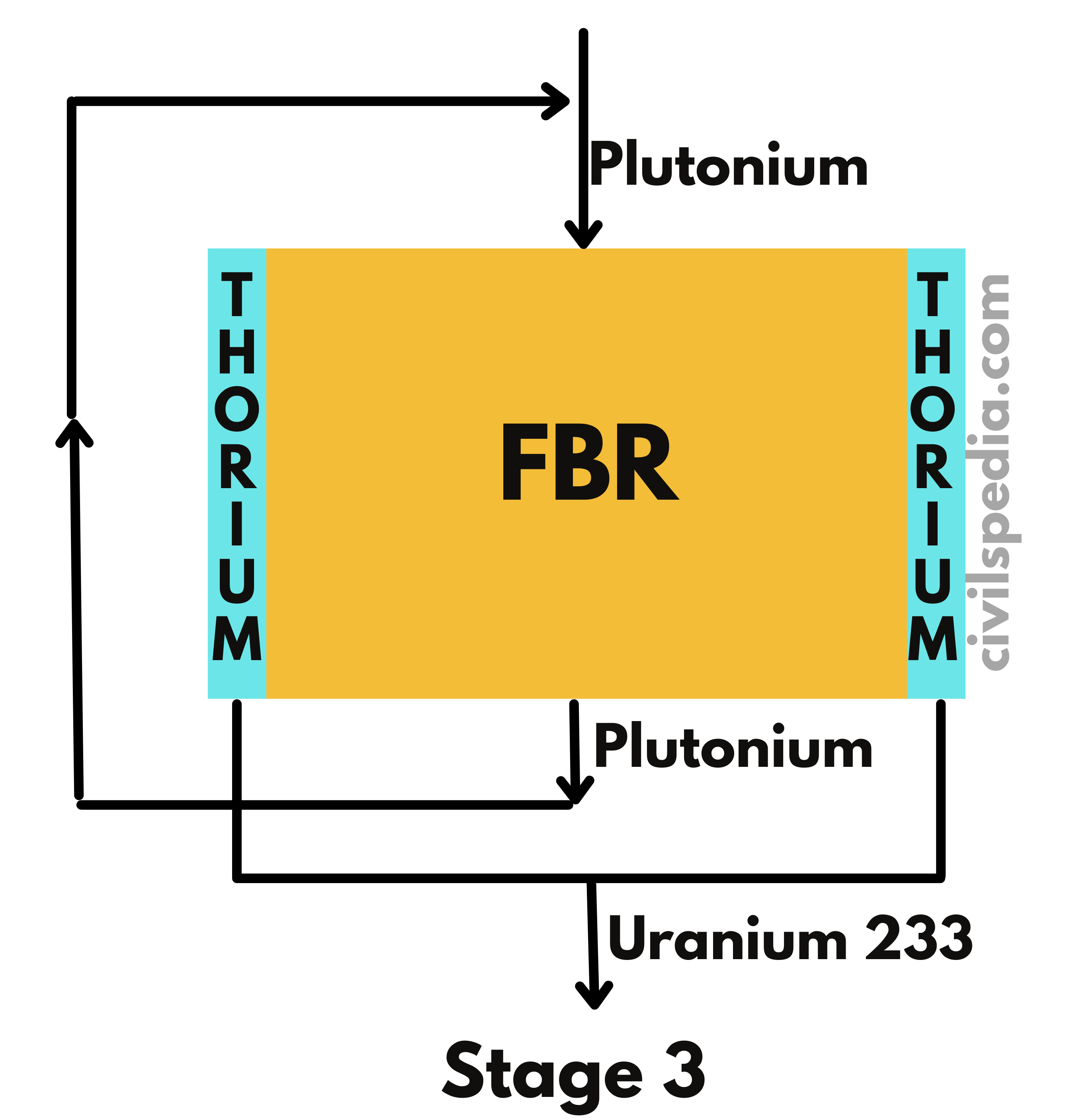
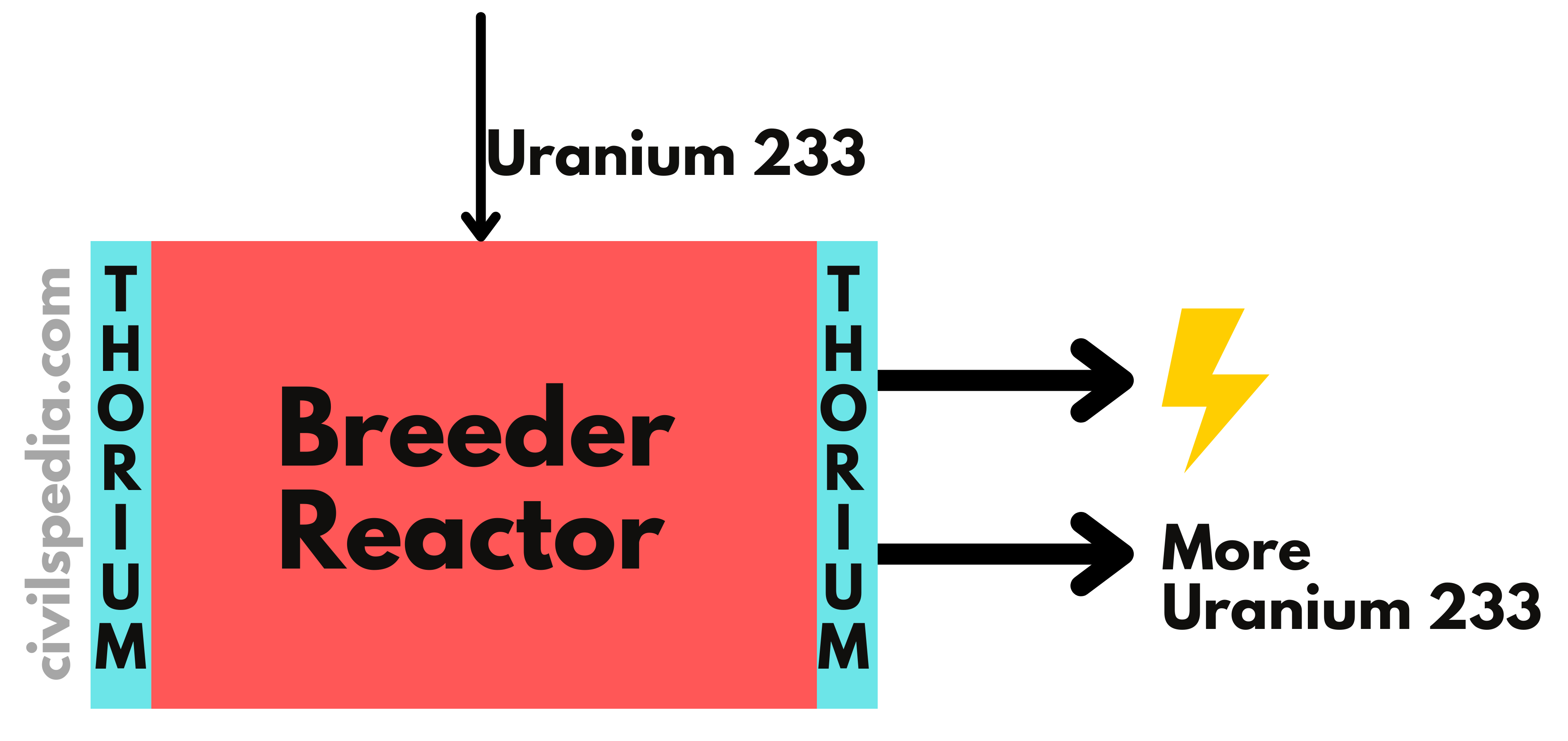
The second stage focuses on utilizing Fast Breeder Reactors. FBRs use Plutonium-239 obtained from the spent fuel of PHWRs as the fuel and liquid sodium as the coolant. These reactors can generate more fissile material (Plutonium-239) than they consume. Thorium would be added to the fuel cycle once sufficient stock had been amassed to transform it into uranium 233 for the third stage.

Reactor

  • FBR (Fast Breeder Reactor )

Fuel used

Mixed oxide (MOX) fuel (received from first stage) consisting of

Pu-239 Undergo fission to produce more energy
U-238 Undergo change to additional Pu239

Moderator 

  • FBR doesn’t use a Moderator, as only fast-moving neutrons produce extra neutrons on collision with Pu-239.

Coolant

  • Liquid Sodium 

Crucialties of Stage 2

Further, 2nd stage is crucial for 3rd stage as it converts Thorium-232 (which occurs naturally) into Uranium–233 by transmutation

  • Once there is a good reserve of Pu-239, Th-232 is introduced at the periphery of the core (blanket material).
  • The collision with neutrons will convert Th-232 to U-233 (which is fissile).

Stage 3

Thorium Based Reactors

Stage 3 of Indian 3 Stage Nuclear Programme

The program’s third and final stage involves deploying Advanced Heavy Water Reactors. AHWRs are designed to use a mix of Thorium-232 and Uranium-233 (obtained as a by-product from 2nd stage) as fuel. Additionally, The Th-232 will be placed at the periphery of the Core fuel, resulting in additional U-233 fuel.


It’s important to note that while India has made significant progress in the first two stages, the third stage of the program is still in the developmental phase, and commercial deployment of AHWRs is yet to take place.


Thorium as Nuclear Fuel

India & Thorium

  • India has the largest reserve of Thorium in the world and consists of 30% of the world’s Uranium reserves
  • Main Indian reserves include
    • Monazite beach sand in Kerala 
    • Found in Andhra (largest producer), Tamil Nadu, Odisha, Kerala and West Bengal

Advantages

  • Thorium is more abundant (4 times more) than Uranium in the Earth’s crust. 
  • Thorium consists of a single isotope, Th-232, unlike Uranium. Hence there is no need for the isotope separation. 
  • Thorium-based fuels have favourable physical and Chemical properties that improve the reactor’s performance. These include
    • Higher melting point 
    • Higher thermal conductivity 
    • Low coefficient of thermal expansion 
    • Greater chemical stability 
    • Doesn’t further oxidise 
  • The long-term radiological hazard of Uranium based nuclear fuel, dominated by Plutonium and other Actinides is not there in Thorium based fuel. 

Disadvantages

  • No fissile isotopes in natural Thorium
  • The high sintering temperature required to make Thorium Oxide 
  • Long interval over which Thorium 232 breeds to Uranium 233 

Ethical Governance in India

Last Updated: May 2023 (Ethical Governance in India)

Ethical Governance in India

This article deals with the topic titled ‘ Ethical Governance in India (UPSC Notes) .’ This is part of our series on ‘Ethics’. For more articles, you can click here.


Introduction

Ethical Governance is a corruption-free, moral and people-centric government.

Ethical Governance in India

Philosophical Basis of Ethical Governance

People think that concept of Good Governance is modern. But they are wrong. Many times in past, scholars have conceptualized what constitutes good governance.


Kautilya

  • Kautilya, in his Arthashastra, wrote, “In the happiness of subjects lies the happiness of king and in the welfare of subjects lies the welfare of king. ” Hence, he has written about Citizen-Centric Government.  
  • Kautilya has also highlighted the corruption & given the concept of Kantakshodhana, i.e. king should purge those elements strictly. 

Gandhi’s Vision of Ramrajya

  • The vision of Ramrajya, or the ideal state, involves Governance based on Moral Principles like nonviolence, truth, and righteousness. 
  • Gandhi said that government which is not working in the people’s interest is morally corrupt. 
  • Swaraj, i.e. Self Rule, is one of the pillars of his Ramrajya or Good Governance. 

Aristotle

He has divided the government into two parts 

  • Perverted Government: Power is used in the interest of the ruling class
  • Legitimate Government: Power is used in the public interest 

8 Characters of Ethical Government

Rule of Law

  • Rule of Law involves governance based upon rules and regulations 
  • In modern times, these rules & regulations are codified in the country’s constitution and laws. 

People’s Participation

  • Real democracy doesn’t just mean voting to elect government but the participation of people in governance itself. 
  • The mechanism of people’s participation in contemporary times are
Conventional Tools Voting
Pressure Groups
New & Contemporary Panchayati Raj Institutions & Gram Sabha
RTI
Social Auditing
Citizen Charter
e-Governance (C2G)
Social Media (change.org, online petitions)

Consensus Orientation

  • Consensus Orientation in governance involves seeking input from various individuals and groups affected by a decision or policy, aiming to reach a consensus that considers the diverse perspectives and interests involved.
  • Ethical Governance is opposite to the ‘Winner takes All’ approach. 

Equity and Inclusiveness

  • The distribution of resources should be based on the principle of equity so that different sections of society receive these resources based on their need
  • Inclusiveness involves including weaker sections in decision-making.

Effective and Efficient

  • Effective government achieves the targets in the stipulated time. 
  • An efficient government is one which delivers maximum with minimum resources 

Accountable


Transparent

  • The literal meaning of Transparency is openness 
  • Tools of Transparency include RTI, E-Governance etc.
  • Dealt exclusively in a separate article (CLICK HERE)

Responsive

  • A responsive government is one which positively responds to people’s demands, needs and aspirations in a timely manner.

Impediments to Ethical Governance in India

The whole scene has to be seen in the context of 

  1. Corruption, Nepotism and Crony Capitalism 
  2. Misuse of power in personal interest
  3. Red Tapism: Undue delay in public service delivery because of complex procedures  
  4. Lack of Transparency 
  5. Weak Accountability 
  6. Lack of public participation in decision making
  7. Bureaucratic apathy, particularly towards weaker sections of society
  8. Status quo and elitist orientation of bureaucracy
  9. Politicization of Bureaucracy
  10. Criminalization of politics

How to Strengthen Ethical Governance

For this, we need to take various steps in various fields

1. Political Structure

  • Enforce expenditure limits on elections strictly 
  • Bring Political Parties under RTI
  • Remove excessive protection given to tainted politicians 

2. Statutory Structure

2nd Administrative Reforms Commission (ARC) has given various recommendations in this regard

  • Amend the Prevention of Corruption Act 
  • Integrity Pacts – When Government Organisation signs any contract with a Private organization, sign integrity pacts stating that if Private Organisation is found involved in any wrongdoing, the contract will cancel automatically. 

3. Institutional Structure

  • Strengthen and give more teeth to CVC, Lokpal, CBI etc.

4. Social Infrastructure

Take help of society in reducing corruption and increasing Ethical Governance

  • Give Civic Education in Schools.  
  • False Claims Act (USA): If you think there is wrongdoing in some organization, gather evidence & produce it before the court. If the fine is imposed on that organization, some portion of money from that fine will be given to the litigant
  • Social Audit: Social Audit is the audit through client or beneficiary groups or civil society groups (i.e. stakeholders) to ensure the social accountability of an organization.

Fossil Fuel Resources in India

Fossil Fuel Resources in India

This article deals with ‘Fossil Fuel Resources in India.’ This is part of our series on ‘Geography’, which is an important pillar of the GS-1 syllabus. For more articles, you can click here.


Fossil Fuel Resources in India

Categories of Energy Sources

  • Conventional: Conventional energy sources refer to the traditional methods of generating power that has been widely used for many years—E.g., Coal, Petroleum etc.
  • Non-Conventional: Non-conventional sources of energy are energy resources that are not derived from traditional fossil fuels—E.g. Solar, Wind etc.

1. Coal

Types of Coal

1. Peat

  • It has the highest percentage of moisture & gives more smoke.
  • Carbon content is 40% (lowest).
  • It represents the very first stage of coal formation. 

2. Lignite

  • It is also known as Brown Coal and is superior to Peat.
  • Under pressure & heat, with time, Peat converts to lignite.
  • Carbon content is 40-60%.
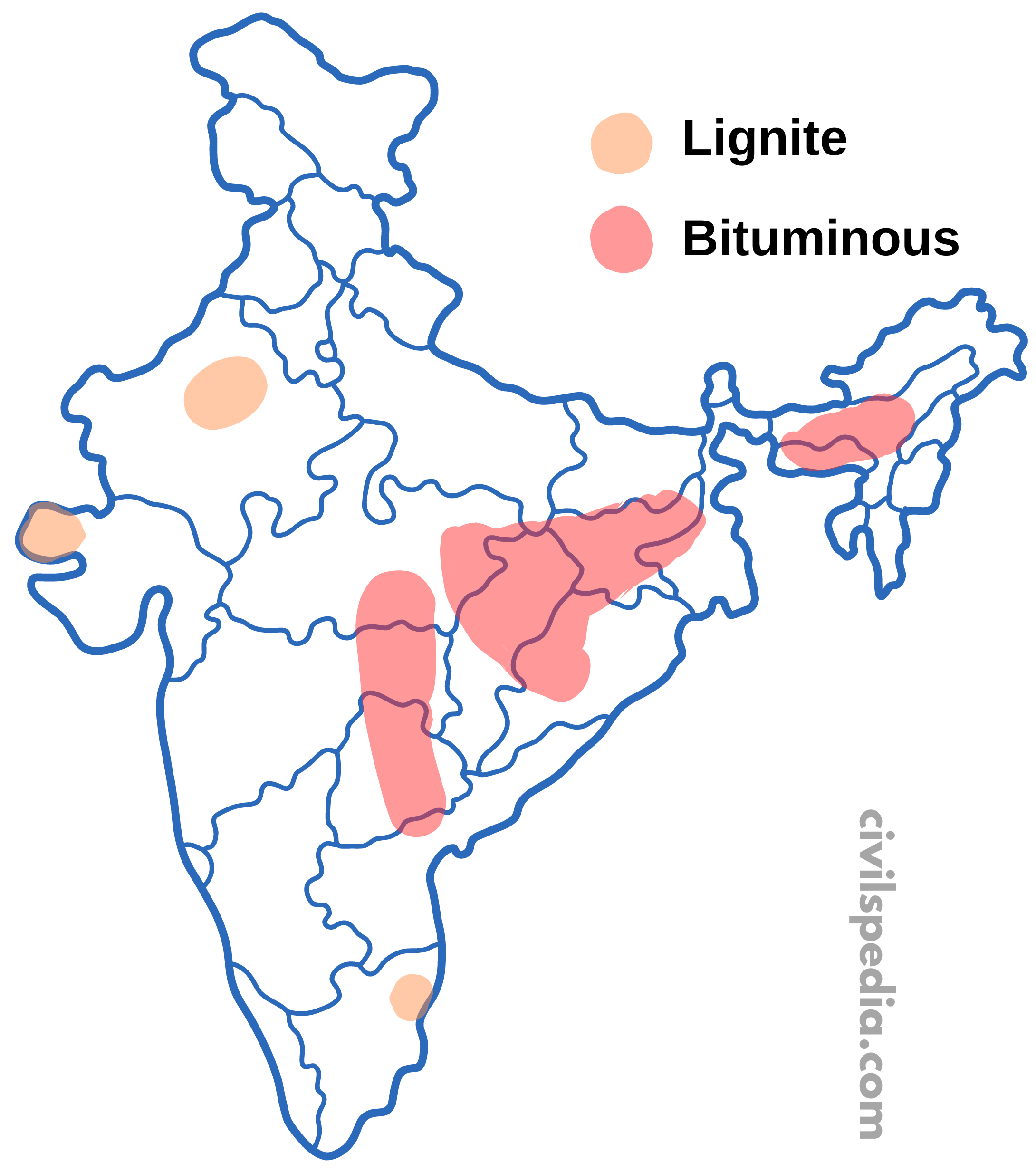
  • In India, it is found in Neyveli (Tamil Nadu) (largest deposit), Palana (Rajasthan), and Lakhimpur (Assam).

3. Bituminous

  • It is also known as Black Coal.  
  • It is dense, compact & black in colour.
  • Carbon content is 60-80%.
  • Almost 80% of Indian Coal is Bituminous. 
  • It is found in Jharkhand, Orissa, West Bengal & Madhya Pradesh.

4. Anthracite

  • It is known as Hard Coal.
  • When buried deep, all moisture gets expelled & Anthracite coal is formed.
  • Carbon content is 80-90%.
  • It has a short flame & is the most expensive of all.
  • In India, Anthracite coal is found only in Jammu and Kashmir (Kalakot).

Distribution of Coal in the World

1. China

  • China has the largest reserves in the world (12%).
  • Overwhelming concentrations are found around
    • Hwang Ho river basin, particularly in Shansi
    • Manchurian coal fields 
    • Shantung Hupei fields

2. USA

  • The USA has the second largest reserves in the world.
  • Main coal regions
    • Appalachian Region
    • Arkansas Rocky Region
    • Illinois 
    • Indiana

3. Australia

  • Australia has the fourth largest coal reserves, but they are substantially unexploited.
  • Main regions
    1. Queensland
    2. Tasmania
    3. New South Wales
    4. Victoria

4. Russia

  • Though coal reserves decreased after disintegration but have substantial reserves.
  • Main coal regions
    1. Pechora coal basin
    2. Kuznetsk region
    3. Moscow-Tula region

5. Ukraine

  • A substantial amount of coal reserves are found in Donetsk Basin.

6. Germany

  • Germany is the largest coal producer in mainland Europe. 
  • Main coal regions
    1. Ruhr Valley
    2. Saxony 
    3. Saar Basin

7. South Africa

  • The main coal regions in South Africa include Transvaal, Cape Province, and New Castle.  

Indian Coal

  • India has the third largest coal reserves in the world, but coal is of medium quality.
  • India coal was not formed in the Carboniferous period. (Hence, it is not Anthracite)
  • Most of the Indian Coal was formed in the Gondwana period. Hence, approx. 80% of Indian coal is Bituminous and non-coking grade.
  • Since Indian Coal is of non-coking grade, it can’t be used as a reducing agent in metallurgical processes. Hence, coking coal is imported 
  • Indian coal has low sulphur but high moisture. Thus it produces more smoke.

Formation of Indian Coal

Coal formation spans millions of years, involving the accumulation and transformation of organic matter. Globally, the formation of coal can be traced back to Carboniferous Period. But in India, most of the coal is from the Gondwana period. Coal formation begins with the accumulation of plant material in swamps and marshes to form peat. As more layers of plant material accumulated, the weight of the overlying sediment and the pressure from the Earth’s crust compressed the peat, gradually transforming it into coal, in the process known as coalification.

In India, Coal occurs in the rock sequences of two geological ages, i.e. Gondwana and Tertiary deposits.

1. Gondwana Coal

  • It was formed 570-275 million years ago (due to in Damodar-Mahanadi Rift) 
  • Most of the coal reserves in India consist of Gondwana coal.
  • Gondwana coal is of Bituminous type.

2. Tertiary Coal

  • Tertiary coal belongs to the Oligocene period (15 to 60 million years ago).
  • 2% of coal reserves in India is of Tertiary coal
  • Tertiary coal has low carbon content, in the range of 40-60%.
  • The largest deposit of Tertiary coal is found in Neyveli in Tamil Nadu.

Indian Distribution

Coal distribution in India

1. Bituminous Coal

Jharkhand Damodar Valley (Bokaro, Dhanbad, Jharia, Giridih and Daltonganj)
Odisha Mahanadi Basin and Talcher Valley
West Bengal Extension of Damodar Valley in Raniganj and Barakar formations
Chhatisgarh Narmada and Son Rift Valley
Madhya Pradesh Chindwara and Jhilmil
Andhra Pradesh Singreni and Kotagudam Coal Field
Maharashtra Nagpur and Kampti Coal Field

2. Lignite Coal

Tamil Nadu Neyvelli
Rajasthan Palana
Gujarat Umarsar

3. Anthracite Coal

Only found in one place

Jammu and Kashmir Kalakot

Problems of Indian Coal 

  • India doesn’t has high-grade coking coal. Hence, India depends on imports to meet domestic requirements.
  • Regulatory challenges: A stricter regulatory framework for land acquisition, resettlement and rehabilitation, and environment management leads to a higher cost of compliance for access and extraction of coal.
  • Good & low-grade coal are found together in Indian mines. Mining companies do selective mining & extract good coal, leaving bad coal behind. Selective mining is wasteful.
  • India does open-cast mining—in contrast to underground mining worldwide. The open cast is cheaper but is associated with high pollution.
  • Deep mining techniques used in India are primitive, leading to high causalities.
  • Poor connectivity from coal mines to consumer locations via railways leads to a mismatch of demand and supply.
  • Mining is primarily done by PSUs (Coal India). Their efficiency is low.  
  • The poor financial state of DISCOMs: This has led to a financial challenge in the overall power sector. Several states, including Jharkhand and Maharashtra, have large outstanding dues to coal companies.

2. Petroleum

Petroleum is obtained from sedimentary rocks of Marine origin of the Tertiary period. 


Theory of Origin

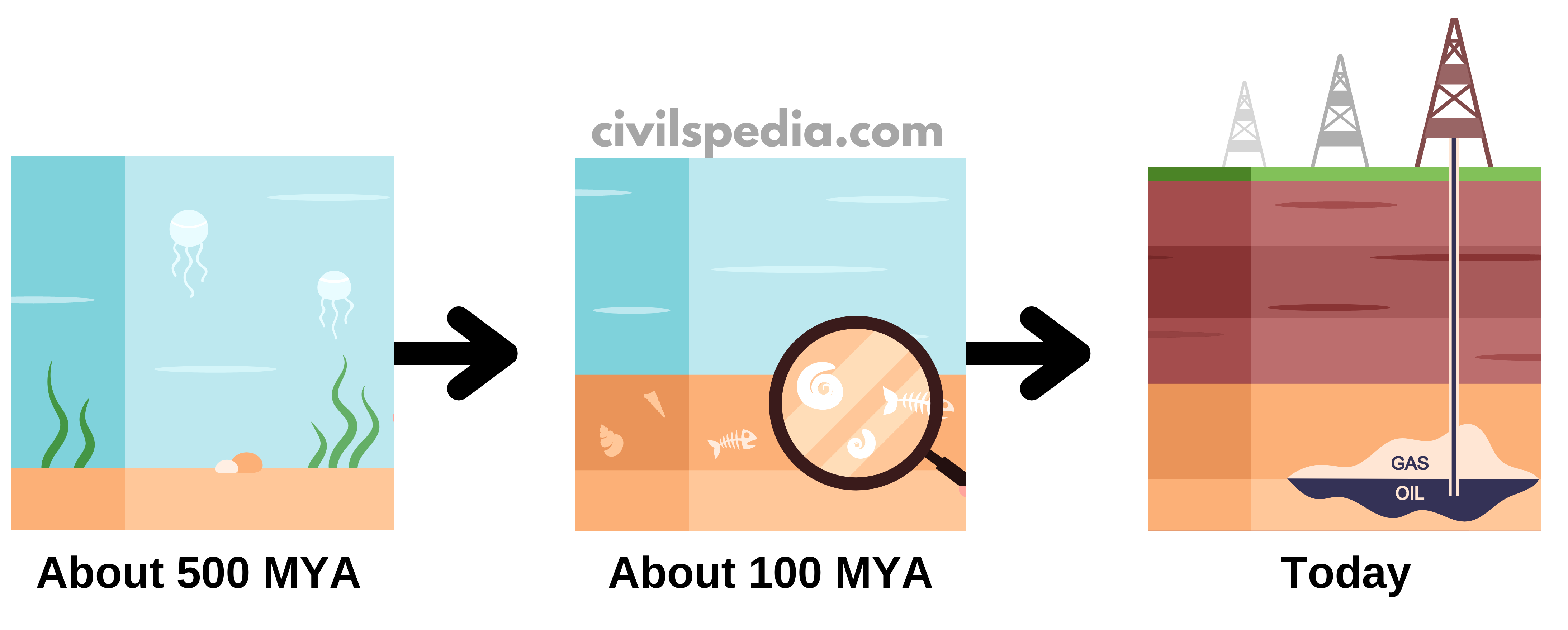
  • The origin of Petroleum & Natural gas is considered to be organic. Marine Living Organisms (like fish and microscopic plants and animals) got buried under accumulated sediments of crude mud, silt & sand and underwent a chemical change to form crude oil and natural gas due to high pressure & heat after millions of years. It is the reason why oil is found in many seabed. 
  • The point to note is that where ever oil is found on land, that region must have been undersea in the geological history because that is the only way living organisms can be settled there and then pressurized to form oil. 
  • E.g. the Middle East has enormous oil reserves because of the same reason. From 500-100 million years ago (MYA), large portions of the modern-day Middle East were submerged under a large, now non-existent sea called the Tethys Sea. Rivers feeding this ancient ocean saturated it with nutrients, giving rise to massive numbers of microscopic animals. They died & fell to the bottom of the sea, which was pressurized to form oil.
Petroleum  - Process of Formation

Some History

  • The first oil well was constructed in the USA in 1859.
  • In India, Petroleum was first discovered at Margherita (upper Assam) in 1860 by Assam Railway & Trading Company & then in Digboi in 1869.
  • ONGC was established in 1956. Later, ONGC discovered oil in the Gulf of Khambat in 1961 & Bombay High in 1976.

Global Distribution

1. North America

USA Alaska and Rocky Mountain region
Canada Alberta province
Mexico Tampico and Taxpum region

2. South America

Venezuela Maracaibo Bay and Orinoco Basin
Columbia Maracaibo Bay
Argentina Patagonia Peninsula

3. Europe

Russia Volga-Caspian Region, Kamchatka & Shakalin Region and Ob-Lena Basin
Ukraine Dnieper and Crimea
UK North Sea

4. Asia

Saudi Arabia Ghawar, Abu Sarah and Safania
Iraq Kirkuk and Mosul
Iran Masjid-i-Suleiman, Naft-i-Shah and Lali
UAE Abu Dhabi, Dubai and Sharjah
Qatar Doha and Jebel
China Sinkiang, South China Bay & Bo Hai Bay
Indonesia Sumatra

5. Africa

Libya Gulf of Sidra
Algeria Edjile and Hassi Masaud
Nigeria Boguma and Bonny
Egypt Ras Gharib, Ras Matarma and Sinai peninsula.

Indian Distribution

States Mineral Rich Regions
Assam Digboi
Neharkatia
Sibsanagar
Dibrugarh
Gujarat On Shore
Kheda
Mehsana

Offshore
Gandhar Oil Field
Aliya Bet
Rajasthan Barmer (exploited by Cairns)
Maharashtra Nilam Oil Field (Bombay High)
KG Basin Rawa Oil Field
Narimanam Oil Field

There are various grades of Crude Oil

RussianUral
North Sea (Europe)Brent
USWest Texas

PYQ: The term ‘West Texas Intermediate’, sometimes found in news, refers to a grade of (UPSC CSE 2020)  

  1. Crude oil 
  2. Bullion  
  3. Rare earth elements  
  4. Uranium


3. Natural Gas

  • Sedimentary rocks in which hydrocarbons are trapped often hold gas, which may be in association with crude oil or alone.
  • It consists primarily of methane, which is lighter than air & toxic. It requires air-tight tanks for storage & similarly, leakproof pipes or trucks for transport, raising capital costs.

Global Distribution

Global Reserves Global Production
Russia Russia
Iran USA
Saudi Arabia Canada
UAE UK
USA Netherlands
Nigeria Algeria
Venezuela Indonesia

Indian Distribution

  • In India,
    natural gas is found along with oil reserves. India does not have
    exclusive natural gas reserves. 
  • Oil &
    Natural gas Commission(ONGC) does the exploration of Natural Gas.
  • According to
    the estimate, the total Natural Gas reserve is about 450 billion cubic
    metres.
  • In India, potential Natural
    Gas sites in India are
    1. Bombay High
    2. Gujarat
    3. Assam
    4. KG Basin
    5. Kaveri Basin
  • After 1990, production of
    natural gas increased phenomenally yet production falls short of demand,
Year Production (in million m^3)
1960 17
1970 76
1980 200
1990 12,873
2000 20,920
2010 25,750

4. Shale Gas

  • Shale oil, often known as “tight oil,” is found in lesser quantities and deeper than conventional crude reserves. Its extraction requires creating fractures in oil and gas-rich shale to release hydrocarbons through hydraulic fracking.
  • Note: Shale is Sedimentary Rock 
  • It is colourless, odourless & lighter than air.
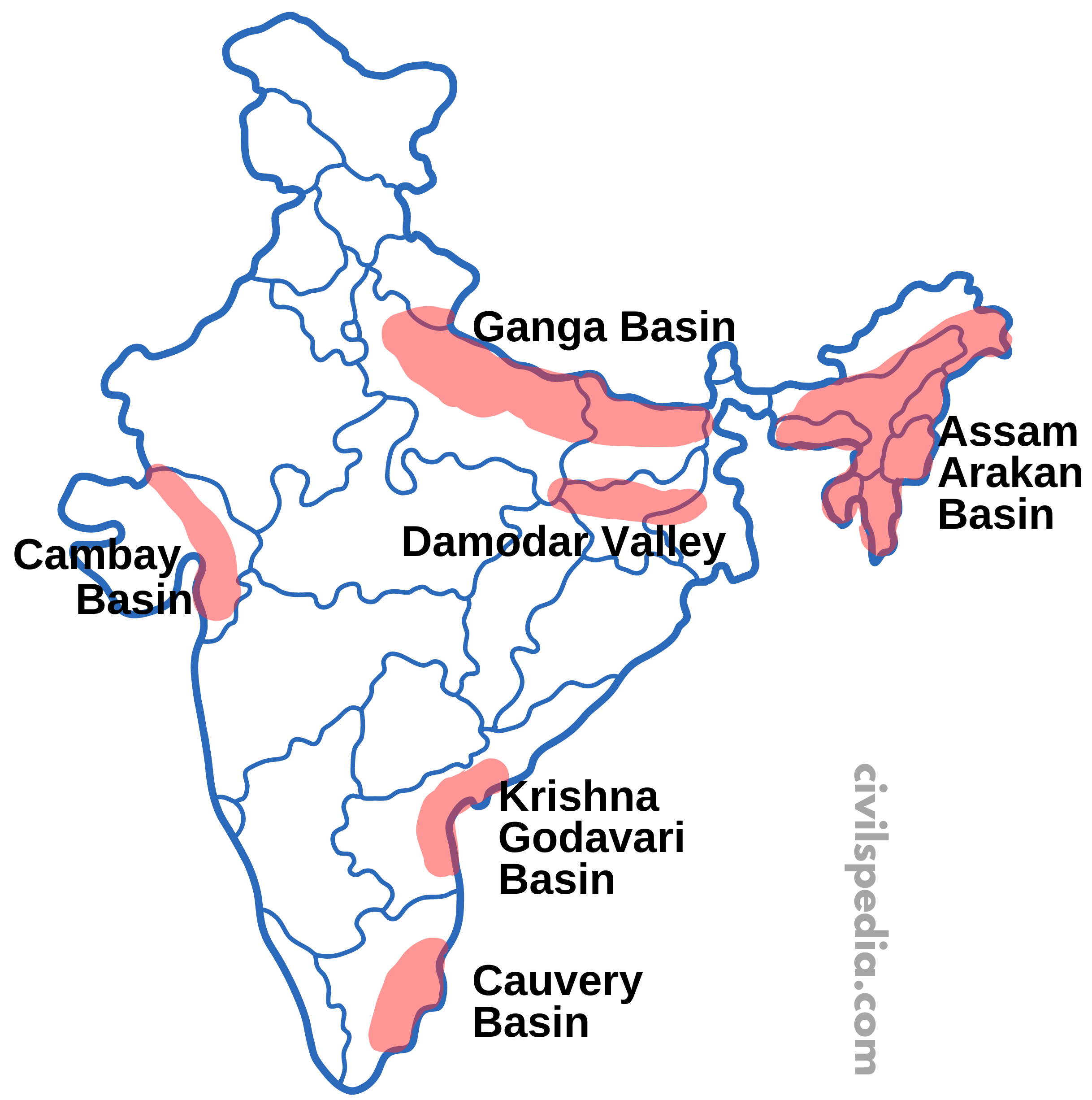
  • In India, potential Shale Gas reserves are in
    1.  Cambay
    2. Gondwana 
    3. Krishna-Godavari (K-G) Basin  
    4. Cauvery Basin 
    5. Ganga Basin 
    6. Assam – Arakan Basin 
    7. Barmer Hill Formation (Rajasthan)
Distribution of Shale Gas in India

Atomic Minerals (UPSC Notes India)

Last Updated: May 2023 (Atomic Minerals (UPSC Notes India))

Atomic Minerals (UPSC Notes India)

This article deals with ‘Atomic Minerals (UPSC Notes India).’ This is part of our series on ‘Geography’, which is an important pillar of the GS-1 syllabus. For more articles, you can click here.


Atomic Minerals (UPSC Notes India)

1. Uranium

Two main sources of Uranium are Pitchblende (containing 50-80% Uranium) & Uraninite (containing 65-80% Uranium).


Naturally occurring Uranium is composed of

Isotope Percentage Nature of Radioactivity  
U238 99.3% Fertile/Fissionable It has to absorb a neutron to become fissile. Plutonium is formed in the process.
U235 .7% Fissile U235 can form a self-sustaining chain reaction.
But they need to be enriched to 3-4 % to sustain the chain reaction.

Global Distribution

Significant uranium deposits are found in

  1. Kazakhstan
  2. Canada (Athabasca Basin)
  3. Australia
  4. Niger
  5. Namibia

Distribution in India

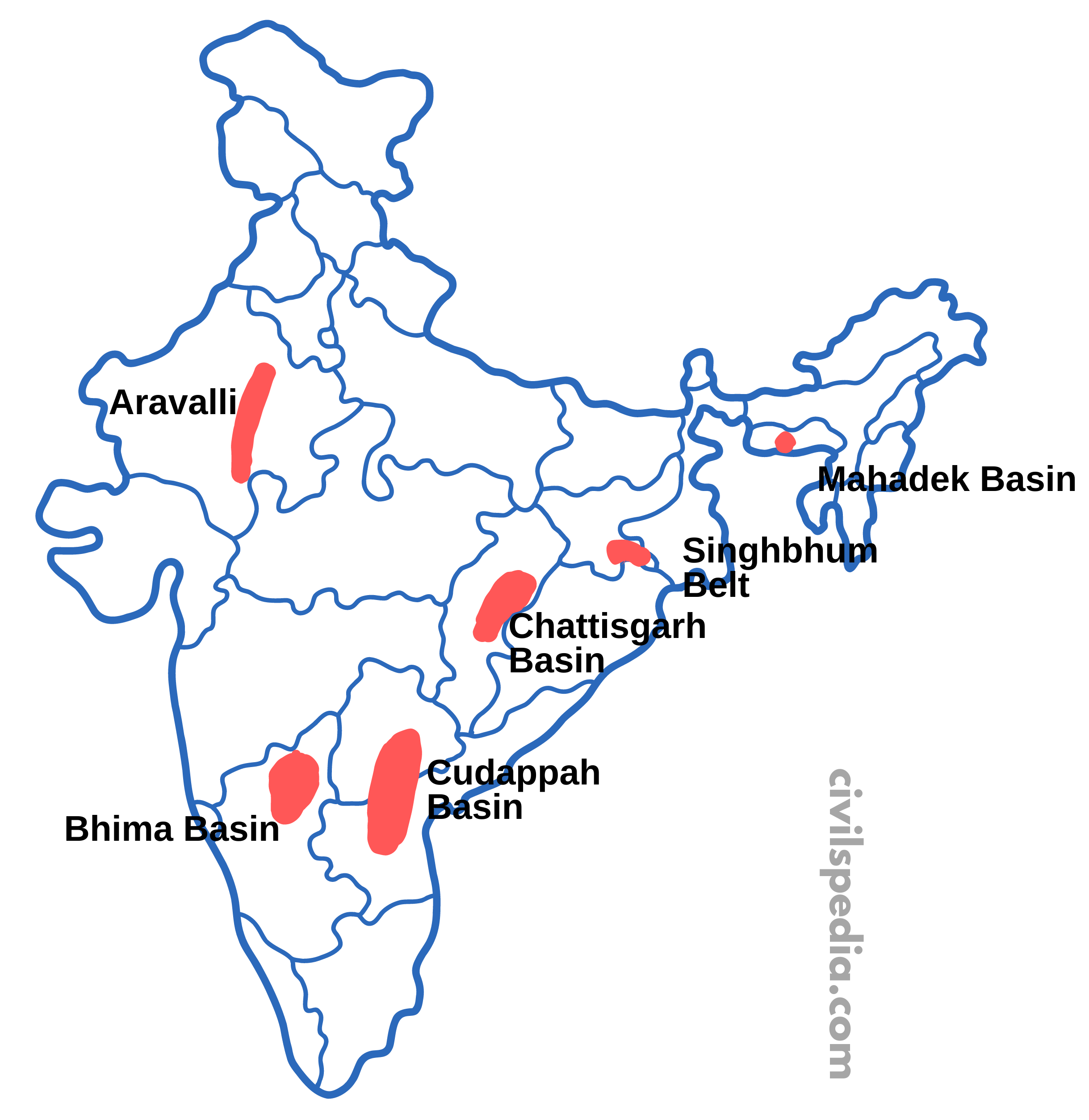
In India, Uranium is found in the following areas

Jharkhand Jadughoda
Bhatin
Narwapahar
Turamdih
Meghalaya Mahadek Basin  
Andhra Tumallapalle (largest mine in India)  
Karnataka Bhima Basin
Rajasthan Aravallis

India produces 2% of the total Uranium produced in the world. 

Distribution of Uranium in India

Important Note 

  • Uranium Corporation of India Ltd. (UCIL) is responsible for mining uranium ore for commercial purposes.  
  • Uranium mined by the UCIL is used for both weapons and civil nuclear programs. The imported Uranium is used for civil nuclear energy purposes only. 

Uranium Mining Issues 

  • Uranium contamination of groundwater due to Mining
  • Uranium deposits in India are primarily of low grade (less than 0.15% Uranium). 
  • Problems with land acquisition
  • Issues of rehabilitation and resettlement of affected persons

2. Thorium

  • In nature, there is more Thorium than Uranium. 
  • Two primary sources of Thorium are Monazite sands & Allanite. 
  • As such, Thorium found in Monazite is fertile but can be converted to fissile material Uranium.

Global Distribution

Significant uranium deposits are found in

  1. Brazil
  2. Australia
  3. USA
  4. Egypt

Distribution in India

  • India has the largest reserve of Thorium in the world.
  • Main reserves include 
    • Monazite beach sand in Kerala 
    • Found in Andhra (largest producer), Tamil Nadu, Odisha, Kerala and West Bengal

Tourism (UPSC Notes)

Last Updated: July 2025 (Tourism (UPSC Notes))

Tourism (UPSC Notes)

This article deals with ‘Tourism (UPSC Notes).’ This is part of our series on ‘Economics’ which is an important pillar of the GS-3 syllabus. For more articles, you can click here.


Introduction

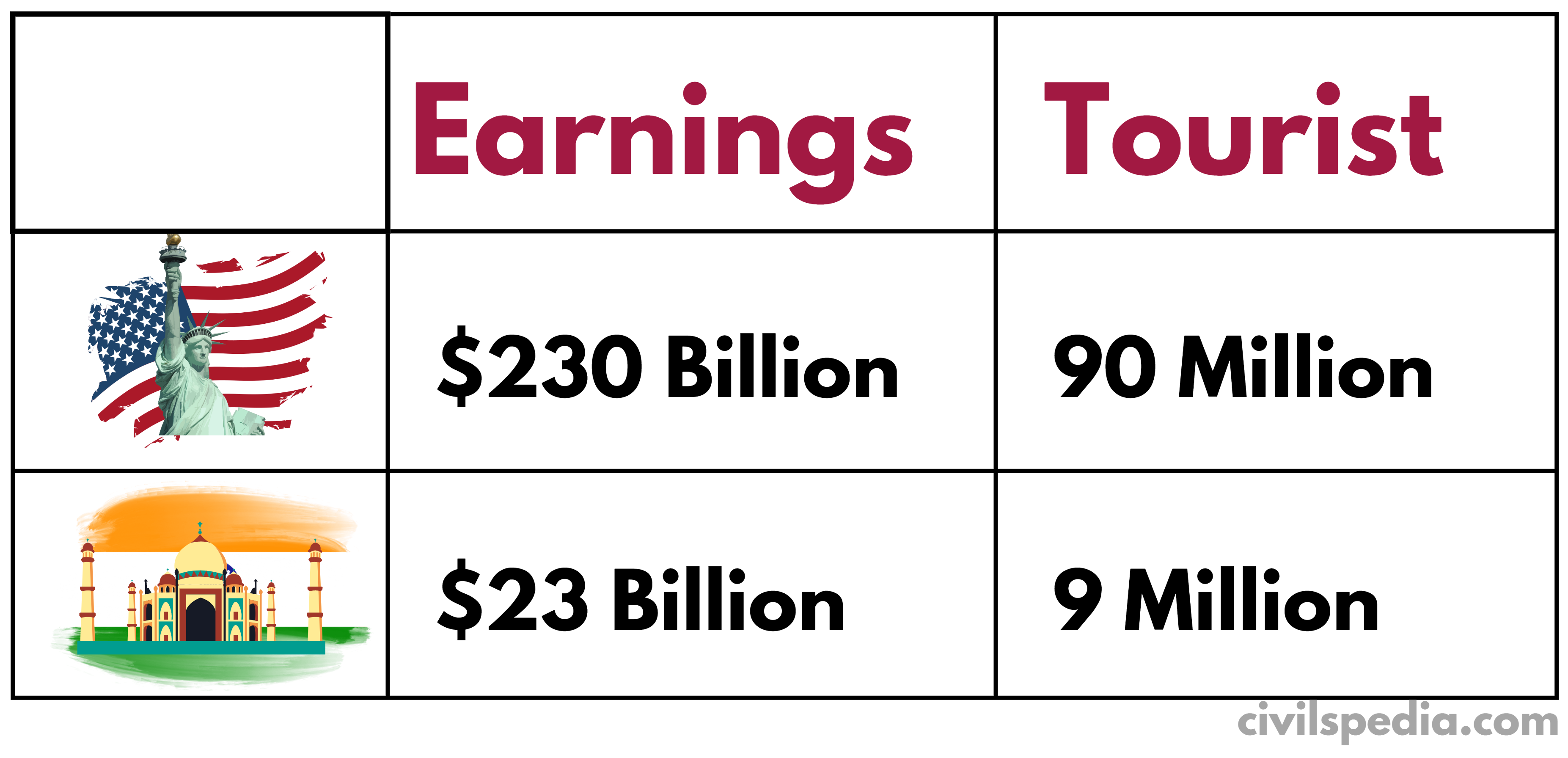
  • India is ranked 8th in terms of tourism’s total contribution to GDP, contributing 5% to total GDP (2020). (target: increase contribution of tourism in the country’s economy to 10 per cent by 2047).
  • It is a labor-intensive sector, accounting for 39 million jobs (2020) and significantly impacts trade, investment, social inclusion, etc.  
  • But India has not been able to exploit the potential of tourism to full capacity (corroborated by India vs. USA)
Tourism (UPSC Notes)

Hence, India has vast untapped potential in the tourism sector


Potential of Tourism in India

  1. Large Diversity in Landscape: India’s landscape can cater to almost every type of traveller, whether they are seeking adventure, wellness, culture and heritage or cuisines. 
  2. Ancient Civilisation: India is an ancient civilization, and a number of historical places and buildings have tremendous potential to draw tourists. E.g., Hampi, Khajuraho, Agra, Delhi, Madurai etc. 
  3. Religious Tourism: India is home to a large number of religions. Hinduism, Sikhism and Buddhism took birth here.  
  4. Huge Labour Available: The availability of a huge labour force, both skilled and unskilled, can act as a catalyst. 
  5. Medical Tourism: India can provide specialized treatments at the cost of 1/4th that of developed countries. Target countries include Central Asia, Neighbours like Bangladesh, Sri Lanka etc. 
  6. MICE (Meeting, Incentive, Conferences & Exhibitions): It is a specialized niche of business tourism. Indian MICE Tourism potential is pegged at 25,000 crore due to Places like Pragati Maidan Delhi (for exhibition) and institutes like IITs, AIIMS, IIMs etc., for International Conferences.


Reasons for untapped Tourism Potential

  • The tourism industry is closely integrated with several other industries like the hotel industry, accommodation, aviation, railway, roadways, healthcare, entertainment etc. The combined weaknesses of all the sectors make Indian Tourism more vulnerable.  
  • Negative Perceptions, such as India being unsafe for female foreign tourists and lack of hygiene, negatively impact Indian tourism.
  • Governance Issue :
    1. Government is unable to make schemes to attract tourists like Buddhist Tourists who have cultural ties with India. 
    2. No advertisement campaigns like Malaysian and Singapore Tourism are run in foreign countries.
    3. Lack of automated immigration procedures like Visa on Arrival.
  • Limited Professionalism in people involved in the tourism sector, like tourist guides
  • Insurgency in potential Tourist Spots: Tourist places like Kashmir and North East are hit by insurgency, impacting tourism potential. 


Schemes to Promote Tourism in India

In the last two years, the Ministry of Tourism has taken many steps to make India an attractive destination.

  1. PRASAD Scheme  (Pilgrimage Rejuvenation and Spiritual Augmentation Drive): To develop tourism infrastructure in and around famous religious and pilgrimage cities. (12 cities AjmerAmritsar, Amravati, Dwarka, Gaya, Kamakhaya, Kancheepuram, Kedarnath, Mathura, Patna, Puri, Varanasi and Velankanni) 
  2. HRIDAY: For holistic development of Heritage cities (12 identified Cities, namely, Ajmer, Amaravati, Amritsar, Badami, Dwarka, Gaya, Kanchipuram, Mathura, Puri, Varanasi, Velankanni and Warangal.)
  3. Swadesh Darshan Scheme It aims to develop a theme-based tourist circuit. These circuits include North-East India Circuit, Buddhist Circuit, Himalayan Circuit, Coastal Circuit, Krishna CircuitDesert Circuit, Tribal Circuit, Eco Circuit, Wildlife Circuit, Rural Circuit, Spiritual Circuit, Ramayana Circuit and Heritage Circuit. 
  4. Adopt a HeritageCorporate Houses will adopt a Heritage and develop their infrastructure. E.g., Dalmia Group adopted Red Fort for ₹ 25 Crore, and they will provide basic amenities and develop infrastructure. 
  5. Fast Track Immigration – Trusted Traveller Programme (FTI-TTP): It involves an accelerated immigration pathway for international travellers by screening them through automated gates. Currently, it is available only to Indian nationals and OCIs at IGI Airport (Delhi).
  6. E-visa process simplified: Nationals of 161 countries have been allowed visits for business and medical treatment. Additionally, a special visa category called ‘Medical Visa’ & ‘Medical Attendant Visa‘ has been created to ease the entry of medical tourists into India 
  7. The government is building a large number of museums to showcase Indian heritage and promote tourism.  
  8. Incredible India Tourist Helpline: Multilingual helpline has been launched to provide assistance and information to tourists in 12 languages of the world, including Hindi & English 
  9. 100 % FDI allowed in hotels, resorts & recreational activities 
  10. Revamped schemes like Hunar se Ruzgar to give training to travel guides and Institutes of Hotel Management have been opened. 
  11. State Specific
    • Rajasthan has passed a bill under which misbehaviour with tourists has been made a cognizable offence. It is to prevent the touts from forcing tourists to buy things at exorbitant prices or fraudulating the tourists, as it impacts tourism negatively.
  12. Other
    • Yuge Yugeen Bharat National Museum: India is developing the world’s largest museum in Delhi, which spans over 117,000 sq m. India has partnered with France for this as France has expertise in such projects.
    • Bharat Ranbhoomi Darshan: Joint project of the Indian Army and Ministry of Tourism to promote battlefield tourism.

Metallic Minerals

Last Updated: May 2023 (Metallic Minerals)

Metallic Minerals

This article deals with  Metallic Minerals (UPSC Notes).’ This is part of our series on ‘Geography’, which is an important pillar of the GS-1 syllabus. For more articles, you can click here.


Introduction

Metallic Minerals
  • Minerals containing one or more metallic elements are called metallic minerals.
  • Metallic Minerals provide a strong base for the development of the metallurgical industry & hence the process of industrialization.

1. Iron Ore

  • Iron ore is the most critical mineral on which a nation’s economy hinges.
  • In 2018, India became the 2nd largest producer of Steel in the world, following China.
  • India has the largest reserve of iron ore in Asia.
  • Haematite and Magnetite are the two primary varieties of iron ore found in our nation.
  • Due to its superior quality, Indian iron ore is in high demand in the global market.
  • In the country’s north-eastern plateau region, the iron ore mines are located adjacent to the coal fields, adding to their advantage. 

4 Main Ore Types

1. Magnetite

  • It is also known as Black Ochre.
  • It has a high iron content of up to 70%. 
  • As the name suggests, it has magnetic properties. 
  • The largest concentration of Magnetite is found in Sweden, Liberia & former USSR. It is found in India as well.
  • It is used in Electronic industries. 

2. Haematite

  • It is the industrially most important ore.
  • It contains 50-65 % iron content 
  • It is known as Red ochre. 
  • The largest concentration of Haematite is found in the Lake Superior Region, Labrador & Quebec in Canada, Guinea Highlands in Venezuela, Brazil etc. & the Dharwarian & Singhbhum rocks of India.
  • In India, it is found in the Chotanagpur Plateau region, Dharawar & Cuddapah systems of Karnataka, Andhra Pradesh, Tamil Nadu (Salem, Tiruchi) & Goa.
  • The main use of Haematite is in the iron & steel industries. 

3. Limonite

  • Limonite has less than 50% iron content.
  • It is yellow in colour.
  • It is used as pigment for paint manufacturing.

4. Siderite

  • Siderite is the carbonate of iron. It is found interbedded in sedimentary rocks. 
  • Iron content is 20-30%. Hence, it is economically unviable to extract.
  • It acts as a source of Manganese & Magnesium.

Distribution in World

North America Lake Superior Region, Labrador & Quebec
South America Brazil
Africa Liberia, South Africa & Algeria.
Europe Sweden, France (Normandy & Lorraine), Former USSR, UK & Germany
Asia India & China (Manchuria & Wuhan)

Distribution in India

Iron Ore Distribution in India

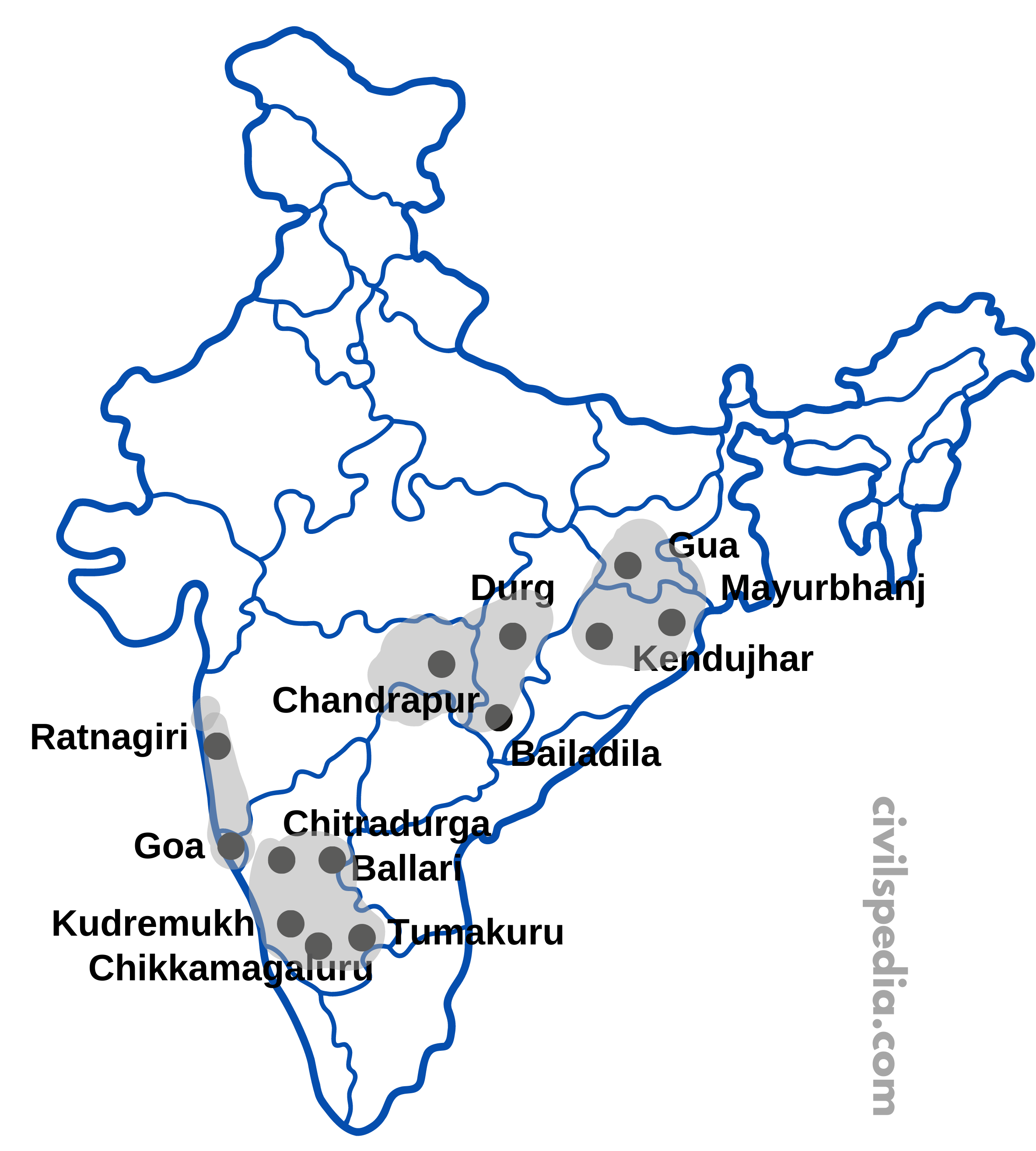
The country’s total reserves of iron ore were about 20 billion tonnes in 2004-05. Jharkhand, Odisha, Chhattisgarh, Goa, Karnataka, Andhra, Telangana, and Tamil Nadu contain over 95% of the country’s iron ore deposits.

1. Odisha

  • Iron ore occurs in a series of hill ranges in Sundergarh, Mayurbhanj and Jhar. 
  • Important mines are Gurumahisani, Sulaipet, Badampahar, Mayurbhanj, Kiruburu (Kendujhar) & Bonai (Sundergarh).
Details of Important Mines
Badampahar Iron ore is supplied to Bokaro, Jamshedpur,  Rourkela & Durgapur steel plants.
Mayurbhanj Haematite with an iron content of more than 65% is found here (the highest quality found in India )
Iron ore is supplied to Bokaro, Durgapur, Rourkela & Jamshedpur.

2. Jharkhand

  • There are some of the oldest iron ore mines & steel plants in this region. 
  • The most important mines are Noamundi and Gua in Poorbi and Pashchimi Singhbhum districts. 

3. Chhattisgarh

Bailadila (Bastar) , Dalli Rajhara (Durg) & Dantewara are important mines in Chattisgarh

Details of Important Mines
Bailadila It is located in the Bastar district & is the largest mechanized mine in India.
Haematite extracted from this mine is exported to Japan and supplied to the Vishakhapatnam plant.  
Dalli Rajhara It is located in the Durg district. 
Haematite extracted from these mines is supplied to the Hindustan Steel plant in Bhilai.

4. Karnataka

In Karnataka, Iron ore is found in the following areas

  • Sandur-Hospet area of Ballari/Bellary district.
  • Baba Budan Hills and Kudremukh of Chikkamagaluru district.
  • Parts of Shivamogga, Chitradurg & Tumakuru districts.
Details of Important Mines
Baba Budan Hills Mostly exported to Iran through Mangalore port.
Kudremukh Deposits Exported to Iran.
Sandur Range Supplied to Vijayanagar Steel plant.

5. Maharashtra

  • Found in districts of Chandrapur, Bhandara and Ratnagiri. 

6. Telangana

  • Found in Karimnagar and Warangal district.

7. Andhra Pradesh

  • Found in Kurnool, Cuddapah and Anantapur districts. 

8. Tamil Nadu

  • Found in Salem and Nilgiri districts. 

9. Goa

  • Iron ore is found in North Goa. 
  • Mormugao port provides an additional advantage from where Iron ore is exported to Iran & Japan.

2. Manganese

  • India is 5th largest producer of Manganese in the world.
  • About 1/5 of Indian Manganese is exported mainly to Japan.

Uses

  • Manganese is needed during iron forging. If Manganese is not added to iron, iron breaks. It makes steel anticorrosive, hard& tough.
  • It is used to produce alloys by mixing with Copper, Bronze, Nickel etc.
  • It is also used in manufacturing insecticides & pesticides, photography and dry battery.

Global Distribution

Africa South Africa and Gabon
South America Brazil
Europe Ukraine and Russia
Asia India
Australia Australia (Victoria & Queensland)

Distribution in India

Manganese ore distribution in India

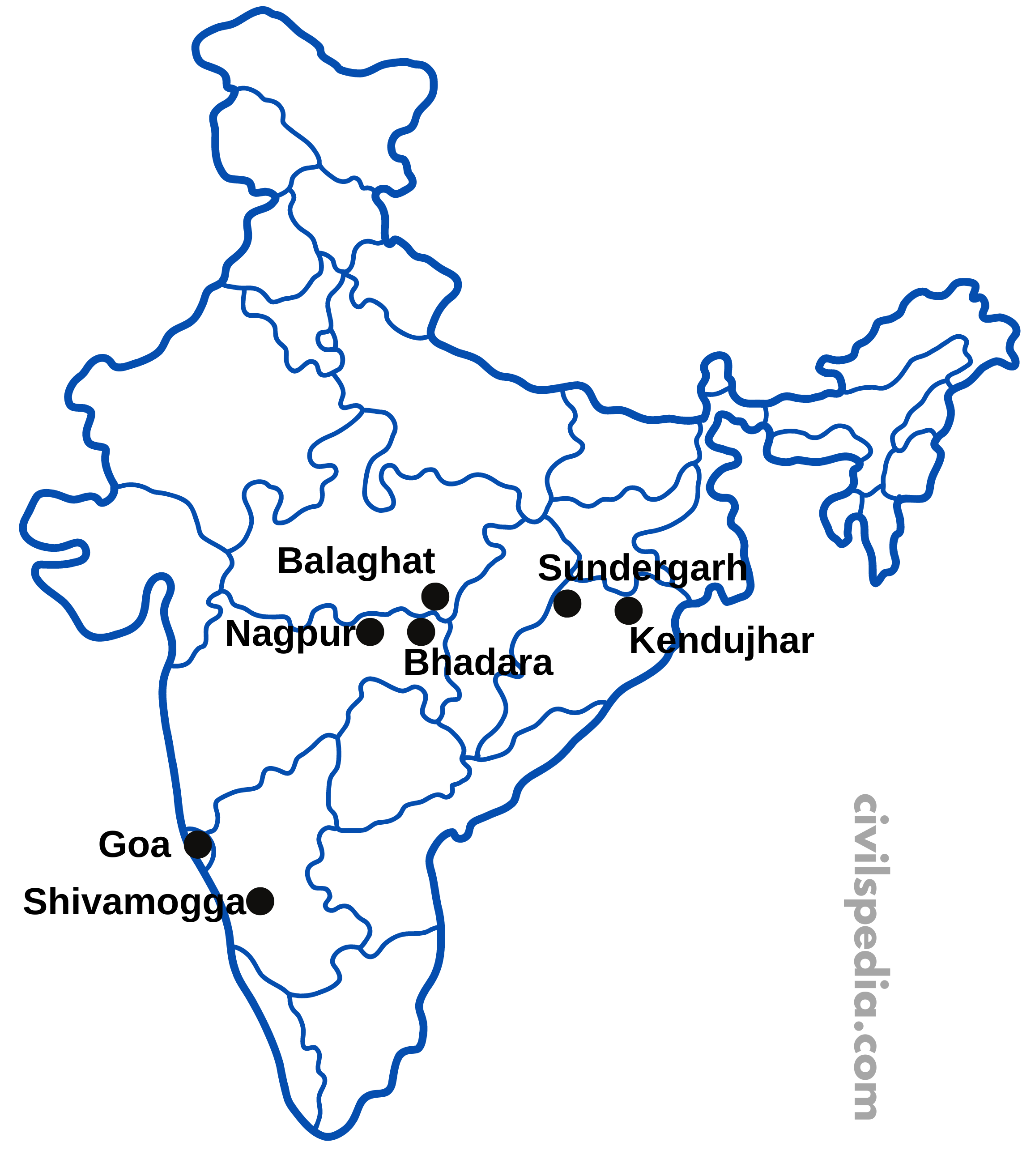
Almost all geological formations include deposits of Manganese. However, it is mainly associated with the Dharwar system.

Odisha Odisha is the largest producer of Manganese. 
Major mines are located in the Iron ore belt, i.e. Kendujhar, Sundergarh, and Koraput.
Karnataka The Manganese mines are located in Dharwar, Belagavi, Ballari, Chikkmagaluru, North Canara, Chitradurg, Shivamogga and Tumkur.
Maharashtra Nagpur, Bhandara and Ratnagiri districts.
Jharkhand Manganese is found in all iron ore regions. Chaibasa is the biggest mine. 
Madhya Pradesh Manganese is found in the Balaghat region. 

Note: Manganese was mined for the first time in Srikakulam (1892) in Andhra Pradesh.


3. Bauxite

  • 8% of the Earth’s crust is made up of Aluminium. 
  • Bauxite is mainly found in tropical & subtropical regions, but Aluminum is separated from the ore in an area with cheap electricity using the Hall Herault method.
  • The first bauxite mine was in Les Baux village in France. Bauxite name derived from it. 

Global Producers

Bauxite reserves Bauxite Producers Alumina Aluminium
Guinea Australia China China
Australia Brazil Australia Russia
Brazil China Brazil Canada
  India (Rank 6) India (Rank 5) India ( Rank 6)

Global Distribution

North America USA (but significant import from Jamaica, Surinam etc.)
South America Guinea, Jamaica, Surinam and Brazil
Europe France, Yugoslavia, Hungry and Russia(Urals)
Asia Vietnam, India and China
Australia Australia (exported to Japan)

Distribution in India

Bauxite distribution in India

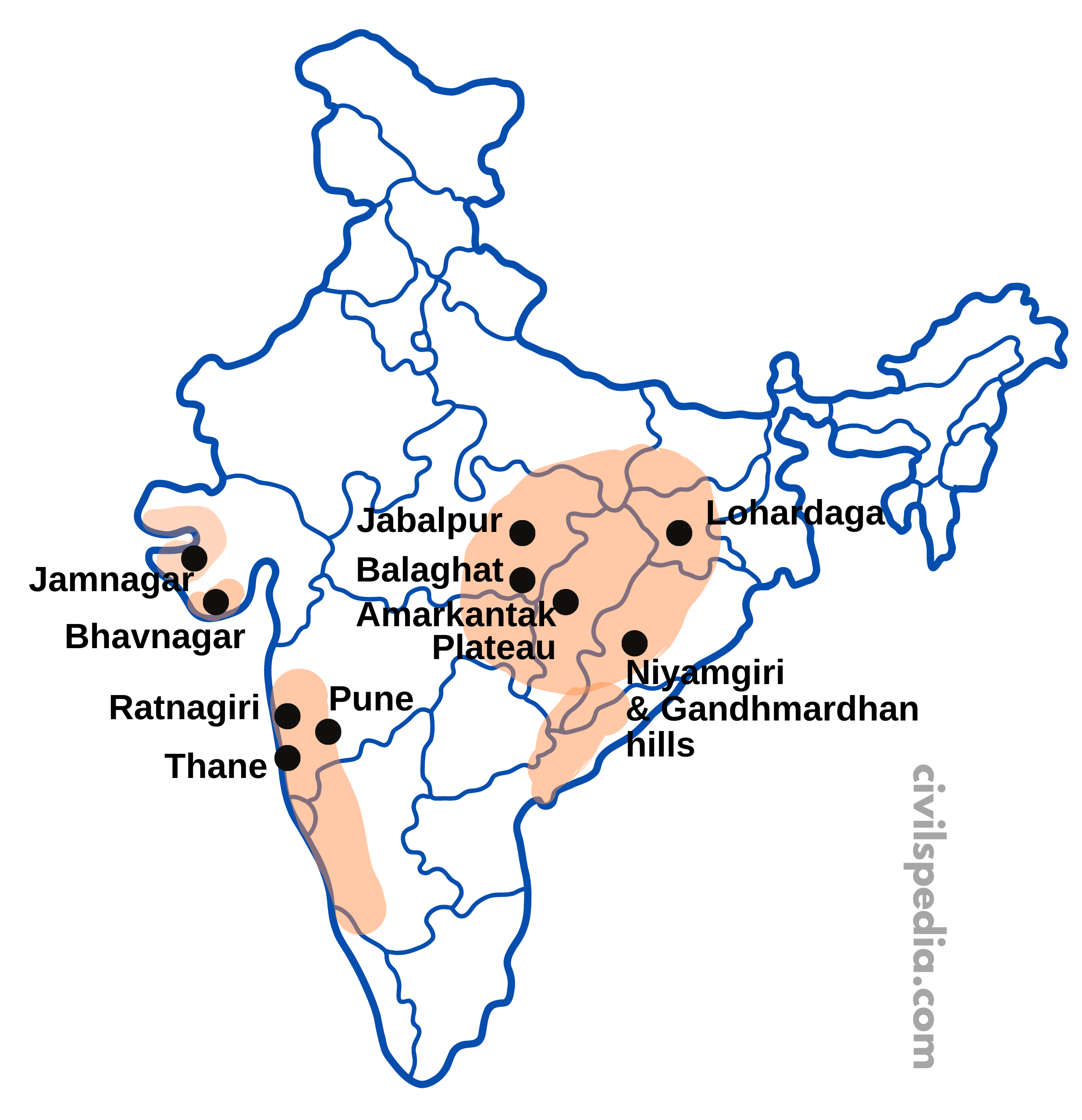
Bauxite is found mainly in tertiary deposits. It is associated with laterite rocks, commonly found in coastal areas and Peninsular India.

Odisha Odisha is the largest producer of Bauxite. 
– Niyamgiri & Gandhmardhan hills are biggest fields .
Bauxite Mines are present in Kalahandi, Sambalpur, Bolangir and Koraput.
Jharkhand Lohardaga
Gujarat Bhavanagar and Jamnagar
Chattisgarh Amarkantak plateau
Madhya Pradesh Katni-Jabalpur area and Balaghat
Maharashtra Kolaba, Thane, Ratnagiri, Satara, Pune and Kolhapur

4. Copper

  • Copper is a soft brown metal found in igneous & metamorphic rocks.
  • The main ores of Copper are Cuprite, Malachite, Chalcocite & Bornite.
  • In the electrical industry, Copper is a crucial metal for producing cables, electric motors, transformers, and generators.
  • It is alloyable, malleable and ductile and a good conductor of heat and electricity. Since gold is a soft metal, Copper is mixed with it to strengthen jewellery.
  • The most important alloys of Copper include
    1. Brass: Alloy of Copper and Zinc
    2. Bronze: Alloy of Copper and Tin

Global Distribution

North America USA (West coast), Canada (Ontario & Quebec) and Mexico
South America Chile and Peru
Europe Russia (Urals), Georgia and Armenia
Asia Kazakhstan
Australia Australia (Mt Esa & Mt Morgan)
Africa Zaire (Katanga Plateau), Zimbabwe and  Zambia.

Distribution in India

Copper ore distribution in India
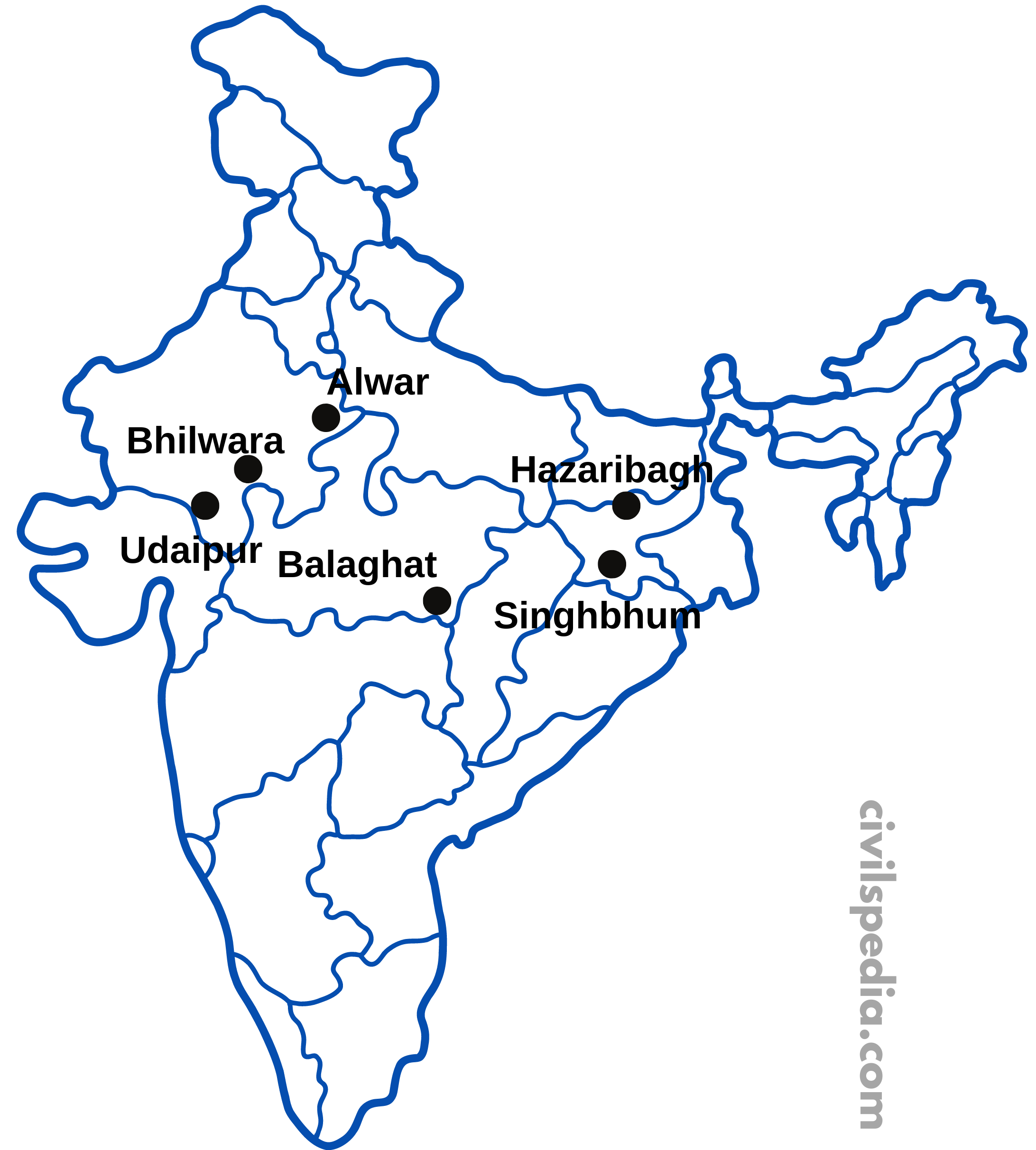
Jharkhand  Singhbhum and Hazaribagh
Madhya Pradesh Balaghat
Rajasthan Udaipur, Bhilwara & Alwar

Indian share in world production is 4%. India isn’t self-sufficient and imports Copper from Zimbabwe, Australia, USA & Mexico.


5. Gold

  • Gold is known as the international currency.
  • Propertiesdurable, doesn’t rust, luster, malleable & ductile. 
  • It is used as an ornament as well as to mint coins (historically).

Global Distribution

Africa South Africa, Zimbabwe and Ghana
North America Canada and USA
South America Columbia, Peru, Ecuador and Brazil.
Europe Former USSR
Asia China, Japan, Korea and India
Australia Australia

Distribution in India

About 90% of production is from Karnataka & rest is from Rajasthan, West Bengal, Jharkhand, Bihar & Andhra Pradesh. Three important gold fields in India.

1. Karnataka

1.1 Kolar Gold Mines, Mysore
  • Mining started here in 1871.
  • It still contributes 60 % of the total production of the country.
  • The mine is more than 3000 m deep, and almost all gold has been extracted.

1.2 Hutti Goldfield, Raichur dist.

  • It is the only gold-producing company in India. 

2. Andhra Pradesh

  • Ramgiri Goldfield and Anantapur.

3. Placer or Alluvial gold

  • Gold is obtained from sand & sedimentary deposits of the river.
  • It is found in the Subarnrekha river in Jharkhand &  Lo in the Singhbhum district of the Chotanagpur plateau.

6. Silver

  • Silver is white & valuable metal.
  • It is used in making ornaments & mint coins (historically).
  • Main ores include Argentine, Stephanite & Proustite.
  • It is found in association with zinc & lead.

Global Distribution

North America Mexico, Canada and USA
South America Bolivia and Chile
Europe Spain, Germany, Sweden,  Italy and France
Asia Japan, Myanmar and India
Australia Australia

Distribution in India

  • India is not very rich in silver.
  • Rajasthan is the largest producer owing to following
    • Zowar mines in Udaipur.
    • In Hindustan Zinc Smelter in Udaipur, Silver is obtained as a by-product of Zinc & Lead.
  • Other producers include
    • Tudoo Lead Smelter: Dhanbad(Jharkhand)
    • Kolar Gold Field & Hutti: Karnataka
    • Vishakhapatnam Smelter: Andhra Pradesh

Corporate Governance in India

Last Updated: Jan 2025 (Corporate Governance in India)

Corporate Governance in India

This article deals with ‘Corporate Governance in India (UPSC Notes).’ This is part of our series on ‘Economics’ which is an important pillar of the GS-3 syllabus. For more articles, you can click here.


What is Corporate Governance?

Corporate Governance works on the Triple Border Line Principle, i.e. it takes into account Planet, People and Profit while taking any decision. 

It is a way of directing company to 

  1. Protect the interests of stakeholders
  2. To comply with legal-regulatory-ethical requirements.

Note:  Stakeholders are the people and groups who have a legitimate interest in the operation’s activities. 


Companies Act,2013

The act was made after Satyam Scam to plug the loopholes and to protect all stakeholders with provisions of  

  1. Independent Directors: Independent Directors are appointed to protect the interests of Minority Shareholders. 1/3rd of all Directors should be independent and shouldn’t have a pecuniary relationship with the company more than 10% of their total income.
  2. Audit mechanism: Make Audit Committees consisting of Independent Auditors and give guidelines related to Auditors like individual Auditor cant Audit a company for more than 5 years. 
  3. Serious Fraud Investigation Office (SFIO):  Earlier, this body solved Saradha & Satyam Scam. SFIO was Statutory Status by the Companies Act along with powers of Search and Seizure.
  4. Investor Protection and Education Agency: This fund has been created to educate and spread financial literacy among investors.

Side Topic: Administrative Setup in Company

Corporate Governance in India

Kotak Mahindra Committee on Corporate Governance

Issues with Corporate Governance in India  (according to Kotak Committee)

  • Insider trading (explained below)
  • Nepotism in board appointments (Board members are relatives or known ones)
  • The Independent Directors in India have played a passive role. It can be easily removed if they do not side with promoters.  
  • The entire board is not often present at general meetings for stakeholders. 
  • Executive Compensation policies are not transparent and do not require shareholders’ approval. 
  • Family-owned Indian companies have excessive controls and poor succession planning. 
  • Unrealistic risk assessment policies. 
  • Inadequate emphasis on privacy, data protection and cyber security. 
  • Lack of serious effort by the board towards Corporate Social Responsibility (CSR) projects. 

Kotak Mahindra Committee recommendations

  • Increasing Transparency
    1. Full disclosure of utilization of funds.
    2. Disclosures of Auditor Credentials and Audit Fee.
    3. Disclosure of the Skills of Directors. 
  • Reshaping Board of Directors 
    • Separation of Powers: The CEO & Chairperson of the Board of Directors can’t be the same person in the top 500 listed companies.
    • At least one Women Independent Director in Top 500 listed companies
  • Levelling the playing field in Algorithmic Trading for all investors (big (who can afford) and small (who can’t))
  • Permission of Minority shareholders should be necessary in case payments to related parties exceed 2% of revenue. 

Examples of Corporate Governance Issue

Company Issues
1. Tata Sons Independent Director Nusli Wadia was removed for siding with Cyrus Mistry in his fight with Ratan Tata.
2. Ranbaxy
3. IL&FS
4. DHFL
Indulged in ‘Creative Accounting’, i.e. fudged their accounts.
5. Sun Pharma Insider Trading during Ranbaxy acquisition.

Side Topic: Insider Trading

  • When someone with access to non-public information about the security instrument indulges in buying or selling a security, it is known as Insider Trading. 
  • E.g., a person who is on the board of Directors of a company and knows about the new product that the company is going to launch, which will increase the price of shares, starts buying shares in advance. 

Why is it illegal?

  • Insiders are better positioned to make bigger trading gains due to access to non-public information
  • Against the Right to Equality. 
  • Wrong use of the information given to him in a fiduciary capacity

In India, the following acts prohibit Insider Trading

  • SEBI (Insider Trading) Regulation, 1992
  • Companies Act 2013

Gold Imports in India (UPSC Notes)

Last Update: Jan 2025 (Gold Imports in India (UPSC Notes))

Gold Imports in India (UPSC Notes)

This article deals with ‘Gold Imports in India (UPSC Notes).’ This is part of our series on ‘Economics’, which is an important pillar of the GS-3 syllabus. For more articles, you can click here.


Introduction

  • India is the 2nd largest gold importer in the world (1st = China). India imports gold from the following destinations.
    1. Switzerland 
    2. UAE
    3. South Africa
  • Due to cultural factors, Indians have a high obsession with gold.
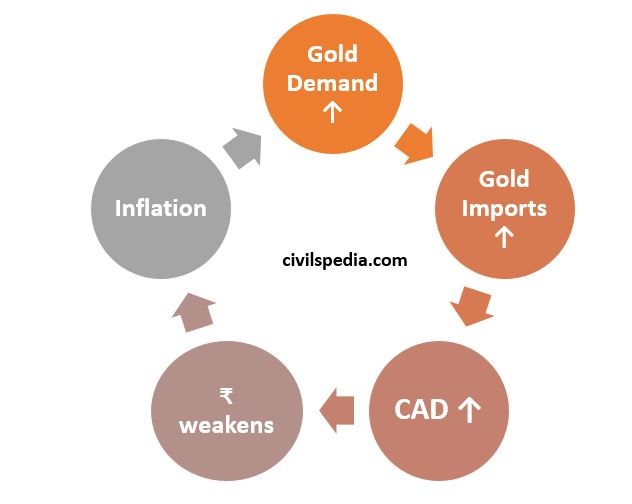
  • As India imports most of its gold, it leads to a significant current account deficit and a weakening of ₹ against $. 
  • Along with that, high usage of gold results in following vicious cycle. 
Gold Imports in India (UPSC Notes)

Why is high gold demand in India?

  1. Cultural Factors: Indians have a great love for gold ornaments.
  2. Intrinsic Value: Gold preserves its value in the long run and generates an above-inflation return, making investors gravitate towards gold in times of high inflation.

Steps taken by the government to reduce gold imports

To control imports of gold, the Government has taken various measures. 

  1. Inflation Indexed Bonds: During the period of high inflation, people invest in Gold because other investments have a negative real interest rate. Interest Rates of Inflation Index Bonds are pegged to inflation. 
  2. Custom Duty on Gold was hiked (Budget 2023).
  3. 80:20 Rule: 20% of imported Gold must be exported after adding value to it.
  4. Various Schemes like Gold Monetisation Scheme, Sovereign Gold Bond Scheme and Indian Gold Coin have been started by the Government (dealt in detail below).

Detail of Gold Schemes

#1 Gold Monetisation Scheme (GMS)

  • GMS offers an option to resident Indians to deposit their precious metal and earn interest on it (up to 2.5%)
  • But that Gold will be melted into Gold Coins and Bars for valuation.
  • All residents can invest in this scheme but are subject to Know Your Customer (KYC) Norms & have to disclose the source of the Gold.
  • Deposit limit: Minimum deposit at any one time is 30 grams with 995 fineness. There is no maximum limit for the deposit. 
  • Tenure and interest rate:
    1. Short Term (1-3 years): 2.25% interest
    2. Medium (5-7 years): 2.5% interest
    3. Long (12-15 years): 2.5 % interest
  • Upon maturity, one can redeem a deposit in gold or cash equivalent.

#2 Sovereign Gold Bond Scheme 

  • The scheme seeks to shift part of the demand for physical gold for investment into Demat (Dematerialised) gold bonds to reduce the demand for physical gold. Additionally, the government use it to finance its fiscal deficit.
  • These gold bonds are interest-giving (up to 2.75% interest paid semi-annually). On the redemption date, one gets the principal equivalent of the latest price of gold in grams. So, if the gold price increases, then investors get more profit.
  • Investment Limits: 
    1. Minimum Investment: 2 grams of physical gold
    2. Maximum Investment: 500 grams 
  • Tenure of Gold Bonds: There is a lock-in period of 5 years. 8 years is the maximum tenure. But there is an exit option from the 5th year. 
  • These Bonds are tradable and exchangeable. 
  • 2024 Update: The government of India is planning to discontinue this scheme due to the high cost of financing this scheme.

#3 Indian Gold Coin

  • It is India’s first ever Indian gold coin and bullion to be officially issued by Union Government. 
  • Denominations: The coins will be available in 5 and 10 grams and 20-gram bullion denominations. 
  • These coins and bullion can be easily liquidated.